
Resources
Explore a wide range of valuable resources on GCED to deepen your understanding and enhance your research, advocacy, teaching, and learning.
145 Results found
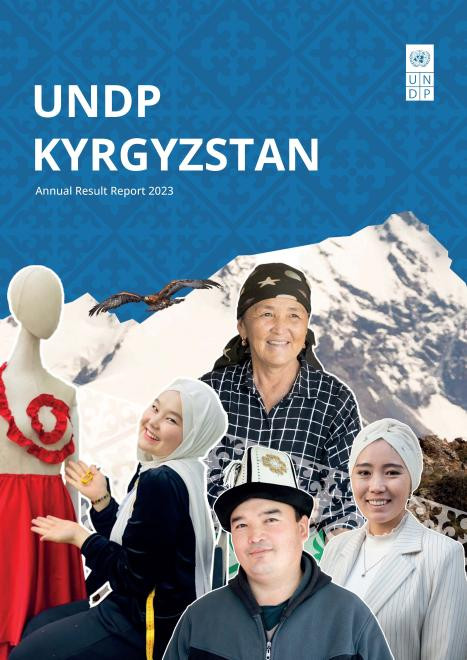 Годовой отчет ПРООН в Кыргызстане за 2023г. Year of publication: 2024 Corporate author: UNDP Kyrgyzstan В 2023 году ПРООН в Кыргызстане использовала свой глобальный опыт и стратегические партнерства для реализации Целей устойчивого развития, уделяя особое внимание цифровой трансформации, финансированию развития и инновациях.
 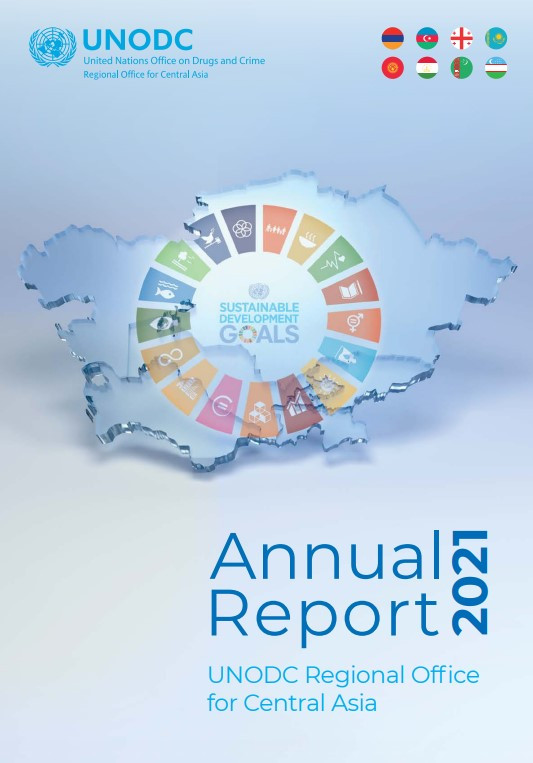 Annual Report for 2021 (UNODC Regional Office in Central Asia) Year of publication: 2022 Corporate author: UN. Office on Drugs and Crime (UNODC) This Annual Report provides an account of the main results achieved by the United Nations Office on Drugs and Crime, Regional Office for Central Asia (UNODC ROCA), in 2021. UNODC has stepped up efforts to help people in these challenging times, addressing emerging threats in line with human rights and gender equality standards, and the rule of law. Through our strategic interventions, we have contributed to strengthening peace, preventing conflict, and tackling the root causes and drivers of instability and violence. Годовой отчет за 2021 (Региональное представительство УНП ООН в Центральной Азии) Year of publication: 2022 Corporate author: UN. Office on Drugs and Crime (UNODC) Отчет содержит сведения об основных результатах, достигнутых Региональным представительством Управления Организации Объединенных Наций по наркотикам и преступности в Центральной Азии (РЦПДЦА УНП ООН) в 2021 году. УНП ООН наращивает свои усилия с целью оказания помощи людям в непростое время, помочь противостоять возникающим угрозам с учетом стандартов в области прав человека и гендерного равенства, а также верховенства закона. Благодаря стратегическим инициативам, способствуют укреплению мира, предотвращению конфликтов, устранению коренных причин и факторов нестабильности и насилия.
  Education, Development and Citizenship in Latin America: Proposals for the Debate Year of publication: 2011 Author: Alicia Barcena | Narcis Serra Corporate author: Naciones Unidas. Comisión Económica para América Latina y el Caribe (CEPAL) | Centro de Estudios y Documentación Internacionales de Barcelona (CIDOB) Through ADI, an initiative promoted by CIDOB, the Ibero-American General Secretariat (SEGIB) and the Economic Commission for Latin America and the Caribbean (ECLAC), with the support of various sponsoring companies, it is intended to encourage academic debate along with the political debate on diverse issues crucial for the region. Through a rigorous analysis of the social, economic and political reality carried out by academics, public policymakers and other key actors in the development process in Latin America, the aim is to offer recommendations that make economic growth compatible with well-being of the majorities. This publication constitutes the fifth volume of the series and is the result of the willingness of the participating institutions to disseminate, as much as possible, the ideas and discussions that emerged in the seminar. Its reading is a fundamental element to understand the current state of education in the region, as well as the possibilities that exist in this area to continue advancing in inclusion and development. Educación, Desarrollo y Ciudadanía en América Latina: Propuestas para el Debate Year of publication: 2011 Author: Alicia Barcena | Narcis Serra Corporate author: Naciones Unidas. Comisión Económica para América Latina y el Caribe (CEPAL) | Centro de Estudios y Documentación Internacionales de Barcelona (CIDOB) Mediante la ADI, iniciativa impulsada por CIDOB, la Secretaría General Iberoamericana (SEGIB) y la Comisión Económica para América Latina y el Caribe (CEPAL), con el apoyo de diversas empresas patrocinadoras, se pretende alentar el debate académico junto con el debate político en diversos temas cruciales para la región. A través del análisis riguroso de la realidad social, económica y política realizado por los académicos, los encargados de formular políticas públicas y otros actores clave en el proceso de desarrollo de América Latina, se pretende ofrecer recomendaciones que hagan compatible el crecimiento económico y el bienestar de las mayorías. Esta publicación constituye el quinto volumen de la serie y es fruto de la voluntad de las instituciones participantes de difundir, en la mayor medida posible, las ideas y discusiones surgidas en el seminario. Su lectura supone un elemento fundamental para comprender el estado actual de la educación en la región, así como las posibilidades que existen en este ámbito para seguir avanzando en la inclusión y el desarrollo.
 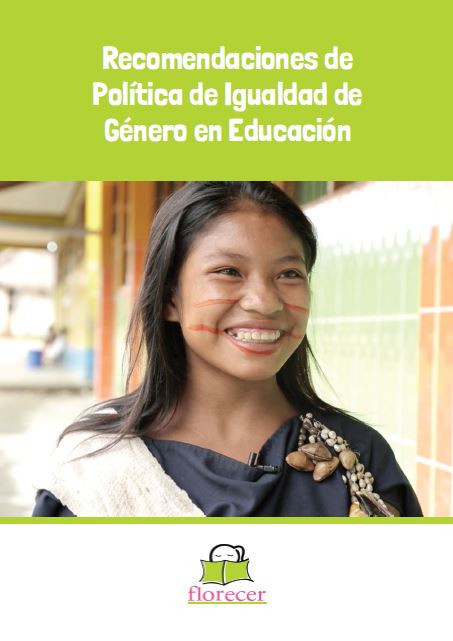 Policy Recommendations of Gender Equality in Education Year of publication: 2015 Author: Teresa Tovar Samanez Corporate author: United Nations Children's Fund (UNICEF) This document synthesizes the proposals of the Florecer Network to advance in gender equality, because we are convinced that the commitment to a more just and more human world necessarily implies the assumption of equality between men and women. Recomendaciones de Política de Igualdad de Género en Educación Year of publication: 2015 Author: Teresa Tovar Samanez Corporate author: United Nations Children's Fund (UNICEF) Este documento sintetiza las propuestas de la Red Florecer para avanzar en la igualdad de género, porque estamos convencidas y convencidos de que la apuesta por un mundo más justo y más humano implica necesariamente por la asunción de la igualdad entre hombres y mujeres.
 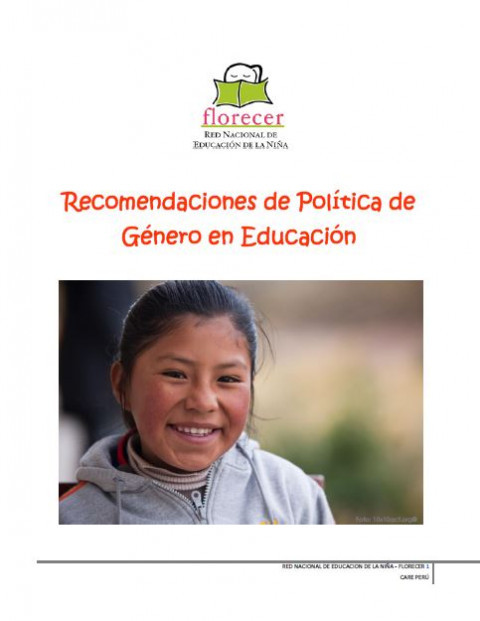 Gender Policy Recommendations in Education Year of publication: 2015 Corporate author: Red Nacional de Educación de la Niña This document synthesizes the proposals of the Florecer Network to advance in gender equality, convinced that the commitment to a more just and more human world necessarily involves the assumption of equality between men and women. The principle that the rights of women and girls are an integral, inalienable and indivisible part of universal human rights has been reaffirmed from the various international forums. Greater equity between men and women is also beneficial for the development of the country. A country with educated girls and women has a lower birth rate, improves their health and productivity conditions. This document synthesizes the main proposals of the Gender and Citizenship Forum: imperative for a quality education, organized by Red Florecer in May 2013 year. We want to put them in the hands of decision-makers and citizens in general to help concretize the mandates of equality between men and women in education. It is time not to give up dreams because they have become possible. Recomendaciones de Política de Género en Educación Year of publication: 2015 Corporate author: Red Nacional de Educación de la Niña Este documento sintetiza las propuestas de la Red Florecer para avanzar en la igualdad de género, convencidos de que la apuesta por un mundo más justo y más humano pasa necesariamente por la asunción de la igualdad entre hombres y mujeres. Desde los diversos foros internacionales se ha reafirmado el principio que los derechos de las mujeres y las niñas son parte integral, inalienable e indivisible de los derechos humanos universales. Una mayor equidad entre hombres y mujeres es además beneficiosa para el desarrollo del país. Un país con niñas y mujeres educadas tiene menor tasa de natalidad, mejora sus condiciones de salud y productividad.Este documento sintetiza las principales propuestas del Foro Género y Ciudadanía: imperativo para una educación de calidad, organizado por la Red Florecer en mayo del 2013 año. Queremos ponerlas en manos de los decisores y de la ciudadanía en general para contribuir a concretar los mandatos de igualdad entre hombres y mujeres en la educación. Es el momento de no desistir de los sueños porque estos se han tornado posibles.
  Building Intercultural Citizenship through Education: A Human Rights Approach Year of publication: 2008 Author: Rodolfo Stavenhagen This article analyses the challenges posed by traditional ethnic and linguistic minorities in multicultural states and more specifically the problems faced by indigenous peoples and communities. Their educational and cultural needs and demands are increasingly being framed in the language of human rights, based on the expanding international legal and institutional human rights system. The United Nations World Conference on Human Rights, held in Vienna in 1993, endorsed a rights-based approach to development, human rights education is a growing field in educational practice, respect for cultural diversity is now enshrined in international and domestic laws, and the right of every person to education and to culture has become a mainstay of international human rights principles to which a majority of the world's states has subscribed.