
Resources
Explore a wide range of valuable resources on GCED to deepen your understanding and enhance your research, advocacy, teaching, and learning.
145 Results found
 A Call to Peace: On a Culture of Peace, Nonviolence, Tolerance and Other Concepts Year of publication: 2017 Corporate author: HRDO Center This is a publication by the HRDO Center that sheds light on the culture of peace, the mechanisms for achieving it, and the repercussions of its disappearance from the societal and personal behavior in Egypt. How can policies and legislation ensure the promotion of notions of peace that are closely linked to ensuring human rights. This report monitors several basic concepts and how they are addressed by international and national legislation and the feasibility of adopting a culture of peace, tolerance and non-violence as an initial step to raise awareness of the need to renounce violence, discrimination and hatred as a basic entry point for a better, safer and more stable society.
  العنف المدرسيّ في التعليم العربيّ: أسبابه، طرق الوقاية والعلاج Year of publication: 2012 Author: Khalid Abu Asaba Corporate author: Palestinian Center for Israeli Studies يستعرض الكاتب في هذا المقال قضية العنف المدرسيّ في التعليم العربي. ويتطرق لأهم الأسباب، وطرق الوقاية والعلاج. كما يناقش المقال بعض العوامل التي تشير لتعرض الطلاب للعنف المدرسي. School Violence in Arab Education: Its Causes, Prevention and Treatment Methods Year of publication: 2012 Author: Khalid Abu Asaba Corporate author: Palestinian Center for Israeli Studies In this article, the author reviews the issue of school violence in Arab education. It deals with the most important causes, methods of prevention and treatment. The article also discusses some of the factors that indicate students' exposure to school violence.
  Education and Cultural Diversity Lessons from Innovative Practice in Latin America Year of publication: 2008 Author: Carolina Hirmas R. Corporate author: UNESCO Santiago This publication, which is the second volume of the collection, is the result of analysis and reflection on a series of innovative educational experiences from several Latin American countries, which respond with pedagogical relevance to the students' cultural context and offer an education oriented towards knowledge, understanding and dialogue between people of different cultures. The significant contribution of the aforementioned experiences lies in the recognition and appreciation of the ethnic and cultural diversity of its students and communities, as a starting point for the development of new learning and affirmation of their identity. In turn, life in educational centers promotes intercultural relations of respect and fraternity in a local and subregional sociogeographic context, characterized by multiculturalism. Educación y diversidad cultural: lecciones desde la práctica innovadora en América Latina Year of publication: 2008 Author: Carolina Hirmas R. Corporate author: UNESCO Santiago Esta publicación, que constituye el segundo volumen de la colección, es el resultado del análisis y la reflexión acerca de un conjunto experiencias educativas innovadoras de varios países de Latinoamérica, que responden con pertinencia pedagógica al contexto cultural de los estudiantes y ofrecen una educación orientada al conocimiento, comprensión y diálogo entre personas de diferentes culturas. El aporte significativo de las experiencias referidas, reside en el reconocimiento y valoración de la diversidad étnica y cultural de sus estudiantes y comunidades, como punto de partida para el desarrollo de nuevos aprendizajes y afirmación de su identidad. A su vez, la vida en los centros educativos promueve relaciones interculturales de respeto y fraternidad en un contexto sociogeográfico local y subregional, caracterizado por la multiculturalidad.
  Global Security, Religion and Education Development: a Crisis for the Field of Comparative Education? Year of publication: 2011 Author: Yusuf Sayed | Lynn Davies | Mike Hardy | Abbas Madandar Arani | Lida Kakia | Masooda Bano Corporate author: Taylor & Francis Building common ground on shared values should be a high priority for a diverse and devout society in an era of religious conflict. Otherwise we might fall into the equally false and far more dangerous illusion that we agree on nothing at all – and perhaps we tend to assume that education helps to do this, which is not necessarily the case. There is a greater concern that education is not just failing to step up effectively to the task of contesting undifferentiated and negative views of religions, but that it might not always be a force for good at all. It may in some cases help reinforce difference and create the conditions for conflict.The relationship, therefore, between religious difference, security and the assumed supportive role of education is far from a simple one. Global security, religion and education development: a crisis for the field of comparative education? Year of publication: 2011 Author: Yusuf Sayed | Lynn Davies | Mike Hardy | Abbas Madandar Arani | Lida Kakia | Masooda Bano Corporate author: Taylor & Francis Partager des valeurs communes devrait être une priorité absolue dans une société diversifiée et dévote en cette période de conflits religieux. Autrement, on pourrait tomber dans l’illusion, fausse et dangereuse, que nous sommes d’accord en rien - et on pense, probablement que l'éducation contribue à cet état de choses, alors que ce n’est pas forcément le cas. On est de plus en plus préoccupé par la question suivante : celle de considérer que non seulement l'éducation échoue quand il s’agit de contester d’une manière solide et efficace les points de vues non nuancés et négatifs en matière de religions, mais aussi que l’éducation n’est finalement pas une bonne chose. Dans certains cas, elle peut contribuer à renforcer la différence et créer les conditions d'un conflit. La relation, donc, entre la différence religieuse, la sécurité et le rôle présumé de soutien de l'éducation est loin d'être simple.
 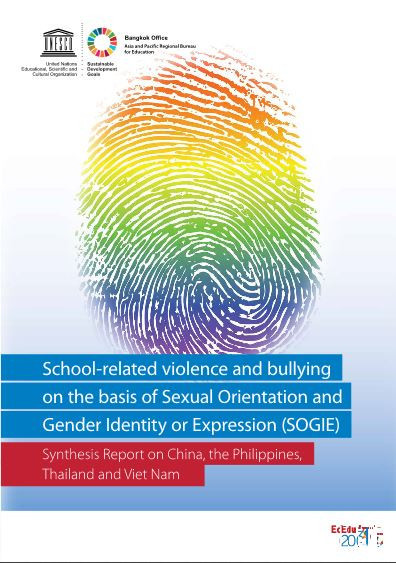 School-related violence and bullying on the basis of Sexual Orientation and Gender Identity or Expression (SOGIE) - Synthesis Report on China, the Philippines, Thailand and VietNam Year of publication: 2018 Corporate author: UNESCO Bangkok School related violence and bullying is a problem in all countries. UNESCO is committed to ensuring that all children and young people have access to safe, inclusive, health-promoting learning environments as part of its strategy on education for health and well-being. This synthesis report on school related violence and bullying on the basis of Sexual Orientation and Gender Identity or Expression (SOGIE), covering China, the Philippines, Thailand and Viet Nam, was developed to broaden awareness and understanding about this issue, while also identifying best practices and policies. It also aims to mobilize support for advocacy among educators, research institutions, policy makers and activists at the national and regional levels.
  منع التطرف من خلال التعليم: بيئة مدرسية آمنة وداعمة Year of publication: 2020 Author: Mohammad Madbouli يتحدث الفيديو عن منع التطرف في المدارس. يستخدم المقدم دليل اليونسكو لواضعي السياسات المنشور في 2018 كإطار لمناقشة منع التطرف. يتحدث المقدم عن بيئة آمنة وداعمة للطلاب في المدارس. Preventing Extremism Through Education: A Safe and Supportive School Environment Year of publication: 2020 Author: Mohammad Madbouli This video talks about preventing extremism in schools. The presenter uses the UNESCO guide for policy-makers published in 2018 as framework for discussing preventing extremism. The presenter speaks about safe and supportive environment for students in schools.