
Resources
Explore a wide range of valuable resources on GCED to deepen your understanding and enhance your research, advocacy, teaching, and learning.
23 Results found
 Education, Identity and Rising Extremism: From Preventing Violent Extremism to Promoting Peace, Resilience, Equal Rights and Pluralism (PREP) Year of publication: 2017 Author: Sanam Anderlini Corporate author: International Civil Society Action Network In November 2016, during ICAN’s fifth annual Women, Peace and Security forum, members of the Women’s Alliance for Security Leadership (WASL) and other women-led organizations in over 30 countries analyzed the role of formal and informal education in contributing to enabling conditions and mitigating extremist violence. They also highlighted their own practical experiences and lessons learnt in providing education to prevent violent extremism by fostering peace, resilience, equal rights and pluralism (PREP) in formal and informal spaces, including through the teachings of alternative religious narratives. Their experiences, combined with desk research on the state of current policy and practice, and the first multi-stakeholder Global Solutions Exchange (GSX) meeting on the nexus of education, gender and extremism held at the UNESCO headquarters in Paris in March 2017, inform the findings of this report. التعليم والهوية ومنع التطرف: من منع التطرف العنيف إلى تعزيز السالم والصمود والمساواة في الحقوق والتعددية )PREP) Year of publication: 2017 Author: Sanam Anderlini Corporate author: International Civil Society Action Network فـي تشـرين الثانـي / نوفمبـر 2016 ، خـال منتـدى ايـكان ICAN السـنوي الخامـس للمـرأة والسـام واألمـن ، قــام أعضــاء التحالــف النســائي مــن أجــل القيــادة األمنيــة )وصــل( وغيرهــا مــن المنظمــات التــي تقودهــا النســاء فــي أكثــر مــن 30 دولــة بتحليــل دور التعليــم الرســمي وغيــر الرســمي فــي المســاهمة فــي تمكيــن الظـروف و تخفيـف العنـف المتطرف.كمـا قامـوا بتسـليط الضـوء علـى تجاربهـم العمليـة الخاصـة والـدروس المســتفادة مــن توفيــر التعليــم لمنــع التطــرف العنيــف مــن خــال تعزيــز الســام والصمــود والمســاواة فــي الحقـوق والتعدديـة )PREP )فـي المسـاحات الرسـمية وغيـر الرسـمية، بمـا فـي ذلـك مـن خـال تعاليـم بديلـة إلـى جنـب مع األبحـاث المكتبيـة حـول حالـة السياسـات والممارسـات للروايـات الدينيـة.إن تجاربهـم، جنبـا الحاليــة، وأول اجتماع للمنصــة العالميــة لتبــادل الحلــول )GSX ) حــول العالقــة بيــن التعليــم والجنــدر والتطـرف الـذي عقـد فـي مقـر اليونسـكو فـي باريـس فـي مـارس 2017 ، تقـوم بإبـاغ نتائج هـذا التقريـر .
  Preventing Violent Extremism through Sport: Technical Guide; Criminal Justice Handbook Series Year of publication: 2020 Corporate author: UN. Office on Drugs and Crime (UNODC) The Technical Guide on Preventing Violent Extremism through Sport, developed in consultation with international experts, recognizes the importance of promoting the well-being of children and youth. It applies an approach that encourages prosocial behaviour and good safeguarding and welfare practices, with particular emphasis on educational and social development measures in line with the United Nations Guidelines for the Prevention of Crime.The guide, addressed mainly to policy makers and implementing organizations, has been carefully designed to support effective integration of sport-based learning in primary prevention frameworks. By adopting a five-zone approach to prevent violent extremism namely safe space, empowerment, resilience, social inclusion and education, it supports informed policy development and a Theory of Change that can shape curriculum design and content. To further support global efforts in preventing violent extremism, UNODC is also developing an e-learning module and a practical tool for trainers that will be published soon and will complement this technical guide.
  Youth Engagement to Counter Violent Extremism and Radicalization that Lead to Terrorism: Report on Findings and Recommendations from an OSCE Secretariat - OSCE ODIHR Expert Roundtable Year of publication: 2013 Corporate author: Организация по безопасности и сотрудничеству в Европе (ОБСЕ) This report is based on the results of a joint meeting of experts in a round-table format of the OSCE Secretariat and the OSCE Office for Democratic Institutions and Human Rights on October 23-24, 2012 in Vienna, Austria.This report should not be considered official OSCE recommendations on the basis of an agreed decision or the official position of the OSCE Secretariat, the OSCE Office for Democratic Institutions and Human Rights, or any OSCE participating State. It presents opinions individually expressed by the participants in the expert meeting in a round-table format. Вовлечение молодежи в усилия по противодействию насильственному экстремизму и радикализации, ведущим к терроризму: Отчет о выводах и рекомендациях Year of publication: 2013 Corporate author: Организация по безопасности и сотрудничеству в Европе (ОБСЕ) Данный отчет составлен по итогам совместного заседание экспертов в формате «круглого стола» Секретариата ОБСЕ и Бюро ОБСЕ по демократическим институтам и правам человека 23-24 октября 2012 года в Вене, Австрия.Настоящий отчет не следует считать официальными рекомендациями ОБСЕ на основании согласованного решения или официальной позицией Секретариата ОБСЕ, Бюро ОБСЕ по демократическим институтам и правам человека или какого-либо государства-участника ОБСЕ. В нем представлены мнения, индивидуально выраженные участниками заседания экспертов в формате «круглого стола».
  State Program on Countering Religious Extremism and Terrorism in the Republic of Kazakhstan for 2018 - 2022 Year of publication: 2018 Corporate author: Government of the Republic of Kazakhstan The document contains the main provisions of the State program on countering religious extremism and terrorism in the Republic of Kazakhstan for 2018 - 2022.The geopolitical changes taking place in the world initiate a new spectrum of challenges and risks in the field of national security, which is becoming more diverse and emanating from a greater number of sources of danger. This determines the complexity and relevance of the tasks within the framework of a systematic prevention of threats of religious extremism and terrorism.Under these conditions, the current national system of combating religious extremism and terrorism needs to be further improved in the context of creating a mechanism for reliable protection of individuals, society and the state from extremist manifestations of a violent nature and threats of terrorism. Государственная программа по противодействию религиозному экстремизму и терроризму в Республике Казахстан на 2018 – 2022 годы Year of publication: 2018 Corporate author: Government of the Republic of Kazakhstan Документ содержит основные положения Государственной программы по противодействию религиозному экстремизму и терроризму в Республике Казахстан на 2018 – 2022 годы.Происходящие в мире геополитические изменения инициируют новый спектр вызовов и рисков в сфере национальной безопасности, который становится все более разнообразным и исходящим от большего числа источников опасности. Этим обусловлены сложность и актуальность задач в рамках системного предупреждения угроз религиозного экстремизма и терроризма.В этих условиях действующая общегосударственная система противодействия религиозному экстремизму и терроризму нуждается в дальнейшем совершенствовании в контексте создания механизма надежной защиты личности, общества и государства от экстремистских проявлений насильственного характера и угроз терроризма.
  أسباب ظاهرة التطرف لدى طالب الجامعة وأساليب الحد منها من وجهة نظرهم) دراسة ميدانية ( Year of publication: 2016 Author: Ramadan Abdel-Hamid Mohamed El-Tantawi | Mahmoud Abdel-Hamid Hussein Kamal | El-Sayed Mohamed Abdel-Meguid Abdel-Aal | Osama Mahmoud Zidan | Moataz El-Morsi El-Nagari | Mohamed Ramadan Abdel-Hamid El-Tantawi Corporate author: Damietta University تسعى الدراسة الى التعرف على الأسباب التي تؤدي الى انتشار ظاهرة التطرف. وأيضا مناقشة الأساليب الأكثر جدوى ومناسبة في الحد من ظاهرة التطرف. وتنتهي الورقة بوضع توصيات وحلول للحد من هذه الظاهرة. The Causes of the Phenomenon of Extremism Among University Students and Methods of Reducing it from Their Point of View (A Field Study) Year of publication: 2016 Author: Ramadan Abdel-Hamid Mohamed El-Tantawi | Mahmoud Abdel-Hamid Hussein Kamal | El-Sayed Mohamed Abdel-Meguid Abdel-Aal | Osama Mahmoud Zidan | Moataz El-Morsi El-Nagari | Mohamed Ramadan Abdel-Hamid El-Tantawi Corporate author: Damietta University The study seeks to identify the reasons that lead to the spread of the phenomenon of extremism. And also discuss the most feasible and appropriate methods in curbing the phenomenon of extremism. The paper ends with recommendations and solutions to reduce this phenomenon.
 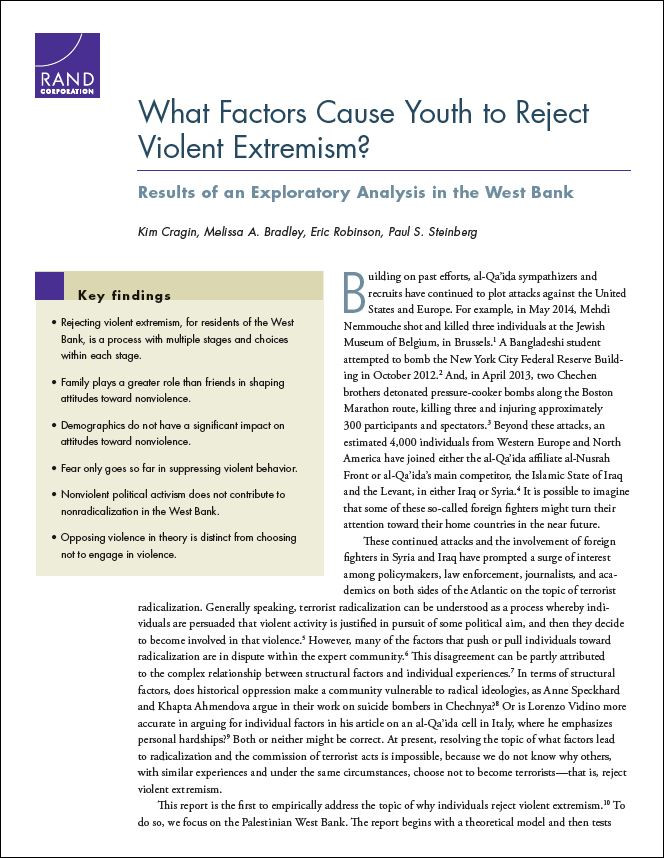 ما هي العوامل التي تدفع الشباب إلى رفض التطرف العنيف؟: نتائج تحليل استكشا في تم إجراؤه في الضفة الغربية Year of publication: 2015 Author: Kim Cragin | Melissa A. Bradley | Eric Robinson | Paul S. Steinberg Corporate author: RAND Corporation أدت الهجمات الإرهابية المستمرة وتورط مقاتلين أجانب في سوريا والعراق إلى زيادة الاهتمام بين صانعي السياسات وإنفاذ القانون والصحفيين والأكاديميين على جانبي المحيط الأطلسي بشأن موضوع التطرف الإرهابي. العديد من العوامل التي تدفع الأفراد أو تدفعهم نحو التطرف محل نزاع داخل مجتمع الخبراء. بدلاً من فحص العوامل التي تؤدي إلى التطرف وارتكاب أعمال إرهابية ، يتخذ هذا التقرير مقاربة جديدة. ما هي العوامل التي تدفع الشباب إلى رفض التطرف العنيف؟ نتائج التحليل الاستكشافي في الضفة الغربية تعالج بشكل تجريبي موضوع لماذا يرفض الشباب التطرف العنيف. للقيام بذلك ، يركز المؤلفون على الضفة الغربية الفلسطينية. يبدأ التقرير بنموذج نظري ثم يختبر هذا النموذج بالبيانات التي تم جمعها من خلال المقابلات والمسح المنظم. في هذه الدراسة ، تم إجراء عشر مقابلات شبه منظمة مع سياسيين من حماس وفتح في عام 2012. إلى جانب هذه المقابلات ، أجرى المؤلفون مسحًا على 600 شاب (تتراوح أعمارهم بين 18 و 30 عامًا) يعيشون في الخليل وجنين ورام الله.تظهر النتائج الشاملة لهذا الجهد أن (1) رفض التطرف العنيف ، بالنسبة لسكان الضفة الغربية ، هو عملية ذات مراحل وخيارات متعددة في كل مرحلة. (2) تلعب الأسرة دورًا أكبر من دور الأصدقاء في تشكيل المواقف تجاه اللاعنف ؛ (3) الديموغرافيات ليس لها تأثير كبير على المواقف تجاه اللاعنف. و (4) تختلف مناهضة العنف نظريًا عن اختيار عدم الانخراط في العنف.