
Resources
Explore a wide range of valuable resources on GCED to deepen your understanding and enhance your research, advocacy, teaching, and learning.
58 Results found
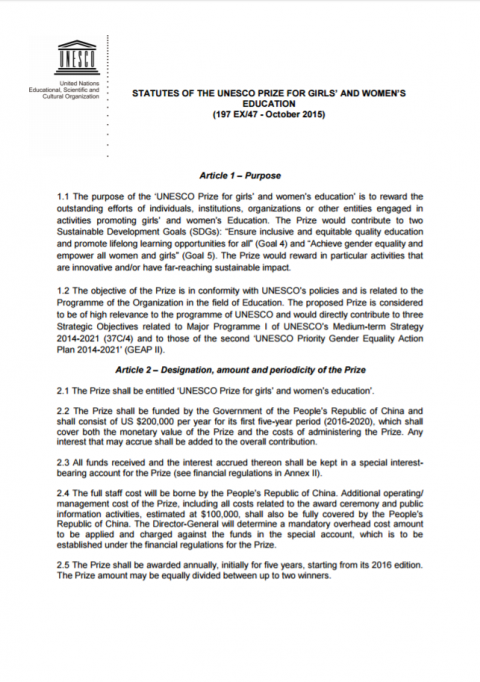 Statuts du Prix UNESCO pour l'éducation des filles et des femmes (197 EX/17, 14 octobre 2015) Year of publication: 2016 Corporate author: Organisation des Nations Unies pour l'éducation, la science et la culture (UNESCO) The purpose of the ‘UNESCO Prize for girls’ and women’s education’ is to reward the outstanding efforts of individuals, institutions, organizations or other entities engaged in activities promoting girls’ and women’s Education. The Prize would contribute to two Sustainable Development Goals (SDGs): “Ensure inclusive and equitable quality education and promote lifelong learning opportunities for all” (Goal 4) and “Achieve gender equality and empower all women and girls” (Goal 5). The Prize would reward in particular activities that are innovative and/or have far-reaching sustainable impact.
 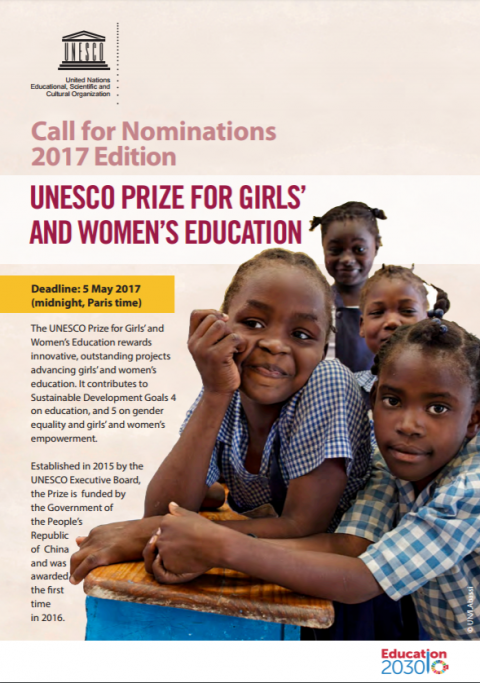 UNESCO Prize for Girls' and Women's Education, 2017 edition: call for nominations Year of publication: 2017 Corporate author: UNESCO The UNESCO Prize for Girls’ and Women’s Education rewards innovative, outstanding projects advancing girls’ and women’s education. It contributes to Sustainable Development Goals 4 on education, and 5 on gender equality and girls’ and women’s empowerment.
 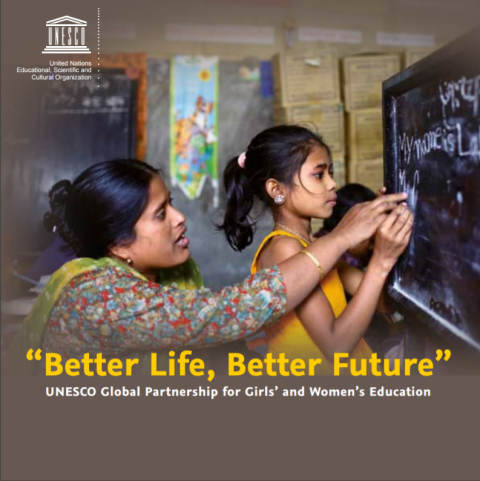 Better Life, Better Future: UNESCO Global Partnership for Girl's and Women's Education Year of publication: 2011 Corporate author: UNESCO “Better Life, Better Future”, UNESCO’s global partnership for girls’ and women’s education, addresses two main areas requiring increased attention – secondary education and adult literacy. It will seek to introduce programmes aimed at stemming the dropout of adolescent girls in the transition from primary to secondary education and in lower secondary schools, as well as focus on scaling up women’s literacy programmes through stronger advocacy and partnerships. As a first step, and in complement to other United Nations initiatives, UNESCO has recently concluded several dynamic public and private partnerships, which stand to benefit marginalized girls and women in Africa and Asia.
 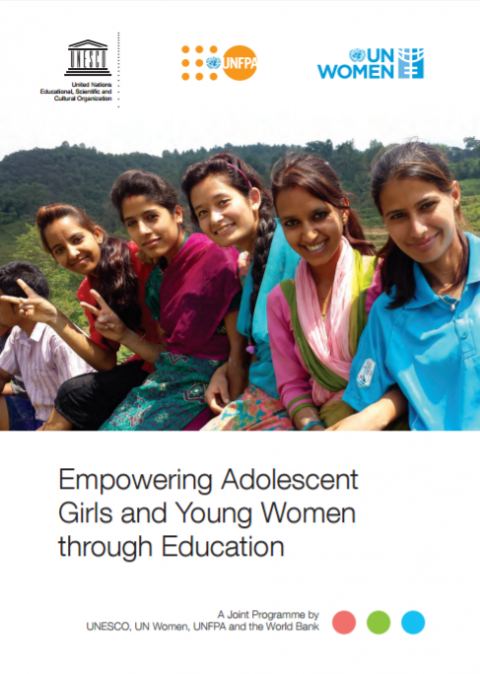 Empowering Adolescent Girls and Young Women through Education Year of publication: 2015 Corporate author: UNESCO L'Autonomisation des adolescentes et des jeunes femmes par l'éducation Year of publication: 2015 Corporate author: Organisation des Nations Unies pour l'éducation, la science et la culture (UNESCO)
 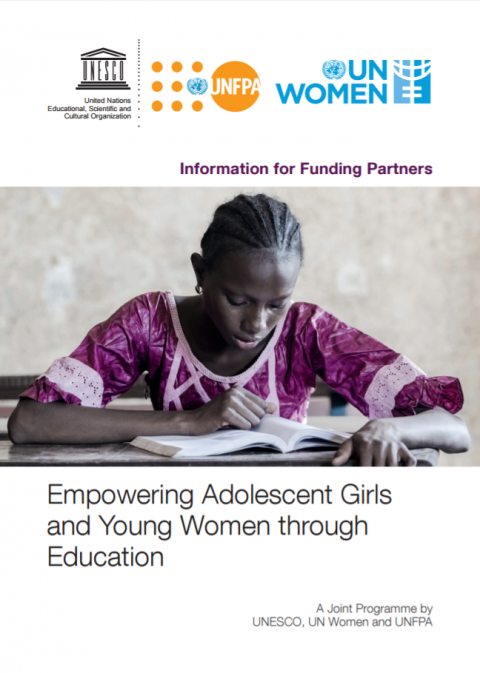 Empowering Adolescent Girls and Young Women through Education: Information for Funding Partners Year of publication: 2016 Corporate author: UNESCO | United Nations Population Fund (UNFPA) | United Nations Entity for Gender Equality and the Empowerment of Women (UN Women) Empowering Adolescent Girls and Young Women through Education: Information for Funding Partners
  UNESCO's Education Evaluation in 2016: A Review Year of publication: 2017 Corporate author: UNESCO UNESCO completed 12 education related evaluations in 2016. Part A of this review presents the key insights and lessons learned from those evaluations. These learnings are designed to help enhance UNESCO’s leadership and coordination of the SDG 4 – Education 2030 Agenda. Part B of the review provides an assessment of the quality and usefulness of these evaluations based on the UNEG and OECD quality standards for evaluation reports.
  UNESCO and Education Year of publication: 2017 Corporate author: UNESCO Education is a fundamental human right and
a public good and, as such, has been at the core of UNESCO’s work since its inception.Education is also the path to sustainability – to poverty alleviation, better health, environmental protection and gender equality.As the only United Nations agency with a mandate to cover all aspects of education, UNESCO was entrusted in 2015 to lead the coordination and monitoring of Sustainable Development Goal 4, as part of the new Global Education 2030 Agenda.Goal 4 aims to “ensure inclusive and equitable quality education and promote lifelong learning opportunities for all,” and renewed UNESCO’s and Member States’ commitment to a vision of education that is holistic, inspirational and which leaves no one behind.This commitment is reflected in the size and scope of the Education Sector, the largest in UNESCO, with staff working at its Paris Headquarters and spread across a global network of field offices and specialized institutes and centres. With its close links with education ministries and other partners, UNESCO is strongly placed to press for action and change.UNESCO’s Education Sector supports Member States in developing education systems that foster high-quality and inclusive lifelong learning for all, empowering learners to be creative and responsible global citizens while leading the debate to help shape the future international education agenda.There is no stronger, no more lasting, investment a country can make than educating its citizens. The Education Sector exists to further this collective vision worldwide by transforming lives one by one. L'UNESCO et l'éducation Year of publication: 2017 Corporate author: UNESCO Education is a fundamental human right and
a public good and, as such, has been at the core of UNESCO’s work since its inception.Education is also the path to sustainability – to poverty alleviation, better health, environmental protection and gender equality.As the only United Nations agency with a mandate to cover all aspects of education, UNESCO was entrusted in 2015 to lead the coordination and monitoring of Sustainable Development Goal 4, as part of the new Global Education 2030 Agenda.Goal 4 aims to “ensure inclusive and equitable quality education and promote lifelong learning opportunities for all,” and renewed UNESCO’s and Member States’ commitment to a vision of education that is holistic, inspirational and which leaves no one behind.This commitment is reflected in the size and scope of the Education Sector, the largest in UNESCO, with staff working at its Paris Headquarters and spread across a global network of field offices and specialized institutes and centres. With its close links with education ministries and other partners, UNESCO is strongly placed to press for action and change.UNESCO’s Education Sector supports Member States in developing education systems that foster high-quality and inclusive lifelong learning for all, empowering learners to be creative and responsible global citizens while leading the debate to help shape the future international education agenda.There is no stronger, no more lasting, investment a country can make than educating its citizens. The Education Sector exists to further this collective vision worldwide by transforming lives one by one.
UNESCO and Education Year of publication: 2017 Corporate author: UNESCO Education is a fundamental human right and
a public good and, as such, has been at the core of UNESCO’s work since its inception.Education is also the path to sustainability – to poverty alleviation, better health, environmental protection and gender equality.As the only United Nations agency with a mandate to cover all aspects of education, UNESCO was entrusted in 2015 to lead the coordination and monitoring of Sustainable Development Goal 4, as part of the new Global Education 2030 Agenda.Goal 4 aims to “ensure inclusive and equitable quality education and promote lifelong learning opportunities for all,” and renewed UNESCO’s and Member States’ commitment to a vision of education that is holistic, inspirational and which leaves no one behind.This commitment is reflected in the size and scope of the Education Sector, the largest in UNESCO, with staff working at its Paris Headquarters and spread across a global network of field offices and specialized institutes and centres. With its close links with education ministries and other partners, UNESCO is strongly placed to press for action and change.UNESCO’s Education Sector supports Member States in developing education systems that foster high-quality and inclusive lifelong learning for all, empowering learners to be creative and responsible global citizens while leading the debate to help shape the future international education agenda.There is no stronger, no more lasting, investment a country can make than educating its citizens. The Education Sector exists to further this collective vision worldwide by transforming lives one by one. L'UNESCO et l'éducation Year of publication: 2017 Corporate author: UNESCO Education is a fundamental human right and
a public good and, as such, has been at the core of UNESCO’s work since its inception.Education is also the path to sustainability – to poverty alleviation, better health, environmental protection and gender equality.As the only United Nations agency with a mandate to cover all aspects of education, UNESCO was entrusted in 2015 to lead the coordination and monitoring of Sustainable Development Goal 4, as part of the new Global Education 2030 Agenda.Goal 4 aims to “ensure inclusive and equitable quality education and promote lifelong learning opportunities for all,” and renewed UNESCO’s and Member States’ commitment to a vision of education that is holistic, inspirational and which leaves no one behind.This commitment is reflected in the size and scope of the Education Sector, the largest in UNESCO, with staff working at its Paris Headquarters and spread across a global network of field offices and specialized institutes and centres. With its close links with education ministries and other partners, UNESCO is strongly placed to press for action and change.UNESCO’s Education Sector supports Member States in developing education systems that foster high-quality and inclusive lifelong learning for all, empowering learners to be creative and responsible global citizens while leading the debate to help shape the future international education agenda.There is no stronger, no more lasting, investment a country can make than educating its citizens. The Education Sector exists to further this collective vision worldwide by transforming lives one by one. 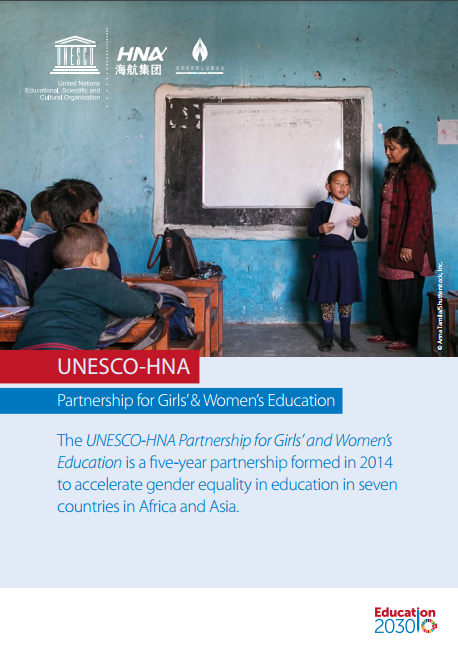 UNESCO-HNA Partnership for Girls' & Women's Education Year of publication: 2017 Corporate author: UNESCO The UNESCO-HNA Partnership for Girls’ and Women’s Education is one component of the “Better Life, Better Future” Global Partnership for Girls’ and Women’s Education launched by UNESCO in 2011. The Global Partnership recognizes that educating girls and women can break the cycle of poverty, foster greater social justice and contribute to the achievement of the Sustainable Development Goals. It aims to expand and improve the quality and relevance of education for girls and women, creating a better life and better future for all members of society for generations to come.