
Resources
Explore a wide range of valuable resources on GCED to deepen your understanding and enhance your research, advocacy, teaching, and learning.
58 Results found
 Son Atlas: Outil de plaidoyer interactif sur le droit à l’éducation des filles et des femmes Year of publication: 2023 Corporate author: UNESCO De nombreuses filles et femmes ne peuvent pas exercer leur droit à l'éducation en raison des inégalités entre les genres et des pratiques discriminatoires. La pauvreté, les mariages précoces et les violences basées sur le genre ne sont que quelques-unes des nombreuses raisons qui expliquent le pourcentage élevé d'analphabétisme et de décrochage scolaire chez les filles et les femmes dans le monde. Le renforcement du droit des filles et des femmes pour une éducation de qualité est essentiel pour éliminer la discrimination et parvenir à l'égalité des droits entre les genres. Ceci ne peut être réalisé sans des cadres juridiques nationaux solides, basés sur les droits, sensibles au genre et inclusifs. C'est là qu'intervient SonAtlas. SonAtlas est un outil en ligne, le premier du genre, qui cartographie le droit à l'éducation des filles et des femmes. Il vise à améliorer les connaissances du public et à surveiller le statut des constitutions, législations et réglementations nationales relatives aux droits à l'éducation des filles et des femmes, afin d'encourager les pays à agir, à renforcer leurs lois et leurs politiques et à entraîner un changement à long terme. Des changements concrets sont déjà visibles. En 2019, 4 % des pays restreignaient explicitement le droit à l'éducation des filles mariées, enceintes et jeunes mères. Ce chiffre a chuté à 2 % en 2022, au profit de millions de filles qui peuvent désormais aller à l'école en toute légalité lorsqu'elles se marient ou sont enceintes ou jeunes mères.
  Protect Her Rights, Strengthen Your Laws: Her Atlas; Status Report on Girls’ and Women’s Right to Education Year of publication: 2022 Corporate author: UNESCO UNESCO’s Her Education, our future initiative, Her Atlas was launched in 2019 with the aim to enhance public knowledge and monitor the status of national constitutions, legislation and regulations related to girls’ and women’s education rights in order to encourage countries to take actions to improve their legal frameworks. Three years after its launch, the research phase has been completed: overall, the legal frameworks of 196 countries have been thoroughly analyzed to evaluate the level of protection of girls’ and women’s right to education around the world. In an interactive world map format, Her Atlas uses a color-coded scoring system to monitor 12 indicators of legal progress towards gender equality in the right to education. This report marks the completion of the first research phase and intends to highlight some key trends outlined by the research work, and to emphasize examples of legal provisions regarding some aspects of girls’ and women’s right to education guaranteed by States’ domestic laws.
 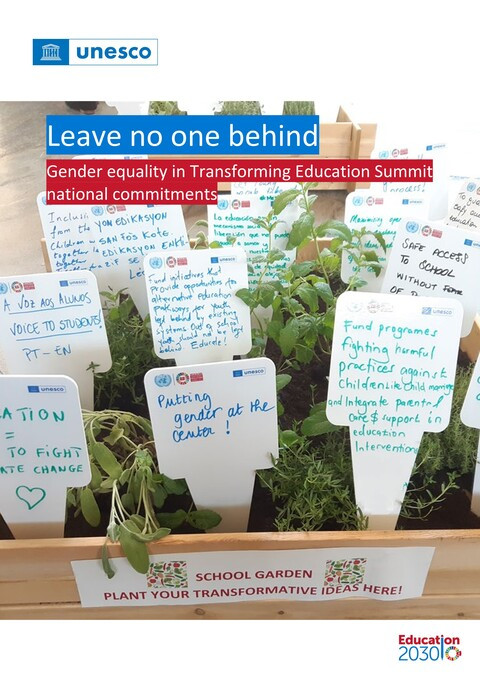 Leave No One Behind: Gender Equality in Transforming Education Summit National Commitments Year of publication: 2023 Corporate author: UNESCO The Transforming Education Summit was convened in response to a global crisis in education – one of equity and inclusion, quality and relevance. This paper applies a gender lens to the national statements of commitments made by countries during the Summit. It considers the scope of commitments to gender equality and gender- transformative education, common gender themes and considerations emerging across commitments, and notable gaps. It aims to inform future actions by the Global Platform to Drive Leadership and Accountability for Gender Equality and Girls’ and Women’s Empowerment in and through Education, and support to country action to transform education systems to advance gender equality.
  Communication Strategy: UNESCO Guidance on Communicating on Gender Equality in and through Education Year of publication: 2022 Corporate author: UNESCO About 259 million children and youth are out of school according to the UNESCO Institute for Statistics, including 127 million girls and 132 million boys. Twothirds of the 750 million non-literate adults around the world are women. This gender disparity remains one of the persistent challenges in adult literacy and education. The COVID-19 pandemic has exacerbated existing challenges, disrupting the education of over 1.5 billion learners. UNESCO estimates that close to 24 million children and youth, including over 11 million girls and 13 million boys, may drop out of school due to the pandemic’s economic impact. A window of opportunity is now more than ever open to build back equal. This communication strategy is designed to provide strategic guidance on communicating on gender equality in and through education. While prepared for UNESCO Education Sector staff, including those at Headquarters, in Field/Regional/Cluster Offices and in Institutes as well as for implementing partners, a broader audience of gender focal points, partners, Member States and others with an interest in and commitment to gender equality in and through education may also find this strategy particularly useful. Estrategia de comunicación: Orientaciones de la UNESCO sobre la comunicación en materia de igualdad de género en y a través de la educación Year of publication: 2022 Corporate author: UNESCO Según el Instituto de Estadística de la UNESCO, aproximadamente 259 millones de niños y jóvenes no están escolarizados, entre los cuales 127 millones de niñas y 132 millones de niños. Asimismo, dos tercios de los 750 millones de adultos analfabetos de todo el mundo son mujeres. Esta disparidad de género sigue siendo uno de los desafíos persistentes en la alfabetización de adultos y la educación. La pandemia de COVID-19 ha exacerbado los desafíos existentes, interrumpiendo la educación de más de 1 500 millones de alumnos. La UNESCO calcula que aproximadamente 24 millones de niños y jóvenes, incluyendo más de 11 millones de niñas y 13 millones de niños, pueden llegar a abandonar la escuela debido al impacto económico de la pandemia. Ahora más que nunca se abre la posibilidad de reforzar la igualdad. Esta estrategia de comunicación está diseñada para proporcionar una orientación estratégica sobre la comunicación de la igualdad de género en y a través de la educación. Aunque se ha preparado teniendo en cuenta al personal del Sector de la Educación de la UNESCO en la Sede, las oficinas fuera de la Sede, regionales y multipaís y los institutos, así como a los asociados en la ejecución, esta estrategia también puede resultar especialmente útil a un público más amplio de coordinadores en cuestiones de género, socios, Estados Miembros y otras personas interesadas y comprometidas con la igualdad de género en y a través de la educación. Stratégie de communication: Orientations de l’UNESCO pour la communication relative à l’égalité des genres dans et par l’éducation Year of publication: 2022 Corporate author: UNESCO Selon l’Institut de statistique de l’UNESCO, 259 millions d’enfants et de jeunes ne sont pas scolarisés, dont 127 millions de filles et 132 millions de garçons. Les deux tiers des 750 millions d’adultes analphabètes à travers le monde sont des femmes. Cet écart entre les genres reste l’un des défis les plus persistants à relever en matière d’alphabétisme des adultes et d’éducation. La pandémie de la COVID-19 a exacerbé les difficultés préexistantes, perturbant l’éducation de plus de 1,5 milliard d’apprenants. L’UNESCO estime que près de 24 millions d’enfants et de jeunes, dont plus de 11 millions de filles et 13 millions de garçons, pourraient être déscolarisés en raison des répercussions économiques de la pandémie. Aujourd’hui, nous avons plus que jamais l’occasion de reconstruire l’égalité. Cette stratégie de communication est conçue pour orienter la communication relative à l’égalité des genres dans et par l’éducation. Bien que préparée avec des considérations pour le personnel du Secteur de l’éducation de l’UNESCO au siège, dans les bureaux hors siège, régionaux et multi-pays et instituts, ainsi que pour les partenaires de mise en œuvre, un public plus large de points focaux pour le genre, de partenaires, d’États membres et d’autres ayant un intérêt et un engagement pour l’égalité des genres dans et par l’éducation peuvent également trouver cette stratégie particulièrement utile. Her Atlas: Interactive Advocacy Tool on Girls’ and Women’s Right to Education Year of publication: 2023 Corporate author: UNESCO Many girls and women cannot exercise their right to education due to gender inequality and discriminatory practices. Poverty, early marriage, and gender-based violence are just some of the many reasons behind the high percentage of global female illiteracy and school drop-outs. Strengthening the right of girls and women to quality education is key to eliminate discrimination and to achieve equal rights between genders. This cannot be achieved without solid national legal frameworks that are rightsbased, gender responsive and inclusive. This is where HerAtlas comes in. HerAtlas, is a first of its kind online tool that maps the right to education of girls and women. It aims to enhance public knowledge and monitor the status of national constitutions, legislation and regulations related to education rights for girls and women to encourage countries to take action, strengthen their laws and policies, and lead to long term change. Concrete changes are already apparent. In 2019, 4% of countries were explicitly restricting the right to education of married, pregnant, and parenting girls. This has dropped to 2% in 2022, benefiting millions of girls who can now legally attend school when they marry or become pregnant.
 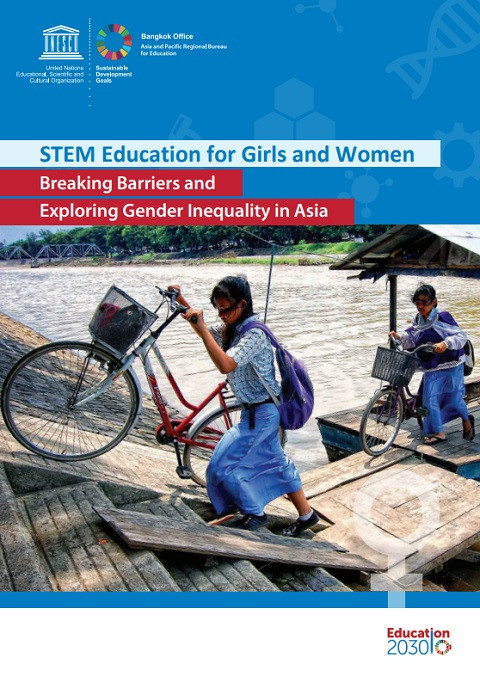 STEM Education for Girls and Women: Breaking Barriers and Exploring Gender Inequality in Asia Year of publication: 2020 Corporate author: UNESCO Bangkok | UNESCO Science, Technology, Engineering and Mathematics (STEM) fields are considered catalysts for the achievement of the 2030 Agenda for Sustainable Development. Yet, particularly for STEM fields, girls and women, for a multitude of social, cultural and psychological reasons, engage and participate at a lower rate than boys and men. This research collection aims to highlight the contextual barriers that girls and women face in STEM education and careers and offer concrete examples of interventions that successfully encourage participation of girls and women in STEM. These eight case studies from across Asia explore both the barriers and the achievements in SDG 4 and SDG 5, and give context-specific analysis of different aspects of gender disparities in the respective countries.