
Resources
Explore a wide range of valuable resources on GCED to deepen your understanding and enhance your research, advocacy, teaching, and learning.
6 Results found
 School Coexistence Toolkit: Prevention of Xenophobia Corporate author: Ministry of Education of Colombia The infographics guide the actions that should be developed in the school environment in the face of situations that incite or configure acts of xenophobia, exclusion or stigmatization against migrant girls, boys and adolescents. This message aims to have a positive impact on those who, beyond any nationality and any other migratory origin, should be welcomed and their rights guaranteed. Kit de herramientas para la convivencia escolar: Prevención de la xenofobia Corporate author: Ministry of Education of Colombia Las infografías orientan las acciones que deben desarrollarse en el entorno escolar frente a situaciones que inciten o configuren actos de xenofobia, exclusión o estigmatización en contra de niñas, niños, y adolescentes migrantes. Este mensaje pretende tener un impacto positivo hacia quienes, más allá de cualquier nacionalidad y de cualquier otro origen migratorio, se les debe acoger y garantizar sus derechos.
  National identity and xenophobia in an ethnically divided society Year of publication: 2005 Author: Noah Lewin Epstein | Asaf Levanon Corporate author: UNESCO Recent studies have suggested that national identity is empirically related to negative sentiments of individuals towards foreigners. This type of analysis has hitherto been based on the notion that xenophobia is shaped by the specific nature of national identity in a given society. Representing a stronger and more exclusive perception of national identity, ethnic national identity (compared with civic national identity) is expected in this line of research to result in less favourable perceptions of immigrants. In this paper we expand this approach by arguing that, in deeply divided societies, national identity itself may have different meanings among different social groups. L'identité nationale et la xénophobie dans une société ethniquement divisée Year of publication: 2005 Author: Noah Lewin Epstein | Asaf Levanon Corporate author: UNESCO Des études récentes ont suggéré que l'identité nationale est empiriquement associée à des sentiments négatifs des individus envers les étrangers. Ce type d'analyse a été jusqu'ici fondée sur la notion que la xénophobie est façonnée par la nature spécifique de l'identité nationale dans une société donnée. Représenter une perception plus forte et plus exclusive de l'identité nationale, l'identité nationale ethnique (par rapport à l'identité nationale civique) est attendue dans cette ligne de recherche pour aboutir à la perception moins favorable des immigrants. Dans cet article, nous étendre cette approche en faisant valoir que, dans les sociétés profondément divisées, l'identité nationale elle-même peut avoir des significations différentes entre les différents groupes sociaux.
 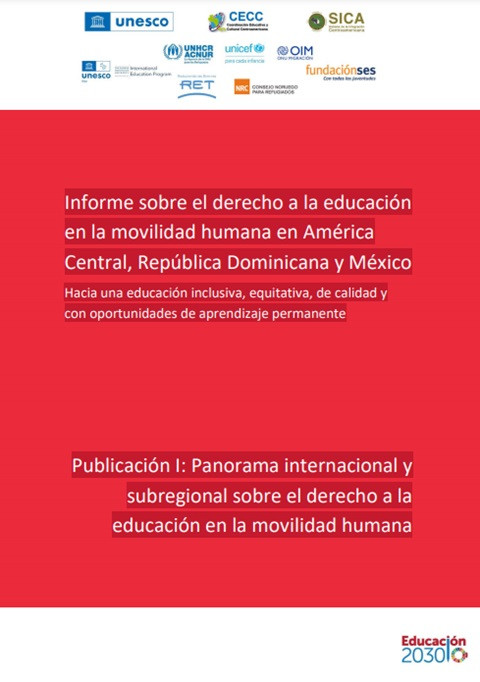 Report on the Right to Education in Human Mobility in Central America, the Dominican Republic and Mexico: Towards Inclusive, Equitable, Quality Education With Lifelong Learning Opportunities Year of publication: 2024 Corporate author: UNESCO San José | Central American Educational and Cultural Coordination | Central American Integration System Although human mobility is not a new phenomenon, data indicate that the number of people in this situation has reached its highest point since records began and there are no signs that the trend will decrease in the coming years. This scenario threatens to become a structural situation, strongly impacting the right to education and educational systems. Therefore, it is imperative that States and other key actors make a deep commitment to guarantee the fundamental right to education of people in situations of mobility through urgent measures, in line with the provisions of Sustainable Development Goal (SDG) 4 of the United Nations 2030 Agenda. For this reason, the preparation of this Report on the right to education of people in situations of mobility in Belize, Costa Rica, El Salvador, Guatemala, Honduras, Mexico, Nicaragua, Panama and the Dominican Republic has been undertaken. The Report is an effort by UNESCO and the Central American Educational and Cultural Coordination (CECC/SICA) in collaboration with UNHCR, IOM, UNICEF, the Norwegian Refugee Council and RET International, and with the technical support of the SES Foundation and the UNESCO Chair for the Development of International Education at George Washington University (United States). Informe sobre el derecho a la educación en la movilidad humana en América Central, República Dominicana y México: Hacia una educación inclusiva, equitativa, de calidad y con oportunidades de aprendizaje permanente Year of publication: 2024 Corporate author: UNESCO San José | Central American Educational and Cultural Coordination | Central American Integration System Si bien la movilidad humana no es un fenómeno nuevo, los datos indican que la cantidad de personas en esta situación ha alcanzado su punto más alto desde que se tiene registro y no hay indicios de que la tendencia vaya disminuyendo en los próximos años. Este escenario amenaza con volverse una situación estructural, impactando fuertemente en el derecho a la educación y los sistemas educativos. Por ello, es perentorio el compromiso profundo de los Estados y otros actores clave para garantizar el derecho fundamental a la educación de las personas en situación de movilidad a través de medidas urgentes, en sintonía con lo estipulado en el Objetivo de Desarrollo Sostenible (ODS) 4 de la Agenda 2030 de las Naciones Unidas. Por ello se ha emprendido la elaboración del presente Informe sobre el derecho a la educación de las personas en situación de movilidad en Belice, Costa Rica, El Salvador, Guatemala, Honduras, México, Nicaragua, Panamá y República Dominicana. El Informe constituye un esfuerzo de la UNESCO y la Coordinación Educativa y Cultural Centroamericana (CECC/SICA) en colaboración con ACNUR, OIM, UNICEF, el Consejo Noruego para Refugiados y RET International, y con el apoyo técnico de la Fundación SES y la Cátedra UNESCO para el Desarrollo de la Educación Internacional en la Universidad George Washington (Estados Unidos)