
Resources
Explore a wide range of valuable resources on GCED to deepen your understanding and enhance your research, advocacy, teaching, and learning.
46 Results found
 An intercultural program from a Balkan perspective Year of publication: 2003 Author: Emilia Ilieva The author focuses on the particular case of the Bosporus International Network as an intercultural program. Bosporus International Network is a network of five independent and registered NGOs in Germany, Bulgaria, Romania, Greece and Turkey and four local groups in Albania, Macedonia/FYROM, Slovenia and Hungary that share the same name, goals and aims. The goal of the network can best be described as “building bridges" between cultures.
 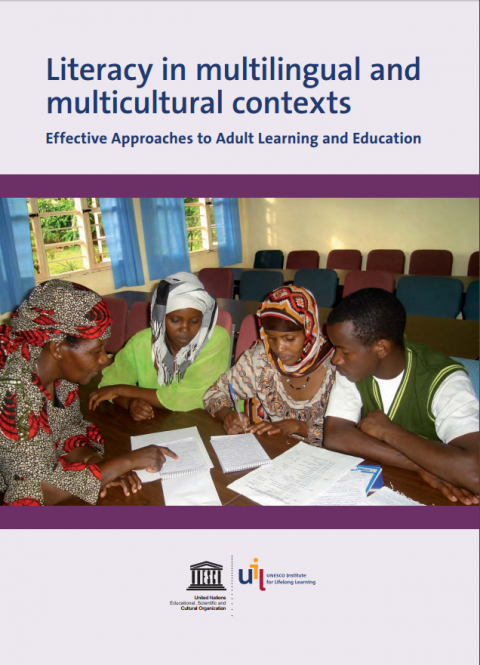 Literacy in multilingual and multicultural contexts: effective approaches to adult learning and education Year of publication: 2016 Author: Ulrike Hanemann, Cassandra Scarpino All of the literacy programmes featured in this publication offer valuable experiences and lessons on how the challenges posed by linguistic and cultural diversity can be productively addressed by harnessing the potential of language and culture as enriching resources in the process of literacy teaching and learning. A major lesson that has emerged over the years is that the use of local languages as the medium of instruction enhances the effectiveness and efficiency of the learning process in developing literacy, numeracy and (second or more) language skills. However, mother tongue-based literacy not only facilitates the learning process, but is also an important symbol of identity, unity and self-determination. It is closely intertwined with culture and local values, wisdom, worldviews and tradition. A number of the featured programmes demonstrate that language and culture in education are highly political. Respect for all languages and cultures, and their equal treatment, can play a critical role in fostering national cohesion. In some cases, this is contributing to rebuilding peace in post-conflict communities. Literacy programmes that contribute to the preservation of linguistic and cultural diversity should, also, be viewed as integral to sustainable development.
  Generation Z: Global Citizenship Survey Year of publication: 2017 Corporate author: Varkey Foundation The Varkey Foundation commissioned Populus to carry out research on a global scale into the attitudes of 15- to 21-year-olds on a variety of ethical, personal, community and political issues. We chose twenty countries to poll: Argentina, Australia, Brazil, Canada, China, France, Germany, India, Indonesia, Israel, Italy, Japan, New Zealand, Nigeria, Russia, South Africa, South Korea, Turkey, the UK and the US. We chose a range of countries that would give a geographic spread, include some of most populous nations, and would also include those that have particular political significance – as rising powers and/or countries that are important in global geopolitics and cultural influence.The first part of the survey asked about young people’s wellbeing, hopes and ambitions – from their relationships and future careers, to their physical and mental health.. The second part focused on their personal, community and religious values – from their attitudes towards abortion, same sex marriage and transgender rights, to the importance of religion in their lives and whether they feel equipped to contribute to their own community. Finally, it covered issues of global citizenship – attitudes towards migrants, the factors that make young people hopeful and fearful for the future, and their views on whether the world is becoming a better or worse place. This is the first time that there has been an international comparative study of the attitudes of young people on these matters. Not only have we asked them how they feel, what their attitudes are, and who influenced them: we have also reflected on what differences and similarities there may be in terms of their wellbeing, fears, hopes and views across the world.With this survey, we do not aim to document the events that loomed large in young people’s lives or the social forces that have shaped their emotions and opinions. That is a huge subject for expert analysis. Rather, we wanted to hold up a mirror to Generation Z and simply record the reflection that they give us – providing some illumination to help us all understand them better. Expert group meeting “youth civic engagement:enabling youth participation in political, social and economic life” 16-17 June 2014 UNESCO Headquarters Paris, France: concept note Year of publication: 2014 Corporate author: UN. Department of Economic and Social Affairs (UN. DESA) From 16-17 June 2014, the Division for Social Policy and Development in the Department of Economic and Social Affairs of the United Nations and UNESCO will organize an Expert Group Meeting at UNESCO Headquarters, Paris, under the theme “Youth Civic Engagement: enabling youth participation in political, social and economic life.” The meeting will bring together experts and representatives of youth organizations, academia, representatives of Member States, United Nations entities, and intergovernmental organizations to discuss the ways in which youth civic engagement can be an enabler for political, social and economic participation, as well as to examine current opportunities and challenges affecting such potential. These topics will be considered under the framework of both the World Programme of Action for Youth1 and of the UN System-Wide Action Plan on Youth which respectively incorporate youth participation and youth civic engagement among their priority areas for action. Peace education in formal schools of West Africa: an implementation guide Year of publication: 2012 Corporate author: West Africa Network for Peacebuilding (WANEP) This guide, first and foremost, seeks to bring hope and provide opportunity for practitioners to use tried and tested techniques to develop capacities of young people to build requisite knowledge and skills to become credible and responsible leaders. It provides both a conceptual and practical framework of peace education and confirms the potential benefits of Peace Education, particularly in the formal sector. It has been developed based on the extensive experience of WANEP’s Peace Education programme across West Africa and this experience has been outlined in great detail throughout the manual. The guide lays emphasis on entry points for developing and initiating Peace Education programmes in schools and provides practical tools for engaging various stakeholders and the wide range of potential roles they can play. In terms of the content of a peace education programme, guidelines are provided on developing a comprehensive programme that integrates effectively key concepts such as Gender and Human Rights. Critical issues of sustainability, resource mobilisation and monitoring and evaluation are covered using practical case studies based on the WANEP experience. The concluding chapter is devoted to addressing some Frequently Asked Questions. This laudable initiative and recommend this guide for adoption by West African states and institutions especially the educational sector as a tool for inculcating a culture of peace and nonviolence amongst children.The guide is divided into six chapters.Chapter 1 consists of introduction and the conceptual definition of basic philosophy that influenced the peace education program of WANEP. It also examines the role of peace education on the psycho social behaviour of youths in West Africa.Chapter 2 highlights WANEP’s guiding principles to the development of its peace education in the sub region and also the basic steps it took to implement its program in the seven (7) pilot states.Chapter 3 looks at how to mobilise resources to sustain the peace education program especially within the context of West Africa.Chapter 4 highlights the challenges that WANEP encountered in implementing the program.Chapter 5 emphasises the importance of monitoring and evaluation for impact and success of a peace education program.Chapter 6 deals with frequently asked questions by interested stakeholders. The education we want: youth advocacy toolkit Year of publication: 2015 Author: James Edleston | Dan Smith, Sumaya Saluja | David Crone | Chernor Bah | Emily Laurie Corporate author: UN Global Education First Initiative - Youth Advocacy Group (YAG) | Plan | A World at School This toolkit is for anyone who believes passionately in the power of education as a force for good in the world and the right for all children to get a good quality education, no matter where they are and what the circumstances. We hope this toolkit will support you to carry out your own advocacy campaign. If you are just beginning to think about taking action on education, you can work your way through the toolkit from start to finish. But you can also dip in to pick up useful hints or activities to help you carry out your existing plans. We know this toolkit doesn’t cover everything you might need and we’ve tried to sign-post you to other resources where possible. Included in here are lots of real stories of change, led by young people, from all over the world. We hope they inspire you. The young global movement for education is growing, and you can be part of it.
  Preventing Violent Extremism through Sport: Technical Guide; Criminal Justice Handbook Series Year of publication: 2020 Corporate author: UN. Office on Drugs and Crime (UNODC) The Technical Guide on Preventing Violent Extremism through Sport, developed in consultation with international experts, recognizes the importance of promoting the well-being of children and youth. It applies an approach that encourages prosocial behaviour and good safeguarding and welfare practices, with particular emphasis on educational and social development measures in line with the United Nations Guidelines for the Prevention of Crime.The guide, addressed mainly to policy makers and implementing organizations, has been carefully designed to support effective integration of sport-based learning in primary prevention frameworks. By adopting a five-zone approach to prevent violent extremism namely safe space, empowerment, resilience, social inclusion and education, it supports informed policy development and a Theory of Change that can shape curriculum design and content. To further support global efforts in preventing violent extremism, UNODC is also developing an e-learning module and a practical tool for trainers that will be published soon and will complement this technical guide.
  Building Back Better: Youth, Power and Planet Year of publication: 2020 Author: Valerie Duffy | Leo Gilmartin | Eva Janssens | Dermot O’Brien Corporate author: National Youth Council of Ireland (NYCI) Building Back Better: Youth, Power and Planet is about power. The understanding of power in youth work is vitally important for the development of young people as they navigate through their lives and society.The aim of this resource is to support young people and youth workers in understanding power, seeing power, claiming power, and activating power. It includes a wealth of background information on concepts around power and terminology, as well as a guide on ‘How to Use this Resource’, activities, stimulus sheets. This toolkit explores the issue of power and helps you make links to the Sustainable Development Goals.It is designed for global educators, youth workers, development education practitioners, trainers, climate activists, changemakers of all shapes and sizes but in particular those working with the current generation of young people.Building Back Better contains 4 main sections:Section 1. Defining PowerSection 2. Seeing PowerSection 3. Claiming PowerSection 4. Activating PowerIt also contains:an introduction to power in theory and in practice 10 activities with interactive exercisesaction power templates for planningstriking visuals, case studies on human development for adapting This was resource was created by the NYCI Youth 2030 programme.
  Belonging to the Homeland and Its Impact on Protecting Young People from Delinquency Year of publication: 2018 Author: Alla Aldeen Mohammed Corporate author: Imam Mohammad Ibn Saud Islamic University The file is a paper on belonging to the homeland and its impact on protecting young people from delinquency. This paper was presented at the conference entitled "The Role of Saudi Universities and Its Impact on Protecting Young People from Groups, Parties and Deviance".
  The Role of Kuwaiti Satellite Channels in Promotion of Citizenship among Kuwaiti Youth Year of publication: 2012 Author: Hassan Al Gharbi Corporate author: Middle East University The focus of the problem that the research dealt with was on the following question: Have public and private Kuwaiti satellite channels contributed to enhancing the concept of citizenship among young Kuwaitis? The researcher adopted a definition of the concept of citizenship among the multiple definitions of this concept, which was tainted by some uncertainty and disagreement. Citizenship in this study "is the awareness of belonging to a geographical area of a specific political and social goals and shared one common culture and political system."