
Resources
Explore a wide range of valuable resources on GCED to deepen your understanding and enhance your research, advocacy, teaching, and learning.
66 Results found
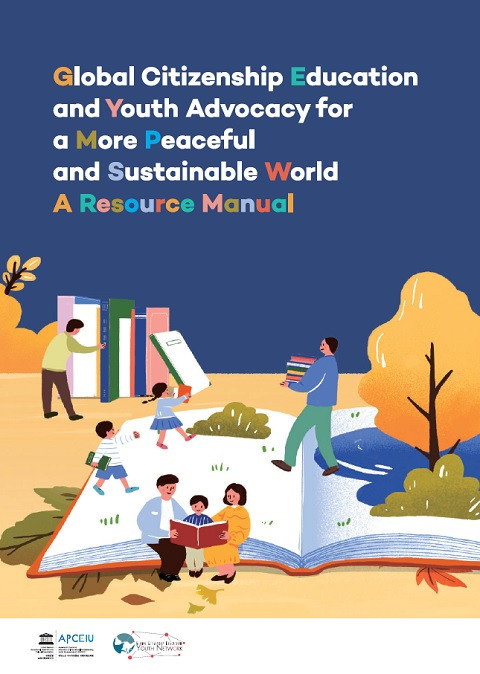 Global Citizenship Education and Youth Advocacy for a More Peaceful and Sustainable World: A Resource Manual Year of publication: 2020 Author: Dylan Wray | Lisa Van Wyk | Rigoberto D. Banta Jr. | Roy Hellenberg | Anna Susarenco | Diego Manrique | Guranda Bursulaia | Noora Elkenawi | Shawgi Ahmed | Tshering Zangmo | Valeriia Moroz Corporate author: APCEIU Since 2016 the Global Citizenship Education (GCED) Youth Network and UNESCO Asia-Pacific Centre of Education for International Understanding(APCEIU) have been working together to support young people to take action to make their communities and the world a better place.This manual, which is the outcome of a joint initiative by the GCED Youth Network and APCEIU, is intended to provide a useful resource for those who teach GCED, for youth organisations that are engaged in advocacy on themes that relate to global citizenship, and those who are supporting youth advocacy.The manual is organized in three main sections: Section 1 focuses on GCED and the teaching of history as a strategy for building a peaceful world.Section 2 provides step by step practical guidelines and ideas for youth advocacy organisations to help them plan advocacy initiatives.Section 3 includes background information and practical ideas for youth advocacy on a series of themes that are relevant to GCED, including empowerment of vulnerable communities, media literacy and peace building. It also considers the role of GCED, and young people, in global crises, using the example of the COVID-19 pandemic, and provides suggestions to help youth advocacy and other organisations to prepare for and respond to such crises
  Youth Advocacy Kit on Global Citizenship Education Year of publication: 2018 Corporate author: APCEIU APCEIU has published the Youth Advocacy Kit on Global Citizenship Education (GCED) in order to provide youth leaders a guideline on advocacy for GCED. Targeting youth activists who currently participate in GCED programmes around the world, the kit offers the overview of GCED and advocacy as well as tips and tools to effectively implement advocacy campaign for GCED in local and global context. Furthermore, by sharing cases of youth advocacy in diverse fields, this kit also provides the real life examples which can be easily referred by youth interested in GCED advocacy. <Table of Contents> Youth Advocacy Kit on GCEDChapter 1 - What is Global Citizenship Education (GCED)?Chapter 2 - What is GCED Advocacy?Chapter 3 - Youth as an Active Agent for GCEDChapter 4 - Sharing Cases of Youth AdvocacyChapter 5 - Youth Initiatives on GCED
 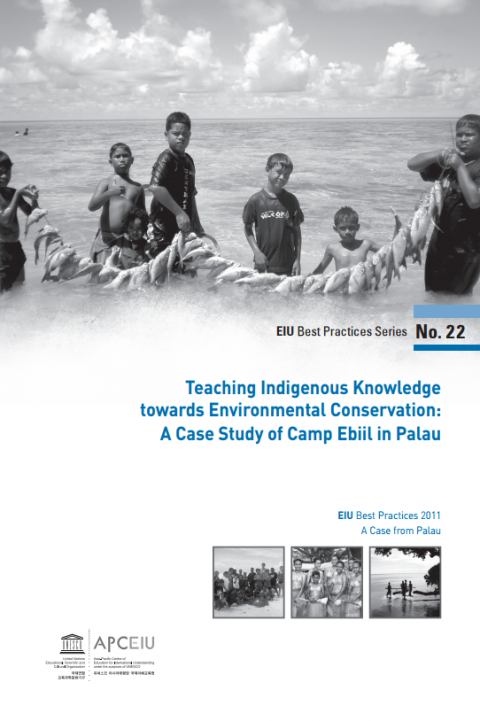 EIU Best Practices Series No. 22: Teaching Indigenous Knowledge towards Environmental Conservation: A Case Study of Camp Ebiil in Palau Year of publication: 2011 Author: Ann Kloulechad Singeo Corporate author: APCEIU This monograph is one of APCEIU's EIU Best Practices Series, which aims to encourage educators, scholars, and activists to implement and share local initiatives on EIU. The Series No.22 introduces a case study of community-based education program from Camp Emiil in Palau that promote protection of one's identity and heritage by teaching the youth with the traditional knowledge. The camp allows young participants to take direct part in fun activities and learning opportunities to immerse in culture and nature. Through such experiential learning, participants become more knowledgeable about ethnic practices and acquire important character building skills and conservation knowledge.
  Because youth perspectives matter: UNESCO toolbox for youth policy and programming Year of publication: 2023 Corporate author: UNESCO <Short summary>Placing trust in youth voicesYoung people fear for their future. Pandemics, conflict, climate change, inequality – these are the issues defining their reality.Yet their potential to provide solutions to the multiple crises is not realized. From low representation and tokenistic approaches, to institutional obstacles to participation and limited civic spaces, young people are disconnected from influencing decisions and actions that affect their lives. They need real opportunities to participate in decision-making and contribute to practical solutions.Policy-makers, public officials and practitioners – as well as development sector and civil society actors – can and should create such opportunities for youth. This Toolbox is a comprehensive go-to resource to make that possible. It is intended to support these stakeholders in designing and implementing effective policies and programmes to address the multidimensional needs of youth at national and local levels.It consists of:• A guide for participatory youth policy design;• Intergenerational dialogue tools on holistic youth development and youth civic engagement; and• A training tool on meaningful youth engagement. Together, we can prove that youth perspectives matter.
  Youth PVE: Preventing Violent Extremism Year of publication: 2020 Corporate author: UNESCO | UN. Office of Counter-Terrorism (UNOCT) Violent extremism threatens the security and fundamental rights of citizens all over the world, and undermines the attempts of many countries to achieve sustainable peace. Many violent extremist organizations work by recruiting disenfranchised youth and inciting them to commit acts of violence. This project focuses on meaningful youth engagement because we believe that enhancing the resilience of young people will prevent their involvement in violent extremism and instead transform them into agents of positive change. We provide a framework for action that mobilizes UNESCO at multiple levels to provide young people with opportunities, knowledge and capacities to foster dialogue and cooperation in furtherance of PVE.
  Enhancing Youth Participation in Urban Governance through City Youth Councils Year of publication: 2023 Corporate author: UNESCO City youth councils offer a formalized arrangement for continuous dialogue with policymakers. They have played a key role in fostering the next generation of leaders and encouraging youth to be contributors and agents to social change and dialogue. UNESCO is publishing this report to ensure that the actions and solutions proposed by youth can be applied and scaled up worldwide. It encourages local governments to create spaces for youth to participate actively and genuinely in decision-making processes.