
Resources
Explore a wide range of valuable resources on GCED to deepen your understanding and enhance your research, advocacy, teaching, and learning.
1,372 Results found
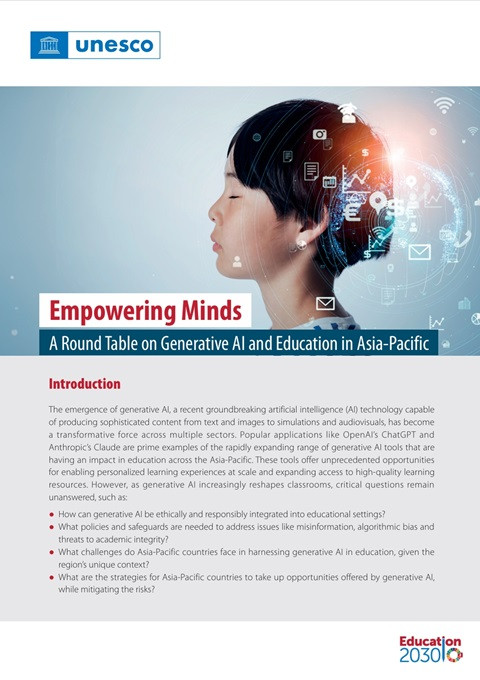 Empowering Minds: A Round Table on Generative AI and Education in Asia-Pacific Year of publication: 2023 Corporate author: UNESCO Bangkok The emergence of generative AI, a recent groundbreaking artificial intelligence (AI) technology capable of producing sophisticated content from text and images to simulations and audiovisuals, has become a transformative force across multiple sectors. Popular applications like OpenAI’s ChatGPT and Anthropic’s Claude are prime examples of the rapidly expanding range of generative AI tools that are having an impact in education across the Asia-Pacific. These tools offer unprecedented opportunities for enabling personalized learning experiences at scale and expanding access to high-quality learning resources. However, as generative AI increasingly reshapes classrooms, critical questions remain unanswered, such as:- How can generative AI be ethically and responsibly integrated into educational settings?- What policies and safeguards are needed to address issues like misinformation, algorithmic bias and threats to academic integrity?- What challenges do Asia-Pacific countries face in harnessing generative AI in education, given the region’s unique context?- What are the strategies for Asia-Pacific countries to take up opportunities offered by generative AI, while mitigating the risks? In response to these questions and emerging challenges in the region, the UNESCO Regional Office in Bangkok (UNESCO Bangkok), in collaboration with The Southeast Asian Ministers of Education Organization (SEAMEO), organized the regional experts meeting on 7-9 November 2023 in Bangkok, Thailand. This hybrid meeting, titled ‘Empowering Minds: A Round Table on Generative AI and Education in Asia-Pacific’, explored the implications of generative AI for teacher training and development. It served as an important platform to leverage opportunities and mitigate risks of generative AI in education across the Asia-Pacific region.
 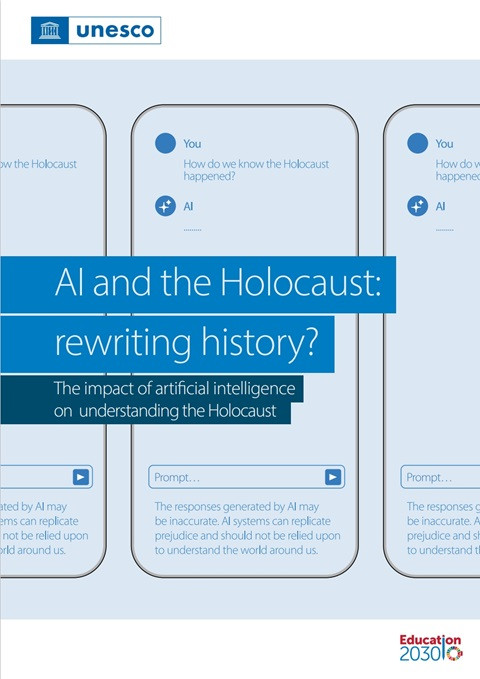 AI and the Holocaust: Rewriting History?; The Impact of Artificial Intelligence on Understanding the Holocaust Year of publication: 2024 Author: Mykola Makhortykh | Heather Mann Corporate author: UNESCO The threats associated with AI on safeguarding the record of the Holocaust are manifold, including the potential for manipulation by malicious actors, the introduction of falsehoods or dissemination of biased information, and the gradual erosion of public trust in authentic records. This paper provides a warning of what is at stake for the preservation of historical truth in a digital era increasingly mediated by AI. It highlights five major concerns:1. AI automated content may invent facts about the Holocaust2. Falsifying historical evidence: Deepfake Technology3. AI models can be manipulated to spread hate speech4. Algorithmic bias can spread Holocaust denial5. Oversimplifying history While there are some benefits to be gained, such as enhanced engagement and interaction opportunities for learners, as well as more efficient data processing capabilities for researchers, to navigate these challenges and capitalize on the benefits, it’s essential for AI designers, policymakers, educators, and researchers to collaborate closely. Only AI systems equipped with robust safeguards and human rights assessments, coupled with an increased focus on developing digital literacy skills, can uphold the integrity of historical truth and ensure the responsible use of artificial intelligence.
 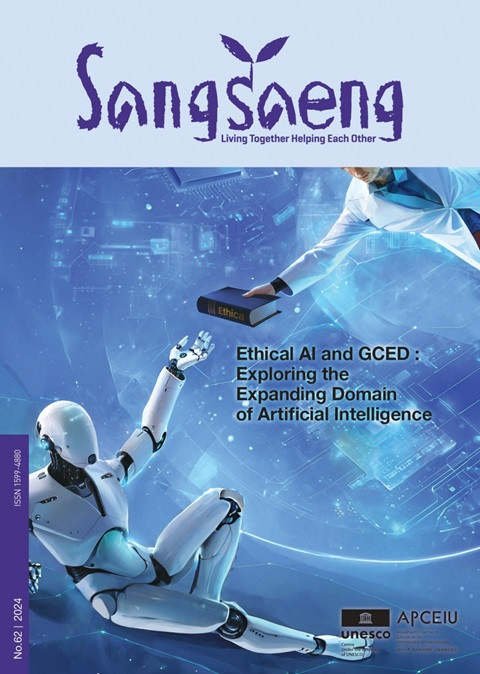 Ethical AI and GCED: Exploring the Expanding Domain of Artificial Intelligence (SangSaeng; No. 62, 2024) Year of publication: 2024 Corporate author: APCEIU The 62nd issue of SangSaeng has been published with the theme of “Ethical AI and GCED: Exploring the Expanding Domain of Artificial Intelligence.” AI has never been as pervasive and influential as it is in today’s rapidly changing world. Despite the convenience and cutting-edge technology AI has offered us, it has the potential to pose a threat to humanity. This is where ethics for AI should come forward. In this regard, this issue will lead readers to the alarming side of AI as well as its future developments, focusing on the importance of GCED and AI ethics in tackling any potential problems. Contents03 Editor's Note 04 Special ColumnEmbracing Change to Cultivate Success — Integrating Global Citizenship Education into Tertiary Education / Dendev Badarch 08 FOCUS: Ethical AI and GCED: Exploring the Expanding Domain of Artificial IntelligenceRole of Ethics in the Era of AI — Protecting and Guiding AI Processes for Humanity to Flourish / Emma Ruttkamp-BloemPaying Attention to AI Ethics — An Avenue for a New Competitive Edge in Business / Myoungshin KimDriving Innovative Education — Balancing Future Possibilities and Ethical Concerns: How GCED Can be Used to Address AI Issues / Angelique Southern 20 Special ReportEmpowering a Climate Generation — From Classrooms to Climate Frontlines: The Transformative Role of Education highlighted at COP28 / Djian Sadadou 22 Best PracticesNavigating an AI Future — Ethical AI and the Importance of Critical Thought / Hannah GrantGLACE Brings the World to a City — Empowering Youth as Global Citizens: Lessons from Navotas City’s Project GLAC / Marco D. MedurandaLowering Eco-Anxiety — Teaching Climate Change Through Media and Information Literacy / Laetitia Legrand 33 GCED YOUTH NETWORK New Wave of Youth Advocacy — Role of AI in Youth Advocacy and its Ethical Implications to Global Citizenship / Oshan M. Gunathilake and Diego Manrique 36 Understanding the Asia Pacific RegionDiscovering Auroville — Where Boundaries Fade, Nature Thrives, and Global Minds Unite / Akanksha Arya 39 Peace in My MemoryHappiness without Violence — Mindanao Peace ForumCelebrates Building a Culture of Peace / Ludivina Borja-DekitPeace Scholar Passes Away Amidst Turbulent Times / Kwang-Hyun KIM 45 Story TimeThe Right Footing — My Life Has Purpose Thanks to Football / Hajar Abulfazl 48 LetterShared Challenges of Global Citizens / Natsuki Nagata 50 APCEIU in Action
 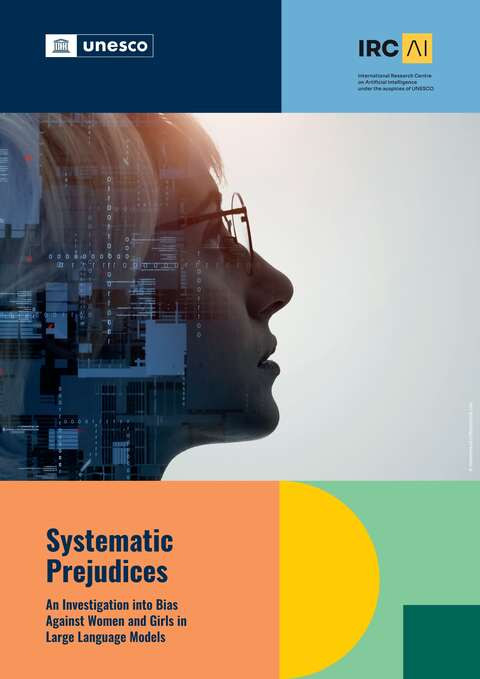 Challenging Systematic Prejudices: An Investigation into Bias Against Women and Girls in Large Language Models Year of publication: 2024 Author: Daniel Van Niekerk | Maria Peréz Ortiz | John Shaw-Taylor | Davor Orlic | Ivana Drobnjak | Jackie Kay | Noah Siegel | Katherine Evans | Nyalleng Moorosi | Tina Eliassi-Rad | Leone Maria Tanczer | Wayne Holmes | Marc Peter Deisenroth | Isabel Straw | Maria Fasli | Rachel Adams | Nuria Oliver | Dunja Mladenić | Urvashi Aneja | Madeleine Janicky Corporate author: UNESCO | International Research Centre on Artificial Intelligence (IRCAI) This study explores biases in three significant large language models (LLMs): OpenAI’s GPT-2 and ChatGPT, along with Meta’s Llama 2, highlighting their role in both advanced decision-making systems and as user-facing conversational agents. Across multiple studies, the brief reveals how biases emerge in the text generated by LLMs, through gendered word associations, positive or negative regard for gendered subjects, or diversity in text generated by gender and culture. The research uncovers persistent social biases within these state-of-the-art language models, despite ongoing efforts to mitigate such issues. The findings underscore the critical need for continuous research and policy intervention to address the biases that exacerbate as these technologies are integrated across diverse societal and cultural landscapes. The emphasis on GPT-2 and Llama 2 being open-source foundational models is particularly noteworthy, as their widespread adoption underlines the urgent need for scalable, objective methods to assess and correct biases, ensuring fairness in AI systems globally.
  Disability Discrimination in the Digital Realm: How the ICRPD Applies to Artificial Intelligence Decision-Making Processes and Helps in Determining the State of International Human Rights Law (Human Rights Law Reivew; Volume. 23, Issue. 3) Year of publication: 2023 Author: Tetyana Krupiy | Martin Scheinin Scholars have identified challenges to protecting individuals from discrimination in contexts where organisations deploy artificial intelligence decision-making processes. While scholarship on ‘digital discrimination’ is growing, scholars have paid less attention to the impact of the use of artificial intelligence decision-making processes on persons with disabilities. This article posits that while the use of artificial intelligence technology can be beneficial for some purposes, its deployment can also construct a disability. The article demonstrates that the Convention on the Rights of Persons with Disabilities can be interpreted in a manner that confers a wide variety of human rights on persons with disabilities in the context when entities deploy artificial intelligence decision-making processes. The article proposes a test for digital discrimination based on disability and shows how it can be incorporated into the treaty through legal interpretation. Thereafter, it moves to developing an analogous general test for digital discrimination under international human rights law, applicable beyond a catalogue of protected characteristics.
  The Effects of AI on the Working Lives of Women Year of publication: 2022 Author: Clementine Collett | Gina Neff | Livia Gouvea Gomes Corporate author: UNESCO | Inter-American Development Bank | Organisation for Economic Co-operation and Development (OECD) The use of AI technologies will affect women’s opportunities for work, and their position, status and treatment in the workplace. Around the globe, women in the labour force earn less than men, spend more time undertaking unpaid child- and elder-care jobs, hold fewer senior positions, participate less in science, technology, engineering and mathematics (STEM) fields, and tend to hold more precarious jobs overall. In harnessing AI, governments, institutions and companies must narrow gender gaps rather than perpetuate or exacerbate them. This report, by the IDB, OECD and UNESCO, outlines current knowledge of the impact that AI systems have on women’s opportunities for work, and their position, treatment and status in the workforce. It does so by exploring how AI is used within and outside the workplace, and how it could be used in the future. It looks at the potential impact of new and emerging AI technologies on the skills that employers will require, on how women look for and are hired for jobs, and on how jobs are structured through automated monitoring and oversight. The report maps the opportunities and challenges that AI presents for the working lives of women and highlights the complexities that varying national and regional contexts present for understanding the impact of AI on the work of women. The report also notes that current research does not offer a complete or definite picture of how AI impacts the working lives of women and calls for further research and analysis in this area.
  AI and the Future of Education: Disruptions, Dilemmas and Directions Year of publication: 2025 Corporate author: UNESCO Artificial intelligence (AI) is reshaping the way we learn, teach and make sense of the world around us, but it is doing so unequally. While one-third of humanity remains offline, access to the most cutting-edge AI models is reserved for those with subscriptions, infrastructure and linguistic advantage.These disparities not only restrict who can use AI, but also determine whose knowledge, values and languages dominate the systems that increasingly influence education.This anthology explores the philosophical, ethical and pedagogical dilemmas posed by disruptive influence of AI in education. Bringing together insights from global thinkers, leaders and changemakers, the collection challenges assumptions, surfaces frictions, provokes contestation, and sparks audacious new visions for equitable human-machine co-creation.Covering themes from dismantling outdated assessment systems to cultivating an ethics of care, the 21 think pieces in this volume take a step towards building a global commons for dialogue and action, a shared space to think together, debate across differences, and reimagine inclusive education in the age of AI.Building on UNESCO’s Recommendation on the Ethics of AI, its Guidance on Generative AI in Education and Research and its twin AI competency frameworks for teachers and students, such a global commons can direct collective sense-making and bold reimagination around curricula, pedagogy, governance and policy with human rights, justice and inclusion at its core.
  Responsible AI in Africa: Challenges and Opportunities Year of publication: 2023 Corporate author: Palgrave Macmillan This open access book contributes to the discourse of Responsible Artificial Intelligence (AI) from an African perspective. It is a unique collection that brings together prominent AI scholars to discuss AI ethics from theoretical and practical African perspectives and makes a case for African values, interests, expectations and principles to underpin the design, development and deployment (DDD) of AI in Africa. The book is a first in that it pays attention to the socio-cultural contexts of Responsible AI that is sensitive to African cultures and societies. It makes an important contribution to the global AI ethics discourse that often neglects AI narratives from Africa despite growing evidence of DDD in many domains. Nine original contributions provide useful insights to advance the understanding and implementation of Responsible AI in Africa, including discussions on epistemic injustice of global AI ethics, opportunities and challenges, an examination of AI co-bots and chatbots in anAfrican work space, gender and AI, a consideration of African philosophies such as Ubuntu in the application of AI, African AI policy, and a look towards a future of Responsible AI in Africa.
  Missing Links in AI Governance Year of publication: 2023 Corporate author: UNESCO | Mila – Quebec Artificial Intelligence Institute Over the next decade, Artificial Intelligence (“AI”) will continue to significantly impact societies. While these scientific and technological advances take place at an extraordinary pace, it is necessary that we simultaneously stimulate a global and inclusive conversation around their development and governance. It is in this context that Mila and UNESCO join forces to steer a collective work to identify and understand missing links in AI governance. This publication is a compilation of 18 selected submissions from a global open call for proposals launched in 2021. The works featured cross disciplinary and geographical boundaries, and include the perspectives of academics, civil society representatives, and innovators to help shift the conversation on AI from what we do know and foresee to what we do not, the missing links. The topics covered are wide ranging, including AI and Indigenous rights, Deepfakes, Third-Party Audits of AI Systems, AI alignment with SDGs, and the centralization of decision-making power AI allows. Policymakers and civil society members will benefit from the insightful perspectives brought forward to face the immense task they are presented with – which is to ensure the development of AI in a human-centred, responsible and ethical way, in accordance with human rights. Angles morts de la gouvernance de l’IA Year of publication: 2023 Corporate author: Organisation des Nations Unies pour l'éducation, la science et la culture (UNESCO) | Mila – Quebec Artificial Intelligence Institute Au cours de la prochaine décennie, l’intelligence artificielle (IA) continuera d’avoir une influence et un effet considérables sur nos sociétés. Alors que ces avancées scientifiques et technologiques se succèdent à un rythme soutenu, il est essentiel de poursuivre et accélérer la conversation mondiale et inclusive sur leur développement et leur gouvernance.C’est dans ce contexte que Mila et l’UNESCO unissent leurs forces pour mener un travail collectif pour cerner des questions importantes et novatrices quant à la gouvernance de l’IA. La présente publication est une compilation de 18 chapitres sélectionnés à la suite d’un appel à contributions lancé mondiale-ment en 2021. Les articles présentés traversent les frontières disciplinaires et géographiques en plus d’inclure différentes perspectives, incluant celles d’universitaires, de membres de la société civile et d’innovateurs et innovatrices. Cette publication vise à influencer la conversation sur l’IA pour que celle-ci porte moins sur ce que nous savons déjà que sur ce qui échappe à notre regard : les angles morts de l’IA. Les sujets abordés sont donc variés et incluent notamment la perspective du droit international et des droits des peuples autochtones, les audits des systèmes d’IA, l’alignement de ces technologies avec les objectifs de développement durable des Nations Unies et la centralisation du pouvoir décisionnel que permet cette technologie de rupture.Les membres des milieux politiques, de la recherche et de la société civile engagés dans cette conversation mondiale sur l’IA bénéficieront des perspectives présentées pour faire face à l’immense tâche qui leur incombe : assurer un développement de l’IA qui soit éthique, inclusif et conforme aux droits humains.« Les guerres prenant naissance dans l’esprit des hommes et des femmes, c’est dans l’esprit des hommes et des femmes que doivent être élevées les défenses de la paix »18 propositions sélectionnées offrant une approche pluraliste, informée et critique de la gouvernance de l’IA.