
Resources
Explore a wide range of valuable resources on GCED to deepen your understanding and enhance your research, advocacy, teaching, and learning.
1,372 Results found
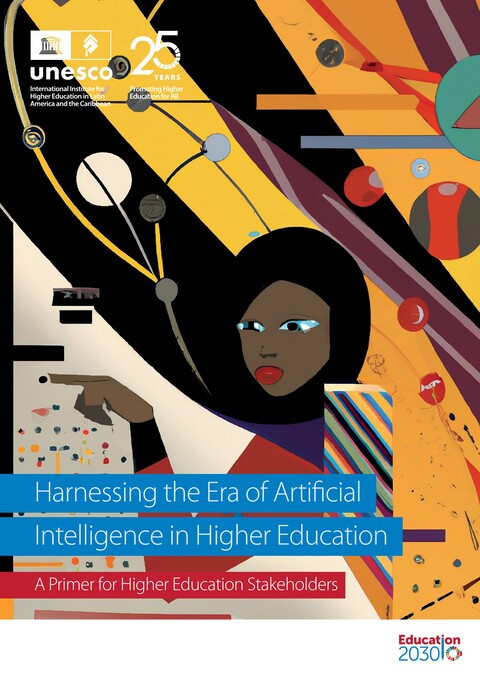 Harnessing the Era of Artificial Intelligence in Higher Education: A Primer for Higher Education Stakeholders Year of publication: 2023 Author: Bosen Lily Liu | Diana Morales | Jaime Roser-Chinchilla | Emma Sabzalieva | Arianna Valentini | Daniele Vieira do Nascimento | Clarisa Yerovi Corporate author: UNESCO | UNESCO International Institute for Higher Education in Latin America and the Caribbean (IESALC) The International Institute for Higher Education in Latin America and the Caribbean (UNESCO IESALC) is one of UNESCO’s key education-focused institutes and is the only institute in the United Nations with a specific mandate for higher education. Taking a holistic and integrated intersectoral and cross-sectoral approach to higher education, UNESCO IESALC provides support to Member States through policy-driven and action-oriented research and publications, capacity development, training, advocacy and networking. Following the release of a Quick Start Guide on using ChatGPT and Artificial Intelligence (AI) in higher education, UNESCO IESALC is pleased to offer to the wider community of higher education stakeholders worldwide this Primer on AI and higher education. Providing information and tips for developing further thinking and policies related to the use of AI processes and outcomes in higher education institutions, the Primer is a comprehensive and comprehensible introduction to AI. It also serves as a practical tool for guidance and reference with recommendations for its use in higher education. Oportunidades y desafíos de la era de la inteligencia artificial para la educación superior: Una introducción para los actores de la educación superior Year of publication: 2023 Author: Bosen Lily Liu | Diana Morales | Jaime Roser-Chinchilla | Emma Sabzalieva | Arianna Valentini | Daniele Vieira do Nascimento | Clarisa Yerovi Corporate author: Organización de las Naciones Unidas para la Educación, la Ciencia y la Cultura (UNESCO) | UNESCO International Institute for Higher Education in Latin America and the Caribbean (IESALC) El Instituto Internacional de la UNESCO para la Educación Superior en América Latina y el Caribe (UNESCO IESALC) es uno de los institutos clave de la UNESCO centrado en la educación y es el único instituto de las Naciones Unidas con un mandato específico para la educación superior. Adoptando un enfoque holístico e integrado de manera intersectorial y transectorial de la educación superior, el IESALC presta apoyo a los Estados miembros mediante investigaciones y publicaciones orientadas a la formulación de políticas y a la acción, al desarrollo de capacidades, la formación, la abogacía y la creación de redes. Tras la publicación de una Guía de inicio rápido sobre el uso de ChatGPT y la Inteligencia Artificial (IA) en la educación superior, UNESCO IESALC se complace en ofrecer a la comunidad en general interesada en la educación superior global este Manual en IA y educación superior. Proporcionando información y consejos para el desarrollo de pensamiento y de políticas relacionadas con el uso de la IA en las instituciones de educación superior, este Manual es una introducción comprensible y exhaustiva a la IA. También sirve como herramienta práctica de orientación y referencia con recomendaciones para su uso en la enseñanza superior.
  Learning About Human Rights in the Primary School Year of publication: 2013 Corporate author: Amnesty International UK This booklet provides a sample of our human rights education resources produced for primary schools. It helps provide pupils with an understanding of their own human rights and the values and attitudes that underpin them. It will help to foster attitudes of respect and an appreciation of the uniqueness of each individual. Pupils will also develop skills to enable them to take action to defend human rights.You will find a set of 10 interactive lessons for children – five for age 5+ (England and Northern Ireland: Key Stage 1; Wales: Foundation Phase; Scotland: Early and First Level) and five for age 7-11 (England, Nothern Ireland and Wales: Key Stage 2; Scotland: Second Level). Please photocopy and adapt these exercises for your own classroom use.All the activities are designed to encourage pupils to take a basic starting point, often based on something close to home or an event or situation they’ve experienced or can relate to, and then develop it. Pupils are then invited to expand their understanding beyond themselves and to begin to think outwards and towards others, whether locally, nationally or globally.The final activity, Taking action for human rights, explains how schools can sign up to the Junior Urgent Action Network. It’s an opportunity for children to become more actively involved with Amnesty International’s human rights work through our letter-writing campaign. In addition, you can download free resources on a range of human rights issues and order free posters for your school from www.amnesty.org.uk/resources-schools.
 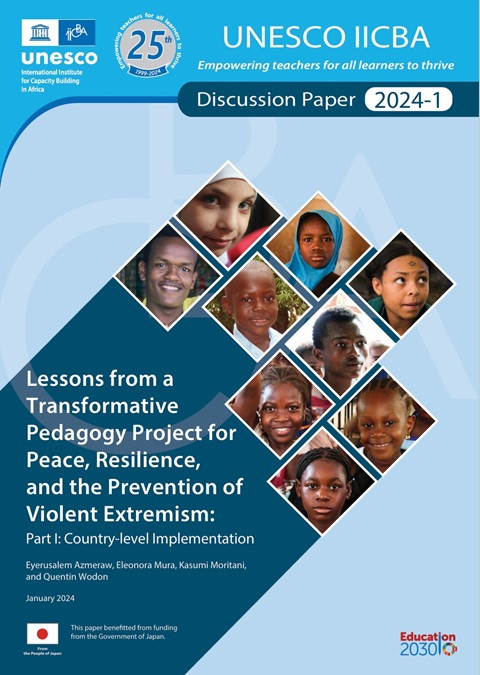 Lessons from a Transformative Pedagogy Project for Peace, Resilience, and the Prevention of Violent Extremism: Part I; Country-Level Implementation Year of publication: 2024 Author: Eyerusalem Azmeraw | Quentin Wodon | Eleonora Mura | Kasumi Moritani Corporate author: UNESCO International Institute for Capacity-Building in Africa (IICBA) From 2017 to 2022, UNESCO’s International Institute for Capacity Building in Africa (IICBA) led a series of projects for peacebuilding and the prevention of violent extremism through education with support from the Government of Japan. This two-part paper draws lessons from the projects. The first part of the paper briefly explains the transformative pedagogy approach that guided project implementation and provides examples of changes that were implemented at the country level under the projects. The analysis is qualitative, with the aim being to outline, through country examples, what can be achieved through such projects. Lessons on factors contributing to impact are also outlined.
  “I Don’t Have a Gender, Consciousness, or Emotions. I’m Just a Machine Learning Model” Year of publication: 2023 Corporate author: UNESCO | International Research Centre on Artificial Intelligence (IRCAI) An introduction to a forthcoming Gender bias in Artificial Intelligence report coming out on March 8, 2024. As we stand on the precipice of a technological revolution driven by Artificial Intelligence (AI), it is imperative to ensure that this future is shaped equitably, representing all genders. With this essay we are excited to announce our forthcoming in-depth report on Gender and Artificial Intelligence in a partnership between IRCAI and UNESCO, set for release on March 8, 2024. As we prepare for this milestone event, we extend an invitation to experts, scholars, and all interested stakeholders to join us in our research.
  The UNESCO Recommendation on the Ethics of AI: Shaping the Future of Our Societies Year of publication: 2023 Corporate author: German Commission for UNESCO | Netherlands National Commission for UNESCO | Slovenian National Commission for UNESCO The UNESCO commissions of Germany, the Netherlands and Slovenia with the support of IRCAI have jointly published a brochure on the UNESCO recommendation on the ethics of artificial intelligence. It summarizes the most important content in a compact manner and presents the central demands from the areas of health, culture, the environment, gender equality as well as education and research. The recommendation with its diverse topics is not only relevant for political experts, but it offers one for various areas of application of the ethical framework and thus serves as an orientation for dealing with AI in general. The brochure is available for the wider public in a number of formats including the original Adobe InDesign file that allows translations to be inserted and format pages, resulting in new versions of the brochure. Therefore, we strongly encourage all UNESCO Commissions from across all UNESCO regions Africa, Arab States, Asia and the Pacific, Europe and North America, Latin America and the Caribbean to use the text in the basic files and translate the content into their own languages, including using the graphic file to setup their own designs of the brochure.
  Global Media and Information Literacy Assessment Framework: Country Readiness and Competencies Year of publication: 2013 Corporate author: UNESCO The MIL Assessment Framework can foster lifelong learning initiatives by building on the relationship between information, media, digital, and ICT literacies, along with societal transformations, education, workforce, policy and decision making processes, economic growth and democracy. The overall goal of the publication is to guide UNESCO’s Member States throughout the assessment of country readiness and competencies regarding the media and information literacy of citizens, in particular teachers in service and in training. The document is particularly aimed at the following stakeholders: policy makers and decision makers; national officers responsible for statistical data collection and analysis; educational policy makers and planners working in formal and informal education settings; teacher training institutions and teachers. It is also of relevance to the professional information and communication community, and has wide applicability for civil society at large.
  Connected: An Introduction to Digital Media Literacy Year of publication: 2020 Corporate author: Webwise | Professional Development Service for Teachers (PDST) Connected comprises five modules exploring young people’s rights and responsibilities online, emerging digital technologies and topics including big data and the data economy, deep fakes, false information and online wellbeing. The five modules are:1. My Online Wellbeing2. News, Information and Problems of False Information3. Big Data & the Data Economy4. My Rights Online5. Publishing Online - Group ProjectThe programme is mapped to the Junior Cycle Digital Media Literacy Short Course and will give students an understanding of the role of digital technologies and will help students develop key digital media literacy skills to responsibly navigate the online environment.
  How to Understand Misinformation, Disinformation and Malinformation Year of publication: 2020 Corporate author: Shout Out UK | U.S. Embassy London | Association for Citizenship Teaching (ACT) We live in a world where information is very easy to fabricate. Now more than ever, media literacy (the ability to critically analyse information) is critical for us as citizens and for our democracy to function. This video explains the difference between Misinformation, Disinformation and Malinformation and presents you with some examples! This video is part of a resource pack created and designed by Shout Out UK, supported by the US Embassy in London and in collaboration with the Association For Citizenship Teaching.For more info: https://www.shoutoutuk.org/media-literacy/
  Information Neighbourhoods Year of publication: 2020 Corporate author: Shout Out UK | U.S. Embassy London | Association for Citizenship Teaching (ACT) We live in a world where information has a variety of purposes. So how can you identify what each type of information is trying to do? Now more than ever, media literacy (the ability to critically analyse information) is critical for us as citizens and for our democracy to function. This video explains what Information neighbourhoods exist and how to identify them.