
Resources
Explore a wide range of valuable resources on GCED to deepen your understanding and enhance your research, advocacy, teaching, and learning.
1,366 Results found
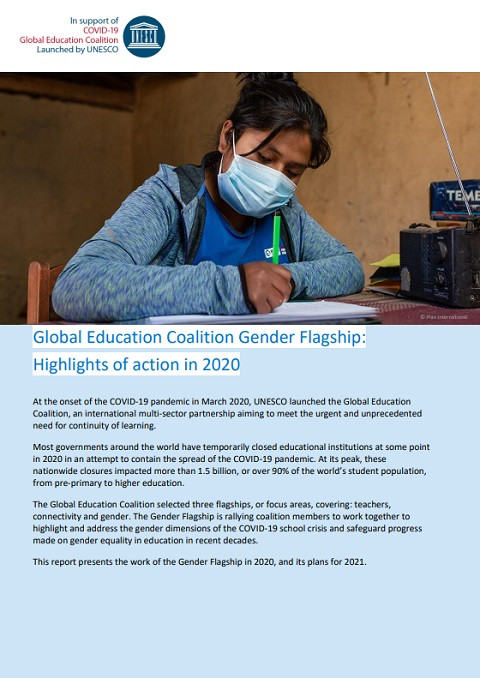 Global Education Coalition Gender Flagship: Highlights of Action in 2020 Year of publication: 2021 Corporate author: UNESCO | Global Education Coalition At the onset of the COVID-19 pandemic in March 2020, UNESCO launched the Global Education Coalition, an international multi-sector partnership aiming to meet the urgent and unprecedented need for continuity of learning.Most governments around the world have temporarily closed educational institutions at some point in 2020 in an attempt to contain the spread of the COVID-19 pandemic. At its peak, these nationwide closures impacted more than 1.5 billion, or over 90% of the world’s student population, from pre-primary to higher education. The Global Education Coalition selected three flagships, or focus areas, covering: teachers, connectivity and gender.The Gender Flagship is rallying coalition members to work together to highlight and address the gender dimensions of the COVID-19 school crisis and safeguard progress made on gender equality in education in recent decades.This report presents the work of the Gender Flagship in 2020, and its plans for 2021.
  Artificial Intelligence and Gender Equality: Key Findings of UNESCO’s Global Dialogue Year of publication: 2020 Corporate author: UNESCO The purpose of the UNESCO’s Dialogue on Gender Equality and AI was to identify issues, challenges, and good practices to help: Overcome the built-in gender biases found in AI devices, data sets and algorithms; Improve the global representation of women in technical roles and in boardrooms in the technology sector; and Create robust and gender-inclusive AI principles, guidelines and codes of ethics within the industry. This Summary Report sets forth proposed elements of a Framework on Gender Equality and AI for further consideration, discussion and elaboration amongst various stakeholders. It reflects experts’ inputs to the UNESCO Dialogue on Gender Equality and AI, as well as additional research and analysis. This is not a comprehensive exploration of the complexities of the AI ecosystem in all its manifestations and all its intersections with gender equality. Rather, this is a starting point for conversation and action and has a particular focus on the private sector. It argues for the need to 1. Establish a whole society view and mapping of the broader goals we seek to achieve in terms of gender equality;2. Generate an understanding of AI Ethics Principles and how to position gender equality within them; 3. Reflect on possible approaches for operationalizing AI and Gender Equality Principles; and4. Identify and develop a funded multi-stakeholder action plan and coalition as a critical next step.
  UNESCO Women for Ethical AI: Outlook Study on Artificial Intelligence and Gender Year of publication: 2024 Corporate author: UNESCO The gender chapter of the UNESCO Recommendation on the Ethics of AI is a concrete commitment by 194 Member States to advance gender equality in the AI ecosystem. To track progress in the implementation of the gender provisions of UNESCO’s Recommendation, and to assess the impacts of AI on gender equality, the UNESCO Women for Ethical AI (W4EAI) Platform has been established. This report advances the workstream through evidence-based insights in three critical areas: women’s participation in AI development and deployment, the inclusion of gender equality concerns in AI governance and the impact of AI on gender equality. It highlights the significant underrepresentation of women in AI, the lack of gender-disaggregated data, and the compounded challenges women face in the field. The report also addresses the neglect of gender dimensions in AI policy, the risks posed by AI systems to women, and the need for responsible and ethical AI governance to promote gender equality. Finally, it outlines actionable recommendations to enhance gender equality through and in AI, emphasizing the importance of comprehensive data collection, targeted interventions, and inclusive policy-making.
  Elimination of Racial Discrimination, Racial Hatred and Racial Hate Crimes In the World (General Conference; 40th session) Year of publication: 2019 Corporate author: UNESCO At its 207th session, in decision 207 EX/Decision 49, the Executive Board decided to inscribe this item on the agenda of the 40th session of the General Conference. The document underscores that racial discrimination, incitement to racial hatred and racial hate crimes represent a threat for all peoples and the international community. With that in mind, the Director-General is requested to strengthen UNESCO’s substantive contribution to the fight against racism, racial discrimination, xenophobia, and related intolerance and to report to the Executive Board, at its 210th session, on the progress made in this matter. Élimination de la discrimination raciale, de la haine raciale et des crimes motivés par la haine raciale dans le monde (Conférence générale; 40e session) Year of publication: 2019 Corporate author: Organisation des Nations Unies pour l'éducation, la science et la culture (UNESCO) À sa 207e session, par sa décision 207 EX/49, le Conseil exécutif a décidé d’inscrire ce point à l’ordre du jour de la 40e session de la Conférence générale. Le document souligne le fait que la discrimination raciale, l’incitation à la haine raciale et les crimes motivés par la haine raciale constituent une menace pour tous les peuples et pour la communauté internationale. Dans cette perspective, la Directrice générale est appelée à renforcer la contribution réelle de l’UNESCO à la lutte contre le racisme, la discrimination raciale, la xénophobie et l’intolérance qui y est associée, et de faire rapport au Conseil exécutif, à sa 210e session, des progrès accomplis à cet égard. Eliminación de la discriminación racial, el odio racial y los crímenes de odio racial en el mundo (Conferencia general; 40a reunión) Year of publication: 2019 Corporate author: Organización de las Naciones Unidas para la Educación, la Ciencia y la Cultura (UNESCO) En su decisión 207 EX/49, adoptada en su 207a reunión, el Consejo Ejecutivo decidió incluir este punto en el orden del día de la 40a reunión de la Conferencia General. El presente documento pone de relieve que la discriminación racial, la incitación al odio racial y los crímenes de odio racial constituyen una amenaza para todos los pueblos y para la comunidad internacional. Teniendo esto presente, se pide a la Directora General que refuerce la contribución sustantiva de la UNESCO a la lucha contra el racismo, la discriminación racial, la xenofobia y las formas conexas de intolerancia, y que informe al Consejo Ejecutivo, en su 210a reunión, sobre los progresos realizados al respecto. Ликвидация расовой дискриминации, расовой ненависти и преступлений на почве расовой ненависти во всем мире (Генеральная конференция; 40-я сессия) Year of publication: 2019 Corporate author: Организация Объединенных Наций по вопросам образования, науки и культуры (UNESCO) На своей 207-й сессии Исполнительный совет в решении 207 EX/49 постановил включить данный пункт в повестку дня 40-й сессии Генеральной конференции. В настоящем документе отмечается, что расовая дис- криминация, подстрекательство к расовой ненависти и преступления на почве расовой ненависти представляют собой угрозу для всех народов и международного сообщества. С учетом этого Генераль- ному директору предлагается укрепить содержательный вклад ЮНЕСКО в борьбу с расизмом, расовой дискриминацией, ксенофо- бией и связанной с ними нетерпимостью и представить Исполнитель- ному совету на его 210-й сессии доклад о достигнутых в данной обла- сти результатах. القضاء على التمييز العنصري والكراهية العنصرية والجرائم الناجمة عن الكراهية العنصرية في العالم Year of publication: 2019 Corporate author: منظمة الأمم المتحدة للتربية والعلم والثقافة (UNESCO) تؤكد الوثيقة أنأشكالالتمييز العنصري والتحريض على الكراهية العنصرية والجرائم الناجمة عن الكراهية العنصرية تمثلًﺗﻬديدالكلالشعوب واﻟﻤﺠتمع الدوليبرمتهطلب ُ. ومن هذا المنطلق، يمن المديرة العامة تعزيز مساهمة اليونسكو الجوهرية في مكافحة العنصرية والتمييز العنصريوكراهية الأجانبان دور ّوما يتعلق ﺑﻬا من تعصب، وموافاة اﻟﻤﺠلس التنفيذي، إبته العاشرة بعد المائتين، بمعلوماتعن التقدم المحرز في هذا الصدد. 消除世界上的种族歧视、种族仇恨和种族仇恨犯罪 Year of publication: 2019 Corporate author: 联合国教科文组织 (UNESCO) 本文件强调,种族歧视、煽动种族仇恨和种族仇恨犯罪对各国人民和国际社会构成威胁。考虑到这一点,兹要求总干事加大教科文组织对打击种族主义、种族歧视、仇外心理及相关不容忍行为的实质性贡献,并向执行局第二一〇届会议报告在这一事项上取得的进展。
  Best Practices of Online Learning in COVID-19 Year of publication: 2020 Author: Odelia Younge | Kristen Franklin | Dan Foreman | John Seylar | Angela Hardy | Windy Lopez-Aflitto | Missy Bellin | Cricket Fuller | My Nguyen | Vicky Masson | Wrendi McDavid | Jordana McCudden | Karin Bradley | Rachael Wilcox | K. D. Meucci | Jessica Bibbs-Fox | Kristy Carter | Grace Angel | Jiyeon Hong | Sanghyeon Choi | Kwonyoung Lee | Seokhyeon Seo | Seungyeon Kim | Gahyeon Jeon | Yooncheol Shin | Myungwoo Cho | Jiwon Lim | Junyoung Kim Corporate author: Digital Promise | Korea Education and Research Information Service (KERIS) This book introduces teaching strategies that developed as a response to the pandemic and provides some example cases from classes in both U.S. and Korea.