
Resources
Explore a wide range of valuable resources on GCED to deepen your understanding and enhance your research, advocacy, teaching, and learning.
1,329 Results found
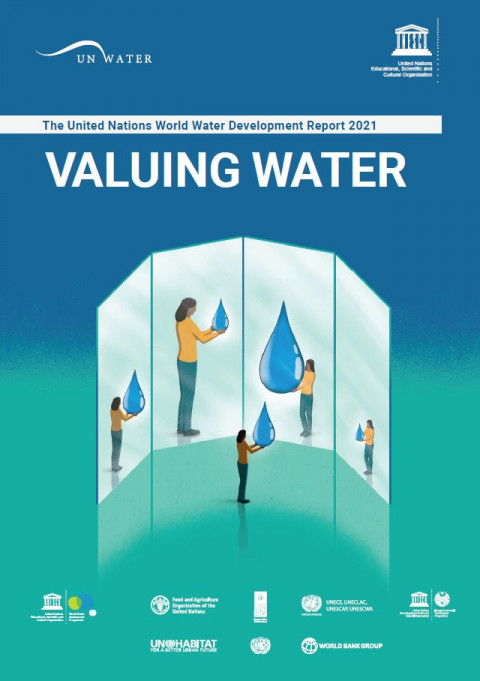 The United Nations World Water Development Report 2021: Valuing Water Year of publication: 2021 Corporate author: UNESCO World Water Assessment Programme (WWAP) The 2021 edition of the United Nations World Water Development Report focuses on valuing water. There is enough water for all provided we use and manage it efficiently. But we don’t. We invest too little, and ineffectively. We use too much water, creating scarcities. Quality is suffering and so is the environment.The value we place on water varies, depending upon who is using it, and why. Value can be a guide to what our goals should be, what actions are needed, and where we should invest. Many of our problems arise because we don’t value water highly enough; all too often water is not valued at all.This report explains various approaches to valuing water for environmental considerations, water-related infrastructure, drinking water, sanitation and hygiene. It looks at valuation issues in food and agriculture, business, industry, energy and financing. And it highlights the perspectives of different value systems and cultures, and associated social and gender-based considerations.
  Address by Irina Bokova, Director-General of UNESCO, on the occasion of the conference: Creating Sustainable Society of Peace: A Legacy of King Bhumibol Adulyadej of Thailand Year of publication: 2017 Corporate author: UNESCO. Director-General, 2009-2017 (Bokova, I.G.) This address was delivered by Irina Bokova, Director-General of UNESCO, on the occasion of the conference: Creating Sustainable Society of Peace: A Legacy of King Bhumibol Adulyadej of Thailand; UNESCO, 26 September 2017.
  Concept note for the 2020 Global education monitoring report on inclusion Year of publication: 2018 In line with its mandate, the 2020 GEM Report will assess progress towards Sustainable Development Goal 4 (SDG 4) on education and its ten targets, as well as other related education targets in the SDG agenda.Echoing the overall orientation in the SDGs to “leave no one behind”, this year's Report will also take an in-depth look at inclusion and education. Inclusion is central in the formulation of SDG 4 but is also taken up in other targets in the goal, notably targets 4.5 on gender equality and 4.a on learning environments. Responding to this emphasis, the 2020 GEM Report will analyse policies the world over and present evidence on the different elements of education systems that can support inclusion, such as laws and policies, governance and finance, curricular and learning materials, teachers, school infrastructure, school selection and parental and community views.The Report will focus on the barriers faced by all learners, especially those with overlapping characteristics that make them particularly vulnerable to exclusion. It will also take an in-depth look at people with disabilities, a group whose particular challenges gave rise to the inclusion debate. The Report will look at a range of indicators measuring inclusion in education using both quantitative and qualitative data. The analysis will be based on geographically balanced evidence, and will pay special attention to contexts where disadvantaged children might be particularly at risk of exclusion from education, such as in situations of conflict.
  Artificial intelligence in education: challenges and opportunities for sustainable development Year of publication: 2019 Author: Pedró, Francesc | Subosa, Miguel | Rivas, Axel | Valverde, Paula Artificial Intelligence is a booming technological domain capable of altering every aspect of our social interactions. Ineducation, AI has begun producing new teaching and learning solutions that are now undergoing testing in differentcontexts. This working paper, written for education policymakers, anticipates the extent to which AI affects the education sector to allow for informed and appropriate policy responses. This paper gathers examples of the introduction of AI in education worldwide, particularly in developing countries, discussions in the context of the 2019 Mobile Learning Week and beyond, as part of the multiple ways to accomplish Sustainable Development Goal 4, which strives for equitable, quality education for all. First, this paper analyses how AI can be used to improve learning outcomes, presenting examples of how AI technology can help education systems use data to improve educational equity and quality in the developing world. Next, thepaper explores the different means by which governments and educational institutions are rethinking and reworking educational programmes to prepare learners for the increasing presence of AI in all aspects of human activity. Thepaper then addresses the challenges and policy implications that should be part of the global and local conversations regarding the possibilities and risks of introducing AI in education and preparing students for an AI-powered context. Finally, this paper reflects on future directions for AI in education, ending with an open invitation to create new discussions around the uses, possibilities and risks of AI in education for sustainable development.
  Bridge Zambia Project Report Year of publication: 2019 Corporate author: Korean National Commission for UNESCO | Zambia National Commission for UNESCO The Bridge Zambia Project (the Project) has been implemented jointly between the Korean National Commission for UNESCO (KNCU) and its partners in Zambia since October 2010. In March 2019, KNCU’s involvement in the Project will come to an end and Zambia will take over full responsibility for the Project as it goes forward. The Project has supported grassroots activities through the establishment of a Community Learning Centre (CLC), which acts as a hub of community-led development activities in non-formal education. The Project has mobilized and empowered communities and local leadership to take charge of non-formal education programmes with the aim of assisting Zambia to attain UNESCO’s Education for All goals and UN Sustainable Development Goal 4 (SDG 4), concerning education quality.
 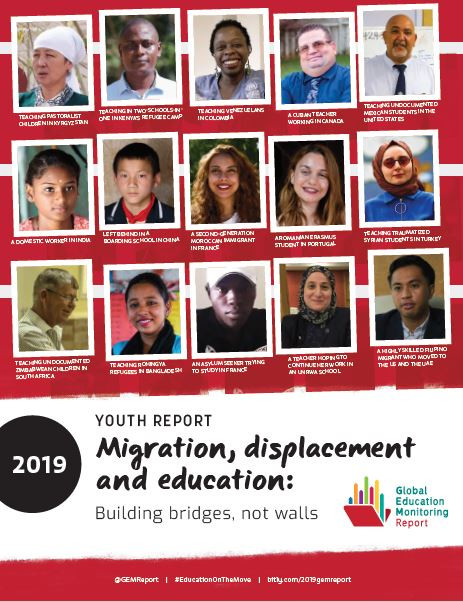 Migration, displacement and education: building bridges, not walls; Global education monitoring report, youth report, 2019 Year of publication: 2018 Corporate author: Global Education Monitoring Report Team The Education 2030 Incheon Declaration and Framework for Action specifies that the mandate of the Global Education Monitoring Report is to be ‘the mechanism for monitoring and reporting on SDG 4 and on education in the other SDGs’ with the responsibility to ‘report on the implementation of national and international strategies to help hold all relevant partners to account for their commitments as part of the overall SDG follow-up and review’. It is prepared by an independent team hosted by UNESCO. This is among the most aspirational global commitments of the United Nations 2030 Agenda for Sustainable Development. Migration and displacement are two global challenges the agenda needs to address in achieving the 17 Sustainable Development Goals (SDGs), including SDG4: ‘Ensure inclusive and equitable quality education and promote lifelong learning opportunities for all’.
  Integrating education for sustainable development (ESD) in teacher education in South-East Asia: a guide for teacher educators Year of publication: 2018 Corporate author: UNESCO Bangkok This publication is a cumulative output of the project Sustainability Begins with Teachers in South-East Asia, implemented by UNESCO Bangkok, in cooperation with SEAMEO from 2017 to 2018, with the generous support of the Government of Japan. The initial content was developed together with the representatives of the universities and teacher education institutions who participated in the South-East Asia Sub-Regional Workshop on Education for Sustainable Development for Teacher Education Institutions, held from 5 to 9 June 2017 in Chiang Rai, Thailand. Content has since been enhanced through the sharing of knowledge and experiences gathered from a series of in-country workshops held in Cebu, Philippines; Luang Prabang, Lao PDR; Kampot, Cambodia; Bangkok, Thailand; and Yogyakarta, Indonesia. This culminated in a project review workshop in Bangkok from 24 to 26 April 2018 in which different in-country experiences were shared and comments on the guidebook collected. Twenty-six universities and teacher education institutions have taken part in the project process in total. This guidebook is a result of this collaborative journey.
 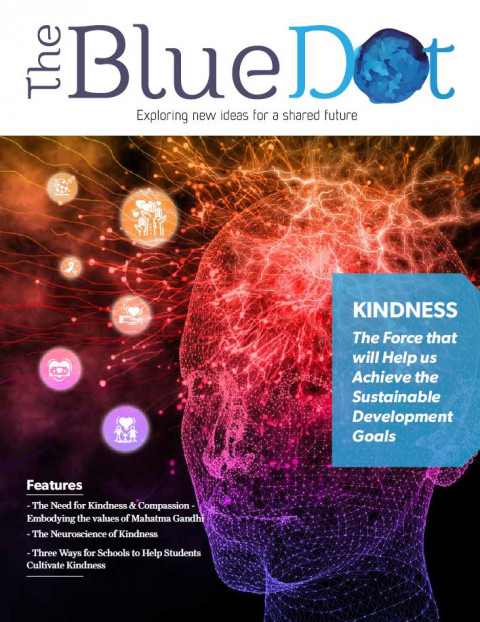 Kindness: The Force That Will Help Us Achieve the Sustainable Development Goals (The Blue Dot Issue 11, 2020) Year of publication: 2020 Corporate author: Mahatma Gandhi Institute of Education for Peace and Sustainable Development (MGIEP) In the eleventh issue of The Blue Dot, we focus on ‘Kindness’ – as the force that will help us achieve the Sustainable Development Goals, towards making the world more peaceful and sustainable – a better place to live in the future for our children. We hear from Ramesh Pokhriyal ‘Nishank’, Minister of Human Resource Development, Government of India on ‘The Need for Kindness and Compassion – Embodying the values of Mahatma Gandhi’, experts such as Zoran Josipovic on the neuroscience behind kindness; Michael Karlin and Brendran Ozawa-De Silve on the science and theory behind kindness, and from educators (Vicki Zakrzewski and John-Tyler Binfet) on how kindness can be practiced in our classrooms.Our cover story on ‘Kindness – the force to Achieve the Sustainable Development Goals’ discusses the biology of kindness, how kindness can help us achieve the SDGs and Kindness and SDGs and the Youth. Further, we have a hand-picked collection of youth stories on kindness, extracted from the 7,300+ stories we have from 120 countries around the world as part of UNESCO MGIEP’s #KindnessMatters for the SDGs youth campaign.
 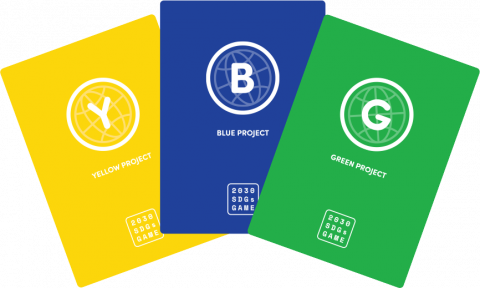 2030 SDGs GAME Year of publication: 2016 Corporate author: Imacocollabo The 2030 SDGs Game is a multiplayer, in-person, card-based game that simulates taking the “real world” into the year 2030. Designed in Japan in 2016, this experience has become a powerful and impactful social phenomenon in Japan, earning extensive media coverage and reaching over 12,000 participants last year. 2030 SDGs Game events are held in corporate, governmental, educational, and community settings, and now has over 100 trained facilitators in a rapidly growing community within Japan. Now, due to a growing demand to bring the game to the rest of the world, we have created an English edition and are beginning to introduce it to a wider audience overseas. The game is designed to be played with anywhere from 5 to 50 players. (That number can be expanded to a maximum of around 200 with multiple parallel ‘worlds’ operating at the same time.) Play time is approximately 1 hour; with the necessary explanation and reflection afterward, it requires a minimum of 90 minutes, and generally works best in a 2 ½ hour time frame.
 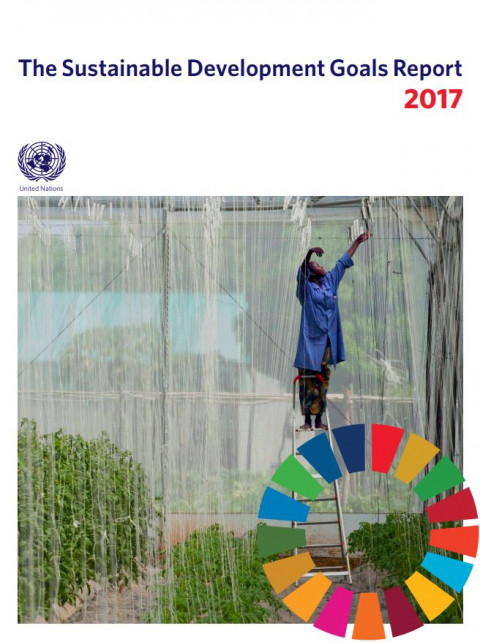 تقرير أهداف التنمية المستدامة 2017 Year of publication: 2017 Corporate author: United Nations (UN) يستعرض تقرير أهداف التنمية املستدامة لعام 2017 التقدم المحرز نحو تحقيق الأهداف السبعة عشر في السنة الثانية من تنفيذ خطة التنمية المستدامة لعام 2030 .ويستند التقرير إلى أحدث البيانات المتاحة. وهو يسلط الضوء على المكاسب والتحديات في الوقت الذي يتحرك فيه المجتمع الدولي صوب تحقيق الطموحات والمباديء التي تبناها في خطة عام 2030.