
Resources
Explore a wide range of valuable resources on GCED to deepen your understanding and enhance your research, advocacy, teaching, and learning.
1,329 Results found
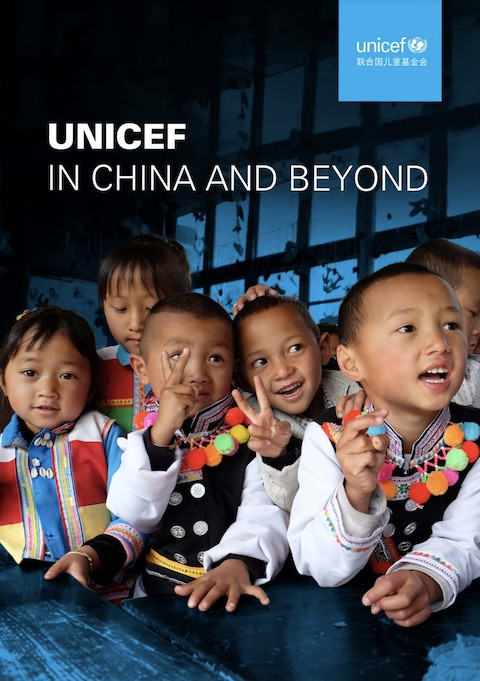 中国经验 全球视角:联合国儿童基金会在华合作项目概览 Year of publication: 2019 Corporate author: United Nations Children's Fund (UNICEF) 该报告概述了联合国儿童基金会在中国所开展的项目,并通过这些项目的经验,为关乎儿童利益的主要发展领域提供全球视角,包括儿童友好家园、减贫与儿童早期教育等。这份报告还简要介绍了合作项目在卫 生保健、教育、儿童保护、社会政策与改革等领域所关注的重点、取得的成果与面临的挑战。
  2021 문화다양성 정책 연차보고서 Year of publication: 2022 Author: 윤소영 | 정보람 | 신아름 Corporate author: 한국문화관광연구원 2021 문화다양성 정책 연차보고서는 2021년 한 해 동안 중앙부처와 지방자치단체에서 추진한 문화다양성 보호·증진 정책 추진 현황 및 세부 이행결과에 대해 분석하고 평가결과를 정리하였다. 또한 2021년 문화다양성 정책 관련 국내외 환경변화 및 정책동향을 살피고 국내 문화다양성 정책 및 주요 의제로 중앙부처·지자체 문화다양성 정책 사업과 활동, 주요 대학·기관·산업계의 관련 활동을 분석하고 주요 국제기구 및 주요 협약 당사국의 문화다양성 정책 및 현황을 다루고 있다. 본 저작물은 문화체육관광부에서 2022년 작성하여 공공누리 제 4유형으로 개방한 '2021 문화다양성 정책 연차보고서(윤소영, 정보람, 신아름)'를 이용하였으며 해당 저작물은 문화체육관광부 누리집 (www.mcst.go.kr/)에서 무료로 다운받으실 수 있습니다.
 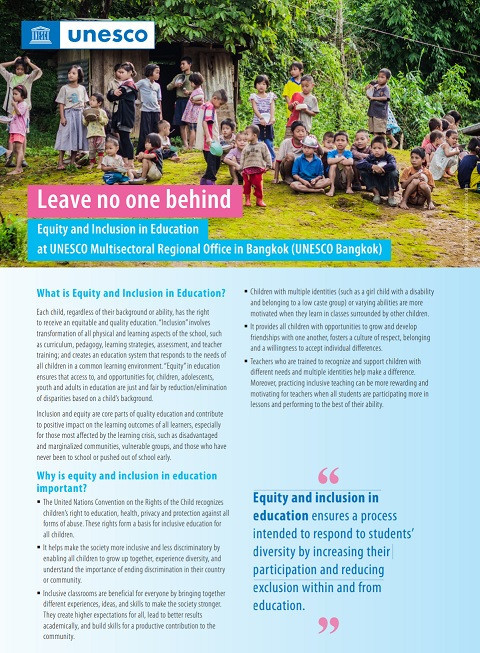 Leave No One Behind: Equity and Inclusion in Education at UNESCO Multisectoral Regional Office in Bangkok (UNESCO Bangkok) Year of publication: 2023 Corporate author: UNESCO Bangkok Equity and inclusion in education ensures a process intended to respond to students’ diversity by increasing their participation and reducing exclusion within and from education.
 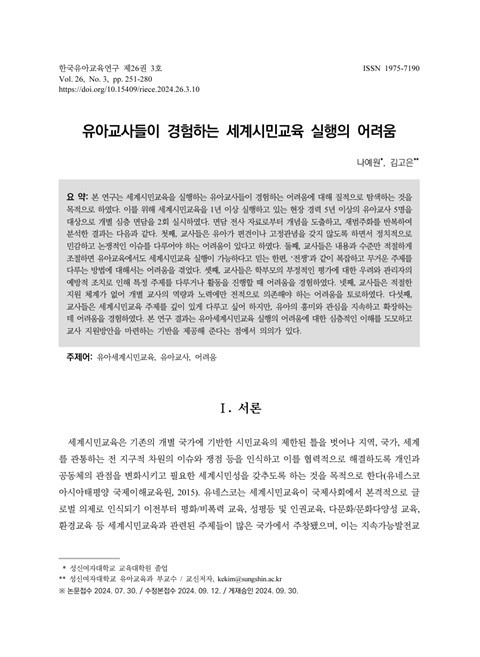 유아교사들이 경험하는 세계시민교육 실행의 어려움 (한국유아교육연구; Vol. 26, No.3) Year of publication: 2024 Author: 나예원 | 김고은 Corporate author: 한국교원대학교 유아교육연구소 본 연구는 세계시민교육을 실행하는 유아교사들이 경험하는 어려움에 대해 질적으로 탐색하는 것을 목적으로 하였다. 이를 위해 세계시민교육을 1년 이상 실행하고 있는 현장 경력 5년 이상의 유아교사 5명을 대상으로 개별 심층 면담을 2회 실시하였다. 면담 전사 자료로부터 개념을 도출하고, 재범주화를 반복하여 분석한 결과는 다음과 같다. 첫째, 교사들은 유아가 편견이나 고정관념을 갖지 않도록 하면서 정치적으로 민감하고 논쟁적인 이슈를 다루어야 하는 어려움이 있다고 하였다. 둘째, 교사들은 내용과 수준만 적절하게 조절하면 유아교육에서도 세계시민교육 실행이 가능하다고 믿는 한편, ‘전쟁’과 같이 복잡하고 무거운 주제를 다루는 방법에 대해서는 어려움을 겪었다. 셋째, 교사들은 학부모의 부정적인 평가에 대한 우려와 관리자의 예방적 조치로 인해 특정 주제를 다루거나 활동을 진행할 때 어려움을 경험하였다. 넷째, 교사들은 적절한 지원 체계가 없어 개별 교사의 역량과 노력에만 전적으로 의존해야 하는 어려움을 토로하였다. 다섯째, 교사들은 세계시민교육 주제를 깊이 있게 다루고 싶어 하지만, 유아의 흥미와 관심을 지속하고 확장하는 데 어려움을 경험하였다. 본 연구 결과는 유아세계시민교육 실행의 어려움에 대한 심층적인 이해를 도모하고 교사 지원방안을 마련하는 기반을 제공해 준다는 점에서 의의가 있다.
  Gender Bias, Citizen Participation, and AI (Policy Research Working Papers; Planet; RRR; 11046) Year of publication: 2025 Author: Jose Antonio Cuesta Leiva | Natalia Gisel Pecorari Corporate author: World Bank This paper investigates the role of gender bias in artificial intelligence–driven analyses of citizen participation, using data from the 2023 Latinobarómetro Survey. The paper proposes that gender bias—whether societal, data driven, or algorithmic—significantly affects civic engagement. Using machine learning, particularly decision trees, the analysis explores how self-reported societal bias (machismo norms) interacts with personal characteristics and circumstances to shape civic participation. The findings show that individuals with reportedly low levels of gender bias, who express political interest, have high levels of education, and align with left-wing views, are more likely to participate. The paper also explores different strategies to mitigate gender bias in both the data and the algorithms, demonstrating that gender bias remains a persistent factor even after applying corrective measures. Notably, lower machismo thresholds are required for participation in more egalitarian societies, with men needing to exhibit especially low machismo levels. Ultimately, the findings emphasize the importance of integrated strategies to tackle gender bias and increase participation, offering a framework for future studies to expand on nonlinear and complex social dynamics.
  United Nations Global Principles for Information Integrity : Recommendations for Multi-stakeholder Action Year of publication: 2024 Corporate author: United Nations (UN) Technological advances have revolutionized communications, connecting people on a previously unthinkable scale. They have supported communities in times of crisis, elevated marginalized voices and helped mobilize global movements for racial justice and gender equality. Yet these same advances have enabled the spread of misinformation, disinformation and hate speech at an unprecedented volume, velocity and virality, risking the integrity of the information ecosystem. New and escalating risks stemming from leaps in AI technologies have made strengthening information integrity one of the urgent tasks of our time. This clear and present global threat demands coordinated international action. The United Nations Global Principles for Information Integrity show us another future is possible. Principes mondiaux des Nations Unies pour l’intégrité de l’information: Recommandations pour une action multipartite Year of publication: 2024 Corporate author: United Nations (UN) Les avancées technologiques ont révolutionné les communications, connectant les personnes à une échelle autrefois inimaginable. Elles ont soutenu les communautés en temps de crise, amplifié les voix marginalisées et contribué à la mobilisation mondiale pour la justice raciale et l’égalité des genres. Pourtant, ces mêmes avancées ont également favorisé la propagation de la désinformation, des informations fallacieuses (ou « fake news ») et des discours de haine à une vitesse, une ampleur et une viralité sans précédent, menaçant ainsi l’intégrité de l’écosystème informationnel. Les risques émergents et croissants liés aux progrès rapides de l’intelligence artificielle font du renforcement de l’intégrité de l’information l’un des défis les plus urgents de notre époque. Cette menace mondiale, claire et actuelle, exige une action internationale coordonnée. La publication Principes mondiaux des Nations Unies pour l’intégrité de l’information nous montrent qu’un autre avenir est possible.
  Carbon Inequality Kills: Why Curbing the Excessive Emissions of an Elite Few Can Create a Sustainable Planet for All Year of publication: 2024 Author: Mira Alestig | Nafkote Dabi | Abha Jeurkar | Alex Maitland | Max Lawson | Daniel Horen Greenford | Corey Lesk | Ashfaq Khalfan Corporate author: Oxfam International The only way to beat climate breakdown and deliver social justice is to radically reduce inequality. This briefing paper reveals the catastrophic climate impacts of the richest individuals in the world, and proposes taking urgent action to protect people and the planet. What little carbon dioxide we can still safely emit is being burned indiscriminately by the super-rich. We share new evidence of how the yachts, jets and polluting investments of the 50 richest billionaires are accelerating the climate crisis. Oxfam’s research shows that the emissions of the world’s super-rich 1% are causing economic losses of trillions of dollars; contributing to huge crop losses; and leading to millions of excess deaths. As global temperatures continue to rise, risking the lives and livelihoods of people living in poverty and precarity, we must act now to curb the emissions of the super-rich and make rich polluters pay. Notice of Corrections available for this report. LA Desigualdad de las emisiones de carbono MATA: Limitar el exceso de emisiones de una reducida élite para lograr un mundo más sostenible para todas las personas Year of publication: 2024 Author: Mira Alestig | Nafkote Dabi | Abha Jeurkar | Alex Maitland | Max Lawson | Daniel Horen Greenford | Corey Lesk | Ashfaq Khalfan Corporate author: Oxfam International La única manera de evitar el colapso climático y garantizar la justicia social es reducir drásticamente las desigualdades. El presente informe pone de manifiesto las nefastas consecuencias que el estilo de vida de las personas más ricas del mundo tiene sobre el cambio climático, y plantea la adopción de medidas urgentes que permitan proteger a las personas y el planeta.Son los más ricos quienes están consumiendo, indiscriminadamente, la limitada cantidad de dióxido de carbono que aún podemos emitir de forma segura. En este estudio se publican nuevos datos que demuestran que los yates, los aviones privados y las contaminantes inversiones de 50 de las personas más ricas del mundo están acelerando la crisis climática. La investigación de Oxfam pone de manifiesto que las emisiones generadas por el 1 % más rico de la población mundial están ocasionando perjuicios económicos por valor de billones de dólares, además de contribuir a enormes pérdidas de cosechas y millones de muertes.Mientras tanto, la temperatura global sigue aumentando, lo cual pone en riesgo la vida y los medios de vida de millones de personas en situación de pobreza y precariedad. Por eso, es urgente que se adopten medidas que permitan frenar las emisiones de los más ricos, y lograr que quienes más contaminan asuman el coste. LES INÉGALITÉS CARBONE TUENT: Réduire les émissions excessives d’une élite peut favoriser la durabilité de la planète pour tou·te·s Year of publication: 2024 Author: Mira Alestig | Nafkote Dabi | Abha Jeurkar | Alex Maitland | Max Lawson | Daniel Horen Greenford | Corey Lesk | Ashfaq Khalfan Corporate author: Oxfam International Pour lutter contre le dérèglement climatique et instaurer une véritable justice sociale, une seule solution s’impose : la réduction drastique des inégalités. En mettant en évidence les répercussions catastrophiques que le mode de vie des plus riches entraîne sur le climat, la présente note d’information propose des mesures urgentes pour protéger l’ensemble de la population et la planète.Le peu de dioxyde de carbone que nous pouvons encore nous permettre de générer sans que cela entraîne des conséquences irréparables est aujourd’hui dilapidé sans discernement par les ultra-riches. Nous offrons ici de nouvelles preuves de la façon dont les yachts de luxe, les jets privés et les investissements polluants de 50 des milliardaires les plus riches au monde accélèrent la crise climatique. Les recherches d’Oxfam montrent que les émissions produites par la frange des 1 % les plus riches de la planète provoquent des pertes économiques estimées à plusieurs milliers de milliards de dollars, contribuent à la destruction d’une énorme quantité de récoltes et entraînent des millions de décès prématurés.Alors que la température de la Terre ne cesse d’augmenter, mettant en péril la vie et les moyens de subsistance des personnes qui vivent dans la pauvreté et la précarité, il nous faut agir sans délai pour endiguer les émissions des ultra-riches et faire payer les riches pollueurs.