
Resources
Explore a wide range of valuable resources on GCED to deepen your understanding and enhance your research, advocacy, teaching, and learning.
1,330 Results found
 Accountability from a Human Rights Perspective: The Incorporation and Enforcement of the Right to Education in the Domestic Legal Order Year of publication: 2017 Corporate author: ActionAid International | Right to Education Initiative (UK) The aim of this paper is to reframe States’ political commitment to education under Education 2030 as a legal commitment the vast majority of States have already made under international human rights law. By recasting the content of SDG Four as part of the right to education, the legal obligations owed to that content can be invoked. This renders various elements of SDG Four, ifthe State in question has legally committed to the right to education and incorporated the right to education in their domestic legal orders, amenable to adjudication by competent mechanisms, offering the possibility of legal accountability through legal enforcement.
 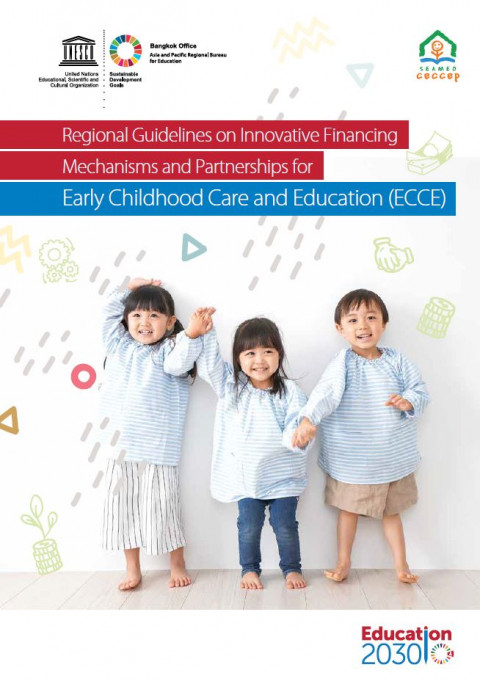 Regional Guidelines on Innovative Financing Mechanisms and Partnerships for Early Childhood Care and Education (ECCE) Year of publication: 2019 Corporate author: SEAMEO. Regional Centre for Early Childhood Care Education and Parenting (CECCEP) | UNESCO Bangkok The development of the Regional Guidelines on Innovative Financing Mechanisms and Partnerships for Early Childhood Care and Education (ECCE) was a joint initiative of the UNESCO Asia-Pacific Regional Bureau for Education (UNESCO Bangkok) and the Southeast Asian Ministers of Education Organization Regional Centre for Early Childhood Care Education and Parenting (SEAMEO CECCEP). The Guidelines are part of UNESCO Bangkok’s “Exploring innovative financing and mechanisms for ensuring free inclusive and equitable quality pre-primary education for all in Asia-Pacific” project, which is supported by the Ministry of Economy and Finance Republic of Korea.
 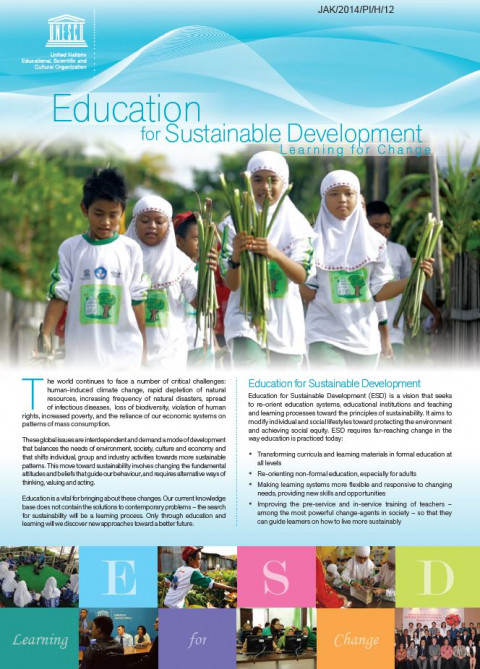 Education for Sustainable Development: Learning for Change Year of publication: 2014 Corporate author: UNESCO Jakarta The world continues to face a number of critical challenges: human-induced climate change, rapid depletion of natural resources, increasing frequency of natural disasters, spread of infectious diseases, loss of biodiversity, violation of human rights, increased poverty, and the reliance of our economic systems on patterns of mass consumption. These global issues are interdependent and demand a mode of development that balances the needs of environment, society, culture and economy and that shifts individual, group and industry activities towards more sustainable patterns. This move toward sustainability involves changing the fundamental attitudes and beliefs that guide our behaviour, and requires alternative ways of thinking, valuing and acting. Education is a vital for bringing about these changes. Our current knowledge base does not contain the solutions to contemporary problems – the search for sustainability will be a learning process. Only through education and learning will we discover new approaches toward a better future.
 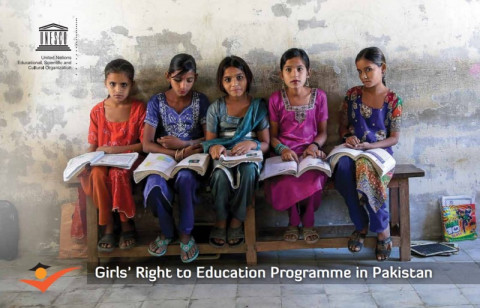 Girls' Right to Education Programme in Pakistan Year of publication: 2018 Corporate author: UNESCO Islamabad The programme is in progress in 14 very marginalized districts of the country selected in consultation with concerned education counterparts. Basic indicators for education, such as literacy rate, enrolment and retention of girls, and level of learning outcomes in primary grades are quite low in each selected district. Each province and area based project has three integrated components: (a) improving girls’ access through social mobilization and advocacy, (b) improving retention through improvement in school physical and learning environments – activation of parents-teachers committees (PTCs), school management committees (SMCs) and teachers training in multi-grade teaching and activity-based learning and, (c) capacity building of education officials at district, provincial and national level to create an enabling environment for girls’ education. All projects are implemented through local civil society organizations (CSOs) as implementing partners in consultation with national, provincial and area education departments. The programme is making significant progress in transforming the parental and community perception towards girls' education. Over seven thousand out of school girls have been enrolled in the target areas and retention is ensured through the provision of school facilities and improvement in overall learning environment.
 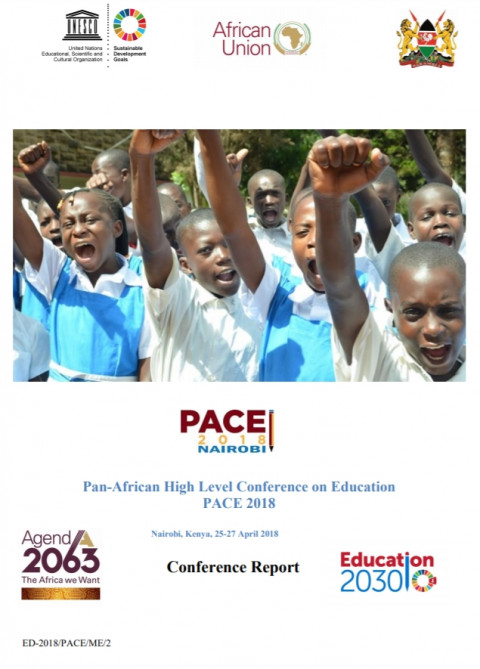 Pan-African High Level Conference on Education, PACE 2018: conference report Year of publication: 2018 Corporate author: African Union | Government of the Republic of Kenya The Pan-African High-level Conference on Education (PACE 2018) was held in Nairobi, Kenya from 25th to 27th April 2018. PACE 2018 was convened by UNESCO, the Government of Kenya and the African Union, with the collaboration of the Association for the Development of Education in Africa (ADEA) and contributions from the Sustainable Development Goal 4 (SDG4) co-conveners. The initiative to organise the PACE 2018 came in the wake of a number of regional consultations organised in Sub Saharan Africa and the Arab states regions to focus attention on the way forward, following the adoption in 2015 of the United Nations’ Sustainable Development Goal 4 on Education (SDG 4) and of the African Union’s Continental Education Strategy for Africa 2016-2025 (CESA 16-25). Conférence panafricaine de haut niveau sur l'éducation, PACE 2018: rapport de la conférence Year of publication: 2018 Corporate author: African Union | Government of the Republic of Kenya La Conférence panafricaine de haut niveau sur l’éducation (PACE 2018) s’est déroulée à Nairobi, au Kenya, du 25 au 27 avril 2018. Elle a été convoquée par l’UNESCO, le Gouvernement du Kenya et l’Union africaine, avec la collaboration de l’Association pour le Développement de l’Éducation en Afrique (ADEA) et des contributions des coorganisateurs de l’Objectif de développement durable 4 (ODD 4). L’initiative d’organiser la conférence PACE 2018 s’inscrit à la suite de plusieurs consultations régionales organisées dans les régions d’Afrique subsaharienne et des États arabes pour appeler l’attention sur la voie à suivre après l’adoption en 2015 de l’Objectif de développement durable 4 (ODD 4) sur l’éducation et de la Stratégie continentale de l’éducation pour l’Afrique de l’Union africaine (CESA 2016-2025) (CESA 16-25).
 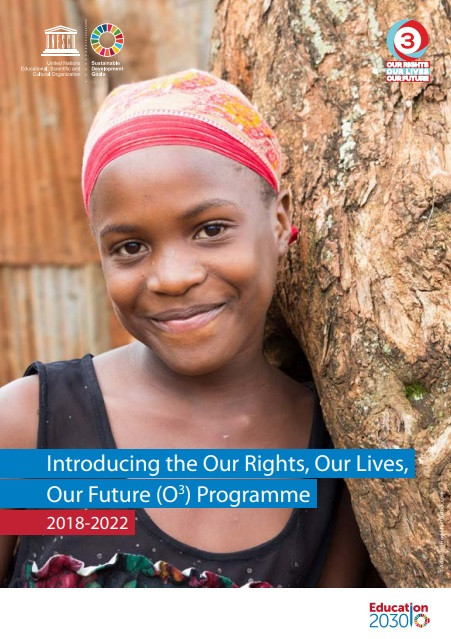 Introducing the Our Rights, Our Lives, Our Future (O3) Programme 2018-2022 Year of publication: 2019 Corporate author: UNESCO Harare Comprehensive sexuality education is a curriculum-based process of teaching and learning about the cognitive, emotional, physical, and social aspects of sexuality. It aims to equip children and young people with the knowledge, skills, attitudes, and values that will empower them to protect their health, well-being, and dignity, as well as to develop respectful social relationships and consider the well-being of others affected by their choices. Importantly, it also helps them to understand and act upon their rights throughout their lives.
  Educación para transformar vidas: metas, opciones de estrategia e indicadores Year of publication: 2016 Corporate author: UNESCO Santiago La educación está en el centro de la agenda de desarrollo sostenible y es esencial para el éxito de todas estas metas. La nueva agenda de educación resumida en el Objetivo 4 es holística, ambiciosa, deseable y universal, yestá inspirada por una visión de que la educación transforma las vidas de las personas, las comunidades y las sociedades. La agenda atiende los temas no resueltos de los objetivos de la Educación para Todos (EPT) ylos ODM relacionados con la educación, al tiempo que aborda de manera efectiva los actuales y futuros desafíos de la educación a nivel mundial y nacional. Está basada en los derechos y está inspirada en una visión humanista de la educación y el desarrollo, con base en los principios de la dignidad humana, los derechos igualitarios, la justicia social, la paz, la diversidad cultural y la responsabilidad compartida. Basándose y continuando con el movimiento EPT, Educación 2030 toma en cuenta lecciones aprendidas desde 2000. Lo que es nuevo en esta agenda es su enfoque en mayores y más amplios resultados en el acceso, la equidad e inclusión, calidad y aprendizaje, además de un aprendizaje a lo largo de toda la vida.
 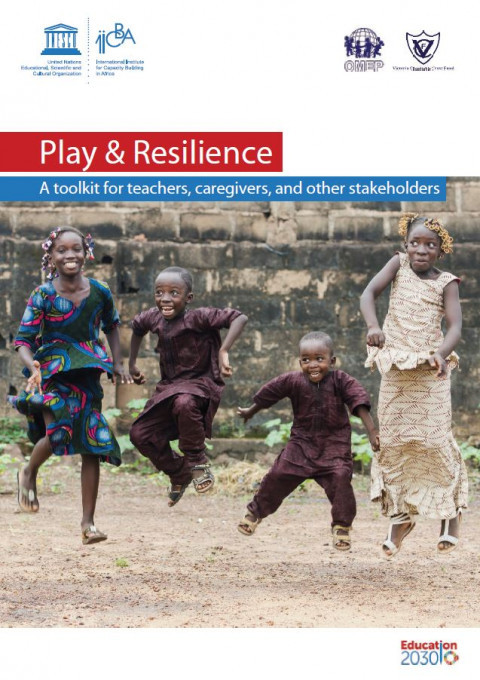 Play & Resilience: A toolkit for teachers, caregivers, and other stakeholders Year of publication: 2019 Corporate author: UNESCO International Institute for Capacity-Building in Africa (IICBA) This publication is a toolkit for teachers, caregivers, community members and other stakeholders in the Early Childhood Care and Education Landscape.This toolkit is aimed at fostering Resilience in children through playbased strategies.
 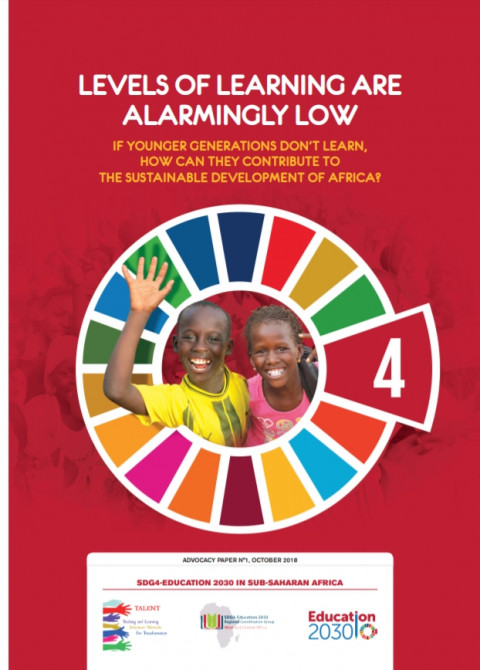 Levels of learning are alarmingly low: if younger generations don't learn, how can they contribute to the sustainable development of Africa? Year of publication: 2018 Corporate author: UNESCO Dakar | Regional Coordination Group on SDG 4-Education 2030 in West and Central Africa | Teaching and Learning Educators’ Network for Transformation With the adoption of The 2030 Agenda for Sustainable Development, UN member states and partner organizations have agreed to ensure inclusive and equitable quality education and promote lifelong learning opportunities for all by 2030. Building on the unfinished agendas of the Millennium Development Goals and Education for All, quality education and learning are at the very core of both SDG4 and CESA 16-25 (see box 1). Five of the seven SDG4 targets are specifically designed with the intention of addressing the global learning crisis. Moreover, CESA 16-25 specifically calls on African Union member states to address issues of quality and equity in education, particularly at the pre-primary level, a neglected area in terms of investment and policy, and at the primary level where geographical disparities indicate that girls and women, the poorest and those leaving in remote areas are still left behind. The next question is whether these international and regional commitments have been translated into national policies and strategies that can address the alarmingly low levels of learning.