
Resources
Explore a wide range of valuable resources on GCED to deepen your understanding and enhance your research, advocacy, teaching, and learning.
1,366 Results found
 Regards sur l'éducation 2019: Les indicateurs de l'OCDE Year of publication: 2019 Corporate author: Organisation for Economic Co-operation and Development (OECD) Regards sur l’éducation est la publication de référence sur l’état de l’éducation dans le monde. Elle fournit des données clés sur la structure, le financement et la performance des systèmes d’éducation des pays de l’OCDE, ainsi que d’un certain nombre de pays partenaires. Avec plus de 100 tableaux et graphiques – et des liens vers de nombreuses données supplémentaires sur notre base de données consacrée à l’éducation – cette publication présente des données clés sur les résultats des établissements d’enseignement ; l’impact de l’apprentissage dans les différents pays ; l’accès, la participation et la progression au sein des systèmes d’éducation ; les ressources financières investies dans l’éducation ; et les enseignants, l’environnement d’apprentissage et l’organisation scolaire.L'édition 2019 inclut un éclairage spécifique sur l'enseignement tertiaire, avec de nouveaux indicateurs sur le taux de réussite à ce niveau, sur les doctorants et leurs perspectives sur le marché du travail, sur les systèmes d'admission dans l'enseignement tertiaire, ainsi qu'un chapitre dédié au quatrième Objectif de développement durable.
  Safe to Learn: Ending Violence in and Through Schools Year of publication: 2019 Corporate author: End Violence Against Children Safe to Learn – is an initiative dedicated to ending violence in and through schools so children are free to learn, thrive and pursue their dreams. Safe to Learn presents an opportunity to unlock the multiple win of ending violence in schools, improving learning outcomes, better leveraging investments in education, and raising awareness and change attitudes towards violence against children. To date, 11 countries have endorsed Safe to Learn’s Call to Action, which sets out in high-level terms what needs to happen to end violence in schools. These countries include Cambodia, Georgia, Ghana, Honduras, Mexico, Moldova, Nepal, Sierra Leone, South Africa, South Sudan, Uganda and El Salvador.
  Regional Capacity Development Resource Book on Monitoring SDG4-Education 2030 in Asia-Pacific Year of publication: 2019 Corporate author: UNESCO Bangkok | UNICEF East Asia and the Pacific The Education 2030 Agenda calls for robust monitoring, reporting, and evaluating indicators from Early Childhood Education (ECE) to adult education. The new agenda demands clear indicators and measurement to generate evidence-based international discourses and advocacy. Ensuring availability of education data and statistics for evidence based policy making and planning is also crucial. Countries’ capacity to respond to these demands will depend on quality mechanism for monitoring in place and technical capacity of data providers and users. The modules included in the this Regional Capacity Development Resource Book on Monitoring SDG 4-Education 2030 in Asia Pacific covers various topics that are relevant to building an effective national monitoring system, such as the creation of a national indicator framework and the development of national strategies for education statistics; strengthening the administrative data production system; and increasing the household survey application in monitoring education at the national level, as well as reporting at the global level.
  Journal on Education in Emergencies: Special Issue on Refugees and Education, Part I (Vol. 5, No.1 December 2019) Year of publication: 2019 Author: Sarah Dryden-Peterson | Jo Kelcey | S. Garnett Russell Corporate author: Inter-agency Network for Education in Emergencies (INEE) This special issue of JEiE—the first of two parts—showcases research on important developments in the field of refugee education across several regions, including the Middle East, Latin America, and Africa. The issue includes four research articles, one interview, two field notes, and three book reviews.The contributing authors describe and analyze how international agencies, state bureaucracies, local organizations and their partners, and refugees shape the structures that influence the education of refugees, both historically and in the present, and how these actors imagine their roles. In so doing, the authors help to untangle key questions about how responsibility for meeting refugees’ educational needs and aspiration is taken up and shared. The articles in this issue include immediate and long-term lessons for how refugee education is designed and experienced.
 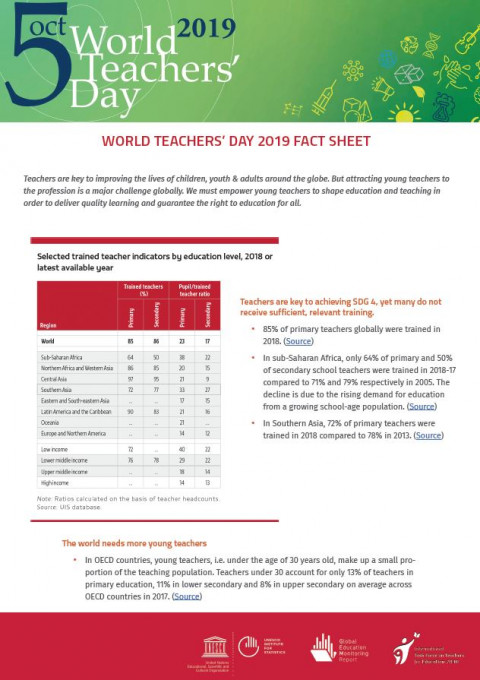 World Teachers' Day 2019: Fact sheet Year of publication: 2019 Corporate author: UNESCO Institute for Statistics (UIS) | International Task Force on Teachers for Education 2030 To mark World Teachers’ Day, GEM(Global education monitoring) report partnered with the UNESCO Institute for Statistics (UIS) and the International Task Force on Teachers for Education 2030 to pull together key facts and statistics on challenges for teachers around the world.The new factsheet provides the latest UIS data on trained teachers, the global indicator for SDG target 4.c. Globally, 85% of primary teachers were trained in 2018 but only 64% in sub-Saharan Africa. The proportion of teachers that are trained in sub-Saharan Africa is falling, mostly due to the rising demand for education from a growing school-age population.
  NISSEM Global Briefs: Educating for the Social, the Emotional and the Sustainable Year of publication: 2019 Author: Andy Smart | Margaret Sinclair | Aaron Benavot | Jean Bernard | Colette Chabbott | S. Garnett Russell | James Williams Corporate author: Networking to Integrate SDG Target 4.7 and SEL skills into Educational Materials (NISSEM) The NISSEM global briefs are a collection of peer-reviewed essays from over 60 contributors with standing within the field of education. At the junction of SDG Target 4.7, SEL, and education in post conflict and low-resource settings, the NISSEM global briefs are a key resource for current research and practice.NISSEM is a Networking to Integrate SDG Target 4.7 and SEL(Social and emotional learning) into Educational Materials launched in March, 2018.
 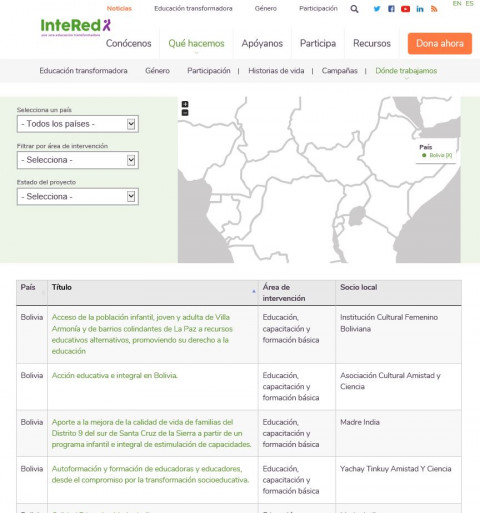 InteRed. Educational Projects in Bolivia Year of publication: 2019 Corporate author: InteRed InteRed carries out educational projects to solve specific social problems around the planet. The projects tackle things such as poverty, health, access to education, Human Rights, access to food, among other things. InteRed. Proyectos educativos en Bolivia Year of publication: 2019 Corporate author: InteRed InteRed lleva a cabo projectos educacionales intentando resolver problemas específicos en el planeta. Los proyectos abordan cuestiones como pobreza, salud, acceso a la educación, Derechos Humanos, acceso a alimentos, entre otras cosas.
  다문화 보육과정 컨설팅 매뉴얼 Year of publication: 2019 Author: 김혜금 | 노성향 | 최현정 Corporate author: 한국보육진흥원 한국보육진흥원에서는 다문화 보육의 질적 향상을 위해 2014년부터 2017년까지 어린이집안전공제회가 관리하는 아이사랑카드 기금을 받아 취약보육(다문화) 담당 어린이집의 컨설팅 사업을 추진하였다. 이를 통해 다문화 보육을 담당하는 교사들의 다문화 보육의 전반적인 이해 및 전문적인 능력을 신장시켰다.다문화 보육 어린이집의 질 제고를 위해서는 장기적이고 체계적인 지원 시스템이 운영될 수 있는 안정적인 여건이 마련되어야 한다. 이에 2019년 아이사랑카드 기금사업으로 추진하는 취약보육 담당 어린이집 및 보육 교직원을 위한 컨설팅 사업을 다문화보육 학계 전문가 및 어린이집 현장전문가로 집필진을 구성하여 컨설팅 매뉴얼을 제작하고 오프라인 보급교육 실시 및 온라인 교육 동영상을 제작하여 관심 있는 보육 교직원들이 스스로 자율컨설팅을 할 수 있도록 사업을 추진하고자 한다.본 매뉴얼을 사용하는 주요 대상자는 다문화가족 아동을 담당하는 일반 어린이집과 현재는 다문화가족 아동을 보육하지는 않고 있지만 관심을 가지는 모든 어린이집의 보육 교직원이 대상이다. 특히 다문화 보육기관 교사들의 연수 및 자율적으로 고민하고 문제를 해결하는 자율컨설팅를 위한 교재로 개발하였다.
 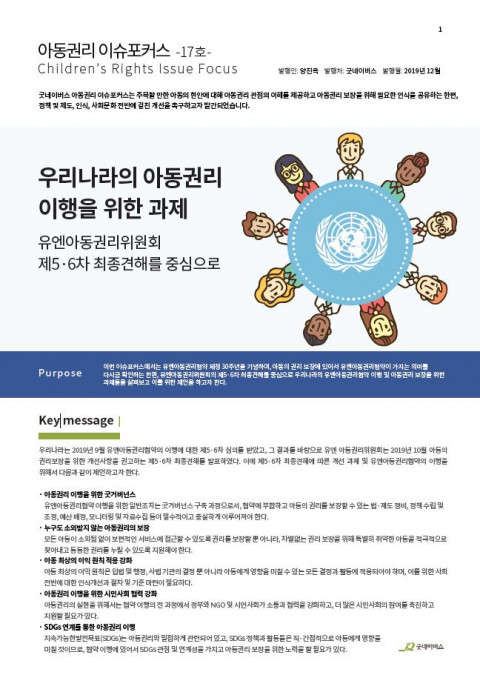 우리나라의 아동권리 이행을 위한 과제: 유엔아동권리위원회 제5·6차 최종견해를 중심으로 (아동권리 이슈포커스 17호) Year of publication: 2019 Corporate author: 굿네이버스 우리나라는 2019년 9월 유엔아동권리협약의 이행에 대한 제5·6차 심의를 받았고, 그 결과를 바탕으로 유엔 아동권리위원회는 2019년 10월 아동의 권리보장을 위한 개선사항을 권고하는 제5·6차 최종견해를 발표하였다.본 원고에서는 유엔아동권리협약 채택 30주년을 맞이하여, 유엔아동권리협약이 아동권리 보장에 있어서 가지는 의미가 무엇인지 확인하고 1991년 유엔아동권리협약 비준 이후 현재 우리나라의 아동권리 보장 수준은 어떠한지, 그리고 아동권리 보장을 위한 이행 과제와 고려점이 무엇인지 유엔아동권리위원회의 대한민국 제5·6차 최종견해를 중심으로 살펴보고자 한다.