
Resources
Explore a wide range of valuable resources on GCED to deepen your understanding and enhance your research, advocacy, teaching, and learning.
1,330 Results found
 Tableau de bord pour l’ODD 4, rapport d’étape sur les points de référence nationaux: focus sur les enseignants Year of publication: 2024 Corporate author: Global Education Monitoring Report Team | UNESCO Institute for Statistics (UIS) Il s'agit de la deuxième évaluation des progrès des pays vers les points de référence, ou objectifs nationaux, que les pays ont fixés pour huit indicateurs de l'ODD 4 afin de marquer leur contribution aux objectifs mondiaux. L’évaluation couvre la période depuis 2015 et examine la probabilité que chaque pays atteigne son point de référence pour 2025 ou – lorsqu’un tel objectif n’a pas été fixé – la valeur qu’il aurait atteinte s’il avait progressé au rythme historique (2000–15) des 25 % des pays qui s’améliorent le plus rapidement.Le tableau de bord de l’ODD 4 2024 révèle que les progrès vers les objectifs nationaux sont en retard pour la plupart des indicateurs. Dans deux cas – l’écart entre les genres au détriment des garçons dans l’achèvement du deuxième cycle du secondaire et les dépenses publiques d’éducation en proportion des dépenses publiques totales – les pays reculent même.En revanche, les progrès sont plus rapides pour le huitième indicateur de référence, la connectivité Internet dans les écoles, qui a été ajouté suite à la priorité accordée à la transformation numérique lors du Sommet sur la transformation de l’éducation en 2022. Un tiers des pays ont fixé des objectifs nationaux en 2023 et les progrès sur l’indicateur sont examinés pour la première fois dans cette édition.Les progrès sont également relativement rapides en ce qui concerne le pourcentage d'enseignants possédant les qualifications minimales requises, qui est également l'indicateur central de cette édition. De nouvelles données sont présentées sur les politiques nationales concernant les niveaux de qualification minimaux requis pour accéder à la profession enseignante, les politiques de développement professionnel continu obligatoire et les politiques de formation des enseignants sur la tec
  SDG 4 Scorecard: Progress Report on National Benchmarks; Focus on Teachers Year of publication: 2024 Corporate author: Global Education Monitoring Report Team | UNESCO Institute for Statistics (UIS) This is the second assessment of country progress towards the benchmarks, or national targets, that countries have set for eight SDG 4 indicators to mark their contribution to the global targets. The assessment covers the period since 2015 and reviews the probability that each country will achieve its 2025 benchmark or – where such a benchmark was not set – the value they would have achieved if they had progressed at the historic (2000–15) rate of the fastest improving 25% of countries.The 2024 SDG 4 Scorecard finds that progress towards national targets is off track for most indicators. In two cases – the gender gap at the expense of boys in upper secondary education completion and public education expenditure as share of total public expenditure – countries are even moving backwards.In contrast, progress is faster in the eighth benchmark indicator, school internet connectivity, which was added following the priority given to digital transformation at the Transforming Education Summit in 2022. One third of countries set national targets in 2023 and progress on the indicator is being reviewed for the first time in this edition.Progress is also relatively fast in the percentage of teachers with minimum required qualifications, which is also the focus indicator of this edition. New evidence is presented on national policies for minimum required qualification levels to enter the teaching profession, compulsory continuous professional development policies, and teacher training policies on technology in education.
  Tablero de control para el ODS 4: informe sobre el progreso hacia los puntos de referencia nacionales; foco en docentes Year of publication: 2024 Corporate author: Global Education Monitoring Report Team | UNESCO Institute for Statistics (UIS) Esta es la segunda evaluación del progreso de los países hacia los puntos de referencia, o metas nacionales, que los países han establecido para ocho indicadores del ODS 4 para marcar su contribución a las metas globales. La evaluación cubre el período desde 2015 y revisa la probabilidad de que cada país alcance su punto de referencia para 2025 o, cuando no se haya establecido dicho punto de referencia, el valor que habría alcanzado si hubiera progresado al ritmo histórico (2000–15) del 25 % de los países que mejoran más rápidamente.El Tablero de Control para el ODS 4 de 2024 revela que el progreso hacia las metas nacionales está desviado en la mayoría de los indicadores. En dos casos – la brecha de género a expensas de los niños que terminan la educación secundaria alta y el gasto público en educación como proporción del gasto público total – los países incluso están retrocediendo.Por el contrario, el progreso es más rápido en el octavo indicador de referencia, la conectividad a Internet en las escuelas, que se añadió tras la prioridad otorgada a la transformación digital en la Cumbre sobre la Transformación de la Educación en 2022. Un tercio de los países estableció objetivos nacionales en 2023 y el progreso en el indicador está siendo revisado por primera vez en esta edición.El progreso también es relativamente rápido en el porcentaje de docentes con las calificaciones mínimas requeridas, que también es el indicador central de esta edición. Se presenta nueva evidencia sobre políticas nacionales en cuanto a los niveles mínimos de calificación requeridos para ingresar a la profesión docente, políticas de desarrollo profesional continuo obligatorio y políticas de formación docente sobre tecnología en educación.
 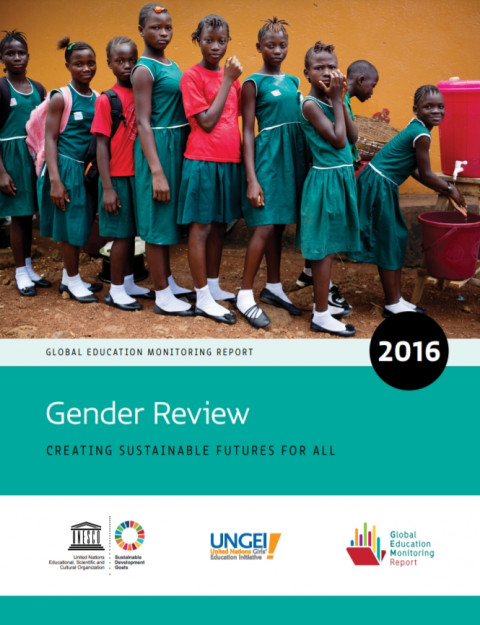 Creating sustainable futures for all; Global education monitoring report, 2016; gender review Year of publication: 2016 Author: Sachs, Jeffrey D Corporate author: Global Education Monitoring Report Team Education and gender equality are central concerns in the new sustainable development agenda. The Education 2030 Framework for Action, agreed by the global education community in November 2015 to accompany the SDG agenda, recognizes that gender equality is inextricably linked to the right to education for all, and that achieving gender equality requires an approach that ‘ensures that girls and boys, women and men not only gain access to and complete education cycles, but are empowered equally in and through education’ (UNESCO, 2016a, p. 8). Women, girls, boys and men all need to be given opportunities for active participation in society, for their voices to be heard and their needs met (UN Women, 2016a). To facilitate and achieve this, better evidence-based knowledge and understanding of gender issues in and through education are needed. The Gender Review of the 2016 Global Education Monitoring Report (GEM Report) recognizes and largely focuses on the challenges facing girls and women because of the disproportionate overall disadvantage they continue to experience in and beyond education. But it also understands that gender disadvantage can be experienced by boys and men, and that gender equality involves males, relationships and power. Gender inequality affects us all. Achieving gender equality must involve us all. Résumé sur l'égalité des genres: créer des avenirs durables pour tous; Rapport mondial de suivi sur l'éducation, 2016 Year of publication: 2016 Author: Sachs, Jeffrey D Corporate author: Global Education Monitoring Report Team L’éducation et l’égalité des genres sont des préoccupations essentielles dans le nouveau programme de développement durable. Le Cadre d’action Éducation 2030, approuvé par la communauté mondiale de l’éducation en novembre 2015 en complément du Programme 2030, reconnaît que l’égalité des genres est indissociable du droit à l’éducation pour tous, et que, pour qu’elle devienne une réalité, il faut adopter une démarche « qui garantisse que les filles et les garçons, les femmes et les hommes non seulement ont le même accès aux différents cycles d’enseignement, jusqu’à leur terme, mais aussi qu’ils ont les mêmes possibilités de s’épanouir dans l’éducation et grâce à l’éducation » (UNESCO, 2016a, p. 8). Femmes, filles, hommes et garçons ont tous besoin que des possibilités leur soient données de participer activement à la vie sociale et de faire entendre leur voix et qu’il soit répondu à leurs besoins (ONU Femmes, 2016a). Faciliter et permettre la réalisation de cet objectif exige une connaissance et une compréhension mieux étayées par des données factuelles de la manière dont l’égalité des genres peut être assurée dans l’éducation et par l’éducation. Le Résumé sur l’égalité des genres de l’édition 2016 du Rapport mondial de suivi sur l’éducation (Rapport GEM) reconnaît les difficultés rencontrées par les filles et les femmes du fait du désavantage global disproportionné auquel elles continuent de se heurter dans leurs études et au-delà, et est grande partie centré sur ces difficultés. Mais il admet aussi que les garçons et les hommes peuvent eux aussi être désavantagés du fait de leur sexe et que l’égalité des genres les concerne et est affaire de relations et d’exercice du pouvoir. L’inégalité entre les genres nous touche tous. Instaurer l’égalité entre les genres est notre responsabilité à tous. Resumen sobre género: creación de futuros sostenibles para todos; Informe de seguimiento de la educación en el mundo, 2016 Year of publication: 2016 Author: Sachs, Jeffrey D Corporate author: Global Education Monitoring Report Team Para la nueva agenda internacional de desarrollo sostenible, la educación y la igualdad de género constituyen preocupaciones básicas. El Marco de Acción Educación 2030, suscrito por la comunidad educativa mundial en noviembre del 2015, en sintonía con la agenda para los ODS, reconoce que la igualdad de género está íntimamente ligada al derecho a la educación para todos y que para alcanzar la igualdad de género se requiere un enfoque que “garantice no solo que las niñas, los niños, las mujeres y los hombres obtengan acceso a los distintos niveles de enseñanza y los cursen con éxito, sino que adquieran las mismas competencias en la educación y mediante ella” (UNESCO 2016a, p.28). Todas las mujeres, las niñas, los niños y los hombres han de tener la posibilidad de participar activamente en la sociedad, de que se oigan sus voces y se satisfagan sus necesidades (ONU-Mujeres, 2016a). Para facilitar y alcanzar estos objetivos, es necesario disponer de conocimientos basados en evidencia, acerca de los temas relacionados con el género en el ámbito de la educación y mediante ella. El Resumen sobre Género del Informe de Seguimiento de la Educación en el Mundo (Informe GEM) identifica y se centra principalmente en los desafíos a los que han de hacer frente las niñas y las mujeres a causa de las desventajas globales y desproporcionadas que siguen experimentando en su período de formación y después de él. Pero tiene presente asimismo que los niños y los hombres pueden sufrir desventajas de género, y que la igualdad de género también afecta a los varones, a sus relaciones y al poder. Por tanto, todos debemos participar en lograr la igualdad de género.
 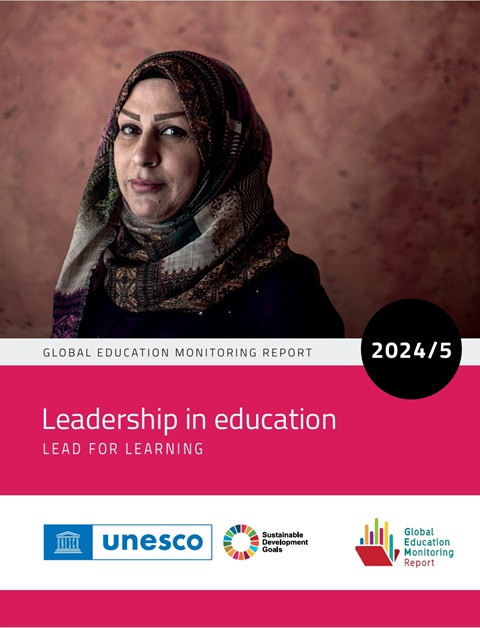 Global Education Monitoring Report 2024/5: Leadership in Education; Lead for Learning Year of publication: 2024 Corporate author: Global Education Monitoring Report Team Leadership matters in education. Strong leaders are needed to help institutions, systems and societies change for the better. Strong leaders work in collaboration with other actors towards the same goals. At the school level, they are the principals but also those who surround them, in the school and in the community, in positions of responsibility. At the system level, they are civil servants working as district officers, supervisors or planners. At the societal level, they are political leaders, as well as a very broad range of actors who help shape education goals, from unions and researchers to civil society and the media.Entitled Lead for learning, this report argues that, in pursuing specific goals, education leaders are more than just managers. They are change agents, who need the time, trust and support to focus on setting a vision and developing the people they serve and work with. The report calls for investment in and empowerment of school and system leaders. There should be fair hiring processes and growth opportunities that recognize the full scope of leaders’ roles. Moreover, leadership works best when it is shared, empowering others to lead as they can within their roles.There is no one leadership style that works. Different contexts, capacities and personalities mean that styles vary, and rightfully so. This, combined with the different goals that each leader is trying to achieve, means that their impact is hard to fully assess. Yet, all research points towards the critical need for strong leaders to continuously improve education quality. School leaders are second only to teachers for transforming student outcomes. Meanwhile, politicians wield huge influence in making equitable and inclusive education a national priority.Supporting this seventh Global Education Monitoring Report is a new series of country profiles on PEER, an online resource supporting policy dialogue and describing policies and regulations on school principal selection, preparation and development in the world’s education systems.
  Rapport mondial de suivi sur l'éducation 2024/5, Leadership dans l'éducation : diriger pour apprendre Year of publication: 2025 Corporate author: Global Education Monitoring Report Team Le Rapport mondial de suivi sur l'éducation 2024/5 évalue les progrès accomplis dans la réalisation des objectifs du Programme 2030 et montre que, si le nombre d'enfants scolarisés et achevant l'enseignement secondaire n'a jamais été aussi élevé, de nombreux domaines connaissent une stagnation. Le leadership joue un rôle central pour y remédier. Aucune école n’améliore les résultats des élèves sans un bon leader pour montrer la voie. Sur la base d’un examen des lois et politiques concernant la sélection, la préparation et les conditions de travail des chefs d'établissement de 211 systèmes éducatifs, le rapport analyse les leviers stratégiques permettant d'attirer et de retenir des leaders de talent.Les possibilités d’exercer un leadership ne se limitent pas aux dirigeants des écoles, elles s’étendent à des personnes qui occupent d’autres postes dans le système éducatif et en dehors de celui-ci, telles que les directeurs adjoints, les enseignants et les élèves lorsque le leadership est partagé, les responsables politiques, la société civile, les organisations internationales, les syndicats et les médias, qui contribuent à définir les objectifs en matière d’éducation.Le rapport préconise que des efforts soient faits pour former des leaders dans quatre dimensions essentielles : fixer des objectifs, donner la priorité à l’apprentissage, encourager la collaboration et faire évoluer les personnes. Pour que ces dimensions se concrétisent, il faut faire confiance aux personnes occupant des postes de direction et leur donner les moyens d’agir ; il faut les recruter grâce à des pratiques d’embauche équitables ; les soutenir dans leur évolution ; et les encourager à mettre en place une culture de collaboration. Le rapport appelle également à investir dans la capacité des responsables de l'éducation à jouer un rôle de leader au sein du système, en mettant particulièrement l'accent sur la direction pédagogique et l'assurance qualité
  Informe de seguimiento de la educación en el mundo, 2024/5: Liderazgo en la educación: liderar por el aprendizaje Year of publication: 2025 Corporate author: Global Education Monitoring Report Team El Informe de seguimiento de la educación en el mundo 2024-2025 evalúa los avances hacia el logro de las metas de 2030 y muestra que, aunque hay más niños escolarizados y que finalizan la educación secundaria que nunca, en muchos ámbitos hay estancamientos. El liderazgo es fundamental para abordar esta cuestión. Ninguna escuela puede mejorar los resultados de los alumnos sin un buen líder que muestre el camino a seguir. Partiendo de un examen de la legislación y las políticas relativas a la selección, preparación y condiciones laborales de los directores de escuela de 211 sistemas educativos, el informe analiza instrumentos de política para atraer y retener a líderes talentosos.El potencial de liderazgo no se limita a los líderes escolares, sino que abarca también a las personas que ocupan otros puestos en el sistema educativo, así como fuera de él, desde subdirectores, docentes y alumnos, cuando el liderazgo es compartido, hasta líderes políticos, la sociedad civil, organizaciones internacionales, sindicatos y medios de comunicación, que contribuyen a definir los objetivos de la educación.El informe insta a adoptar medidas para que los líderes desarrollen sus capacidades en las cuatro dimensiones fundamentales del liderazgo: establecer expectativas, centrarse en el aprendizaje, fomentar la colaboración y favorecer el perfeccionamiento personal. Para llevar a la práctica estas dimensiones, es esencial confiar en quienes ocupan puestos de liderazgo y empoderarlos; reclutarlos mediante prácticas de contratación justas; brindarles apoyo para que se perfeccionen; y motivarlos a fomentar culturas de colaboración. Asimismo, el informe pide que se invierta en fortalecer las capacidades de los funcionarios de educación para que actúen como líderes del sistema, especialmente en el liderazgo pedagógico y la garantía de la calidad.
 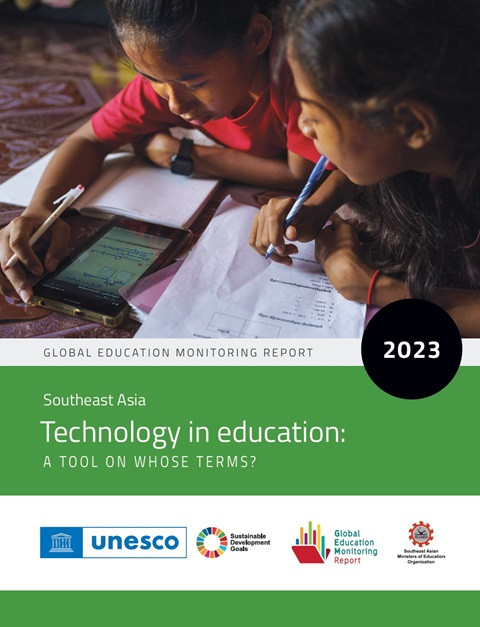 Global Education Monitoring Report 2023, Southeast Asia: Technology in Education; A Tool on Whose Terms? Year of publication: 2023 Corporate author: Global Education Monitoring Report Team | Southeast Asian Ministers of Education Organization (SEAMEO) Developed in partnership with the Southeast Asia Ministers of Education Organization (SEAMEO), and with the contribution of EdTech Hub, the fifth regional report focuses on technology in education in Southeast Asia. Characterized by a variety of contexts and resources, Southeast Asia has experienced a rapid growth in digital technology applications. In education, digital technologies have been identified for their potential to transform education and meet the region’s development aspirations. The regional report investigates both challenges and potentials, which technology as a tool and as a process can potentially contribute to, across and within countries, and education levels. The regional report on Southeast Asia covers 11 countries, Brunei Darussalam, Cambodia, Lao PDR, Indonesia, Malaysia, Myanmar, Philippines, Singapore, Thailand, Timor-Leste and Viet Nam. Extensive background research informs the regional analysis: 9 country case-studies compiled by local research teams and independent experts; 5 thematic studies produced by SEAMEO centers on open and distance learning, technology for students with disabilities, integration of technology in teaching practices, key policies issues in ICT in education; technology in technical and vocational education and training, and 3 research inputs on ICT in education practices produced by SEAMEO affiliate members and partners.