
Resources
Explore a wide range of valuable resources on GCED to deepen your understanding and enhance your research, advocacy, teaching, and learning.
1,372 Results found
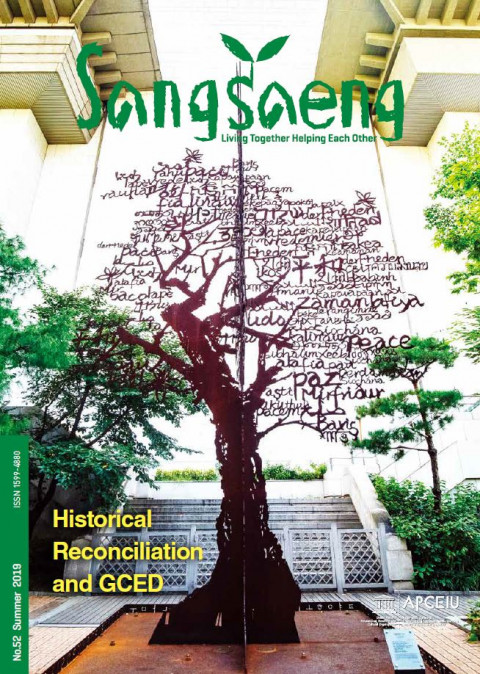 Historical Reconciliation and GCED (SangSaeng no. 52 Summer 2019) Year of publication: 2019 Corporate author: APCEIU The 52th issue of SangSaeng has been published with the theme “Historical Reconciliation and GCED.” This issue explores various endeavours aimed at attaining historical reconciliation and peace, as well as the important role education plays to achieve this goal. How we teach and learn about our past and present conflicts is critical in shaping our future. It can help enhance global citizenship and lead us to peaceful reconciliation and peacebuilding, or it can intensify the hatred of others and build up more conflicts. 3 Editor’s Note4 Special ColumnToward Reconciliation in a Divided, Dangerous World / Jonathan Jansen8 Focus: Historical Reconciliation and GCED8 Historical Dialogue among Korea, China and Japan / Jeongin Kim12 Teaching Shared Histories in Southeast Asia / Doung Bich Hanh16 Learning about Europe’s Common History / Dominik Pick19 Dual Narrative to Teach History / Sami Adwan21 Mystic of ‘General History of Afica’ / Ali Moussa Iye 24 Best Practices24 The Power of Silence / Dylan Wray27 Mobile Library / Andri Nurcahyani31 Special Report31 Migration, Displacement and Education: Building Bridges, Not Walls / Manos Antoninis33 Harmonizing ‘Heart, Head and Hand’ in Hanoi / APCEIU37 InterviewFour Students for One Common Good / Sabine Detzel41 Understanding the Asia-Pacific RegionUniting Under Legends of Ghandhara / Nadeem Omar Tarar44 Youth NetworkHELP Nurtures Youth Citizenship through Collaboration / Nephtaly Pierre-Louis and Meaghan Balzer48 LetterSpeaking Silently in the Loud World / Elvira Sarsenova50 APCEIU in Action
  Being and Becoming Global Citizens: Measuring Progress toward SDG 4.7 (Phase I: Monitoring teacher and school readiness to enact global citizenship in the Asia-Pacific region) Year of publication: 2023 Author: Rachel Parker | Jennie Chainey | Payal Goundar | Sarah Richardson | Anna Dabrowski | Amy Berry | Claire Scoular Corporate author: Australian Council for Educational Research (ACER) | APCEIU Since 2022, APCEIU and the Australian Council for Educational Research (ACER) have conducted a study to identify enhanced tools and resources for schools and systems in the Asia-Pacific region to monitor and evaluate GCED in line with SDG 4.7.The Report of the Research for Phase 1 is available in three forms: Full report; Summary; and Policy Brief.
 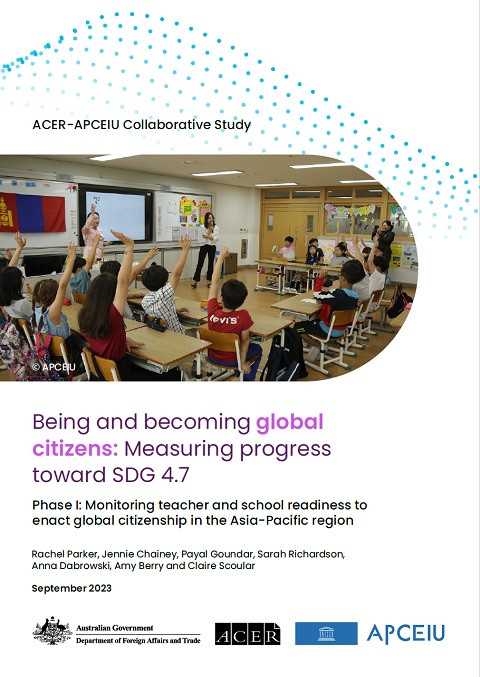 [Summary] Being and Becoming Global Citizens: Measuring Progress toward SDG 4.7 (Phase I: Monitoring teacher and school readiness to enact global citizenship in the Asia-Pacific region) Year of publication: 2023 Author: Rachel Parker | Jennie Chainey | Payal Goundar | Sarah Richardson | Anna Dabrowski | Amy Berry | Claire Scoular Corporate author: Australian Council for Educational Research (ACER) | APCEIU This is a summary report of the Being and Becoming Global Citizens: Measuring Progress toward SDG 4.7 (Phase I: Monitoring teacher and school readiness to enact global citizenship in the Asia-Pacific region), conducted by APCEIU and ACER in since 2022.
 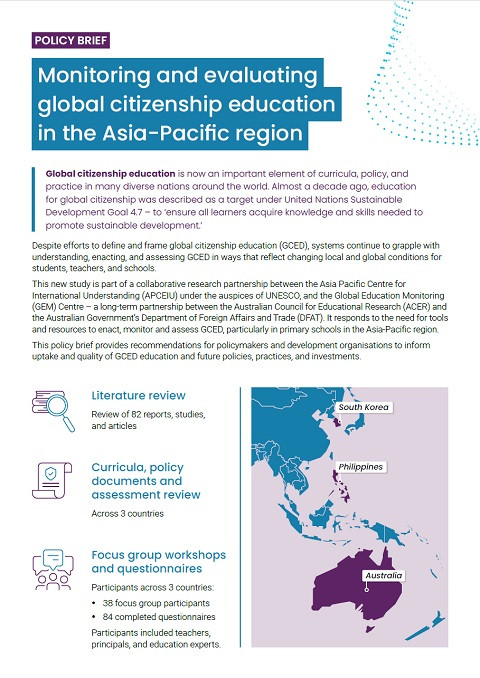 [Policy Brief] Monitoring and Evaluating Global Citizenship Education in the Asia-Pacific Region Year of publication: 2023 Author: Payal Goundar | Rachel Parker Corporate author: Australian Council for Educational Research (ACER) | APCEIU This is a policy brief version of the reserach report, Being and Becoming Global Citizens: Measuring Progress toward SDG 4.7 (Phase I: Monitoring teacher and school readiness to enact global citizenship in the Asia-Pacific region), conducted by APCEIU and ACER in since 2022.
 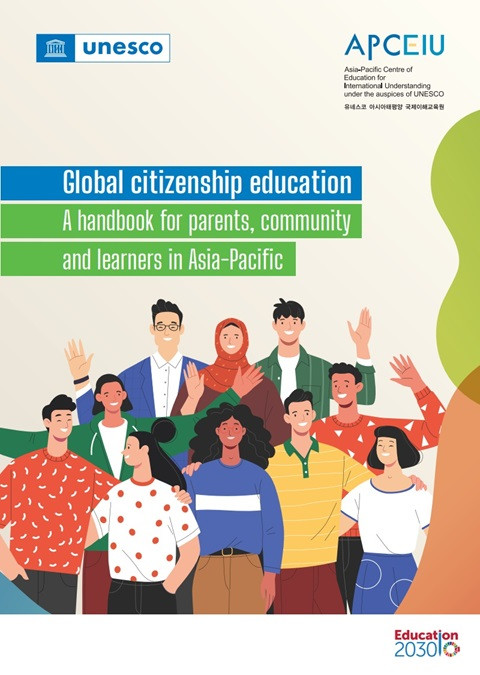 Global Citizenship Education: A Handbook for Parents, Community and Learners in Asia-Pacific Year of publication: 2023 Author: Darla K. Deardorff | Seek Ling Tan Corporate author: UNESCO Bangkok | APCEIU This handbook aspires to engage and involve parents, caregivers and the community to join the mission of developing every learner into a global citizen. To achieve this, parents, caregivers and the community will need to be empowered with the necessary GCED knowledge and skills too. In this handbook, GCED related concepts are introduced, alongside adaptable step-by-step action plans and best practices collected across the Asia-Pacific region to support parents and the community to take action in developing GCED competences in learners.
  21st Asia-Pacific Training Workshop on EIU GCED Mentorship Programme - Final Report Year of publication: 2022 Corporate author: APCEIU This report summarizes 18 GCED projects implemented in the Asia-Pacific region by the alumni of APCEIU’s 21st Asia-Pacific Training Workshop on EIU/GCED (2022).The Mentorship Programme consisted of two tracks.1) Track A: Individual Mentorship with APCEIU’s expert groups (Concretizing the GCED project with guidance from mentors)2) Track B: Developing GCED Training Programme using Design Thinking Strategy with APCEIU & Habi Education LabAsia-Pacific Training Workshop on EIU/GCED (APTW) is APCEIU’s flagship TOT (Training of Trainers) programme for educators and teacher trainers in the Asia-Pacific region, which benefitted more than 600 educators over the last 22 years. Since 2021, it has been shifted to a comprehensive training programme composed of online training workshops, mentorship, and local project implementation to further empower participants to bring changes in their local communities.In 2022, marking its 21st turn, APTW was virtually held from 30 May to 7 June with 52 passionate educators from 19 UNESCO member states in the Asia-Pacific region. This year with the theme of ‘Preparing educators for a post-pandemic world: GCED as a key to change’, the Workshop provided opportunities to explore the timely issues and pedagogies to prepare educators for the post-pandemic world.
  Global Citizenship Education: A Guide for Policymakers Year of publication: 2017 Author: Swee-Hin Toh | Gary Shaw | Danilo Padilla Corporate author: APCEIU In order to assist UNESCO Member States to integrate and strengthen Global Citizenship Education (GCED) in national education policies, strategies and plans to achieve SDG Target 4.7 effectively, the Asia-Pacific Centre of Education for International Understanding (APCEIU) has developed and published Global Citizenship Education: A Guide for Policymakers (hereafter referred to as the Guide).The Guide is mainly divided into two parts. Part 1 provides an overview of GCED, including the following three sections: the background to GCED; the rationale for GCED; and the concept of GCED. In Part 2, various selection strategies which allow each country to incorporate GCED into its current education system aligned with its own priorities and context, were divided and suggested into five major policy areas as follow: policy review and development; curriculum review and development; capacity building; knowledge creation; sharing and dissemination; and monitoring and assessment.The Guide was first published in English and Korean and additional translations will be available in the future in other languages, including French and Arabic to provide access to more readers worldwide. We hope that the Guide will provide an opportunity for policymakers and practitioners to share their experiences and insights. 세계시민교육 정책 개발을 위한 가이드 Year of publication: 2017 Author: Swee-Hin Toh | Gary Shaw | Danilo Padilla Corporate author: 유네스코 아시아태평양 국제이해교육원 유네스코 아시아태평양 국제이해교육원은 유네스코 회원국이 국가 교육정책에 세계시민교육을 반영하고 이를 통해 지속가능발전목표 4.7을 효과적으로 달성하는 것을 돕기 위해 『세계시민교육 정책 개발을 위한 가이드(Global Citizenship Education: A Guide for Policymakers)』를 개발ㆍ출간하였다.본 가이드는 크게 두 부분으로 나뉜다. 첫 번째 장에서는 세계시민교육의 배경과 논리, 그리고 개념을 차례로 살펴봄으로써 세계시민교육을 개괄하고자 하였다. 그리고 두 번째 장에서는 각국이 자신의 우선적 목표와 맥락에 맞게 세계시민교육을 현행 교육 시스템에 반영할 수 있도록 하는 다양한 선별적 전략들을 정책 검토ㆍ개발, 교육과정 검토ㆍ개발, 역량 강화, 지식의 창출ㆍ공유ㆍ확산, 모니터링 및 평가 등의 5가지 주요 정책 영역으로 나누어 제시하고자 하였다.본 가이드는 영어와 한국어로 우선 출간되었으며, 향후 전 세계의 더 많은 독자들에게 접근성을 제공하기 위하여 프랑스어와 아랍어를 포함한 다른 언어로도 추가 번역될 예정이다. 모쪼록 본 가이드가 정책입안자들과 실천가들에게 서로의 경험과 통찰을 나누는 계기를 제공할 수 있기를 바란다.
  2022 Youth Leaders’ Mentorship & Local GCED Projects: Activity Report Year of publication: 2022 Corporate author: APCEIU This report summarizes 15 GCED projects implemented in different parts of the world by the alumni of APCEIU’s Youth Leadership Workshop on GCED in 2022. Ranging from community advocacy for global citizenship to girls’ empowerment projects, 15 GCED initiatives have been taken by the team of 15 young leaders in their own communities in Asia, Europe, Africa, Latin America, and the Caribbean. APCEIU offers GCED training programmes targeting youth leaders around the globe to encourage them to achieve the SDGs through global citizenship and GCED. Since 2015, the Youth Leadership Workshop on GCED has been held every year in the Republic of Korea, inviting 50 young global leaders to take part in an intensive training programme where they share their actions, deepen their knowledge on global/local issues, enhance their motivation to take actions for a change, and establish the young leaders’ network on GCED. Since 2021, it has been shifted to a comprehensive training programme composed of online training workshops, mentorship, and local project implementation.
 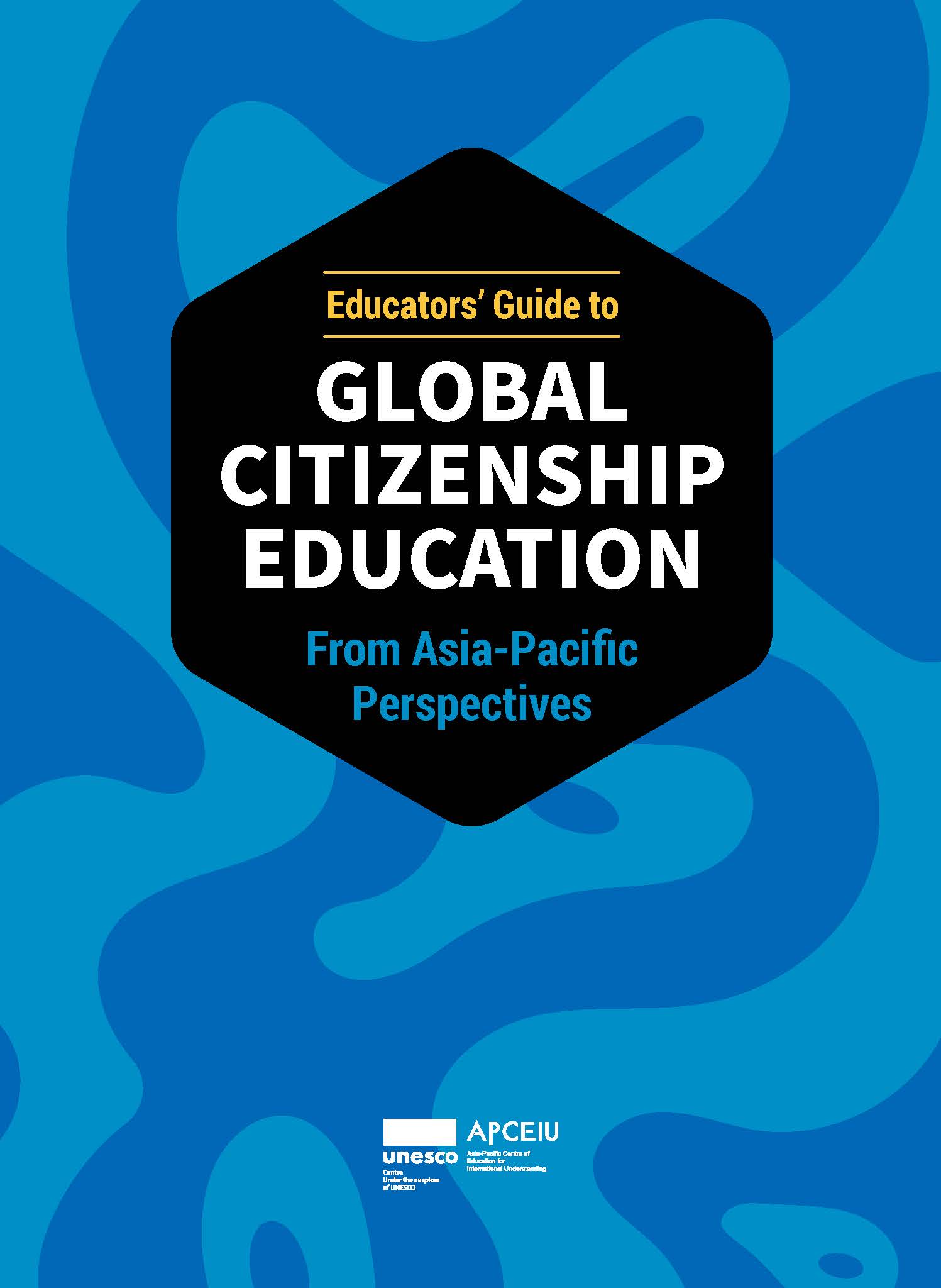 Educator's Guide to Global Citizenship Education: From Asia-Pacific Perspectives Year of publication: 2025 Author: Athapol Anunthavorasakul | Keith C. Barton | Sicong Chen | Suzanne S. Choo | Thippapan Chuosavasdi | Li-Ching Ho | Aigul Kulnazarova | Mousumi Mukherjee | Mousumi Roy | Tania Saeed | Tanya Wendt Samu | Kyujoo Seol | Jun Teng Corporate author: APCEIU Educators’ Guide to Global Citizenship Education from Asia-Pacific Perspectives is designed to translate rich discussions from Rethinking Global Citizenship Education from Asia-Pacific Perspectives (2024) into a more accessible resource for educators. This Guide supports educators by presenting scholarly insights in practical and actionable ways. Serving as a bridge between theory and practice, it helps educators grasp key ideas of global citizenship education (GCED) from Asia-Pacific perspectives, reflect on their relevance to their own contexts, and apply them through concrete activities, stories, cases examples, and instructional strategies. This Guide, which is grounded in the diverse philosophies, religions, and lived realities of the Asia-Pacific region, is intended to serve as a practical companion that helps educators understand GCED from a decolonial perspective, adapt its ideas to their own contexts, and translate it all into meaningful learning experiences for their learners. It is our sincere hope that this Guide fosters ongoing dialogue, experimentation, and collaboration, and that it contributes to nurturing learners who think critically, act with empathy and justice, and participate responsibly in shaping a more harmonious and sustainable world.