
Resources
Explore a wide range of valuable resources on GCED to deepen your understanding and enhance your research, advocacy, teaching, and learning.
3,171 Results found
 Elementos básicos de la teoría del Perdón y la Reconciliación Year of publication: 2018 Author: Leonel Narváez Gómez Corporate author: Fundación para la Reconciliación En este texto se presentan las bases teóricas para el perdón y la reconciliación que sustentan la pedagogía y acciones de la Fundación para la Reconcliación.
  Citizenship Competencies: From the Standards to the Classroom; Proposal for Integration into Academic Areas Year of publication: 2004 Author: Enrique Chaux | Juanita Lleras | Ana María Velásquez Corporate author: Colombia. Ministerio de Educación Nacional | Universidad de los Andes This book presents a proposal on how citizenship education can be promoted in schools. It offers ideas on how to integrate citizenship education within the daily life of educational institutions and, in particular, with education in traditional academic areas, with concrete examples of activities that can be implemented in the classroom. Competencias Ciudadanas: De los Estándares al Aulas; Una propuesta de integración a las áreas académicas Year of publication: 2004 Author: Enrique Chaux | Juanita Lleras | Ana María Velásquez Corporate author: Colombia. Ministerio de Educación Nacional | Universidad de los Andes Este libro presenta una propuesta sobre cómo puede promoverse la formación ciudadana en la escuela. Ofrece ideas sobre cómo integrar la formación ciudadana con la vida cotidiana de las instituciones educativas y, en particular, con la formación en las áreas académicas tradicionales, con ejemplos concretos de actividades que pueden implementarse en las aulas.
  Initial Teacher Education in Citizenship in Latin America: A Comparative Analysis of Six Countries Year of publication: 2017 Corporate author: UNESCO Santiago This document reports on a study of initial teacher education in citizenship education in Latin America undertaken as an initiative of the OREALC-UNESCO Regional Strategy on Teacher Policies. Its purpose is to examine citizenship education in the teacher education curricula of six countries in the region –Argentina, Chile, Colombia, Guatemala, Mexico and Peru – researching the general contents of the programs, their organization, and the topics covered, and analyzing teacher preparation in this crucial dimension of the formative experience provided. La formación inicial docente en educación para la ciudadanía en América Latina: Análisis comparado de seis casos nacionales Year of publication: 2017 Corporate author: UNESCO Santiago El presente informe da cuenta de un estudio impulsado por la Estrategia Regional sobre Políticas Docentes de OREALC-UNESCO, acerca de la Formación Inicial Docente en educación para la ciudadanía en América Latina. Su propósito es examinar la presencia de la educación ciudadana en el currículum de la formación de docentes de seis países de la Región –Argentina, Chile, Colombia, Guatemala, México y Perú-, interrogando acerca de qué contenidos, organizados en qué forma, y cubriendo qué temáticas, caracterizan la preparación de maestros y maestras en esta crucial dimensión de la experiencia formativa que provee la escolaridad.
 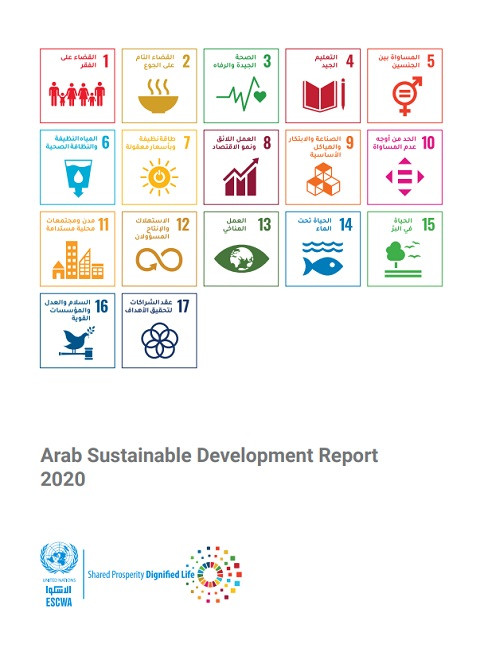 Arab Sustainable Development Report 2020 Year of publication: 2020 Corporate author: United Nations Economic and Social Commission for Western Asia (ESCWA) The 2030 Agenda calls for transformative change and paradigm shifts. Mobilizing domestic and external resources is a pressing challenge in the Arab region, and the pace of efforts on the SDGs must accelerate. However, transformative change not only requires financial resources and an acceleration of efforts but, above all, demands a shift in orientation and approach towards policy integration, environmental sustainability, and universal human rights with their emphasis on equality, justice, inclusion, fundamental freedoms and participatory politics.The story of the SDGs in the Arab region, therefore, is also a story of human rights, gender equality, sustainability and integrated development. The gravity of the task, and the scale of the ambition, are greater than measuring progress at goal, target and indicator level. Five years into the era of the 2030 Agenda and the SDGs, the present report is a reminder that the starting point for implementation and the horizon for achievement must be aligned for change to be transformative. It is only through the alignment of policies and other interventions with the overarching framework of the 2030 Agenda that the region, and the world, can hope to achieve the 2030 Agenda. How close, or how far, the Arab region is from this alignment is the story the present report aims to tell.
  Assurer à tous une éducation équitable, inclusive et de qualité: Objectif de développement durable 4 au Canada Year of publication: 2020 Corporate author: Council of Ministers of Education, Canada (CMEC) Ce rapport fournit un cadre pour communiquer l’information aux échelons pancanadien et international au sujet du travail en cours au Canada sur la réalisation de l’ODD 4. Il tire parti des données et des indicateurs liés à l’ODD 4 et inclut, dans la mesure du possible, les données provinciales et territoriales.
  Advancing Global Citizenship Education Through Global Competence and Critical Literacy: Innovative Practices for Inclusive Childhood Education (SAGE Open; Vol. 9, No. 1) Year of publication: 2019 Author: Alida Anderson Corporate author: SAGE Publications This article presents a critical policy overview of inclusive education and global citizenship education (GCED) and offers two innovative childhood education practices that support inclusion of children with disabilities through dimensions of physical and conceptual access, both noted implementation barriers to inclusive education across the globe. The first section summarizes global human rights and education initiatives that support GCED through access for children with disabilities in education and in societies. This section addresses questions of how inclusion plays a central role to the advancement of GCED, summarizing major global policy advances to inclusion, and highlighting how advancement of inclusive childhood education supports GCED. This article concludes with two innovative childhood education practices, global competence and critical literacy, which offer critical potential to contribute to GCED through conceptual and physical dimensions of access, and ultimately promote inclusive education. Ensuring Inclusive and Equitable Quality Education: Sustainable Development Goal 4 in Canada Year of publication: 2020 Corporate author: Council of Ministers of Education, Canada (CMEC) This report provides a framework to share information at the pan-Canadian and international levels on work underway in Canada to achieve SDG 4. The report builds on SDG 4 data and indicators and includes, where possible, provincial and territorial data.
  Instructional Design Based on Ecological Multiple Citizenship for Elementary Social Studies Classroom: Focusing on National Citizenship, Global Citizenship and Sustainable Development Education (Social studies education; Vol. 55, No. 1) Year of publication: 2016 Author: Kwangtaek Sim Corporate author: Korean Social Studies Association An instructional model for national citizenship, global citizenship, and sustainable development education was developed. Four lesson plans in the elementary 5thgrade social studies were suggested to show the practice of the instructional model. Three outcomes are reported. First, identity as a citizen of a nation, global citizenship, communications are interrelated. National citizenship and communications in the network society can result in a stronger vision of one’s global citizenship. This is especially the case when the wellbeing and happiness of people in neighboring countries who live across the national boundary are viewed within the domain of community- economy- ecology. Each prepares citizens through knowledge and skills that enable them to empathize, criticize constructively, and live together sustainably. The educational methods recommended to attain global citizenship perspectives are critical thinking, comparative studies, and teaching controversial issues. Those methods tend to result in a commitment to guarantee of non-domination freedom and tolerance of others. Second, discussions regarding sustainable development focused largely on deliberative engagement as a teaching method. Issues discussed were: speculative banking and its regulation; medical treatment and education as value goods; the steps necessary for households and businesses to attain sustainability; and environmental justice and social equity. The educational methods recommended to live together sustainably are planning and practice for grassroots democratic communities’ solidarity by applying back-casting strategy and systematic thinking. Thirdly, social studies classrooms intent on to enhance national citizenship, global citizenship, and sustainable development have a five step task. They, should emphasize comparison and critique→ discussion→ empathy→ planning and lastly the engagement of learners in content critical to ecological multiple citizenship.