
Resources
Explore a wide range of valuable resources on GCED to deepen your understanding and enhance your research, advocacy, teaching, and learning.
3,171 Results found
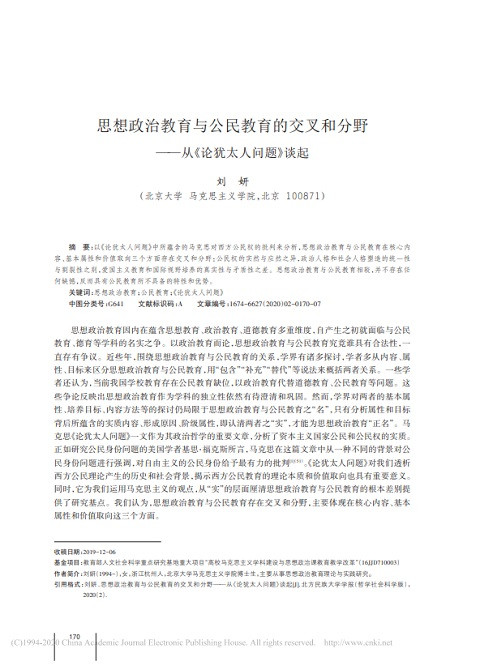 思想政治教育与公民教育的交叉和分野: 从《论犹太人问题》谈起 (北方民族大学学报; No. 2) Year of publication: 2020 Author: Liu Yan Corporate author: North Minzu University 以《论犹太人问题》中所蕴含的马克思对西方公民权的批判来分析,思想政治教育与公民教育在核心内容、基本属性和价值取向三个方面存在交叉和分野:公民权的实然与应然之异,政治人格和社会人格塑造的统一性与割裂性之别,爱国主义教育和国际视野培养的真实性与矛盾性之差。思想政治教育与公民教育相较,并不存在任何缺憾,反而具有公民教育所不具备的特性和优势。
 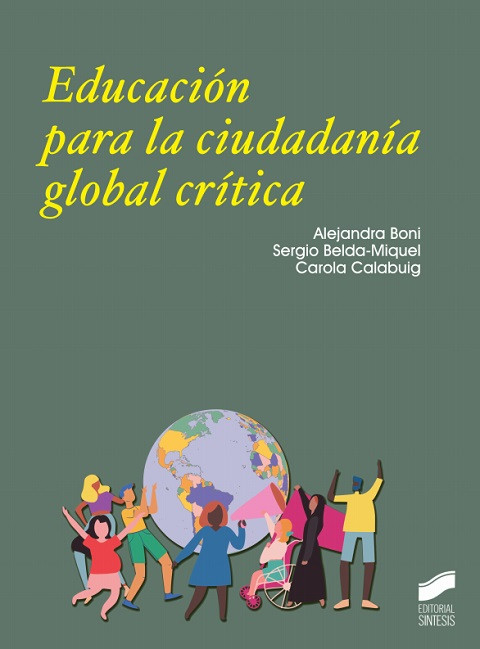 Educación para la ciudadanía global crítica Year of publication: 2020 Author: Alejandra Boni | Sergio Belda-Miquel | Carola Calabuig-Tormo Corporate author: Editorial Síntesis Este libro presenta la propuesta de la educación para la ciudadanía global crítica. Se trata de una invitación a articular una educación transformadora que resulte adecuada para generar una ciudadanía consciente, activa, movilizada, capaz de autoorganizarse, de oponer resistencias, de proponer alternativas y de encontrar caminos distintos ante la actual crisis multidimensional que ataca las bases de la convivencia y las propias condiciones que permiten la vida en el planeta.Las autoras y el autor del presente libro pretenden que este texto sirva, precisamente, para adquirir esa conciencia y para descubrir caminos para ponerla en práctica. Aunque se centra sobre todo en el ámbito educativo formal, ofrece también propuestas y reflexiones para el ámbito no formal y el informal e, incluso, para el diseño de políticas públicas.
 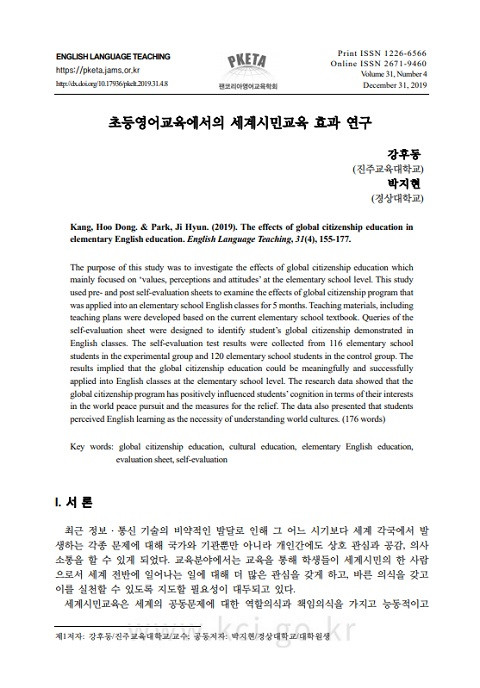 The Effects of Global Citizenship Education in Elementary English Education (English Language Teaching; Vol. 31, No.4) Year of publication: 2019 Author: Hoodong Kang | Jihyun Park Corporate author: Pan-Korea English Teachers Association (PKETA) The purpose of this study was to investigate the effects of global citizenship education which mainly focused on 'values, perceptions and attitudes' at the elementary school level. This study used pre- and post self-evaluation sheets to examine the effects of global citizenship program that was applied into an elementary school English classes for 5 months. Teaching materials, including teaching plans were developed based on the current elementary school textbook. Queries of the self-evaluation sheet were designed to identify student's global citizenship demonstrated in English classes. The self-evaluation test results were collected from 116 elementary school students in the experimental group and 120 elementary school students in the control group. The results implied that the global citizenship education could be meaningfully and successfully applied into English classes at the elementary school level. The research data showed that the global citizenship program has positively influenced students' cognition in terms of their interests in the world peace pursuit and the measures for the relief. The data also presented that students perceived English learning as the necessity of understanding world cultures. 초등영어교육에서의 세계시민교육 효과 연구 (영어교육연구; Vol. 31, No. 4) Year of publication: 2019 Author: 강후동 | 박지현 Corporate author: 팬코리아영어교육학회 이 연구는 초등학교 영어수업에서의 세계시민교육 활동을 개발 및 실시하고 학생들의 가치와 이에 대한 인식, 그리고 태도에 끼친 영향을 알아보고자 한다. 세계시민교육이 초등영어에서 실현 가능한지, 실제 수업의 방향을 점검하고 활성화할 수 있는지를 알아보고자 한다.
 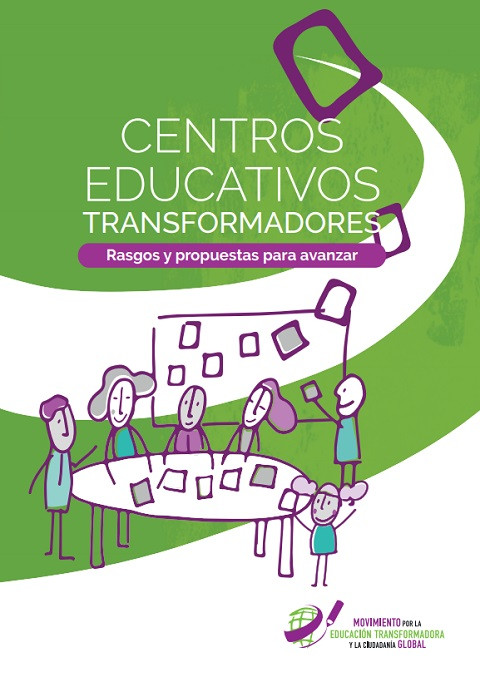 Centros educativos transformadores: Rasgos y propuestas para avanzar Year of publication: 2018 Author: Guillermo Aguado de la Obra | Yénifer López Ramos | Ani Urretavizcaya Loinaz | Elisabet Santpere Baro Corporate author: Movimiento por la educación transformadora y la ciudadanía global | Oxfam Intermón | InteRed | Entreculturas | ALBOAN Este documento es un marco teórico y práctico de innovación pedagógica para la incorporación de la Educación Transformadora para la Ciudadanía Global en el centro educativo.
 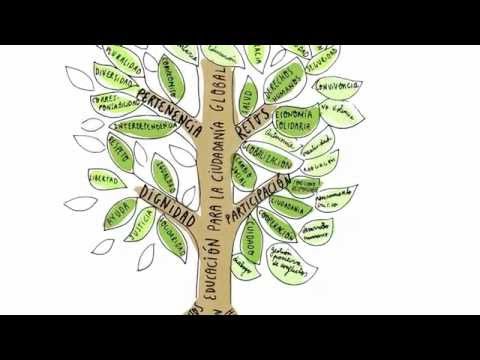 Educación para la Ciudadanía Global Year of publication: 2015 Author: AM Ketterer Corporate author: Universitat de Barcelona | Agencia Española de Cooperación Internacional para el Desarrollo (AECID) La Educación para la Ciudadanía Global orienta los aprendizajes hacia unas finalidades que están presentes en el currículo:- Promover el sentimiento de pertenencia a una comunidad planetaria.- Descubrir la interdependencia de los derechos humanos en la globalización.- Generar una cultura de la solidaridad.- Capacitar para la acción por un desarrollo humano y sostenible.Estos aprendizajes pueden relacionarse con los intereses del alumnado y, de hecho, muchos de ellos conectan con sus vivencias de la globalización.
  Global Citizenship Education in the Primary Geography Curriculum of the Republic of Korea: Content Analysis Focusing on the Semantic Structure of 2009 Revised School Curriculum (Journal of the Korean Geographical Society; Vol. 49, No. 6) Year of publication: 2014 Author: Dongmin Lee Corporate author: Korean Geographical Society The purpose of this study is to analyze the share of global citizenship education in the 2009 Revised Social Studies (geography area) School Curriculum of the Republic of Korea. I selected the achievement standards of the geography domain in the fifth and sixth grades as the subjects of analysis. The chosen subjects were examined using content analysis: I used KrKwic, a Korean language content analysis tool, to analyze the content and drew a semantic network of the analysis results using UciNet/NetDraw. I found that the geography domain of the 2009 Revised Primary School Curriculum included the concepts of and factors of global citizenship education. However, global citizenship education did not account for a major portion of the curriculum, and the curriculum achievement standards were noticeably nation-state centered. Global citizenship education factors were not closely associated with to other related factors in fact, they even revealed a isolated pattern. These findings suggest that the inclusion of global citizenship education in primary geography education is limited, because the connections between global citizenship education and related contents, such as the environment, sustainable development, conflict, and cooperation, are probably impeded. Globalization accompanies the transformation of territories, identities, and the relations between nation-states and the world, although nation-states continue to play a significant role in the globalized worlds. Therefore global citizenship education, a educational trend focusing on the global community, is particularly important and is required in the geography curriculum of the global era. I expect that the examination undertaken in this study to contribute to future curriculum revisions regarding globalizatin and global citizenship. 초등지리 교육과정에 반영된 세계시민교육 관련 요소의 구조적 특성에 관한 연구: 2009 개정 교육과정 성취기준에 대한 내용분석을 중심으로 (대한지리학회지; Vol. 49, No. 6) Year of publication: 2014 Author: 이동민 Corporate author: 대한지리학회 본 연구의 목적은 현행 2009 개정 초등사회과 지리영역 교육과정에 반영된 세계시민교육 관련 요소의 구조적 특성을 분석하는데 있다. 분석대상으로는 세계에 관한 부분을 다룬 5~6학년군 지리영역 교육과정의 성취기준을 선정하였으며, 한글 텍스트의 내용분석을 위한 소프트웨어인 KrKwic 및 의미연결망 분석도구인 UciNet/NetDraw를 활용하여 관련 개념의 출현빈도 및 의미연결망, 연결중심성을 분석하였다. 분석 결과 2009 개정 초등사회과 지리영역 교육과정은 세계시민성 함양 등 세계시민교육의 이상과 요소를 반영하고는 있지만, 교육과정상의 세계에 대한 단원들은 세계나 세계공동체 등 세계시민교육 관련 요소보다는 주로 국가를 중심으로 구성되는 특성을 보이고 있었다. 세계시민교육 관련 요소는 교육과정 성취기준상에서의 출현빈도가 낮았을 뿐만 아니라, 세계와 관련된 주요 개념들과 밀접한 관계를 맺지 못한채 사실상 고립되다시피한 특성을 나타내었다. 이로 인해 환경 및 지속가능개발, 갈등, 협력 등 세계시민교육적으로 접근할 필요성이 높은 개념들 역시 세계시민교육적인 관점과 연결될 수 있는 가능성이 제한될 수 있다는 문제점도 지적된다. 세계화 시대에는 국가도 중요한 역할을 하지만, 기존의 국가 경계가 투과적인 형태로 변화하고 국경을 넘어선 세계공동체적 관점이 중요시되는만큼 지리교육 역시 이러한 현실을 감안하여 세계시민교육적 요소를 보다 적극적으로 반영할 필요성이 제기된다. 이러한 논의를 향후 교육과정 개정에 반영함으로써, 국가뿐만 아니라 세계공동체 또한 중요시되는 세계화 시대에 보다 높은 적합성을 갖는 교육과정을 구성할 수 있으리라고 기대된다.
 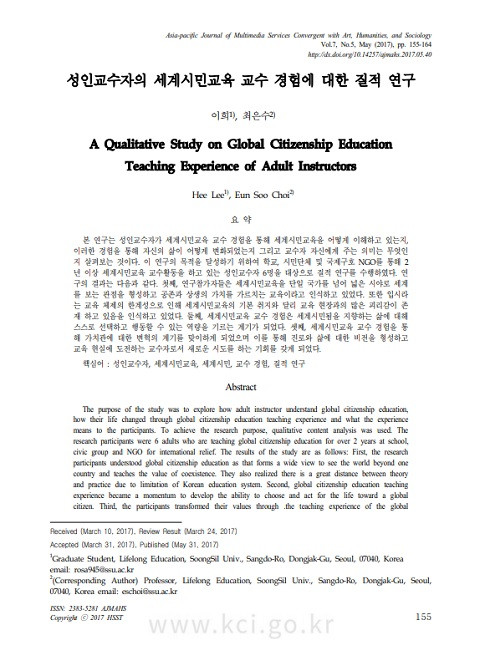 A Qualitative Study on Global Citizenship Education Teaching Experience of Adult Instructors (Asia-pacific Journal of Multimedia Services Convergent with Art, Humanities, and Sociology; Vol. 7, No.5) Year of publication: 2017 Author: Hee Lee | Eunsoo Choi Corporate author: Convergent Research Society Among Humanities, Sociology, Science, and Technology The purpose of the study was to explore how adult instructor understand global citizenship education, how their life changed through global citizenship education teaching experience and what the experience means to the participants. To achieve the research purpose, qualitative content analysis was used. The research participants were 6 adults who are teaching global citizenship education for over 2 years at school, civic group and NGO for international relief. The results of the study are as follows: First, the research participants understood global citizenship education as that forms a wide view to see the world beyond one country and teaches the value of coexistence. They also realized there is a great distance between theory and practice due to limitation of Korean education system. Second, global citizenship education teaching experience became a momentum to develop the ability to choose and act for the life toward a global citizen. Third, the participants transformed their values through .the teaching experience of the global citizenship education. They turned themselves into a teacher who challenges educational obstacles and had an opportunity to form a vision for career and life through global citizenship education teaching experience. 성인교수자의 세계시민교육 교수 경험에 대한 질적 연구 (예술인문사회 융합 멀티미디어 논문지; Vol. 7, No. 5) Year of publication: 2017 Author: Hee Lee | Eunsoo Choi Corporate author: Convergent Research Society Among Humanities, Sociology, Science, and Technology 본 연구는 성인교수자가 세계시민교육 교수 경험을 통해 세계시민교육을 어떻게 이해하고 있는지, 이러한 경험을 통해 자신의 삶이 어떻게 변화되었는지 그리고 교수자 자신에게 주는 의미는 무엇인지 살펴보는 것이다. 이 연구의 목적을 달성하기 위하여 학교, 시민단체 및 국제구호 NGO를 통해 2년 이상 세계시민교육 교수활동을 하고 있는 성인교수자 6명을 대상으로 질적 연구를 수행하였다. 연구의 결과는 다음과 같다. 첫째, 연구참가자들은 세계시민교육을 단일 국가를 넘어 넓은 시야로 세계를 보는 관점을 형성하고 공존과 상생의 가치를 가르치는 교육이라고 인식하고 있었다. 또한 입시라는 교육 체제의 한계성으로 인해 세계시민교육의 기본 취지와 달리 교육 현장과의 많은 괴리감이 존재 하고 있음을 인식하고 있었다. 둘째, 세계시민교육 교수 경험은 세계시민됨을 지향하는 삶에 대해 스스로 선택하고 행동할 수 있는 역량을 기르는 계기가 되었다. 셋째, 세계시민교육 교수 경험을 통해 가치관에 대한 변혁의 계기를 맞이하게 되었으며 이를 통해 진로와 삶에 대한 비전을 형성하고 교육 현실에 도전하는 교수자로서 새로운 시도를 하는 기회를 갖게 되었다.