
Resources
Explore a wide range of valuable resources on GCED to deepen your understanding and enhance your research, advocacy, teaching, and learning.
3,171 Results found
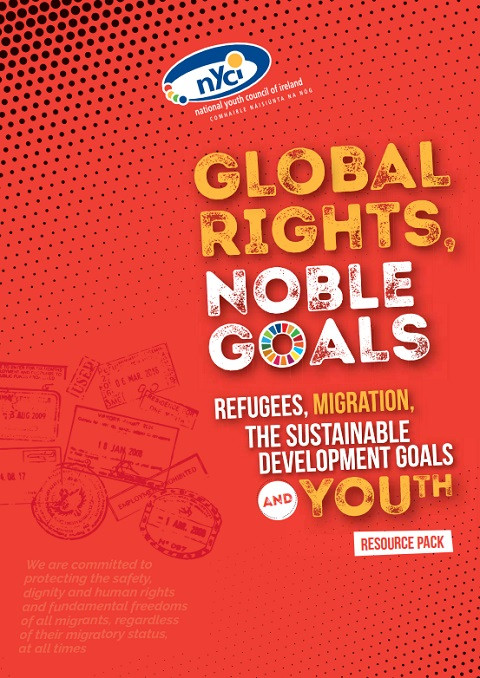 Global Rights, Nobel Goals: Refugees, Migration, the Sustainable Development Goals and Youth; Resource Pack Year of publication: 2016 Author: Valerie Duffy | Leo Gilmartin | Grace McManus | Dermot O’Brien Corporate author: National Youth Council of Ireland (NYCI) This resource pack explores the terms around migration (asylum seeker, refugee, internally displace peoples etc), the reasons that people choose or are forced to migrate and makes connections with the SDGs. It also includes a great selection of activities for young people at different ages and stages.
 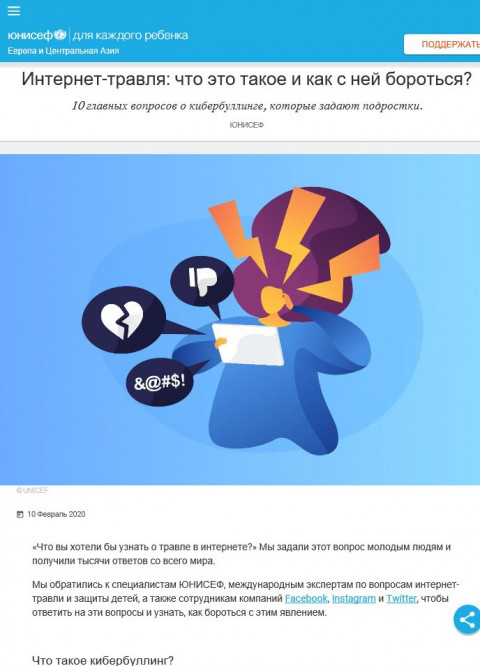 Internet Bullying: What is It and How to Deal with It? ; Top 10 Cyberbullying Questions Asked by Teens Year of publication: 2020 Corporate author: UNICEF Europe and Central Asia In the article, UNICEF experts, international experts on Internet bullying and child protection, as well as employees of Facebook, Instagram and Twitter, answer questions about how to deal with Internet bullying. Top 10 Cyberbullying Questions: How to understand that I am being harassed on the Internet? How to distinguish a joke from bullying? How does Internet bullying affect a person? Who should I talk to if someone is chasing me on the Internet? Why is it important to report bullying? I am being harassed by the Internet, but I’m afraid to talk to my parents about it. How do I turn to them for help? How can I help my friends report online bullying, especially if they don’t want to do this? The Internet gives me access to a lot of information, but it also means that I can become a victim of online violence. How can you protect yourself from cyberbullying without refusing to use the Internet? How to avoid using my personal information to manipulate or humiliate me on social networks? Is there any punishment for Internet harassment? Internet companies are not trying to solve the problem of cyberbullying. Are they responsible for this? Are there any online tools to combat bullying of children or youth? Интернет-травля: что это такое и как с ней бороться? ; 10 главных вопросов о кибербуллинге, которые задают подростки Year of publication: 2020 Corporate author: UNICEF Europe and Central Asia В статье специалисты ЮНИСЕФ, международные эксперты по вопросам интернет-травли и защиты детей, а также сотрудники компаний Facebook, Instagram и Twitter отвечают на вопросы о том, как бороться с интернет травлей. 10 главных вопросов о травле в интернете: Как понять, что меня преследуют в интернете? Как отличить шутку от травли? Как интернет-травля влияет на человека? С кем мне поговорить, если кто-то преследует меня в интернете? Почему важно сообщать о случаях травли? Я подвергаюсь интернет-травле, но боюсь поговорить с родителями об этом. Как мне обратиться к ним за помощью? Как мне помочь друзьям сообщить об интернет-травле, особенно, если они не хотят этого делать? Интернет дает мне доступ к большому количеству информации, но это также означает, что я могу стать жертвой насилия в сети. Как можно оградить себя от кибербуллинга, не отказываясь от использования интернета? Как избежать использования моей личной информации для манипуляции или унижения меня в соцсетях? Существует ли какое-то наказание за интернет-травлю? Интернет-компании не пытаются решить проблему кибербуллинга. Несут ли они за это ответственность? Существуют ли какие-нибудь онлайн-инструменты для борьбы с травлей детей или молодёжи?
  Global Citizenship Concepts in Curriculum Guidelines of 10 Countries: Comparative Analysis Year of publication: 2017 Author: Cristián Cox Corporate author: UNESCO International Bureau of Education (IBE) This paper reports on a study of concepts associated with the new construct of global citizenship education (GCED) in school curricula. We compared the national school curricula of ten countries with markedly different cultures and levels of development across different regions of the world (Africa, Asia, Europe, Latin America, and Southeast Asia) on the presence of concepts associated with GCED. The curricula of both primary and secondary education, in the areas of history and social sciences, and civics and moral education, were compared using a set of categories constructed for this study and derived from UNESCO’s definitions of GCED as well as from the International Association for the Evaluation of Educational Achievement’s (IEA) international assessment studies of civic and citizenship education. Patterns of presence/absence of GCED and related content were identified. The main finding is that only two of the ten countries’ curricula consistently included global citizenship concepts. At the same time, all ten countries, to the extent that the analysis distinguished, included content related to knowledge, values and attitudes that have the world or humanity as referent.
  Audacious Education Purposes: How Governments Transform the Goals of Education Systems Year of publication: 2020 Author: Fernando Reimers This open access book offers a comparative study of eight ambitious national reforms that sought to create opportunities for students to gain the necessary breath of skills to thrive in a rapidly changing world. It examines how national governments transform education systems to provide students opportunities to develop such skills. It analyses comprehensive education reforms in Brazil, Finland, Japan, Mexico, Peru, Poland, Portugal and Russia and yields original and important insights on the process of educational change. The analysis of these 21st century skills reforms shows that reformers followed approaches which are based on the five perspectives: cultural, psychological, professional, institutional and political. Most reforms relied on institutional and political perspectives. They highlight the systemic nature of the process of educational change, and the need for alignment and coherence among the various elements of the system in order. They underscore the importance of addressing the interests of various stakeholders of the education system in obtaining the necessary impetus to initiate and sustain change. In contrast, as the book shows, the use of a cultural and psychological frame proved rarer, missing important opportunities to draw on systematic analysis of emerging demands for schools and on cognitive science to inform the changes in the organization of instruction. Drawing on a rich array of sources and evidence the book provides a careful account of how education reform works in practice.
 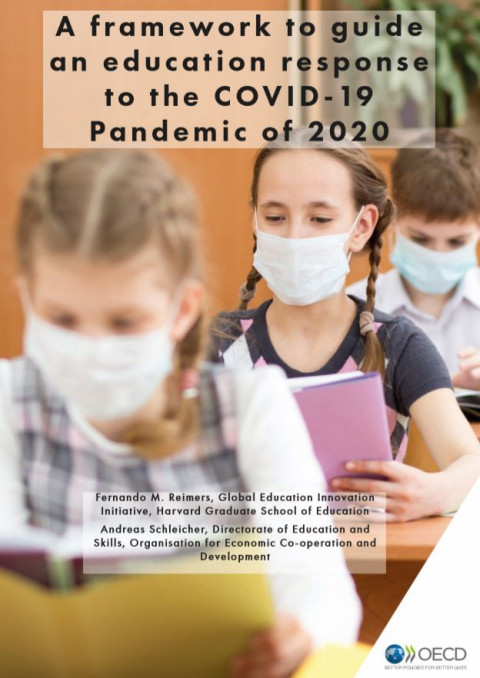 A Framework to Guide an Education Response to the COVID-19 Pandemic of 2020 Year of publication: 2020 Author: Fernando Reimers | Andreas Schleicher Corporate author: Organisation for Economic Co-operation and Development (OECD) This report aims at supporting education decision making to develop and implement effective education responses to the COVID-19 Pandemic. The report explains why the necessary social isolation measures will disrupt school-based education for several months in most countries around the world. Absent an intentional and effective strategy to protect opportunity to learn during this period, this disruption will cause severe learning losses for students.The report proposes that leaders of education systems and organizations develop plans for the continuation of education through alternate modalities, during the period of necessary social isolation. It offers a framework of areas to be covered by such plans. Un cadre pour guider une réponse éducative à la Covid-19 en cas de pandémie de 2020 Year of publication: 2020 Author: Fernando Reimers | Andreas Schleicher Corporate author: Organisation for Economic Co-operation and Development (OECD) Ce rapport vise à appuyer la décision de l'éducation faisant de développer et mettre en œuvre des réponses éducatives efficaces au Covid-19 en cas de pandémie. Le rapport explique pourquoi les mesures d'isolement social nécessaires perturberont l'éducation en milieu scolaire pendant plusieurs mois dans la plupart des pays à travers le monde. En l'absence d'une stratégie délibérée et efficace pour protéger l'occasion d'apprendre au cours de cette période, cette perturbation entraîne des pertes sévères d'apprentissage pour les étudiants.Le rapport propose que les dirigeants des systèmes d'éducation et les organisations à élaborer des plans pour la poursuite de l'éducation des modalités alternatives, au cours de la période d'isolement social nécessaire. Il offre un cadre de zones à couvrir par ces plans.
 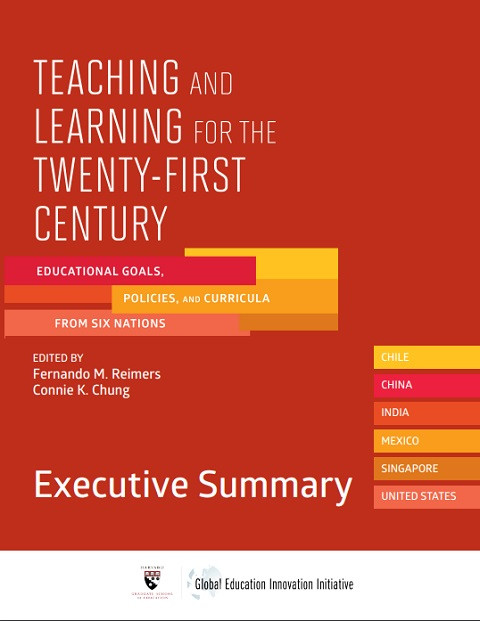 [Summary] Teaching and Learning for the Twenty-first Century: Educational Goals, Policies, and Curricula From Six Nations Year of publication: 2016 Author: Fernando Reimers | Connie K. Chung Corporate author: Global Education Innovation Initiative The book aims to foster discussions on how national education policies support students to prepare for life, work and civic participation in the 21st century. It examines six countries—Chile, China, India, Mexico, Singapore, and the United States—exploring how each one defines, supports, and cultivates those competencies that students will need in order to succeed in the current century. [Resumen] Enseñanza y aprendizaje en el siglo XXI : Metas, políticas educativas y currículo en seis países Year of publication: 2016 Author: Fernando Reimers | Connie K. Chung Corporate author: Global Education Innovation Initiative Este libro pretende promover discusiones sobre cómo las políticas educativas nacionales ayudan a los estudiantes a prepararse para la vida, el trabajo y la participación ciudadana en el siglo XXI. Revisa además cómo los objetivos educativos, los retos y las oportunidades que se perciben, reflejan los contextos histórico, político, y cultural de los sistemas educativos, los cuales a su vez varían en tamaño, mecanismos de gobernanza y condiciones demográficas, entre otros factores.
 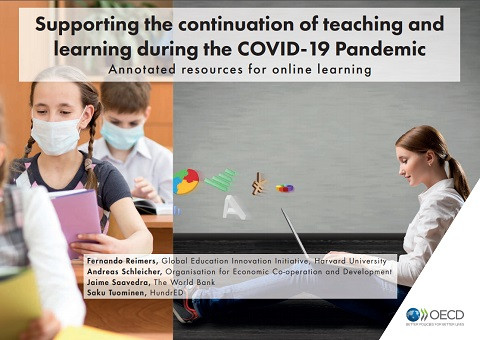 Supporting the Continuation of Teaching and Learning during the COVID-19 Pandemic: Annotated Resources for Online Learning Year of publication: 2020 Author: Fernando Reimers | Andreas Schleicher | Jaime Saavedra | Saku Tuominen Corporate author: Organisation for Economic Co-operation and Development (OECD) | Global Education Innovation Initiative | HundrED This resource discusses the second module of a series which presents the results of a comparative analysis of emerging educational needs and responses as the pandemic unfolds across countries around the world. The overall goal of this series is to facilitate the rapid design process and implementation of adaptive responses to the emerging education challenges, and to protect young people’s educational opportunities during and following the pandemic. This second module presents a first set of online educational resources to support the continuity of teaching and learning during the 2019-20 COVID-19 Pandemic with education leaders around the world. The resources were compiled from responses to the same survey used to produce the first module: A framework to guide an education response to the COVID-19 Pandemic, and additional online sources were included to enhance the list in order to support the continuity of learning for students who have access to the internet and digital devices.