
Resources
Explore a wide range of valuable resources on GCED to deepen your understanding and enhance your research, advocacy, teaching, and learning.
3,165 Results found
 Pants to Poverty: A Global Citizenship Resource for Primary Schools Year of publication: 2018 Author: Stephanie Brown | Jennifer McMillan Corporate author: Smalls for All | Scotdec | International Development Education Association Scotland (IDEAS) With a focus on the right to an education, this series of 9 lessons explores issues affecting children living in poverty and encourages young people to take action for positive change. This resource aims to develop children’s awareness of their connections to and understanding of some of the issues affecting children living in poverty. There is a particular focus on the importance of education and its impact on our life chances.
 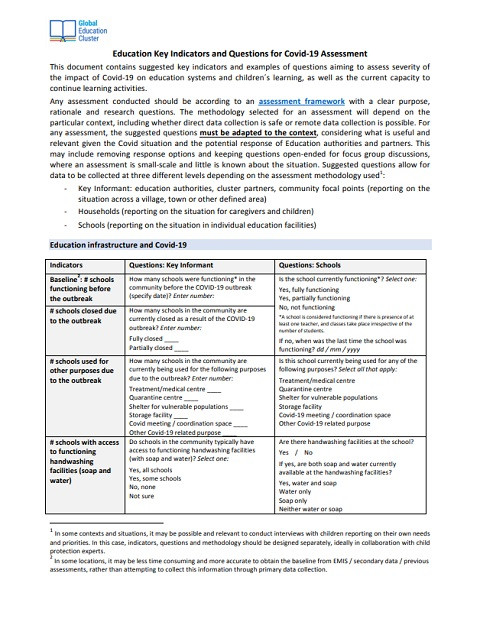 Education Key Indicators and Questions for Covid-19 Assessment Year of publication: 2020 Corporate author: Global Education Cluster This document contains suggested key indicators and examples of questions aiming to acess severity of the impact of Covid-19 on education systems and children’s learning, as well as the current capacity to continue learning activities.
 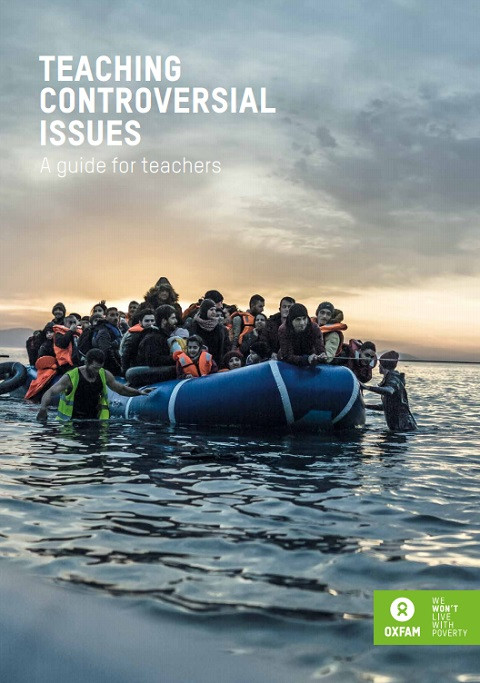 Teaching Controversial Issues: A Guide for Teachers Year of publication: 2018 Corporate author: Oxfam GB This revised and updated version of Oxfam’s popular guide recognises the changes in social and political contexts in recent years and seeks to support educators in their discussions with young people in this complex environment. In increasingly divisive and polarised times, the need for young people to feel confident in tackling controversial issues is more pressing than ever. Advances in technology and the rise of social media mean that it is more important than ever for young people to think critically to become effective global citizens.This guide explores:• What controversial issues are.• Reasons for teaching controversial issues.• The value of a global citizenship education approach.• Guidance and classroom strategies for handling and exploring controversial issues.• Some practical activities for teaching controversial issues.
  What Makes Me a Global Citizen? Year of publication: 2020 Corporate author: Stride This material aims to develop a personal sense of what it means to be a global citizen and to begin to realize a personal potential to change things. Learners will think about what makes them a global citizen and create a poster using pictures and words to illustrate this.
 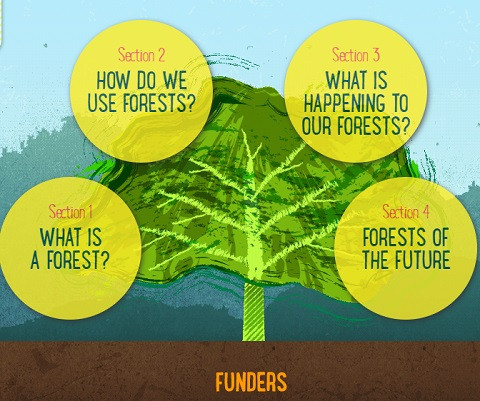 Our Forest, Our Future Corporate author: Scotdec This material helps teachers and pupils to explore the interdependence of people and forests and the vital role forests play in sustaining our environment – in the past, the present and hopefully the future. The Scots Pine forests in Scotland and the Congo Basin rainforest in Africa provide case studies through which pupils will begin to understand why our forests are under threat and the implications for our planet.In making connections between consumerism, people and the environment, pupils will be encouraged to see how they and their actions have an impact on the lives of others globally. It encourages reflection on the possible futures of the world's forests and ways of taking positive actions for a future where people and forests co-exist in a sustainable way. The resource is structured around a global citizenship framework devised by Oxfam.
 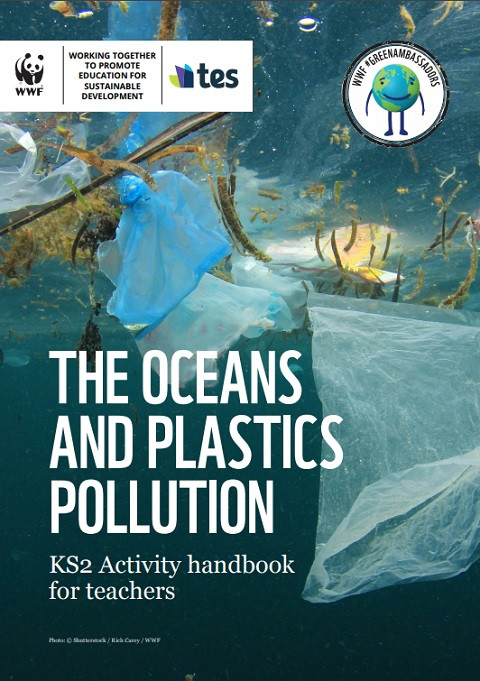 The Oceans and Plastics Pollution: KS2 Activity Handbook for Teachers Year of publication: 2019 Corporate author: World Wide Fund for Nature (WWF) | Tes This resource enables pupils to explore the role of the oceans in our lives and why healthy oceans are so vital to our future. By looking at the impact of plastics pollution on the oceans, pupils will also consider what steps we can all take to safeguard these precious waters for generations to come. It contains a range of activities aimed at teachers of 7-11 year-olds. It is intended that this resource will be used in cross-curricular work and all activities can be linked to the National Curricula of England, Northern Ireland, Scotland and Wales. Teachers will find that the material can be adapted for use with different ages and abilities.The six activities engage pupils in active learning methods, encouraging them to work together to solve problems, to think creatively, and to see themselves as active participants in their communities and the wider world. With a growing awareness of the part that they can play in creating a better future for our oceans, pupils will take a step on the journey to becoming global citizens and sustainability champions of the future.
 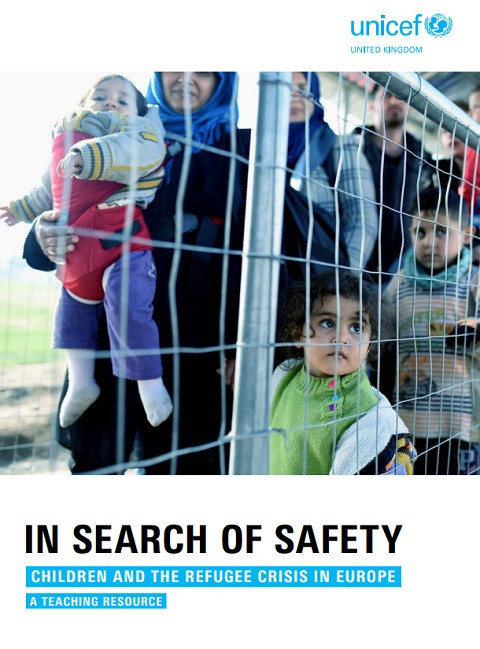 In Search of Safety: Children and the Refugee Crisis in Europe; A Teaching Resource Year of publication: 2016 Author: Carolyne Willow Corporate author: UNICEF UK This resource aims to allow teachers to help their students – primary (age seven upwards) and secondary – make sense of the current refugee and migrant crisis in Europe, within a children’s rights framework. It provides an historical overview of migration, contextualising the challenges we face today with a reminder of what has gone before. Guidance is provided to help you prepare for potentially difficult conversations and situations, and to enable you to be ready to access help for any child that needs it. The resource also includes ideas for extra activities by curriculum area, and ideas for whole-school activities. A range of films, images and information is provided and sign-posted to help you bring these activities to life.
  Maintaining Global Citizenship Education in Schools: A Challenge for Australian Educators and Schools (Vol. 43, No. 4) Year of publication: 2018 Author: John Buchanan | Nina Burridge | Andrew Chodkiewicz Corporate author: Australian Journal of Teacher Education Teaching students about global citizenship remains a critical challenge for schools and communities, especially in a developed country like Australia. With increasingly difficult national and international contexts and its marginal place in the school curriculum, there is an urgent need to help maintain support for global citizenship education. Recognising the challenges and limitations, key ways to raise its profile include considering available pedagogies, drawing on the existing Australian Global Education framework, taking up existing curriculum opportunities, accessing quality educational resources and relevant teacher education programs, and working in partnership with key Non-Government Organisations.
 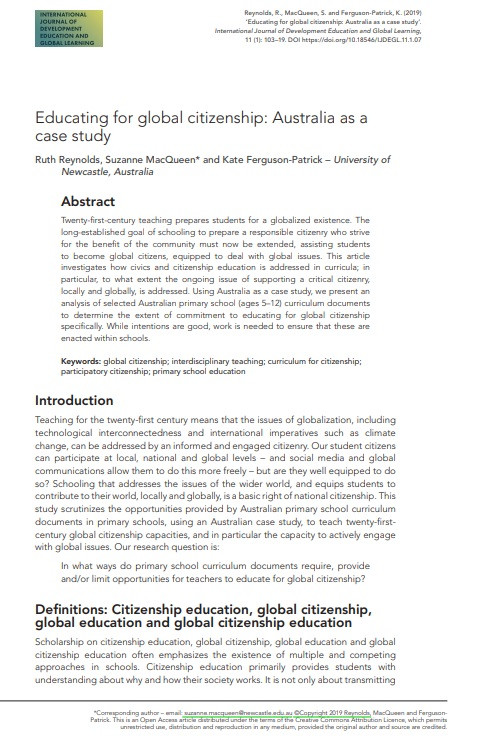 Educating for Global Citizenship: Australia as a Case Study (Vol. 11. No. 1) Year of publication: 2019 Author: Ruth Reynolds | Suzanne MacQueen | Kate Ferguson-Patrick Corporate author: UCL Press Twenty-first-century teaching prepares students for a globalized existence. The long-established goal of schooling to prepare a responsible citizenry who strive for the benefit of the community must now be extended, assisting students to become global citizens, equipped to deal with global issues. This article investigates how civics and citizenship education is addressed in curricula; in particular, to what extent the ongoing issue of supporting a critical citizenry, locally and globally, is addressed. Using Australia as a case study, we present an analysis of selected Australian primary school (ages 5–12) curriculum documents to determine the extent of commitment to educating for global citizenship specifically. While intentions are good, work is needed to ensure that these are enacted within schools.
 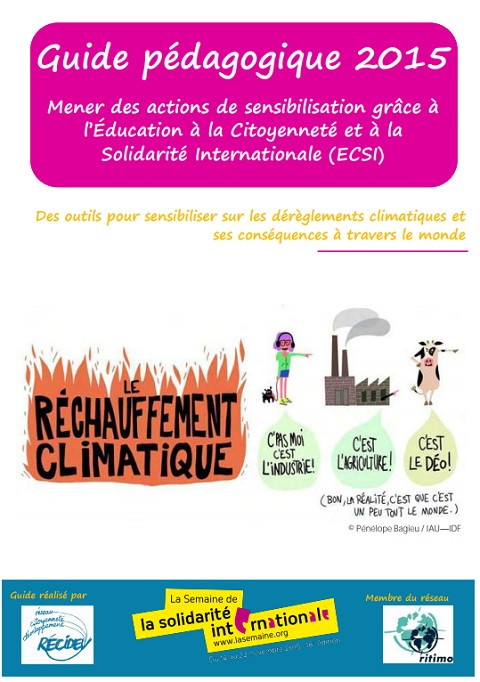 Guide pédagogique 2015: Mener des actions de sensibilisation grâce à l'Education à la Citoyenneté et à la Solidarité Internationale (ECSI): Des outils pour sensibiliser sur les dérèglements climatiques et ses conséquences à travers le monde Year of publication: 2015 Corporate author: RéCiDev Besançon (Réseau Citoyenneté Développement) Ce guide pédagogique est destiné aux acteurs de la semaine de solidarité internationale qui se déroule tous les ans autour de la 3ème semaine de novembre en France. Il propose des outils d'Education à la citoyenneté et à la solidarité internationale (ECSI) pour mener des actions de sensibilisation sur le dérèglement climatique et ses conséquences à travers le monde. Il comprend :- une première partie théorique sur les valeurs et la pédagogie de l'ECSI- une seconde partie pratique qui présente des outils pédagogiques- une troisième partie qui donne des informations pratiques sur les acteurs et les ressources en ECSI.