
Resources
Explore a wide range of valuable resources on GCED to deepen your understanding and enhance your research, advocacy, teaching, and learning.
3,165 Results found
 PEERs for Peace!: A Community-Based Resource Guide for Peace Education Year of publication: 2016 Author: Tyler Hook | Kathleen Kardos | Athena Lao | Sharanya Vasudevan | Erin Wall Corporate author: UNESCO International Institute for Capacity-Building in Africa (IICBA) | University of Pennsylvania This peace education resource guide is designed for teachers of upper primary grades in sub‐Saharan African countries to help them foster the development of peaceful skills, attitudes, and practices in their students and empower students to use peaceful tools to respond productively to conflict. Throughout the seven units in this peace education resource guide, students will explore the concepts of problem solving, empathy, effective communication, and respect (PEER) and how they relate to conflict in various areas of their lives, including families, schools, communities, governments, and more.
  디지털 시대 시민되기: 초등학교 고학년 (디지털 시민교육 시리즈 2nd) Year of publication: 2019 Author: 김양은 | 배은주 | 박정원 | 김영환 | 김형태 | 심성호 Corporate author: 방송통신위원회 | 한국정보화진흥원 본 자료는 초등 고학년(5~6학년) 대상 디지털시민교육을 위한 교육자료이다. 6가지의 역량별로 교수학습지도안과 학생 활동지로 구성되어 있다.
 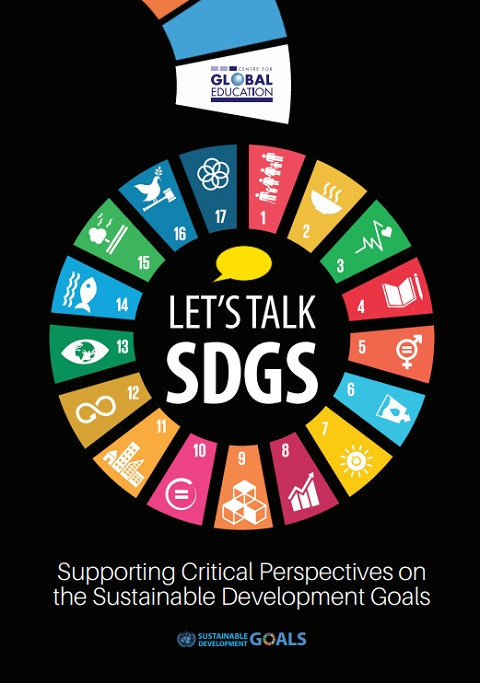 Let’s Talk SDGs: Supporting Critical Perspectives on the Sustainable Development Goals Year of publication: 2020 Author: Caroline Murphy Corporate author: Centre for Global Education (CGE) This resource is an invitation to development educators to critically interrogate the Sustainable Development Goals and discuss their capacity to deliver upon their intended outcomes. It invites users to ask if the SDGs can support effective global learning and represent a sound critique of the international system. The resource is a useful starting point for a critical discussion on the Goals' capacity for effective advocacy and education toward the eradication of poverty and inequality.
  Action Against Hate Speech: A Resource for Teaching and Learning About Hate Speech Year of publication: 2017 Corporate author: Tony Blair Institute for Global Change | Generation Global This module is designed to prepare students for dialogue around the issue of hate speech. It builds upon other work on human rights, and explores the balancing act between freedom of expression and freedom from insult. Additionally, it prepares students for dialogue on these issues in our facilitated videoconferences and on our safe, secure, online community. This material helps you and your students to get involved in educating, advocating, and acting against hate speech in your communities.
 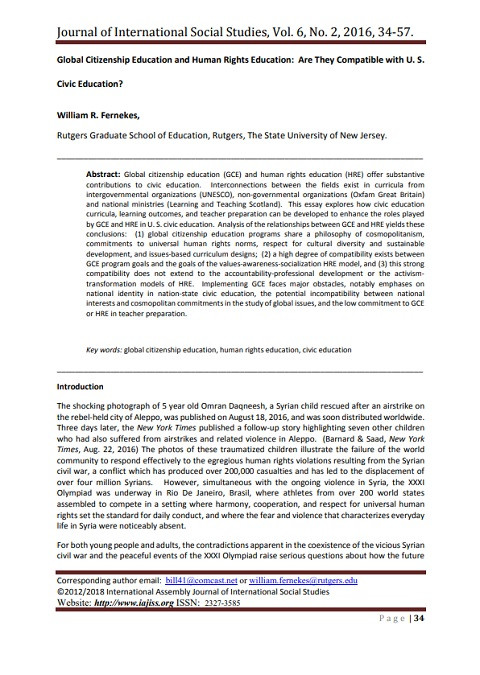 Global Citizenship Education and Human Rights Education: Are They Compatible With U. S. Civic Education? (Journal of International Social Studies; Vol. 6, No. 2) Year of publication: 2016 Author: William R. Fernekes Corporate author: International Assembly of the National Council for the Social Studies Global citizenship education (GCE) and human rights education (HRE) offer substantive contributions to civic education. Interconnections between the fields exist in curricula from intergovernmental organizations (UNESCO), non-governmental organizations (Oxfam Great Britain) and national ministries (Learning and Teaching Scotland). This essay explores how civic education curricula, learning outcomes, and teacher preparation can be developed to enhance the roles played by GCE and HRE in U. S. civic education. Analysis of the relationships between GCE and HRE yields these conclusions: (1) global citizenship education programs share a philosophy of cosmopolitanism, commitments to universal human rights norms, respect for cultural diversity and sustainable development, and issues-based curriculum designs; (2) a high degree of compatibility exists between GCE program goals and the goals of the values-awareness-socialization HRE model, and (3) this strong compatibility does not extend to the accountability-professional development or the activismtransformation models of HRE. Implementing GCE faces major obstacles, notably emphases on national identity in nation-state civic education, the potential incompatibility between national interests and cosmopolitan commitments in the study of global issues, and the low commitment to GCE or HRE in teacher preparation.
  Putting the Voice of Young People at the Heart of Global Citizenship Education Year of publication: 2014 Author: Douglas Bourn Corporate author: UCL Institute of Education | Erasmus+ This briefing is aimed at policy-makers across Europe who are engaged with, or interested in ensuring that education and international development programmes give consideration to the voices of young people. It also aims to contribute to policy-makers responses to how they are implementing the Sustainable Development Goals.
 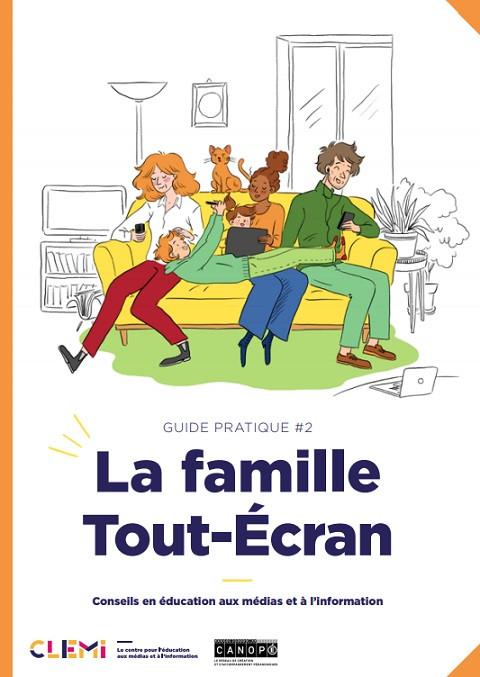 La famille Tout-Écran: Conseils en éducation aux médias et à l’information Year of publication: 2019 Corporate author: Centre pour l’éducation aux médias et à l’information (CLEMI) | Réseau Canopé L’Éducation aux Médias et à l'Information (EMI) devient une exigence républicaine au cœur du Parcours citoyen, un enjeu éducatif et sociétal incontournable dans un environnement où le numérique est omniprésent.Dans un monde globalisé et complexifié, la définition et la compréhension de la source de l’information constituent une priorité pour déjouer les tentatives de manipulation et de désinformation.Les enjeux sociétaux de l’EMI dépassent les murs de l’école et doivent mobiliser tous les acteurs pour renforcer le continuum entre temps scolaire et hors temps scolaire.Ce guide bénéficie de l’expertise des professionnels du CLEMI et de son réseau de pédagogues, de partenaires institutionnels, associatifs et médiatiques. Issu de cette mobilisation, cet ouvrage est le produit d’un groupe de travail dédié aux pratiques informationnelles des jeunes, composé de membres représentant du ministère de l’Éducation nationale et de la Jeunesse, du ministère de la Culture, France Télévisions, Radio France, le CSA, CNRS Images, Ceméa, la Ligue de l’enseignement, la CNAF, Jets d’encre et l’Icem-Pédagogie Freinet.
  Research in Teaching and Learning About the Holocaust: A Dialogue Beyond Borders Year of publication: 2017 Author: Monique Eckmann | Doyle Stevick | Jolanta Ambrosewicz-Jacobs Corporate author: International Holocaust Remembrance Alliance (IHRA) | Metropol A multilingual expert team of the International Holocaust Remembrance Alliance (IHRA) collected and reviewed research on teaching and learning about the Holocaust in fifteen languages identified nearly 400 studies resulting in more than 600 publications.This systematic review includes research conducted in most IHRA Member Countries as well as several non-member countries. The multilingual focus of the project enables cross-cultural analyses and the transfer of knowledge between various regions and countries. The book’s two parts present the research first by language and then by selected themes. This innovative transnational, trans-lingual study reflects IHRA’s core mission: to shape and advance teaching and learning about the Holocaust worldwide.The second outcome is a set of bibliographies in fifteen languages. These bibliographies comprise references to empirical research on teaching and learning about the Holocaust. They also include abstracts or summaries of most of publications. Each bibliography includes research from a single language or related group of languages.
 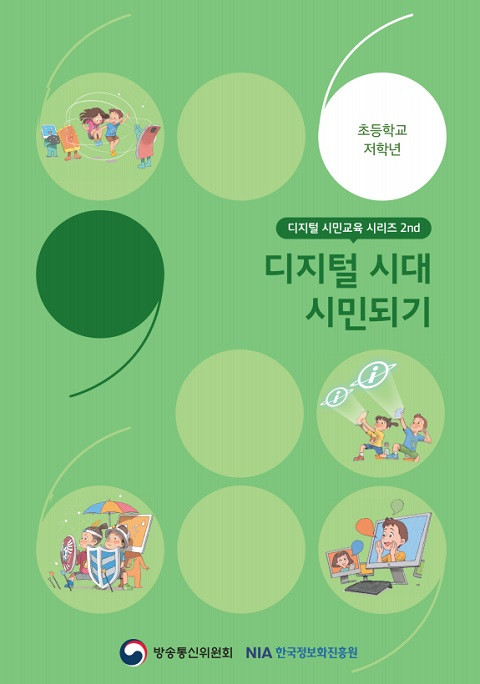 디지털 시대 시민되기: 초등학교 저학년 (디지털 시민교육 시리즈 2nd) Year of publication: 2019 Author: 김양은 | 배은주 | 박정원 | 김영환 | 김형태 | 심성호 Corporate author: 방송통신위원회 | 한국정보화진흥원 본 자료는 초등 저학년(3~4학년) 대상 디지털시민교육을 위한 교육자료이다. 6가지의 역량별로 교수학습지도안과 학생 활동지로 구성되어 있다.
 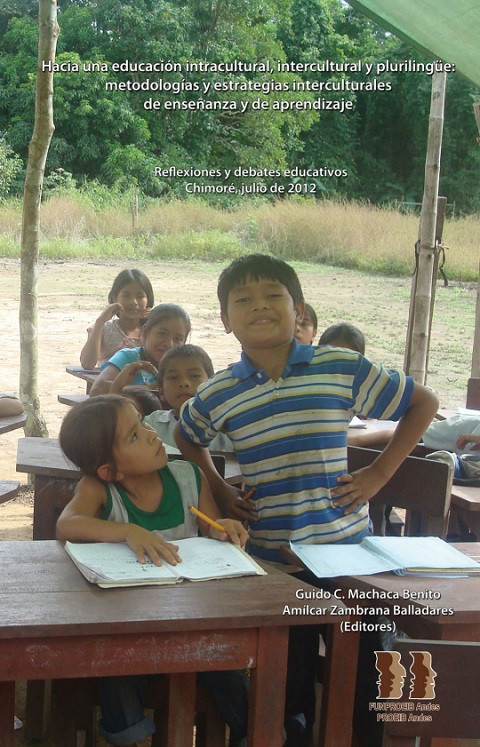 Towards an Intracultural, Intercultural and Multilingual Education: Intercultural Teaching and Learning Methodologies and Strategies Year of publication: 2013 Author: Guido C. Machaca Benito | Amílcar Zambrana Balladares Corporate author: FUNPROEIB Andes This document presents the memories of the seminar - workshop "Towards an intracultural, intercultural and multilingual education: intercultural teaching and learning methodologies and strategies" held in Chimoré, Cochabamba in July 2012.