
Resources
Explore a wide range of valuable resources on GCED to deepen your understanding and enhance your research, advocacy, teaching, and learning.
3,182 Results found
 코로나19와 미래핵심역량: 디지털 리터러시, 자기주도적 학습 능력, 협업 능력을 중심으로 Year of publication: 2020 Author: 김자영 | 옥현진 | 신태섭 | 박미희 | 이정연 | 최보미 Corporate author: 경기도교육연구원 코로나19로 인한 원격수업 과정에서 미래핵심역량인 디지털 리터러시, 자기주도적 학습 능력, 협업 능력 신장에 대한 중요성이 부각되고 있으며 이에 대한 실태를 분석하고 교육의 방향을 설정하는 것이 중요할 것이다. 본 연구는 경기도 지역의 초중고 일반 학교 및 혁신학교, 연구 및 시범학교(디지털교과서 시범학교, 민주시민교육실천학교 등)를 대상으로 미래핵심역량인 디지털 리터러시, 자기주도적 학습 능력, 협업능력에 대한 실태를 조사하고 이러한 미래핵심역량에 영향을 미칠 수 있는 학생 및 학교 맥락변인을 분석하였으며, 분석 결과를 토대로 미래교육이 나아가야 할 방향을 제시하고자 한다.
  2019 꿈다락 토요문화학교 드림 아트랩 4.0 'Everyday is Playful Media' 결과자료집 Year of publication: 2019 Corporate author: 한국예술종합학교 융합예술센터 2019 꿈다락 토요문화학교 드림 아트랩 4.0 프로그램 관련, 한국예술종합학교 융합예술센터가 운영하고 성북구립미술관, N15가 협력하여 진행한 'Everyday is Playful Media' 프로그램 결과자료집으로 자료집은 Playful Thinking, Playful Learning, Playful Making 3개의 세부 프로그램 운영 내용 및 결과 전시 등의 과정이 기록되어있다. 본 저작물은 한국예술종합학교 융합예술센터에서 2019년 작성하여 공공누리 제4유형으로 개방한 ‘2019 꿈다락 토요문화학교 드림 아트랩 4.0 'Everyday is Playful Media' 결과자료집’을 이용하였으며 해당 저작물은 한국문화예술교육진흥원 arte 라이브러리 홈페이지(lib.arte.or.kr)에서 무료로 다운받으실 수 있습니다.
  교육과정 연계 디지털 리터러시 교육 가이드라인 개발 연구 Year of publication: 2023 Author: 김진숙 | 김묘은 | 박일준 | 배현순 | 이지은 | 임동신 | 임지영 | 홍선주 Corporate author: 한국교육학술정보원 본 연구는 본격적인 2022 개정 교육과정의 시행에 앞서 1차적으로 2015 교육과정과 연계된 디지털 리터러시 교수학습 자료 개발 및 확산을 지원하기 위한 이론적 기초를 확보하기 위해 수행되었다. 이를 위해 2022 개정 교육과정에서 명시된 디지털 소양(Digital lteracy)의 개념을 구조화하고, 2022 개정 정보과교육과정 시안 개발 연구(교육부 외, 2022.12.31)에서 도출된 디지털 리터러시 내용 체계의 대영역, 세부 요소 내용 등을 학습 요소와 수행 기대로 구체화하였다. 또한 교육과정의 교과 연계를 기반으로, 교과 성취기준을 분석하고 향후 디지털 리터러시 교육을 실천하기 위한 교수학습 자료 개발 방향을 제시하는 데 목적을 두었다.이러한 목적을 달성하기 위해 디지털 리터러시 구성 체계 정립, 교과 교육과정과 디지털 리터러시 내용 기준 연계, 디지털 리터러시 경험 및 교수학습 사례 분석과 교과 연계 디지털 리터러시 교육 방안 수립을 연구 내용으로 하여 결과를 도출하였다. 이를 위한 기본 연구 방법으로는 디지털 리터러시의 구성 요소 도출을 위한 문헌 분석과 키워드 네트워크 분석이 이루어졌으며, 현장 교사 심층면담(FGI)과 월드카페테리아 형식의 전문가 워크숍 등을 통해 디지털 리터러시 구성 체계의 타당성을 확보하였다. * 본 저작물은 '한국교육학술정보원'에서 2023년 작성하여 공공누리 제4유형으로 개방한 '교육과정 연계 디지털 리터러시 교육 가이드라인 개발 연구(작성자:김진숙 외)'을 이용하였으며, 해당 저작물은 한국교육학술정보원 홈페이지(https://www.keris.or.kr/)에서 무료로 다운받으실 수 있습니다.
 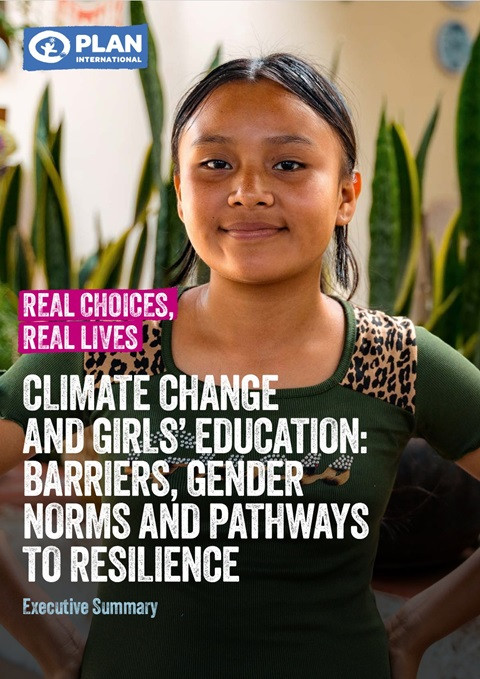 [Executive Summary] Climate Change and Girls' Education: Barriers, Gender Norms and Pathways to Resilience Year of publication: 2023 Corporate author: Plan International This is the Executive Summary for the report: Climate Change and Girls’ Education: Barriers, Gender Norms and Pathways to Resilience. The full technical report and accompanying synthesis report are also available. [Résumé analytique] Changement climatique et éducation des filles: entraves, normes sexistes et chemins vers la resilience Year of publication: 2023 Corporate author: Plan International This is the Executive Summary for the report: Climate Change and Girls’ Education: Barriers, Gender Norms and Pathways to Resilience. The full technical report and accompanying synthesis report are also available. [Resumen Ejecutivo] Cambio climático y educación de las niñas: barreras, normas de género, y rutas hacia la resiliencia Year of publication: 2023 Corporate author: Plan International This is the Executive Summary for the report: Climate Change and Girls’ Education: Barriers, Gender Norms and Pathways to Resilience. The full technical report and accompanying synthesis report are also available.
 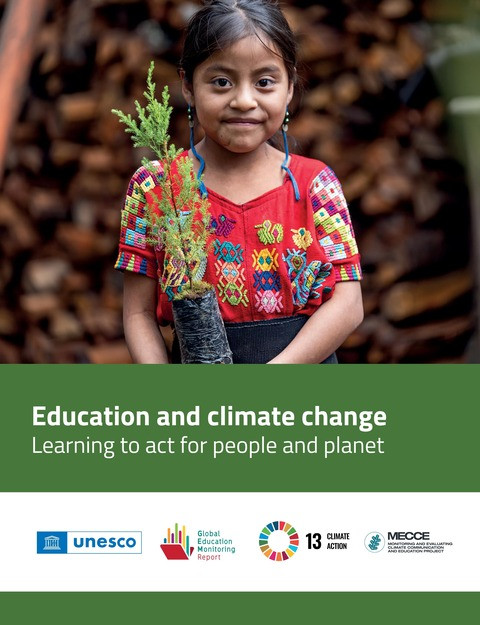 Education and Climate Change: Learning to Act for People and Planet Year of publication: 2024 Corporate author: Global Education Monitoring Report Team | Monitoring and Evaluating Climate Communication and Education Project (MECCE) | University of Sakatchewan How can education lead to climate change action?Despite strong evidence on the impact of education on other development outcomes and the role it plays in developing professional capacity for sustainable development transitions, education is often absent from other sectors’ strategic, policy, planning and financing considerations. The Global Education Monitoring Report is introducing a new series to advance dialogue on the interrelationship of education with the other Sustainable Development Goals.The first paper in the series focuses on climate change. It starts by reviewing the growing impact of climate change on education before turning to the role of education in climate action. Education has a somewhat underappreciated contribution to developing professional capacities for the transition to a green economy. Formal, non-formal and informal learning are also commonly believed to be playing a critical role in motivating actions on climate change mitigation and adaptation.Yet a positive association between education attainment and unsustainable consumption levels, as well as inconclusiveness of much research on the direct impact of education on climate change adaptation and mitigation actions has in part contributed to education receiving low priority in global and national climate change agendas.This paper argues that climate change education needs to adapt to fulfil its potential. The education paradigm cannot rely solely on knowledge transfer but needs to focus on social and emotional, and action-oriented learning.Much of the research has focused on the impact of education attainment and cognitive learning. More research is therefore needed to assess other drivers through which education can influence behaviours and motivate climate change action. Such research is needed to formulate viable education reform packages that improve the curriculum, strengthen climate-readiness of schools and education systems, engage learners and prepare educators accordingly.
 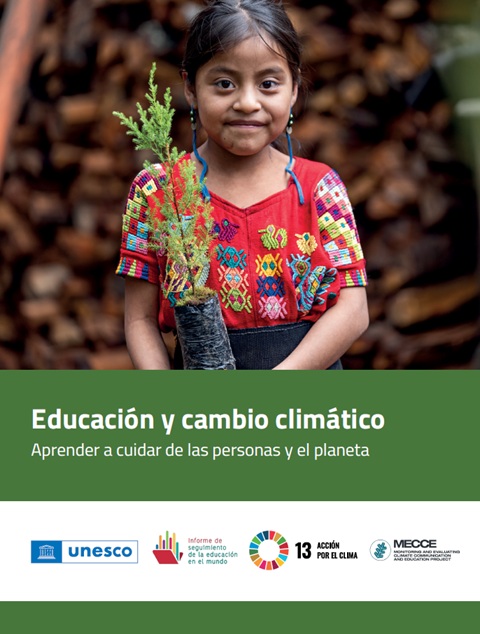 Educación y cambio climático: aprender a cuidar de las personas y el planeta Year of publication: 2024 Corporate author: Global Education Monitoring Report Team | Monitoring and Evaluating Climate Communication and Education Project (MECCE) | University of Sakatchewan ¿Cómo puede la educación conducir a la acción contra el cambio climático?A pesar de las sólidas pruebas existentes sobre la repercusión de la educación en el logro de otros objetivos de desarrollo y la función que desempeña en el desarrollo de la capacidad profesional para las transiciones hacia el desarrollo sostenible, la educación suele estar ausente de las consideraciones estratégicas, políticas, de planificación y de financiación de otros sectores.El Informe de seguimiento de la educación en el mundo presenta una nueva serie destinada a fomentar el diálogo sobre la interrelación de la educación con los demás Objetivos de Desarrollo Sostenible. El primer documento de la serie se centra en el cambio climático, y empieza por analizar el creciente impacto del cambio climático en la educación antes de pasar a abordar la función de la educación en la acción climática.La contribución de la educación al desarrollo de capacidades profesionales para la transición a una economía verde está en cierta medida infravalorada. Al mismo tiempo, existe la conciencia de que el aprendizaje, tanto formal como no formal e informal, desempeña una función esencial a la hora de motivar la acción en materia de mitigación del cambio climático y adaptación a sus efectos.Sin embargo, la existencia de una correlación positiva entre el nivel de educación y los niveles de consumo insostenibles, así como la falta de conclusiones de muchas investigaciones sobre la repercusión directa de la educación en la mitigación del cambio climático y la adaptación a sus efectos, han contribuido en parte a que se otorgue escasa prioridad a la educación en las agendas mundiales y nacionales sobre el cambio climático.En este documento se sostiene que es necesario adaptar la educación sobre el cambio climático para que desarrolle todo su potencial. El paradigma educativo no puede basarse únicamente en la transferencia de conocimientos, sino que debe centrarse en el aprendizaje socioemocional y orientado a la acción. Gran parte de la investigación se ha centrado en analizar el logro educativo y los resultados que se alcanzan mediante el aprendizaje cognitivo. Por ello, es necesario seguir investigando para evaluar otros factores mediante los cuales la educación puede influir en los comportamientos y motivar la acción contra el cambio climático. Estas investigaciones son necesarias para formular paquetes de reformas educativas viables que mejoren los planes de estudios, refuercen la preparación de las escuelas y los sistemas educativos para el cambio climático, impliquen a los educandos y preparen a los educadores en consecuencia.
  UNESCO Roadmap for Implementing the Global Action Programme on Education for Sustainable Development Year of publication: 2014 Corporate author: UNESCO To create a world that is more just, peaceful and sustainable, all individuals and societies must be equipped with and empowered by knowledge, skills and values as well as be instilled with a heightened awareness to drive such change. There is now a growing international recognition of Education for Sustainable Development (ESD) as an integral element of quality education and a key enabler for sustainabledevelopment. Both the Muscat Agreement adopted at the Global Education For All Meeting in 2014 (GEM) and the proposal for Sustainable Development Goals (SDGs) developed by the Open Working Group of the UN General Assembly on SDGs (OWG) include ESD in the proposed targets for the post-2015 agenda.In 2013, the 37th session of the General Conference of UNESCO endorsed the Global Action Programme (GAP) on ESD as the follow-up to the UN Decade of ESD (2005-2014). Building on the achievements of the Decade, the GAP aims to generate and scale up concrete actions in ESD. The present Roadmap communicates the GAP endorsed by UNESCO Member States (37 C/Resolution 12) to decision-makers, stakeholders and actors, and provides suggestions for the implementation of the GAP, as well as details on UNESCO’s role. Feuille de route de l'UNESCO pour la mise en œuvre du programme d'action mondiale sur l'éducation pour le développement durable Year of publication: 2014 Corporate author: Organisation des Nations Unies pour l'éducation, la science et la culture (UNESCO) Les défis mondiaux interconnectés d'aujourd'hui exigent des réponses qui sont enracinées dans l'esprit de notre humanité collective. Je crois que les risques et les opportunités auxquels nous sommes confrontés appellent à un changement de paradigme qui ne peut être intégré dans nos sociétés par le biais de l'éducation et de l'apprentissage. Le rôle de l'éducation en tant que catalyseur pour la construction d'un avenir meilleur et plus durable pour tous a acquis une reconnaissance croissante, ce qui conduit à la déclaration de la Décennie des Nations Unies pour l'éducation pour le développement durable en 2005. Cet engagement a gagné davantage de force lorsque les États membres se sont engagés à promouvoir Education pour le développement durable au-delà de la fin de la Décennie au Royaume-Nationsconférenceon développement durable 2012 - Rio + 20. Pour tirer profit des réalisations et de créer un nouvel élan lorsque la Décennie des Nations Unies se ferme en 2014, l'UNESCO, en tant qu'organisme chef de file de la Décennie, a mis au point un programme d'action mondiale sur l'éducation pour le développement durable. Sur la base de larges consultations et des contributions d'un large éventail de parties prenantes, le programme a été approuvé par le Generalconférencein UNESCO 2013. Elle intervient à un moment où la communauté internationale est chargé de proposer un nouvel ensemble d'objectifs de développement durable qui sont orientés vers l'action, global dans la nature et universellement applicable.En tant que suivi de la Décennie, le Programme d'action mondial est également conçu comme un béton, contribution tangible à l'après 2015 développement et d'éducation agendas L'. Le Programme d'action mondial est livré avec une feuille de route de mise en œuvre détaillé. Il est destiné à toutes les parties prenantes - gouvernements, les organisations de la société civile, le secteur privé, les médias, la communauté universitaire et de recherche, les organisations intergouvernementales et d'autres institutions pertinentes qui facilitent et appuyer l'apprentissage et la formation, tout le chemin aux enseignants et aux apprenants individuels. La feuille de route explique le Programme de but, les objectifs et les domaines d'action prioritaires afin de permettre l'orientation stratégique et l'engagement des parties prenantes, ainsi que des stratégies de mise en œuvre et de Suivi. Je souhaite que le Programme d'action mondial, qui sera lancé à l'éducation Worldconférenceon pour le développement durable à Aichi-Nagoya, au Japon (Novembre 2014), sera successed dans la mobilisation de la communauté des acteurs de l'éducation pour le développement durable et de fournir des conseils pratiques pour sa mise en œuvre effective . Nous avons tous un intérêt profond dans son succès. Avant-propos Introduction - A Better Tomorrow Begins Today - De la Décennie de l'EDD au programme d'action mondial - Esquisse d'une vision commune - Comprendre EDD Feuille de route - But et objectifs - Domaines d'action prioritaires - Stratégies - Mécanismes - Ressources - Suivi et évaluation Annexe - Action Globale Programme sur l'éducation pour le développement durable comme le suivi de la Décennie des Nations Unies pour le développement durable après 2014.