
Resources
Explore a wide range of valuable resources on GCED to deepen your understanding and enhance your research, advocacy, teaching, and learning.
3,126 Results found
 Asia-Pacific Migration Report 2024: Assessing Implementation of the Global Compact for Migration Year of publication: 2024 Corporate author: UN. Economic and Social Commission for Asia and the Pacific (UN. ESCAP) | International Labour Organization (ILO) | International Organization for Migration (IOM) | UN. Office of the United Nations High Commissioner for Human Rights (UN. OHCHR) | United Nations Centre for Human Settlement Programme (UN Habitat) | United Nations Entity for Gender Equality and the Empowerment of Women (UN Women) | United Nations Development Programme (UNDP) | UNESCO | UN. Office of the United Nations High Commissioner for Refugees (UNHCR) | UN. Office on Drugs and Crime (UNODC) | World Bank This report aims to assess the state of GCM implementation in the region, its progress and its challenges since the first Asia-Pacific Regional Review of Implementation of the Global Compact for Migration in 2021, in which a Chair’s summary was adopted. Chapters 2 to 5 each consider clusters of GCM objectives, as presented in General Assembly resolution 73/326 and following the same groupings as in the Asia-Pacific Migration Report (APMR) 2020. These chapters open with a summary of the discussions from the first regional review of the GCM, held in 2021, drawing from the Chair’s summary. Chapter 6 provides overarching recommendations to support and accelerate GCM implementation in Asia and the Pacific. At the end of the report are annexes with information on the GCM objectives and guiding principles, references to migration in Voluntary National Reviews to the High-Level Political Forum on Sustainable Development, and GCM pledges at the level of the State or City, Municipality and Local Authority.
  Global Education Monitoring Report 2025: Gender Report: Women Lead for Learning Year of publication: 2025 Corporate author: UNESCO Barriers to gender equality in education leadership positions can and need to be overcome This gender edition, which is part of the 2024/5 Global Education Monitoring Report on leadership in education, addresses the remaining obstacles for women in their efforts to climb up the leadership ladder in education. Although the teaching profession has been feminized, there are considerable gender gaps in school management, education administration and political leadership positions, a situation illuminated in detail with examples from all over the world. Gender disparity in education leadership is the result of entrenched stereotypes and biases – conscious or unconscious – on the one hand and on the other institutional processes or professional development mechanisms that are insufficiently supportive. Research suggests that women leaders display some differences relative to men in their approaches to education leadership, for example the extent to which they emphasize collaboration, build relationships with the community and retain a focus on learning. While there is little to suggest that these differences are universal or immutable, the evidence points to the fact that the lack of equitable opportunities translates to less talent and fewer diverse approaches to leadership, which are a loss to education systems – not to mention the obvious need for equity. This is particularly evident in parts of the world where gender disparities remain large. This gender edition calls on countries to take a much closer look at gender disparity in education leadership and adopt measures to raise awareness, improve mechanisms and strengthen capacities to address discrimination and bias and thus encourage women who aspire to such careers to pursue them. Gender disparity in education leadership is the result of entrenched stereotypes and biases – conscious or unconscious – on the one hand and on the other institutional processes or professional development mechanisms that are insufficiently supportive. Research suggests that women leaders display some differences relative to men in their approaches to education leadership, for example the extent to which they emphasize collaboration, build relationships with the community and retain a focus on learning. While there is little to suggest that these differences are universal or immutable, the evidence points to the fact that the lack of equitable opportunities translates to less talent and fewer diverse approaches to leadership, which are a loss to education systems – not to mention the obvious need for equity. This is particularly evident in parts of the world where gender disparities remain large. This gender edition calls on countries to take a much closer look at gender disparity in education leadership and adopt measures to raise awareness, improve mechanisms and strengthen capacities to address discrimination and bias and thus encourage women who aspire to such careers to pursue them.
  Journée internationale de l’éducation 2025 : L’intelligence artificielle et l’éducation : préserver l’autonomie dans un monde automatisé Year of publication: 2025 Corporate author: UNESCO La Journée internationale de l’éducation 2025 vise à : Examiner les nouvelles possibilités offertes par l’IA, en particulier pour l’enseignement, l’apprentissage, l’évaluation et l’administration éducative. Promouvoir le développement de compétences critiques en matière d’IA en dotant les éducateurs et les apprenants des aptitudes nécessaires pour comprendre, utiliser et influencer les technologies d’IA, conformément aux cadres de compétences en IA de l’UNESCO pour les enseignants et les élèves. Veiller à ce que l’IA complète, plutôt qu’elle ne remplace, les éléments humains essentiels de l’apprentissage, notamment le développement des relations en présentiel et de l’intelligence émotionnelle.
  Countering Holocaust Denial and Distortion through Education: A Guide for Teachers Year of publication: 2025 Corporate author: UNESCO Antisemitic hate speech, disinformation, and conspiracy theories thrive during crises, making it vital for teachers to address these issues in school curricula. Social media has significantly amplified the spread of such harmful content, including Holocaust denial and distortion. These falsehoods, rooted in antisemitic prejudice and conspiratorial thinking, threaten our shared historical memory and promote hatred. To effectively combat these issues, it is essential to have a comprehensive understanding of the Holocaust —how and why the genocide of the Jewish people occurred. This knowledge helps us recognize the causes and risk factors, contributing to the prevention of future atrocity crimes and the fight against antisemitism. In the digital age, it is also imperative to be able to decipher the manipulation of history, and the misrepresentation of the past.The guide provides teachers with the necessary tools and guidance to prevent the spread of Holocaust denial and distortion. It equips teachers with knowledge, teaching principles, and strategies to foster digital literacy, historical understanding, and critical thinking in learners. Aimed primarily at history and social sciences teachers, it outlines key concepts, teaching methods, and approaches to counter Holocaust denial and distortion.
  Strategies to Counter Antisemitism: A Handbook for Educators Year of publication: 2025 Corporate author: UNESCO Education is the first line of defence against hate and prejudice. By targeting the root causes of hate ideologies, deconstructing the stereotypes that underlie them from an early age, and promoting inclusive models, education is the keystone of a holistic approach to combating discrimination. Tackling antisemitism through education requires tailored content that addresses its complex, shifting and multilayered forms, both past and present.Acknowledging the topic’s complexity and the paucity of resources available to education stakeholders, this concise guide developed by UNESCO and funded by the European Commission aims to provide a roadmap for policymakers, curriculum developers and educators on current approaches and initiatives. It presents ten educational practices, each grounded in academic literature and illustrated by a promising educational initiative that operationalizes core pedagogical principles. The handbook is built around the three core learning domains which inform UNESCO’s approach to Global Citizenship Education: cognitive, socio-emotional, and behavioural learning.Conceived as an accessible operational guide for practitioners, this resource sets out to start a larger conversation about the needs of educators for tackling contemporary forms of antisemitism. It aims to encourage investments in high-quality empirical research that can pave the way for a better approach to combat antisemitism.
  The Representation of Jews, Judaism and Antisemitism in School Textbooks and Curricula in Europe Year of publication: 2025 Corporate author: UNESCO Jewish communities have been integral to Europe’s social fabric for centuries, preserving rich religious and cultural traditions while facing recurring periods of exclusion, persecution, and resilience. School textbooks are important vantage points to understand how this history and heritage is represented, (de)constructed and embedded into a shared historical and cultural memory. They are also important practical tools used daily by students, teachers, and parents.This comprehensive research, carried out by UNESCO in collaboration with the Georg-Eckert-Institute and supported by funding from the European Commission, examines the ways in which Jewish culture, history, life, and anti-Jewish prejudice are represented in secondary school materials across eight European nations.The publication highlights opportunities within curricula to address Jewish experiences and antisemitism, reviews how these themes are incorporated into textbooks, and analyzes the narratives and portrayals that arise. The study also looks at the use of visual sources and assesses whether Jewish viewpoints and agency are sufficiently reflected. The findings highlight both recurring stereotypes and promising practices. By showcasing these contrasts, the study provides targeted recommendations to guide the creation of more inclusive educational materials.
 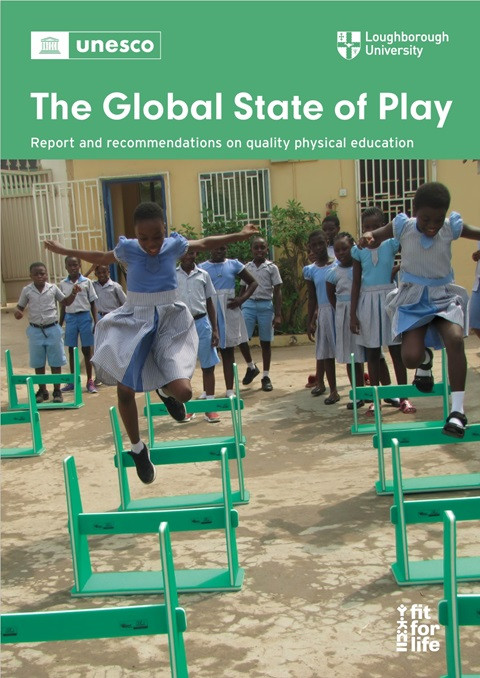 The Global State of Play: Report and Recommendations on Quality Physical Education Year of publication: 2024 Corporate author: UNESCO | Loughborough University Active lifestyles are key to ensuring both individual well-being and sustainable, social development. Quality Physical Education (QPE) plays a key role in achieving this by fostering lifelong physical activity, improving young people’s mental and emotional well-being, and developing critical life skills. UNESCO’s sport initiative, Fit for Life, advocates QPE as a cost-effective investment. Despite its potential as a core curricula subject, UNESCO data reveal that PE is often under-prioritized and due to a lack of investment in certain areas, such as staff training and facilities, potential benefits are not fully realised for students around the world. This investment gap connects directly to a delivery gap. Although 83% of countries worldwide report PE as compulsory in schools, there remain significant issues with the quality of delivery and the diversity of lesson planning within curricula:• Only 1 in 3 secondary school students worldwide meet the minimum requirement of 180 minutes of PE minutes per week set out in UNESCO’s Quality Physical Education Policy Guidelines.• Only 61.7% of schools fully include students with disabilities alongside their peers without disabilities in PE classes.• Only 7.1% of schools implement equal PE time for boys and girls, despite 54.5% of countries having policies or plans for it. Policymakers, PE practitioners and academia are encouraged to take action to implement PE policies, increase investment in PE, upskill PE teachers, enhance PE curricula and promote more equitable and inclusive PE environment.
  Global Education Monitoring Report 2024: Gender Report; Technology on Her Terms Year of publication: 2024 Corporate author: UNESCO | Global Education Monitoring Report Team The 2024 Gender Report tells the increasingly positive story of girls’ education access, attainment and achievement, which is helping reverse decades of discrimination. But there is much more to say on gender equality in and through education. A companion to the 2023 GEM Report, this report looks at the interaction between education and technology with a gender lens. First, it looks at the impact of technology on girls’ education opportunities and outcomes. Although many instances are seen of radio, television and mobile phones providing a learning lifeline for girls, particularly in crisis contexts, gender divides exist globally in both access to technology and in digital skills, although the latter are smaller among youth compared to among adults. Biased social and cultural norms inhibit equitable access to and engagement with technology in and outside of school, with girls always left on the wrong side of the divide. While technology offers many girls opportunities to access important education content in safe environments, for instance on comprehensive sexuality education, technology in practice often exacerbates negative gender norms or stereotypes. Social media usage impacts learners’ and particularly girls’ well-being and self-esteem. The ease with which cyberbullying can be magnified through the use of online devices in the school environment is a cause of concern, as is the biased design of artificial intelligence algorithms. Second, the report looks into the role of education on the shape of future technological development. It shows that women struggle to pursue STEM careers, which manifests from an early age in the form of anxiety in mathematics and develops into a reluctance to study STEM subjects, ultimately resulting in a lack of women in the technology workforce. Women make up only 35% STEM graduates, and hold only a quarter of science, engineering and ICT jobs. Ensuring women participate on equal terms in shaping the world’s ongoing digital transformation will ensure that technology works for everyone and takes into consideration the needs of all humanity.
  Youth Report 2024: Technology in Education; A Tool on Our Terms! Year of publication: 2024 Corporate author: UNESCO | Global Education Monitoring Report Team | Restless Development The 2024 Youth Report on technology in education is the result of an extensive consultation process in partnership with Restless Development involving +1500 youth and students across 8 regions. The consultations invited participants to reflect on the key challenges and opportunities for the use of technology in education in their regions through the lenses of the recommendations in the global 2023 Global Education Monitoring Report on technology in education: Technology on our terms. The discussions centred on the need for the use of technology in education to be appropriate for national and local contexts and to be equitable and leave no one behind. The report calls for decisions about technology in education to keep learners at the centre when deciding whether the use of technology in education would be appropriate, equitable, evidence-based, and sustainable. Through this report, young people have described what technology on their terms would look like. It concludes with a call to action calling which highlights concrete recommendations that governments can follow to ensure that technology in education is on youth terms.
 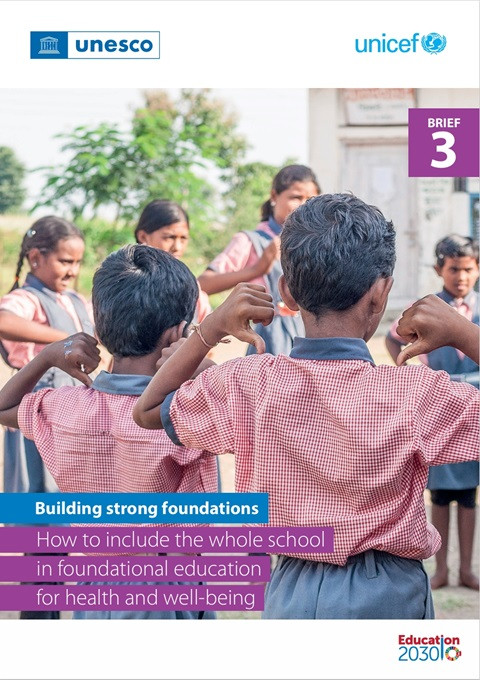 Building Strong Foundations: How to Include the Whole School in Foundational Education for Health and Well-being (Building Strong Foundations Brief; 3) Year of publication: 2024 Corporate author: UNESCO | United Nations Children's Fund (UNICEF) In a rapidly changing world, establishing strong foundations for children is vital for their well-being and resilience. Quality education is central to this endeavour and is the key to lifelong health and success. Recognizing that children thrive in the classroom when they are in good health, it is crucial to learn about health and well-being early on in primary schools. The Building Strong Foundations briefs, developed jointly by UNESCO and UNICEF, provide evidence-based guidance to support primary school-aged children to thrive through foundational education for health and well-being. Drawing from extensive research and consultations with leading experts from various fields and across the world, these briefs serve as a roadmap for education stakeholders to equip learners with the requisite knowledge and skills to navigate their current and future health and well-being needs. The present document is the third of four briefs. It explores how a whole-school approach to health and well-being in primary schools generates significant impacts on learners’ health, well-being and education. The brief shares practical guidance and case studies to distill six essential elements for an effective whole-school approach to health and well-being.