
Resources
Explore a wide range of valuable resources on GCED to deepen your understanding and enhance your research, advocacy, teaching, and learning.
3,126 Results found
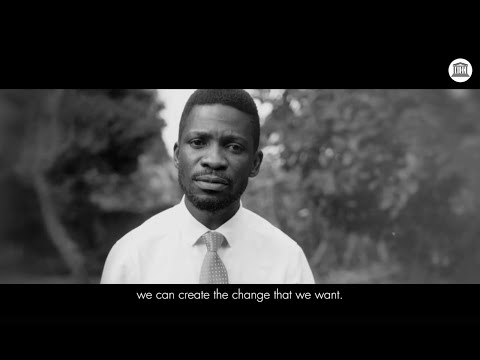 United Against Racism Year of publication: 2020 Corporate author: UNESCO We all can do something against racism. You too. Join UNESCO and leading personalities from all over the world in denouncing mounting racial discrimination.This video features messages by the following prominent women and men from the worlds of cinema, the media, music, sport and science alongside UNESCO Director-General Audrey Azoulay: Charlotte Gainsbourg, Freida Pinto, Naomi Campbell, UNESCO Goodwill Ambassador Jean-Michel Jarre, UNESCO Artist for Peace Marcus Miller, Jorge Ramos, UNESCO Goodwill Ambassador Yalitza Aparicio, Rossy de Palma, UNESCO Goodwill Ambassador Sumaya bint Al Hassan, Bobi Wine, UNESCO Goodwill Ambassador Herbie Hancock, UNESCO Goodwill Ambassador Forest Whitaker, UNESCO Champion for Girls’ and Women’s Education Nadia Nadim, Amadou Gallo Fall, Ada Hegerberg and UNESCO Artist for Peace Gilberto Gil.UNESCO has been on the forefront of the fight against racism since its creation in 1945. In 1978, it adopted the Declaration on Race and Racial Prejudice which reaffirms that “All human beings belong to a single species and are descended from a common stock. They are born equal in dignity and rights and all an integral part of humanity.”Learn more: Fight against Racism and Discrimination
  可持续发展教育: 路线图 Year of publication: 2022 Corporate author: 联合国教科文组织 (UNESCO) 本文是联合国教科文组织实施可持续发展教育所制定的路线图,旨在阐明地球面临的紧迫挑战,探讨教科文组 织通过教育应对这些挑战的下一步工作,并详细梳理新的侧重点和行动。
 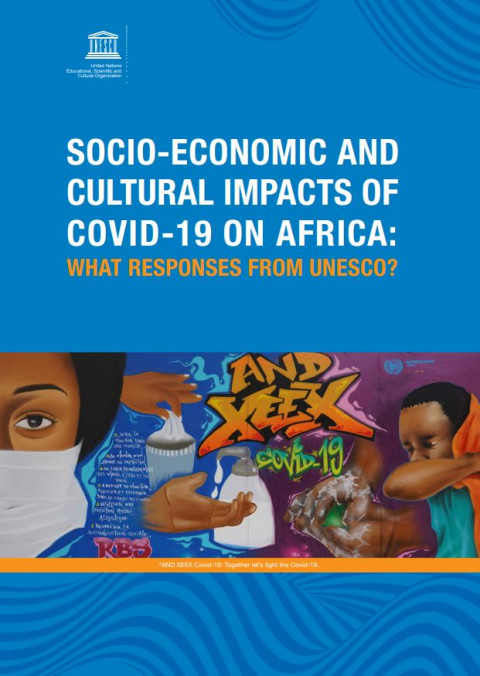 Socio-Economic and Cultural Impacts of COVID-19 on Africa: What Responses from UNESCO? Year of publication: 2020 Corporate author: UNESCO This policy paper analyses the socio-economic and cultural impacts of the disease on Africa as a whole, caused by both the immediate effects and the present and future consequences of the pandemic, including on the African societal fabric, which is likely to lead to a fracture in the trust between States and their citizens and within communities themselves. As such, it highlights the main measures that were adopted by African countries to contain the crisis and its socio-economic and cultural effects. While committing to acting and reflecting on the present and future consequences of the pandemic, UNESCO aims to contribute substantially to the ongoing debates in Africa through the development of a strategic response to help the collective global and regional efforts against the pandemic. Incidences socio-économiques et culturelles de la COVID-19 sur l'Afrique: quelles réponses de l'UNESCO?? Year of publication: 2020 Corporate author: UNESCO Ce document de politique analyse les incidences socioéconomiques et culturelles de la maladie sur l’Afrique dans son ensemble, aussi bien par les effets immédiats que les conséquences présentes et futures de la pandémie, y compris sur le tissu sociétal africain, susceptible d’entraîner une fracture de la relation de confiance entre les États et leurs citoyens, et au sein des communautés elles-mêmes. Ce faisant, elle met en lumière les principales mesures adoptées par les pays africains pour juguler la crise et ses effets socio-économiques et culturelles. Tout en s’engageant dans l’action et dans la réflexion sur les conséquences présentes et futures de la pandémie, l’UNESCO entend ainsi contribuer de manière substantielle aux débats en cours en Afrique à travers en l’articulation d’une réponse stratégique pour apporter sa contribution aux efforts collectifs mondiaux et régionaux de lutte contre la pandémie.
  Culture | 2030 Indicators: Thematic Indicators for Culture in the 2030 Agenda Year of publication: 2019 Corporate author: UNESCO The Culture|2030 Indicators is a framework of thematic indicators whose purpose is to measure and monitor the progress of culture’s enabling contribution to the national and local implementation of the Goals and Targets of the 2030 Agenda for Sustainable Development (SDGs). The methodology is developed to assist countries and cities with very different capacities regarding the collection of data and cultural statistics. The evidence gathered will inform policies and decisions as well as operational actions enabling greater investments in culture as a sector of activity and a greater recognition of its transversal role across other sectors.
  Teacher Policy Development Guide Year of publication: 2019 Corporate author: UNESCO | International Task Force on Teachers for Education 2030 Countries will need to have a broad perspective on teacher issues in order to meet Sustainable Development Goal 4 and address the provisions on Teachers in the Incheon Declaration with the Framework for Action of Education 2030. A system to orient the elaboration and/or review of national teacher policies will be a useful tool. The International Teacher Task Force builds on its comparative advantage as a global multiple-stakeholder alliance joining hands to address the global teacher challenges, to offer the present Teacher Policy Development Guide.Users will find relevant definitions of concepts, description of the different dimensions of teacher issues and how they correlate, and suggestions of phases in the process of developing a national teacher policy. Of utmost importance is the involvement of all stakeholders, especially the teachers, in the process.
 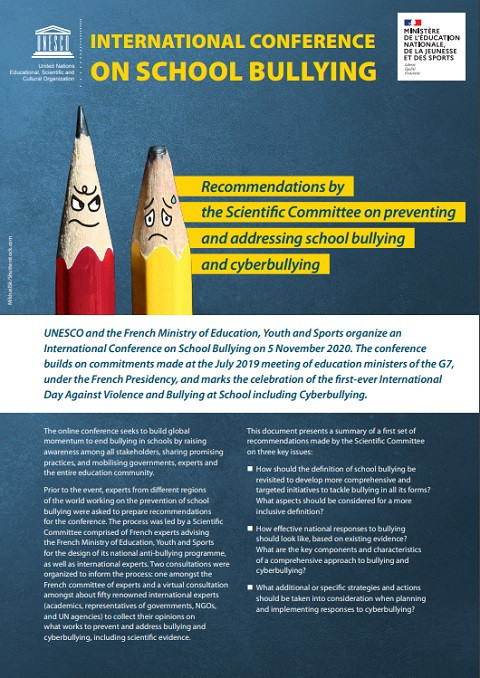 International Conference on School Bullying: Recommendations by the Scientific Committee on Preventing and Addressing School Bullying and Cyberbullying Year of publication: 2020 Corporate author: UNESCO | France. Ministère de l'éducation nationale, de la jeunesse et des sports UNESCO and the French Ministry of Education, Youth and Sports organize an International Conference on School Bullying on 5 November 2020. The conference builds on commitments made at the July 2019 meeting of education ministers of the G7, under the French Presidency, and marks the celebration of the first-ever International Day Against Violence and Bullying at School including Cyberbullying.This document presents a summary of a first set of recommendations made by the Scientific Committee on three key issues:- How should the definition of school bullying be revisited to develop more comprehensive and targeted initiatives to tackle bullying in all its forms? What aspects should be considered for a more inclusive definition?- How effective national responses to bullying should look like, based on existing evidence? What are the key components and characteristics of a comprehensive approach to bullying and cyberbullying?- What additional or specific strategies and actions should be taken into consideration when planning and implementing responses to cyberbullying? Conférence internationale sur la lutte contre le harcèlement entre élèves: Recommandations du Comité scientifique sur la lutte contre le harcèlement et cyber-harcèlement Year of publication: 2020 Corporate author: Organisation des Nations Unies pour l'éducation, la science et la culture (UNESCO) | France. Ministère de l'éducation nationale, de la jeunesse et des sports L’UNESCO et le Ministère français de l’Éducation nationale, de la Jeunesse et des Sports organisent une Conférence internationale sur la lutte contre le harcèlement entre élèves le 5 novembre 2020. La conférence s’appuie sur les engagements pris lors de la réunion des ministres de l’Éducation du G7 sous la présidence française en juillet 2019, et marque la célébration de la première Journée internationale contre la violence et le harcèlement à l’école, y compris le cyber-harcèlement.Ce document présente un résumé d’une première série de recommandations formulées par le Comité scientifique sur trois questions clés :- Comment revisiter la définition du harcèlement en milieu scolaire afin d’élaborer des réponses plus complètes et mieux ciblées pour lutter contre le harcèlement sous toutes ses formes ? Quels sont les aspects à prendre en considération pour une définition plus inclusive ?- Sur la base des données existantes, à quoi devraient ressembler des réponses nationales efficaces au harcèlement ? Quelles sont les principales composantes et caractéristiques d’une approche holistique pour lutter contre le harcèlement et le cyber-harcèlement ?- Quelles stratégies et actions supplémentaires ou spécifiques devraient être prises en considération lors de la planification et de la mise en œuvre des réponses au cyber-harcèlement ?
  Addressing Anti-semitism in Schools: Training Curriculum for Primary Education Teachers Year of publication: 2020 Corporate author: UNESCO | OSCE. Office for Democratic Institutions and Human Rights (ODIHR) This OSCE/ODIHR and UNESCO co-publication aims to help primary school teachers to prevent and respond to anti-Semitism. The curriculum, intended for teacher trainers, is designed to be comprehensive, robust, practical and adaptable. It suggests concrete ways to address anti-Semitism and counter prejudice in and through education, while promoting human rights, global citizenship education, and gender equality.The co-publication is part of a series of four training curricula, designed for trainers of (1) primary school teachers, (2) secondary school teachers, (3) vocational school teachers, and (4) school directors.
 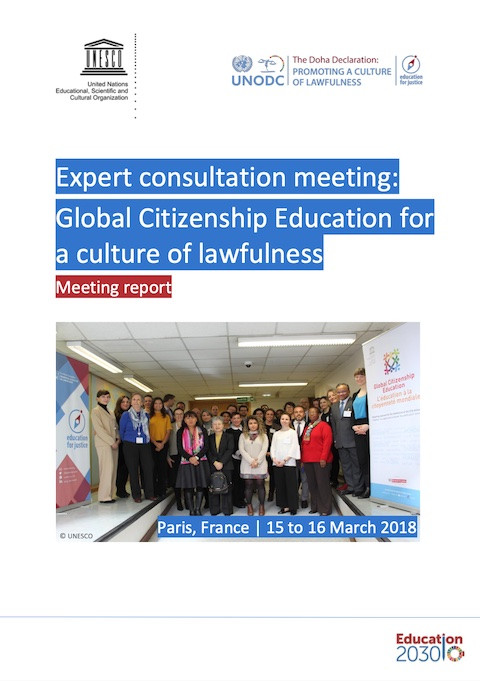 Expert Consultation Meeting: Global Citizenship Education for a Culture of Lawfulness; Meeting Report Year of publication: 2018 Corporate author: UNESCO | UN. Office on Drugs and Crime (UNODC) In the context of a UNESCO/UNODC partnership on “Global Citizenship Education for a Culture of Lawfulness”, an expert consultation meeting was held in Paris on March 15 and 16 of 2018. The purpose of the partnership is to strengthen the capacities of educational systems to promote the rule of law. To this end, the partnership aims to empower and equip learners to act and engage in society as constructive and ethically responsible agents of change, supporting peace, justice, and strong institutions. This notably contributes to the achievement of the 2030 Agenda for Sustainable Development, and in particular Sustainable Development Goals 4 and 16. Additionally, the partnership intends to enable learners to be both motivated and capable to respond resiliently to crime and violence. The meeting had three broad objectives: To help clarify the conceptual foundation of the partnership; to identify the measures that can be taken in the education sector to promote a culture of lawfulness; and to identify effective educational approaches. Thus, the meeting is meant to elucidate core concepts and identify promising educational approaches in the promotion of a culture of lawfulness by asking fundamental questions, including: What constitutes the rule of law and a culture of lawfulness? How do we create demand for the rule of law? How do we ensure learners apply these principles? How do we ensure they survive in a context where there is no rule of law?