
Resources
Explore a wide range of valuable resources on GCED to deepen your understanding and enhance your research, advocacy, teaching, and learning.
3,126 Results found
 Social Contract Pedagogy: A Dialogical and Deliberative Model for Global Citizenship Education (Background paper for the Futures of Education initiative) Year of publication: 2020 Author: Richard Desjardins | Carlos Alberto Torres | Susan Wiksten Corporate author: UNESCO We propose that together Social Contract Pedagogy (SCP) and Global Citizenship Education (GCE) offer a comprehensive vision including key principles and core elements that are important for rethinking education and shaping the future of the world. We introduce the novel concept of Social Contract Pedagogy (SCP) as a means to adapt the social contract in liberal democracies which has been (conceptually) located at the level of the state, to the level of the classroom and other pedagogically relevant contexts. A key feature of this pedagogy is the negotiation of values and norms in ways that maintain cohesion and inclusion and avoids too much power in the hands of sectarian extremes (of any kind) which tend to impose their views on others, oppress and exclude. This includes using fake news, denying scientific debates and/or any extremely politicized interpretations of evidence and facts to obfuscate or deny consequences of individual and group choices and behavior, but also ‘othering’ of any kind whether from the political right or the political left. In our view, this is an essential premise for the education of democratic citizens. Citizenship education of this kind is seen as essential for the survival and growth of liberal democracies in the future.
  Making the Case For Inclusive Quality Physical Education Policy Development: A Policy Brief Year of publication: 2021 Author: Nancy McLennan Corporate author: UNESCO This evidence-based policy brief presents the benefits of investing in inclusive quality physical education (QPE) policy development. Content draws directly on findings from in-country interventions which demonstrate the value of inter-sectoral partnerships in QPE policy development and the delivery of low cost/high impact QPE programming which stands to accelerate post-COVID recovery efforts. A series of practical recommendations are included for public and private stakeholders in the sport-education ecosystem, alongside resources to support the implementation of recommendations. En defensa de un desarrollo inclusivo de políticas de educación física de calidad: Informe de políticas Year of publication: 2021 Author: Nancy McLennan Corporate author: Organización de las Naciones Unidas para la Educación, la Ciencia y la Cultura (UNESCO) Este informe presenta los beneficios de la inversión en el desarrollo de políticas inclusivas de educación física de calidad (EFC). Su contenido se funda directamente en evidencias observadas durante intervenciones en países que demuestran la importancia de las asociaciones intersectoriales en el desarrollo de políticas de EFC y en la ejecución de programas de EFC de bajo costo y alto impacto que ayudarán a agilizar los esfuerzos de recuperación tras la COVID. Se incluye una serie de recomendaciones para socios de los sectores público y privado en el ecosistema deportivo – educativo, así como también recursos para apoyar la aplicación de las recomendaciones. S’engager en faveur de l’élaboration inclusive de politiques d’éducation physique de qualité: Note de politique Year of publication: 2021 Author: Nancy McLennan Corporate author: Organisation des Nations Unies pour l'éducation, la science et la culture (UNESCO) Cette note de politique, fondée sur des faits, présente les avantages à investir dans l’élaboration inclusive de politiques d’Éducation Physique de Qualité (EPQ). Le contenu s’inspire directement des résultats issus d’interventions menées dans quatre pays, qui démontrent l’intérêt des partenariats intersectoriels dans le développement des politiques d’EPQ et de la mise en œuvre de programmes d’EPQ à faible coût/à fort impact qui devraient accélérer les efforts de rétablissement post-COVID. Cette note contient une sélection de recommandations pratiques à destination des acteurs publics et privés de l’écosystème sport-éducation, ainsi que des ressources pour soutenir la mise en œuvre de ces recommandations.
  Media Literacy in Finland: National Media Education Policy Year of publication: 2019 Corporate author: European Training and Research Centre for Human Rights and Democracy (Austria) | UNESCO Media literacy in Finland is the media literacy policy and the national media education policy document, published by the Ministry of Education and Culture in 2019. The document updates and extends the cultural policy guidelines for media literacy published in 2013. The need to update the policy arose from the changes that have taken place in media culture and the broader than before target groups of media education in particular. The Program of the Government also highlights the need for media skills for all age groups, from children to seniors. The vision of the policy is to improve everyone’s opportunities to develop their media literacy. 핀란드의 미디어 리터러시: 국가 미디어교육 정책 Year of publication: 2019 Corporate author: Finand. Ministry of Education and Culture 《핀란드의 미디어 리터러시》는 교육문화부에서 2019년 발간한 미디어 리터러시 정책 및 국가 미디어교육 정책 문서를 한국어로 번역한 자료이다. 이 문서는 2013년에 발간된 미디어 리터러시 가이드라인을 개정하고 확장한 것이다. 미디어 문화가 변화하고 미디어교육 대상 집단이 이전보다 확대되면서 정책 개정의 필요성이 대두됐다. 정부 정책 프로그램(The Program of the Government) 역시 아동에서부터 노년까지 모든 연령 집단에서 미디어 기량(media skills)이 필요함을 강조했다. 이 정책의 목표는 모든 사람이 미디어 리터러시를 개발할 기회를 늘리는 것이다.
 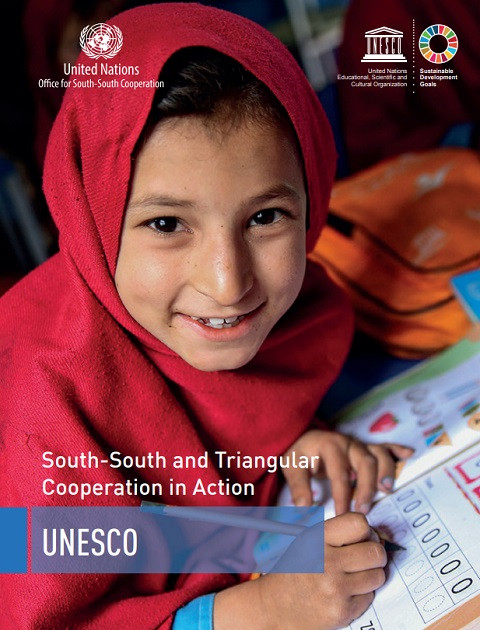 South-South and Triangular Cooperation in Action Year of publication: 2018 Corporate author: UNESCO | UN. Office for South-South Cooperation (UNOSSC) This publication is UNESCO’s first dedicated report on South-South cooperation and triangular cooperation. It presents an overall picture of the progress achieved to support technical cooperation, capacity building and knowledge sharing through South-South and triangular cooperation in UNESCO’s areas of competence with highlights of specific examples. It paves the way for deepening future cooperation in this area.
 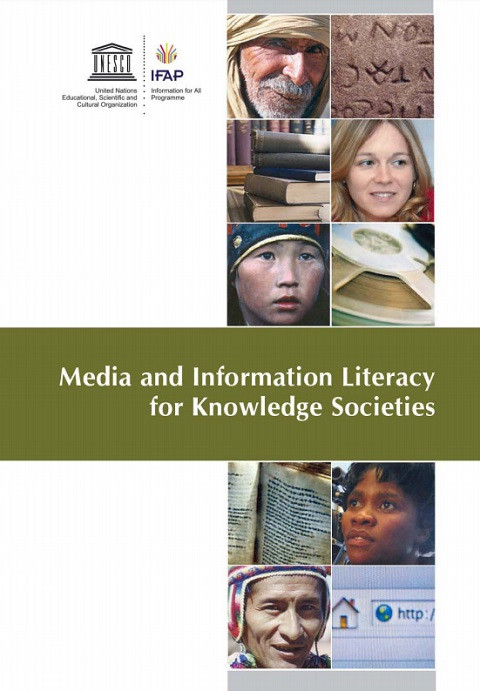 Медиа- и информационная грамотность в обществах знания Year of publication: 2013 Corporate author: Interregional Library Cooperation Centre | UNESCO Издание подготовлено на основе материалов Международной конференции «Медиа- и информационная грамотность в обществах знания», состоявшейся в Москве 24–28 июня 2012 г. в рамках председательства России в Межправительственном совете Программы ЮНЕСКО «Информация для всех».
  Background Document: National Media and Information Literacy (MIL) Policies and Strategies in Albania; 2020-2021 Year of publication: 2021 Corporate author: Albanian Media Institute | European Union (EU) | UNESCO This background study was conducted in the framework of the project "Building trust in the media in Southeast Europe and Turkey, phase II" supported by UNESCO and the European Union and implemented by the Albanian Media Institute. The project, at this stage of implementation, aims to increase the skills of young people for media and information literacy (MIL) through the integration of the MIL curriculum in the formal education system in Albania. The implementation of the project started in June 2020 and will last until 2022. This document suggests objectives for MIL policies and strategy, which should be extended to formal education (university and pre-university level); in non-formal and informal education thus affecting all members of society with the aim of increasing the level of education on media and information in Albania.
 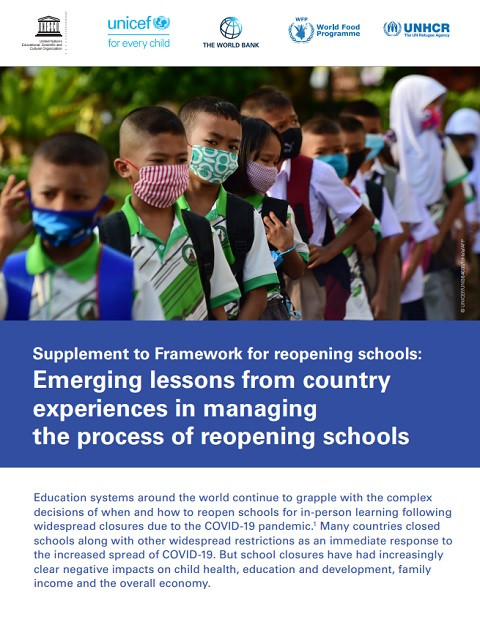 Supplement to Framework for Reopening Schools: Emerging Lessons From Country Experiences in Managing the Process of Reopening Schools Year of publication: 2020 Corporate author: UNESCO | United Nations Children's Fund (UNICEF) | World Bank | World Food Programme | UN. Office of the United Nations High Commissioner for Refugees (UNHCR) Education systems around the world continue to grapple with the complex decisions of when and how to reopen schools for in-person learning following widespread closures due to the COVID 19 pandemic. This supplement to the Framework for reopening schools, originally published jointly by UNICEF, UNESCO, the World Bank, the World Food Programme, and the UN Refugee Agency (UNHCR) in April 2020, summarizes emerging lessons learnt over the past months.The supplement follows the four main dimensions of the Framework (safe operations, focus on learning, wellbeing & protection, and reaching the most marginalized) and highlighting a number of country examples.