
Resources
Explore a wide range of valuable resources on GCED to deepen your understanding and enhance your research, advocacy, teaching, and learning.
3,158 Results found
 Tolerance (Non violence) in the Curricular of Algerian Primary Schools (vol.2, no.1; Journal of Cognitive Fields for Social and Human Sciences) Year of publication: 2021 Author: Morad Fatima Zahra | Fantazi Karima Corporate author: Algeria. Ministry of Higher Education and Scientific Research This study aims to identify tolerance values within primary school curricula in two ways: explicitly and implicitly, focusing specifically on Islamic books due to their significant role in instilling values, particularly respect. The study utilizes the descriptive method and content analysis to analyze primary school books spanning five years. Statistical analysis is conducted using duplicates and percentages. The findings indicate that these books predominantly convey tolerance values implicitly rather than explicitly, which is believed to be more readily accepted by children of this age group. It is concluded that fostering tolerance values should be a shared responsibility of both the community and the school, not solely the latter.
  تقرير مراجعة الخطة الاستراتيجية لقطاع التعليم من منظور الفساد المبني على النوع الاجتماعي Year of publication: 2023 Author: Hudhaifah Jalamna Corporate author: Coalition for Integrity and Accountability (AMAN) يهـدف التقريـر إلـى مراجعـة الخطـة الاسـتراتيجية لقطـاع التعليـم وتحليلهـا؛ للوقـوف علـى مـدى اسـتجابتها لمكافحـة الفسـاد بشـكل عـام، والفسـاد المبنـي علـى النـوع الاجتماعـي بشـكل خـاص. واقتـــراح توصيـــات لصنـاع القـرار تسـهم في تضمـين سياسـات وآليـات لتعزيـز النزاهـة ومكافحـة الفسـاد في الخطـة الإسـتراتيجية القادمـة. Report on Reviewing the Strategic Plan for the Education Sector From a Gender-Based Corruption Perspective Year of publication: 2023 Author: Hudhaifah Jalamna Corporate author: Coalition for Integrity and Accountability (AMAN) The report aims to review and analyze the strategic plan for the education sector to assess its effectiveness in addressing corruption in general, and gender-based corruption in particular. It proposes recommendations aimed at incorporating policies and mechanisms to enhance integrity and combat corruption in the subsequent strategic plan.
  سد الفجوة: دعم قاعدة الأدلة المتعلقة بالتعليم في حالات الطوارئ المستجيب للنوع الاجتماعي Year of publication: 2022 Author: Lauren Gerken | Sumbal Bashir Corporate author: The Inter-agency Network for Education in Emergencies (INEE) يسلّط هذا الملخص الضوء على الثغرات الرئيسية في قاعدة الأدلة حول النوع الاجتماعي والتعليم في حالات الطوارئ، ويقدم التوجيه الاستراتيجي والمحتوى المواضيعي لمبادرات الأبحاث الجديدة. يتضمن توصيات لإجراء أبحاث تعليمية مستجيبة للنوع الاجتماعي والمناصرة للعمل التعاوني وتبادل المعرفة بين النوع الاجتماعي والجهات الفاعلة الرئيسية في مجال التعليم في حالات الطوارئ. يمكن استخدام الملخص لتحديد المجالات ذات الأولوية للبحث وأسئلة البحث للمضي قدمًا، وفرص التعاون، ومجالات البحث ذات الأولوية للتمويل. Bridging the Gap: Strengthening the Evidence Base for Gender Responsive Education in Emergencies Year of publication: 2022 Author: Lauren Gerken | Sumbal Bashir Corporate author: The Inter-agency Network for Education in Emergencies (INEE) This brief was developed by the INEE Gender Task Team in response to global calls for more and better data and evidence on gender-responsive EiE. The brief draws from findings of the 2021 and 2022 editions of the INEE Mind the Gap report on the state of girls’ education in emergencies, and from consultations with gender and education experts.
  دور المدرسة في تعزيز التربية من أجل المواطنة العالمية لدي طالبها علي ضوء بعض المتغيرات المعاصرة "دراسة تحليلية" (vol.22, no.4 مجلة البحث العلمي في التربية) Year of publication: 2021 Author: Sayeda Salama, Fatma Mohamed Al-Bardawily Corporate author: South Valley University هدف البحث الحالي إلي التعرف علي مفهوم التربية من أجل المواطنة العالمية، وأهم متطلبات تعزيزها لدي الطلاب، والتعرف أيضاً علي اهم المتغيرات المعاصرة وعلاقتها بالمواطنة العالمية، ودور المدرسة في تعزيز التربية من أجل المواطنة العالمية في ضوء ادبيات التربية، کما يضع البحث تصوراً مقترحاً لتفعيل دور المدرسة في تعزيز التربية من أجل المواطنة العالمية علي ضوء بعض المتغيرات المعاصرة، واعتمد البحث علي المنهج الوصفي التحليلي للکشف عن المتطلبات النظرية لتعزيز التربية من أجل المواطنة العالمية، وايضاً تحليل المتغيرات المعاصرة، ثم تحليل وتفسير هذه المعلومات، والخروج منها باستنتاجات ذات دلالة ومعني تفيد في وضع التصور المقترح, The Role of the School in Promoting Education for Global Citizenship Education for Students in Light of Some Contemporary Changes: An Analytical Study (vol.22, no.4; Journal of Scientific Research in Education) Year of publication: 2021 Author: Sayeda Salama, Fatma Mohamed Al-Bardawily Corporate author: South Valley University The aim of the current research is to delineate the concept of education for global citizenship and its crucial requisites for enhancing student understanding. Additionally, it seeks to explore significant contemporary changes and their correlation with global citizenship, as well as the role of schools in advancing global citizenship education in accordance with educational literature. The research further proposes a strategy to bolster the role of schools in promoting global citizenship amidst modern shifts. Employing a descriptive and analytical approach, the study unveils the theoretical prerequisites for fostering education for global citizenship.
 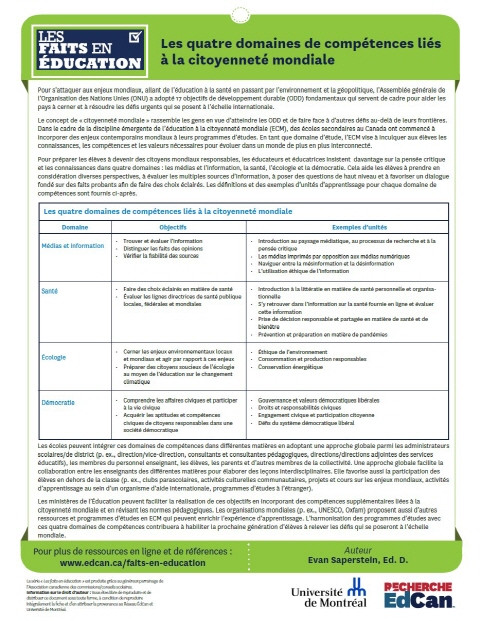 The Four Areas of Competence Linked to Global Citizenship Year of publication: 2023 Author: Evan Saperstein Corporate author: Université de Montréal | Association Canadienne d'Education Ce document présente les quatre domaines de compétences liées à la citoyenneté, et comment les intégrer à l'éducation des élèves. Pour préparer les élèves à devenir des citoyens mondiaux responsables, les éducateurs et éducatrices insistent davantage sur la pensée critique et les connaissances dans quatre domaines : les médias et l’information, la santé, l’écologie et la démocratie. This document presents the four areas of competency linked to citizenship, and how to integrate them into pupils' education. To prepare students to become responsible global citizens, educators are placing greater emphasis on critical thinking and knowledge in four areas: media and information, health, ecology and democracy. Les quatre domaines de compétences liés à la citoyenneté mondiale Year of publication: 2023 Author: Evan Saperstein Corporate author: Université de Montréal | Association Canadienne d'Education Ce document présente les quatre domaines de compétences liées à la citoyenneté, et comment les intégrer à l'éducation des élèves. Pour préparer les élèves à devenir des citoyens mondiaux responsables, les éducateurs et éducatrices insistent davantage sur la pensée critique et les connaissances dans quatre domaines : les médias et l’information, la santé, l’écologie et la démocratie. This document presents the four areas of competency linked to citizenship, and how to integrate them into pupils' education. To prepare students to become responsible global citizens, educators are placing greater emphasis on critical thinking and knowledge in four areas: media and information, health, ecology and democracy.
  Supporting Schools’ and Teachers’ Use of Assessment to Inform Learning of All Students (Using Assessment Data in Education Policy and Practice: Examples from the Asia-Pacific issue 5, December 2023) Year of publication: 2023 Author: Ursula Schwantner | Soumaya Maghnouj Corporate author: UNESCO Bangkok | Australian Council for Educational Research (ACER) In more than half of Asia-Pacific countries, a majority of learners in primary and secondary education do not have the required foundational skills. The fifth issue of the topical case studies series 'Using Assessment Data in Education Policy And Practice: Examples From The Asia-Pacific' under the Network for Education Quality Monitoring in Asia-Pacific (NEQMAP), documents four promising practices from countries in the Asia-Pacific region on how education systems can better support teachers and schools in effectively integrating assessment practices in the teaching and learning process. The goal of this support is to identify and meaningfully address every learner’s needs, so that every learner can learn successfully. The case studies look at a variety of levers that promote a better use of assessment for learning such as how to develop teachers’ assessment literacy and capacity to design, implement and use assessment to inform their classroom teaching and learning; how to improve the use of standardized assessment data to inform teaching and learning and how to rethink the organization of instruction to address the needs of all learners.