
Resources
Explore a wide range of valuable resources on GCED to deepen your understanding and enhance your research, advocacy, teaching, and learning.
3,500 Results found
 Learning with Intangible Heritage for a Sustainable Future: Guidelines for Educators in the Asia-Pacific Region Year of publication: 2015 Corporate author: UNESCO Bangkok The guide provides teacher educators and teachers with an understanding of the concept of intangible cultural heritage (ICH) and explains why ICH should be integrated into the curriculum in tandem with the principles and perspectives of Education for Sustainable Development (ESD). This guide explains how the strategic incorporation of ICH elements and ESD principles into the curriculum can enable learners to gain the knowledge and skills that are necessary for ensuring sustainable development in the future. Нематериальное наследие в системе обучения в интересах устойчивого будущего Year of publication: 2015 Corporate author: UNESCO Bangkok Руководство предоставляет работникам образования и преподавателям понимание концепции нематериального культурного наследия и объясняет внедрения нематериального культурного наследия в учебные планы вместе с принципами и теорией Образования в интересах устойчивого развития (ОУР). Руководство объясняет, как стратегическое включение элементов нематериального культурного наследия и принципов ОУР в учебные планы может помочь учащимся получить знания и навыки, необходимые для обеспечения устойчивого развития в будущем.ЮНЕСКО разработала настоящее руководство на основании результатов пилотных проектов, проведенных в четырех странах в Азиатско-Тихоокеанском регионе, где участники разработали своиместные руководства и материалы для включения элементов нематериального культурного наследия и принципов ОУР в образовательный процесс. Примеры нематериального культурного наследия, приведенные в данном руководстве, не являются более важными, чем другие, и не обязательно должны быть приоритетными. Они скорее представлены в качестве иллюстративных примеров.
  2019 유네스코 ESD 정책 포럼: 2030년을 위한 지속가능발전교육(ESD), 한국은 어떻게 준비할 것인가 Year of publication: 2019 Corporate author: 대한민국 교육부 | 유네스코한국위원회 2019년 11월에 유네스코한국위원회(ESD한국위원회)에서 주최한 '2019 유네스코 지속가능발전교육 정책 포럼'의 자료집으로 행사개요와 토론자료, 지속가능발전교육에 대한 부록을 수록하고 있다.2030년을 위한 지속가능발전교육(ESD), 한국은 어떻게 준비할 것인가를 주제로 ESD for 2030 체계 수립 및 이행 준비에 대한 국제사회 최신 동향 공유, 국가 이니셔티브 구축 관련 한국 차원의 정책적 준비 및 운영 체계 수립 방안 논의, GAP 참여기관 등 국내 ESD 이행 핵심 주체별 활동 내용 공유 및 제언 등이 주요 내용이다.
  The Conceptualization of competencies related to sustainable development and sustainable lifestyles Year of publication: 2017 Author: Irmeli Halinen Corporate author: UNESCO International Bureau of Education (IBE) The education system of Finland has been developed soundly and steadily during the past 40 years. The guiding principles have been equity and equality in education as going hand in hand with the view to promote every individual’s life-long learning. Following these principles, it has strengthened the sustainability of the system itself. This report describes the role of sustainable development and the importance of learning a sustainable lifestyle in Finnish basic (primary and lower secondary) education. It highlights the goals, values, tasks, and the conceptualization of the competencies related to sustainability in the 2014 National Core Curriculum for basic education. In addition, it describes the sustainable nature of the curriculum reform process itself. The report examines the role and the contribution of various school subjects and key aspects, such as the school culture and the learning environment, in creating a strong knowledge base on which to build the values, attitudes, skills and the will needed for sustainable lifestyle, and in promoting sustainable ways of living. The report concludes with lessons drawn from the Finnish way of enhancing sustainability in education.
  기후 정의를 위해 행동하는 법: 교사 가이드; 9-16세 대상 Year of publication: 2023 Corporate author: 옥스팜 기후 정의란 무엇일까? 우리는 모두 기후위기로부터 영향을 받고 있지만 어떤 특정 지역사회가 다른 지역보다 더 큰 영향을 받고 있다. 그리고 가장 큰 고통을 받고 있는 사람들은 기후위기 발생에 거의 기여하지 않은 사람들이다. 이러한 불공정한 기후위기 영향에 대해 알고, 이를 바꾸기 위해 기꺼이 행동하는 것이 바로 기후 정의이다. 이번 교육자료는 행동하는 것이 기후 정의 달성에 얼마나 중요한 지에 대한 내용을 다루고 있다. 특히 청소년들이 기후위기를 위해 행동하는 것은 사람과 지구의 삶을 개선하는 아주 중요한 변화를 가져오는 한 주체가 되는 경험이 될 것이다.
 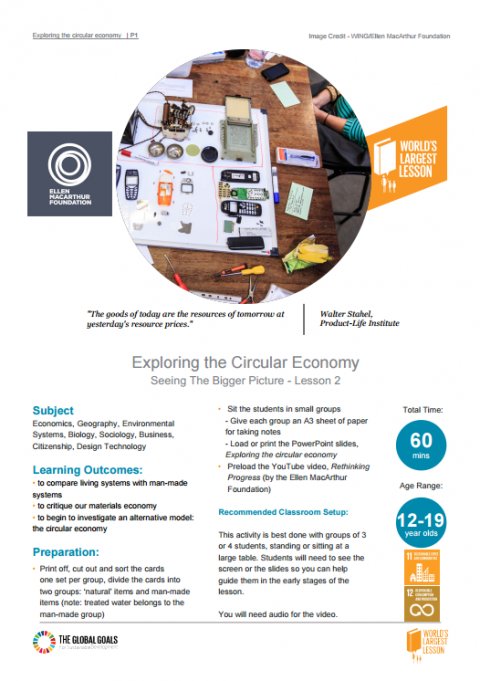 Exploring the Circular Economy: Seeing The Bigger Picture - Lesson 2 Corporate author: United Nations Children's Fund (UNICEF) World’s Largest Lesson is a collaborative education project to support the announcement of the United Nations Global Goals for Sustainable Development. Learning outcomes of the project: • to compare living systems with man-made systems • to critique our materials economy • to begin to investigate an alternative model: the circular economy
  Understanding the Challenge of Finite Resources: Seeing The Bigger Picture - Lesson 3 Corporate author: United Nations Children's Fund (UNICEF) World’s Largest Lesson is a collaborative education project to support the announcement of the United Nations Global Goals for Sustainable Development. Learning outcomes of the project: • To understand and the urgent challenge that finite resources pose to our current economic system • To explore economic history since the industrial revolution through personal narrative • To critically evaluate our current consumption and production systems and explore better ways of dealing with resources.
  Designing for a Circular Economy: Seeing The Bigger Picture - Lesson 4 Corporate author: United Nations Children's Fund (UNICEF) World’s Largest Lesson is a collaborative education project to support the announcement of the United Nations Global Goals for Sustainable Development. Learning outcomes of the project: • To learn about companies that have adopted the circular economy framework • To design a product or service based on the circular economy
  한국의 SDGs 이행보고서 2022 Year of publication: 2022 Author: 박영실 | 진유강 | 윤민희 | 김소연 Corporate author: 통계개발원 『한국의 SDGs 이행보고서 2022』는 데이터와 통계를 근거로 한국의 지송가능발전 현황을 진단하였고 고품질의 국제 비교 가능 자료와 증거 기반 분석에 기초해 이해하기 쉽게 시각화했습니다. 본 보고서가 전 세계가 목표한 SDGs 달성에 한 걸음 더 다가갈 수 있는 나침반 역할을 하기 바라며 증거 기반 정책의 핵심 지표로 이용되기를 기대합니다. 본 저작물은 통계청 통계개발원에서 2022년작성하여 공공누리 제3유형으로 개방한 '한국의 SDGs 이행보고서 2022(작성자:김석호)'을 이용하였으며, 해당 저작물은 통계청 통계개발원 홈페이지(https://kostat.go.kr/)에서 무료로 내려받으실 수 있습니다.
  Global Education Guidelines 2019: Concepts and Methodologies on Global Education for Educators and Policy Makers Year of publication: 2019 Corporate author: North-South Centre of the Council of Europe | Council of Europe The Global Education Guidelines are an initiative of the Global Education Programme of the North South Centre of the Council of Europe, and answer a need expressed by the North-South Centre’s (NSC) network of global education practitioners – the Global Education network - to have a common tool, built on experience gained by the network and other partners, to support educators to comprehend and successfully design, implement and carry out global education initiatives and learning activities. This updated edition of the Guidelines includes novelties and responds to the challenge of being a user-friendly handbook, by (i) introducing the concept of competence-based learning, with the Council of Europe Reference Framework of Competences for Democratic Culture and the OECD concept of global competences, and explains in detail and with practical examples and user friendly tools how global education can make use of competence-based learning to empower learners; (ii) has broadened the content of the chapter on methodology and methods, with step by step guides for the daily work of practitioners, educators and facilitators, and further exemplifying the competence-based learning concept; and (iii) by including a new chapter on media literacy to support practitioners and learners to navigate today’s communication and digital challenges.