
Resources
Explore a wide range of valuable resources on GCED to deepen your understanding and enhance your research, advocacy, teaching, and learning.
3,559 Results found
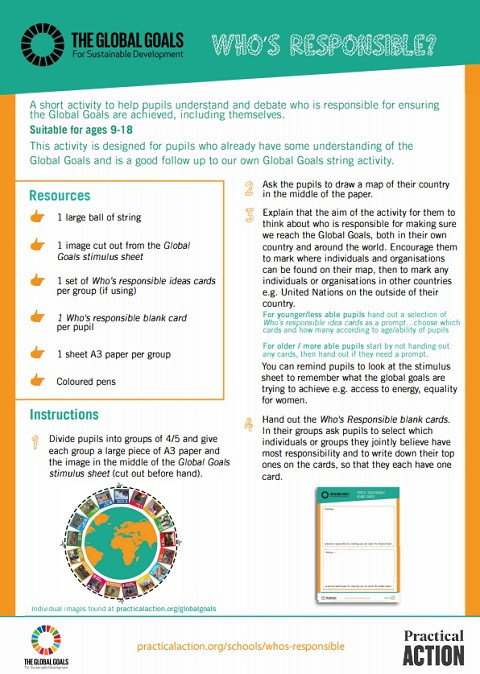 Who’s Responsible?: The Global Goals for Sustainable Development Year of publication: 2018 Corporate author: Practical Action This 30 minute activity encourages pupils to consider who is responsible for ensuring we achieve the Global Goals (also known as the Sustainable Development Goals, SDGs). It is suitable for pupils 9-18 it stimulates discussion and debate, and help pupils recognize the role they themselves have to play.
  Creativity, Resilience and Global Citizenship: Activity Toolkit Year of publication: 2015 Corporate author: CIT Crawford College of Art and Design | Youth Work Ireland This publication is a step by step guide to a range of activities exploring the themes of Creativity, Resilience & Global Citizenship through a wide range of workshops, sharing creative methods and tools. It has been co-developed by the Fast Forward training programme which brought together young people and youth workers from Ireland, Hungary, Italy and UK in Cork, Ireland in January 2015. It was developed with thirty young people: youth workers, artists and educators who are passionate about supporting young people to grow as global citizens. It is useful to provide a context for anyone engaging others in the creative activities presented in this toolkit.
 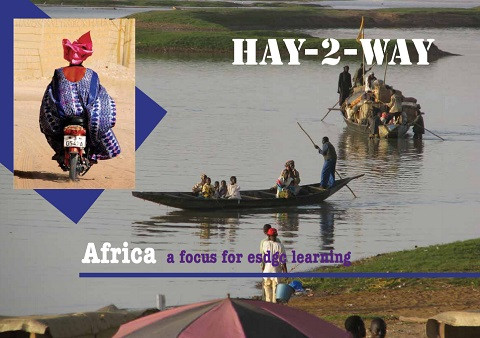 HAY-2-WAY: Africa; A Focus for ESDGC learning Year of publication: 2014 Author: Scott Sinclair Corporate author: Hay 2 Timbuktu This resource describes the education work that was part of the Two Towns One World project. It makes the case for an Africa focus as a significant theme in Education for Sustainable Development and global citizenship learning (ESDGC).The Two Towns One World project had two main strands: Locally in the Hay-on-Wye area with the Gwernfed cluster of schools and Nationally in Wales through a series of workshops and conferences.The scope of the work was enhanced through partnership with other initiatives on the themes ‘Unpacking Africa’ and ‘Debating Development’. A conference in Llandrindod Wells in November 2013 brought the strands of work together and provided the main narrative of this publication.
 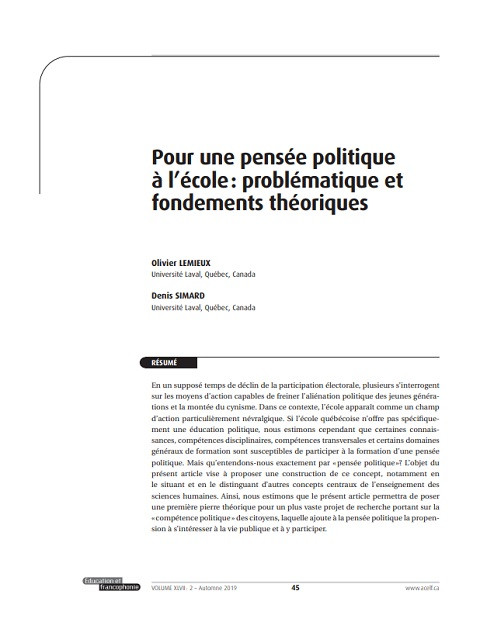 Political Thought at School: Problem and Theoretical Foundations Year of publication: 2019 Author: Olivier Lemieux | Denis Simard Corporate author: Éducation et francophonie At a time when voter turnout is apparently declining, many are wondering what actions to take to curb the political alienation and rise of cynicism among younger generations. In this context, the school seems to be an important nerve centre for action. Although Quebec schools do not specifically offer political education, we believe that some knowledge, subject-specific skills, cross-curricular competencies and general areas of training are likely to contribute to the formation of political thought. But what exactly do we mean by «political thought»? The purpose of this article is to propose a construction of this concept, notably by situating it and distinguishing it from other central concepts of human sciences. We therefore believe that this article will provide a theoretical foundation for a broader research project on citizens’ «political competence», which adds to political thought the tendency to take an interest in and participate in public life. Pour une pensée politique à l’école: Problématique et fondements théoriques Year of publication: 2019 Author: Olivier Lemieux | Denis Simard Corporate author: Éducation et francophonie En un supposé temps de déclin de la participation électorale, plusieurs s’interrogent sur les moyens d’action capables de freiner l’aliénation politique des jeunes générations et la montée du cynisme. Dans ce contexte, l’école apparaît comme un champ d’action particulièrement névralgique. Si l’école québécoise n’offre pas spécifiquement une éducation politique, nous estimons cependant que certaines connaissances, compétences disciplinaires, compétences transversales et certains domaines généraux de formation sont susceptibles de participer à la formation d’une pensée politique. Mais qu’entendons-nous exactement par «pensée politique»? L’objet du présent article vise à proposer une construction de ce concept, notamment en le situant et en le distinguant d’autres concepts centraux de l’enseignement des sciences humaines. Ainsi, nous estimons que le présent article permettra de poser une première pierre théorique pour un plus vaste projet de recherche portant sur la « compétence politique» des citoyens, laquelle ajoute à la pensée politique la propension à s’intéresser à la vie publique et à y participer.
 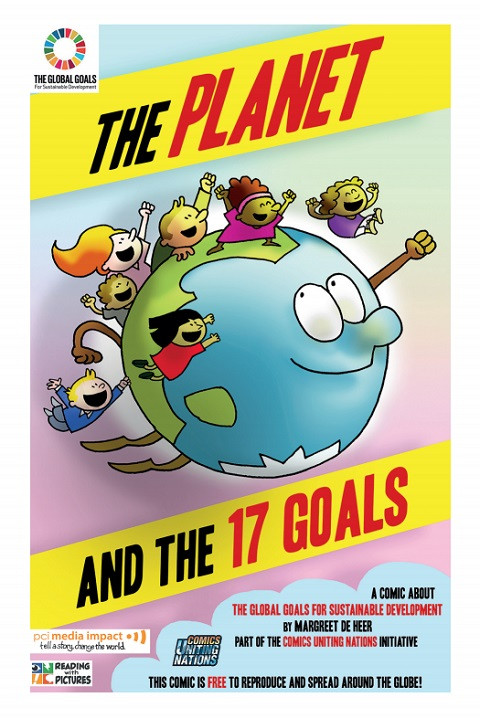 The Planet and the 17 Goals: A Comic About the Global Goals for Sustainable Development Year of publication: 2015 Author: Margreet de Heer Corporate author: Reading With Pictures | United Nations (UN) In September 2015, the 193 countries of The United Nations launched The Global Goals of Sustainable Development, a commitment to achieve 3 extraordinary things in the next 15 years: end extreme poverty, fight inequality & injustice and fix climate change. In order to get this done, 17 Goals have been set. This material aims to spread the word about the 17 Goals in the form of comics.
  Building Cross-Sectoral Cooperation: Estonian Coalition for Sustainable Development Year of publication: 2020 Corporate author: Estonian Roundtable for Development Cooperation (AKÜ) | Bridge 47 | European Union (EU) This publication presents the members of Estonian Coalition for Sustainable Development, examples of their actions towards a more sustainable future and also some of the activities that the partnerships together have carried over the past few years. It is a great example of a cross-sectoral cooperation and a way of sharing knowledge.
  교실에서 만나는 세계시민교육 Year of publication: 2016 Author: 정애경 | 윤지아 | 정혜선 | 이근화 | 공석범 | 주예진 | 이원용 | 정용민 Corporate author: 서울특별시교육청 본 자료는 학습자로 하여금 인류가 공동으로 직면하고 있는 문제들에 대해 이해하고 지구촌 공동체에 대한 소속감과 연대감을 키워 지구촌의 문제들을 해결할 수 있는 다양한 실천적이고 협력적인 능력을 키우는데 그 목적을 두고 있으며, 직접 교실 현장에서 활용할 수 있도록 교수학습과정안의 형식으로 구성되어 있다. 학습주제로 제시된 것은 국제이해교육과 세계시민교육에서 공통으로 다루는 인권과 평화, 다문화를 비롯하여 2030년까지의 인류 공동의 목표인 지속가능발전의 환경과 사회와 경제 부분, 그리고 세계시민교육의 배경인 세계화와 미래사회의 지향점인 국제협력 다섯 영역이다.
 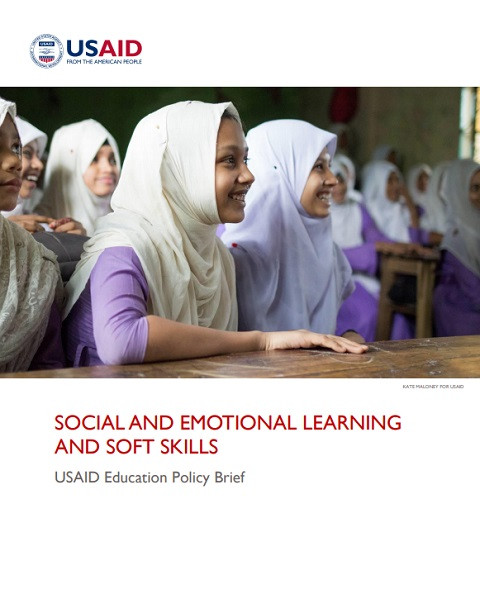 Social and Emotional Learning and Soft Skills: USAID Education Policy Brief Year of publication: 2019 Author: Kalene Resler | Anjuli Shivshanker | Samantha Alvis | Chris Capacci-Carneal | Melissa Chiappetta | Lauren Greubel | Julie Hanson Swanson | Ashley Henderson | Josh Josa | Laura Lartigue | Rebeca Martinez | Leah Maxson | Olga Merchan | Yolande Miller-Grandvaux | Sandy Oleksy-Ojikutu | Rebecca Pagel | Nancy Taggart | Nina Weisenhorn | Wendy Wheaton Corporate author: United States Agency for International Development (USAID) Both the 2018 USG Strategy on International Basic Education and the 2018 USAID Education Policy emphasize the importance of social and emotional skills or soft skills in assuring the long-term success of children and youth. Through the Strategy and Policy, USAID is providing new opportunities to systematically design, measure, implement, and understand the impact of programs that build social and emotional skills or soft skills for children and youth.To support USAID staff and implementing partners in this work, this brief: Provides an introductory understanding of what USAID means by the terms “social and emotional skills” and “soft skills” and how to communicate about them. Specifies the desired outcomes and quality standards for programming that teach social and emotional skills or soft skills. Identifies areas in which evidence and best practices still have gaps, and areas in which we should consider investing in further learning.
 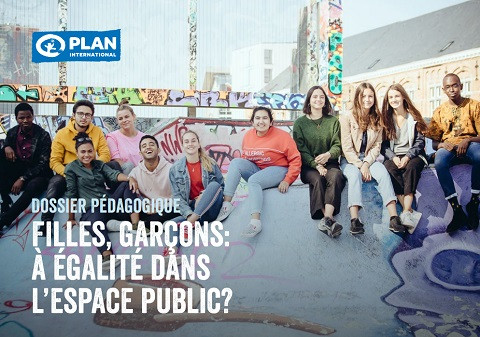 Dossier pédagogique: Filles, garçons, à égalite dans l'espace public? Year of publication: 2019 Corporate author: Plan International Ce dossier pédagogique vise à sensibiliser les adolescent-e-s à propos des inégalités entre garçons et filles et à les faire réfléchir aux conséquences. Le message global est positif: le chemin est porteur d’espoir. Les jeunes peuvent changer les choses. Ils/elles peuvent réfléchir et s’élever contre des normes inadaptées et construire leur avenir. Et nous pouvons, ensemble, briser les stéréotypes de genre, améliorer les modèles de rôles et construire à l’égalité des chances entre garçons et filles. Prendre conscience du poids des stéréotypes et les questionner constamment en les observant à travers le prisme du genre sont des étapes décisives sur la voie de l’égalité. La classe est un cadre idéal pour cette remise en question.