
Resources
Explore a wide range of valuable resources on GCED to deepen your understanding and enhance your research, advocacy, teaching, and learning.
3,559 Results found
 El sistema educativo paraguayo ante los desafíos sociales del siglo XXI: una evolución histórica hacia el programa metas educativas 2021 Year of publication: 2018 Author: Carlos Novella García Corporate author: Autonomous University of Madrid En el resumen el autor sostiene: "En el año 2011 la Organización de Estados Iberoamericanos para la Educación y la Cultura asumió la responsabilidad de coordinar las acciones y realizar el seguimiento de un programa educativo muy ambicioso llamado “Metas Educativas 2021: la educación que queremos para la generación de los bicentenarios”. Este artículo pretende conocer con más detalle los fines de este programa y analizar los avances y logros alcanzados por Paraguay uno de los países firmantes de este proyecto. Para dicho análisis nos servimos de informes nacionales e internacionales que nos permitieran conocer con detalle y fiabilidad los resultados de la aplicación y desarrollo de las once metas del programa en materia educativa en el contexto educativo paraguayo. No obstante, por extensión de este artículo nos centramos en tres de estas once metas consiguiendo resultados muy relevantes respecto a los logros y a las ausencias de los objetivos de las metas analizadas. Los datos reflejan un avance considerable de las políticas educativas desde el 2011 hasta la actualidad aunque siguen existiendo carencias notables en aspectos relacionados, principalmente, con la formación, la selección y el fortalecimiento de la profesión docente." Agregaría que el autor subraya la importancia de una ciudadanía internacional e Iberoamericana.
  The Future of Education and Skills: Education 2030 Year of publication: 2018 Corporate author: Organisation for Economic Co-operation and Development (OECD) The aim of OECD’s Education 2030: The Future of Education and Skills project is to support countries to find answers to two far-reaching questions: “What knowledge, skills, attitudes and values will today’s students need to shape and thrive their world in 2030?” and “How can instructional systems develop these knowledge, skills, attitudes and values effectively?” This OECD Education 2030 position paper considers the challenges that young people will face; suggests the importance of the concept of learner agency; proposes an overarching learning framework with transformative competencies; reviews the nature of the knowledge, skills, attitudes and values that young people will need; and ends with possible curriculum design principles. It encapsulates the key messages of the project so far. Le Futur de l’éducation et des compétences: Projet Éducation 2030 Year of publication: 2018 Corporate author: Organisation for Economic Co-operation and Development (OECD) Le projet Le Futur de l’éducation et des compétences : Éducation 2030 a pour objectif d’aider les pays à trouver des réponses à deux questions d’une portée considérable : « De quelles connaissances, compétences, attitudes et valeurs les élèves d’aujourd’hui auront-ils besoin pour réussir leur vie et bâtir le monde de demain ? » et « Comment les systèmes éducatifs peuvent-ils transmettre ces connaissances, compétences, attitudes et valeurs de manière efficace ? » Cette note d’information sur le projet Éducation 2030 de l’OCDE étudie les défis auxquels les jeunes générations vont être confrontées, met en lumière l’idée de capacité d’agir des apprenants, propose un cadre d’apprentissage global reposant sur des compétences transformatives, revient sur la nature des connaissances, des compétences, des attitudes et des valeurs dont les jeunes auront besoin à l’avenir et se conclut par de possibles principes de conception des programmes scolaires. Les principaux messages tirés du projet jusqu’à présent sont également présentés. OECD学习框架 2030: 经济合作与发展组织 (OECD) Year of publication: 2018 Corporate author: Organisation for Economic Co-operation and Development (OECD) "教育公平" "高质量的教育" "核心素养" "减负'等已成为流行热词,在新时代背景下实践者对 究竟要"教什么"需要再思考。经济合作与发展组织(简称经合组织 OECD) 2015 年启动了"教育2030: 未来 的教育与技能"项目,项目中启动了"面向 2030 的学习指南"讨论,旨在开发一种新的学习框架,描述需要用什 么样的能力来塑造未来的一代。学习框架包括知识、技能、态度和价值观,个人和社会的福祉 变革性能力,通 过反思、预期和行动的过程,调动知识 技能、态度和价值观,以便发展与世界接触所需的相互关联的能力.此 外, "教育与技能2030项目"专家组也提出了设计教育体系与课程改革的指导原则,包括概念、内容和主题设计 以及流程设计.
  Green Marketing in the Conformation of a Planetary Citizenship in the Educational Field Latinamerican Year of publication: 2019 Author: Julio Juvenal Aldana Zavala | Félix Colina Ysea The article reviews and analyzes the contribution of green marketing in the formation of a planetary citizenship in the latin american educational systems. A documental and biblographic review methodology was used to gather and structure the information. The content of the documents was analyzed trying to discover the implicit competences for global citizenshipo present in the information. One of the main conclusions is that green marketing offers education the possibility of building competences that favour global thinking in students; thing that should be encouraged from a latin american green education perspective for the global context. Marketing verde en la conformación de una ciudadanía planetaria en el ámbito educativo latinoamericano Year of publication: 2019 Author: Julio Juvenal Aldana Zavala | Félix Colina Ysea El artículo de revisión tuvo por objetivo analizar el aporte del marketing verde en la conformación de una ciudadanía planetaria en el ámbito educativo latinoamericano. Se empleó una metodología de tipo documental con un diseño bibliográfico que permitió estructurar la información recopilada, se aplicó un análisis de contenido con la finalidad de descubrir las competencias implícitas en la información analizada. Entre las principales conclusiones se tiene que el marketing verde ofrece a la educación, la posibilidad de edificar competencias en el estudiante en pro de configurar un pensamiento global, el cual debe ser fomentado desde una educación verde planetaria latinoamericana para el contexto global.
  Planetary Citizenship Year of publication: 2016 Author: Edgar Montiel The blog contains and article where many worldiwide problems that humans are facing are described, and it states that it is necessary to modifiy the way in which we live by adopting a practical education that will enable sustainable life in the planet as it would consider environmental sustainability and peaceful international cooperation from diverse perspectives. Ciudadanía Planetaria Year of publication: 2016 Author: Edgar Montiel El blog contiene un artículo donde se describen los problemas actuales que enfrenta la humanidad a escala planetaria y se arguye que se precisas modificar la forma en que vivimos adoptando una educación práctica de vida sostenible que tenga en cuenta el medio ambiente y la cooperación internacional pacífica desde la diversidad.
 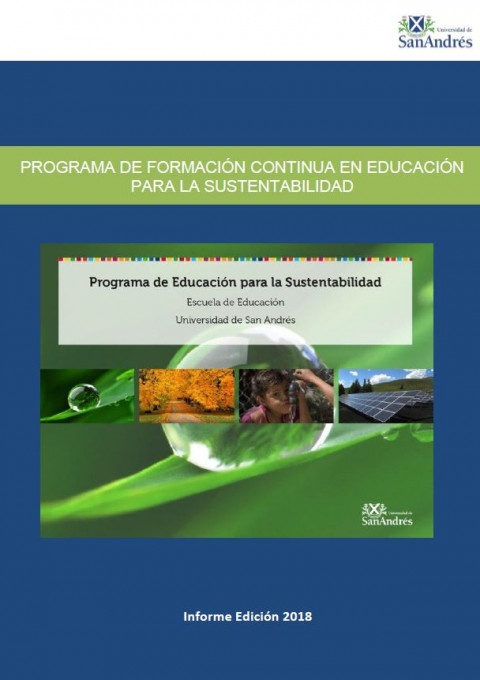 Programa de formación continua en educación para la sustentabilidad; Informe Edición 2018 Year of publication: 2018 Corporate author: Universidad de San Andrés El programa(Programa de Educación para la Sustentabilidad) se propuso trabajar en la promoción de la Educación para la Susten-tabilidad en las escuelas, a fin de generar en toda la comunidad educativa una cultu-ra sustentable. Este trabajo se basó en un enfoque holístico orientado al desarrollo de una mirada crítica y transformadora, y en la promoción de la participación ciuda-dana.Nuestro planteo fue que cada participante diseñe una propuesta pedagógica innova-dora en Educación para la Sustentabilidad, que responda a las particularidades de su institución de pertenencia, pero que a la vez pueda ser replicada por otras institu-ciones y actores. De esta forma, se deja capacidad instalada para la planificación e implementación de proyectos educativos orientados a la promoción de la Educación para la Sustentabilidad. Mediante las suce-sivas ediciones del programa, buscamos fortalecer una masa crítica de especialistas en Educación para la Sustentabilidad como apoyo a la calidad del sistema educativo en Argentina, conformando una Comunidad Profesional de Aprendizaje que reconozca a nuestro programa como un espacio de encuentro y referencia.
 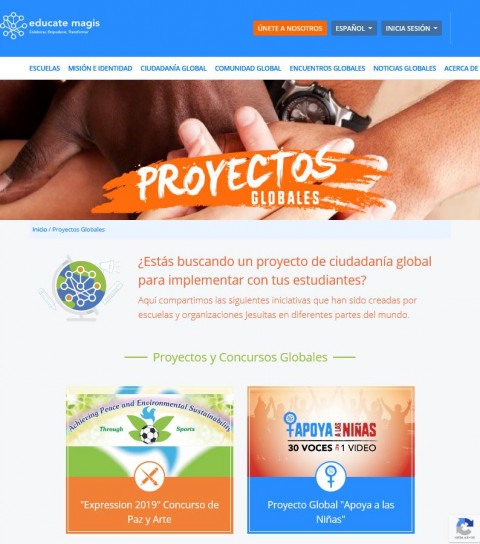 Are You Looking for a Global Citizenship Project to Implement with Your Students?: Global Projects and Contests Year of publication: 2019 Corporate author: Educate Magis In this part of the Educate Magis' webpage from the Society of Jesus one can access a calendar with global activities and events and information about different initiatives that have been organized by different jesuit schools and organizations around the world. One can access different global citizenship educational projects such as "Global red chair", "Walk a mile in my shoes", or "Stand with Girls global project".