
Resources
Explore a wide range of valuable resources on GCED to deepen your understanding and enhance your research, advocacy, teaching, and learning.
3,559 Results found
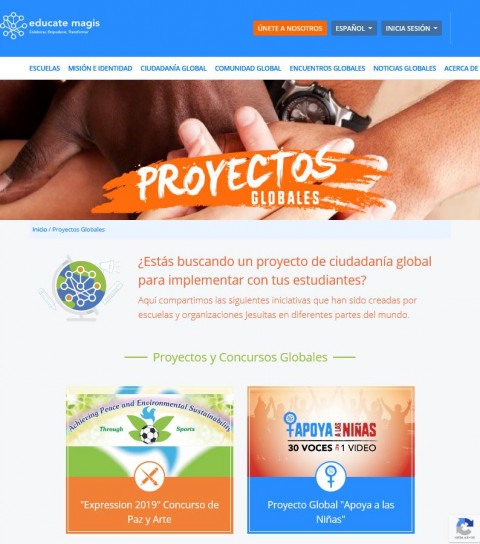 ¿Estás buscando un proyecto de ciudadanía global para implementar con tus estudiantes?: Proyectos y Concursos Globales Year of publication: 2019 Corporate author: Educate Magis En este espacio de la página web de Educate Magis de la Comunidad de Jesús se accede a un calendario de actividades y eventos a nivel global y a información sobre iniciativas que han sido creadas por escuelas y organizaciones Jesuitas en diferentes partes del mundo. Se accede a distintos proyectos educatiovs para fomentar una ciudadanía mundial como "La silla roja global", "Camina una milla en mis zapatos", o "Únete a las niñas".
 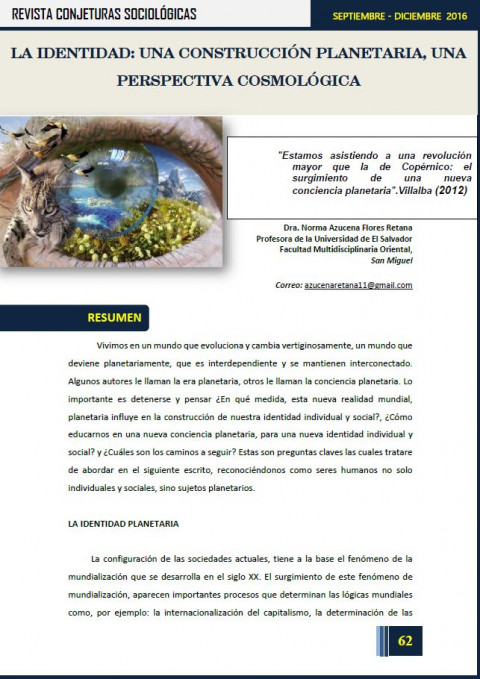 Identity: A Planetary Construction, a Cosmological Perspective Year of publication: 2016 Author: Norma Azucena Flores Retana In the article the author asks herself what a planetary citizenship is and how it should be promoted. She starts by questioning econocimic perspectives and ends by focusing on an ideal based on solidarity. In the article summary she states: "We live in a world that evolves and changes at a very high speed, a world that is become planetary, that is interdependant and interconnected. Some authors call it the planetary era, others a planetary consciousness. The important thing is to stop and think. Up to what extent, this new world reality, planetary, influences our individual and social identities? How can we educate ourselves in a new planetary conciousness, for a new individual and social identity?, and, which are the paths that we should follow? These are key questions which I will try to analyse in the article, recognizing ourselves not only as human beings that are individual and social, but also planetary." In the article the author provides broad answers and perspectives to the questions stated in the summary. La identidad : una construcción planetaria, una perspectiva cosmológica Year of publication: 2016 Author: Norma Azucena Flores Retana En el artículo la autora se pregunta qué es una ciudadanía planetaria y cómo debería fomentarse esta. Comienza haciendo una critica a las perspectivas econocimicistas para luego centrarse en un ideal basado en la solidaridad. En su resumen del artículo dice: "Vivimos en un mundo que evoluciona y cambia vertiginosamente, un mundo que deviene planetariamente, que es interdependiente y se mantienen interconectado. Algunos autores le llaman la era planetaria, otros le llaman la conciencia planetaria. Lo importante es detenerse y pensar ¿En qué medida, esta nueva realidad mundial, planetaria influye en la construcción de nuestra identidad individual y social?, ¿Cómo educarnos en una nueva conciencia planetaria, para una nueva identidad individual y social? y ¿Cuáles son los caminos a seguir? Estas son preguntas claves las cuales tratare de abordar en el siguiente escrito, reconociéndonos como seres humanos no solo individuales y sociales, sino sujetos planetarios. " En el artículo la autora da respuestas y perspectivas amplias a las preguntas que plantea en el resumen.
 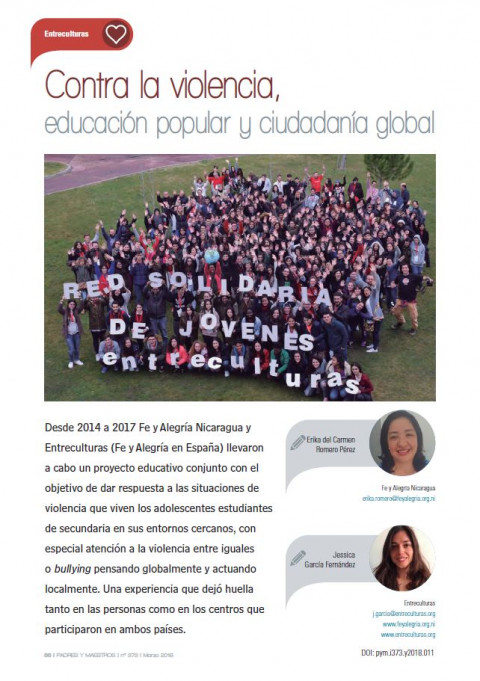 Against Violence, Popular Education and Global Citizenship Year of publication: 2018 Author: Erika del Carmen Romero Pérez | Jessica García Fernández The article is about a project that was carried out between 2014 and 2017 by two countries: Nicaragua and Spain, on behalf of the organizations "Fe y alegría Nicaragua" and "Entreculturas (Fe y Alegría España)". It was an educative project among both nations that had two main objectives: promoting both local and global citizenship, and to give answer to violent situations that adolescent students hae to face in secondary education contexts, with special attention to the violence among equals or bullying. Contra la violencia, educación popular y ciudadanía global Year of publication: 2018 Author: Erika del Carmen Romero Pérez | Jessica García Fernández El artículo habla sobre un proyecto que se llevó a cabo entre 2014 y 2017 por medio de dos países: Nicaragua y España, a través de las organizaciones "Fe y alegría Nicaragua" y "Entreculturas (Fe y Alegría España)". Fue un proyecto educativo conjunto entre los dos países, y tenía dos objetivos principales: el fomentar una ciudadanía tanto local como global, y el de dar respuesta a las situaciones de violencia que viven los adolescentes estudiantes de secundaria en sus entornos cercanos, con especial atención a la violencia entre iguales o bullying.
 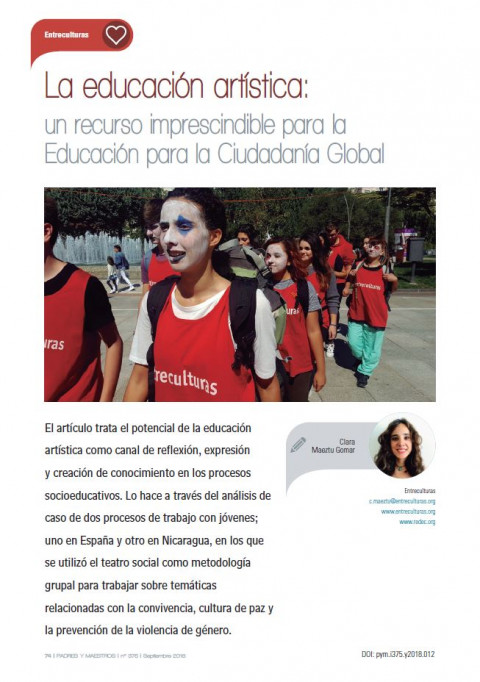 Artistic Education: An Essential Resource for Global Education Year of publication: 2018 Author: Clara Maeztu Gomar The article is about the potential of artistic education as a means of reflection, expression and production of knowledge in socioeducative processes. It details a case study were two working processes with youth are explained: one in Spain and the other one in Nicaragua. In both cases social theatre was used as a group methodology to work on thematics related with coexistence, culture of peace, and prevention of gender violence. La educación artística: un recurso imprescindible para la Educación para la Ciudadanía Global Year of publication: 2018 Author: Clara Maeztu Gomar El artículo trata el potencial de la educación artística como canal de reflexión, expresión y creación de conocimiento en los procesos socioeducativos. Lo hace a través del análisis de caso de dos procesos de trabajo con jóvenes; uno en España y otro en Nicaragua, en los que se utilizó el teatro social como metodología grupal para trabajar sobre temáticas relacionadas con la convivencia, cultura de paz y la prevención de la violencia de género.
 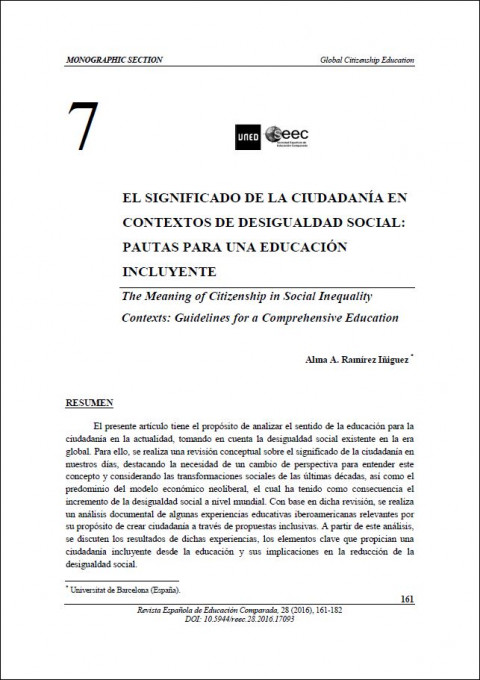 The Meaning of Citizenship in Social Inequality Contexts: Guidelines for a Comprehensive Education Year of publication: 2016 Author: Alma A Ramírez Iñiguez This article analyses the sense of citizenship education currently regarding the social inequality in the global era. For this, a conceptual framework about citizenship meaning is stablished and the need of a conceptual change is highlighted taking into account the social transformations, the increase of inequality in the worldwide and the neoliberal model hegemony in last decades. Based on this, some relevant Ibero American educational experiences in citizenship education are analyzed and their results are discussed. From this, some key elements involved in education for inclusive citizenship are pointed out as well as their contribution for social inequality decrease. El significado de la ciudadanía en contextos de desigualdad social: pautas para una educación incluyente Year of publication: 2016 Author: Alma A Ramírez Iñiguez El presente artículo tiene el propósito de analizar el sentido de la educación para la ciudadanía en la actualidad, tomando en cuenta la desigualdad social existente en la era global. Para ello, se realiza una revisión conceptual sobre el significado de la ciudadanía en nuestros días, destacando la necesidad de un cambio de perspectiva para entender este concepto y considerando las transformaciones sociales de las últimas décadas, así como el predominio del modelo económico neoliberal, el cual ha tenido como consecuencia el incremento de la desigualdad social a nivel mundial. Con base en dicha revisión, se realiza un análisis documental de algunas experiencias educativas iberoamericanas relevantes por su propósito de crear ciudadanía a través de propuestas inclusivas. A partir de este análisis, se discuten los resultados de dichas experiencias, los elementos clave que propician una ciudadanía incluyente desde la educación y sus implicaciones en la reducción de la desigualdad social.
 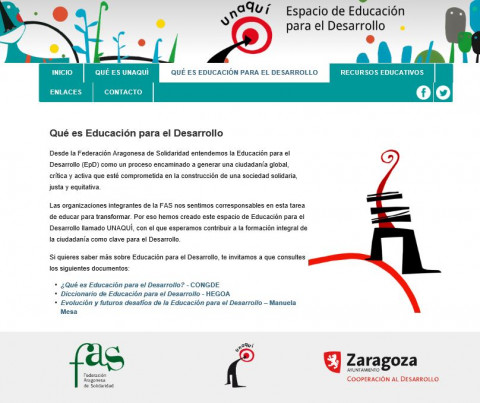 What is Education for Development? Year of publication: 2019 Corporate author: UNAQUÍ The blog of Unaquí informs that the Aragones Federation of Solidarity understands that Education for Development (ED) is a process which fosters critical and active global citizenship, that promotes more just, equal and cooperative societies. The blog also informs that the organizations that are part of the FAS believe that they are responsible of the education in order to transform societies, therefore, they created this space, called UNAQUÍ, to promote Education for Development and contribute to the promotion of citizenship.The blog provides information about different projects that are carried out.