
Resources
Explore a wide range of valuable resources on GCED to deepen your understanding and enhance your research, advocacy, teaching, and learning.
3,559 Results found
 2020 연대와 공동체 의식으로 코로나바이러스감염증-19를 함께 극복해 나가는 세계시민교육 Year of publication: 2020 Corporate author: 서울특별시교육청 민주시민생활교육과 세계시민교육은 지역에서 일어나는 다양한 사안들이 지구 공동의 문제와 연결되어 있다는 것을 이해하고 공감하며 이러한 문제들을 해결하기 위한 다양한 방면에서의 지식, 기술, 태도를 기르고 지구 공동체의 더 평화롭고 행복한 미래를 지향하는 교육이다.이 자료는 서울특별시교육청에서 코로나바이러스감염증-19로 인한 위기에 대응하기 위해 발간한 혐오와 차별을 극복하는 연대와 책임의 세계시민성 함양 자료이다. 코로나 바이러스 감염으로 학교에 오지 못하는 학생들에게 온라인 수업 교재로 활용하여 관련 주제에 대해 학생 스스로 다양한 자료를 찾아보거나 자신의 생각을 온라인으로 공유하는 방법으로 사용할 수 있으며 직접 교실에서 학생들과 함께 교과 융합이나 주제 중심 수업으로도 활용 가능하다.
 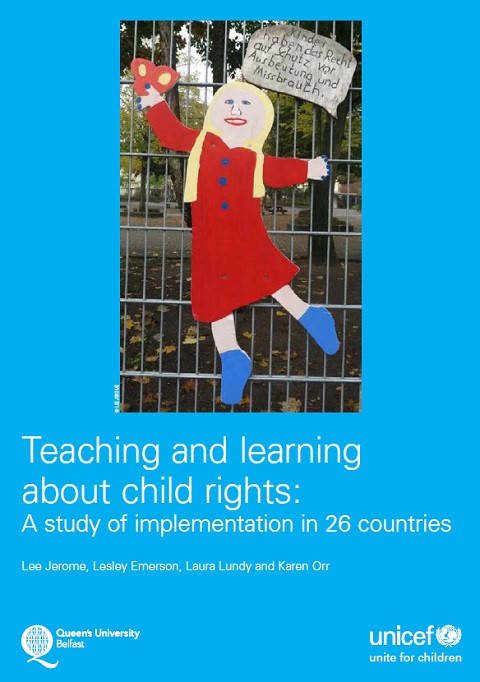 Teaching and Learning about Child Rights: A Study of Implementation in 26 Countries Year of publication: 2015 Author: Lee Jerome | Lesley Emerson | Laura Lundy | Karen Orr Corporate author: Queen’s University Belfast | United Nations Children's Fund (UNICEF) This research contributes to the global debate on child rights education (CRE). It explores implementation of CRE in early childhood education, primary and secondary schools in 26 countries with a UNICEF National Committee presence. It includes a literature review, results from an on-line survey completed by national experts, seven country case studies and a series of benchmarking statements for CRE implementation.
  Well-Being and Safety of Women: OSCE-Led Survey on Violence Against Women Year of publication: 2019 Corporate author: Organization for Security and Co-operation in Europe (OSCE) This report presents the cross-regional, comparable findings of the OSCE-led Survey on the Well-being and Safety of Women, which was implemented in 2018 in Albania, Bosnia and Herzegovina, Montenegro, North Macedonia and Serbia, Moldova3 and Ukraine. The research was also conducted in Kosovo.The OSCE-led survey included a quantitative and qualitative component and was undertaken with the goal of providing comparable data on different forms of violence women experience in their childhood and throughout the course of their lives. The research examined violence that women experience in conflict and non-conflict settings, as well as the impact violence has on women, including its lasting consequences. Questions on norms and attitudes connected to violence against women were asked to better understand the underlying causes of violence.The area covered by this research is diverse and has different historical, social and economic contexts. Rather than focusing on the findings from particular locations, the report aims to provide an overview of women’s experiences and to highlight the issues – often similar – that persist and continue to hamper the well-being and safety of women throughout the area covered by the research.
  From Volunteers to Active Citizens Year of publication: 2015 Author: Grainne O’Neil Corporate author: Comhlámh This is a practical guide for volunteer sending-organisations, which aims to build capacity to support and deepen volunteers’ ongoing learning and critical engagement with international development issues, and to help volunteers “to address the structural and underlying causes of inequality and injustice to participate in social change making.”
 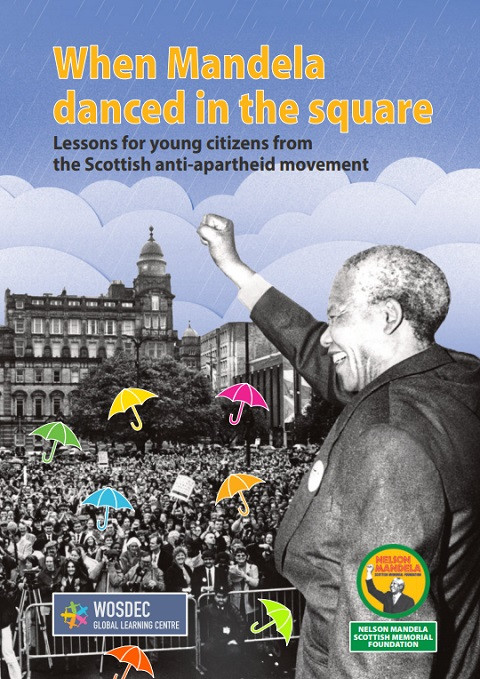 When Mandela Danced in the Square: Lessons for Young Citizens from the Scottish Anti-Apartheid Movement Year of publication: 2020 Corporate author: West of Scotland Development Education Centre (WOSDEC) | Nelson Mandela Scottish Memorial Foundation This resource aims to understand the context of apartheid South Africa, the life of Nelson Mandela and the connections to the Scottish anti-apartheid movement. The activities in this resource support second and third level learners within Scotland's Curriculum for Excellence to explore Scotland’s connection with Nelson Mandela and feel empowered to take action on issues of importance to them today.
 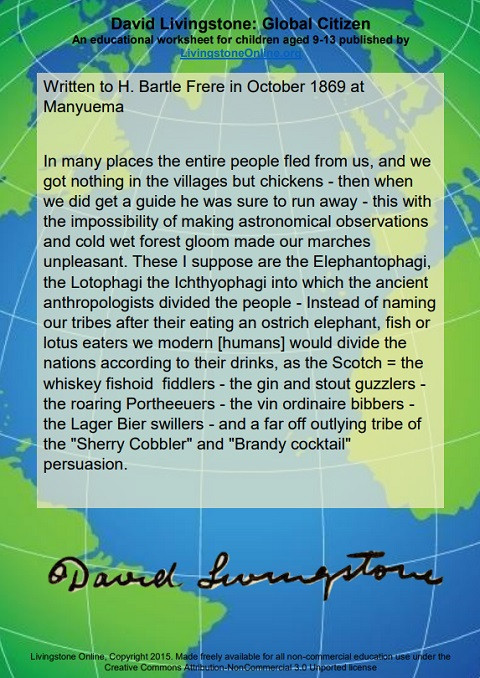 David Livingstone: Global Citizen Year of publication: 2015 Author: Kate Simpson | Megan Ward Corporate author: Livingstone Online This material urges students to explore the term global citizenship and what it means to them. Students can use Livingstone’s letter to practice their deep reading skills, finding out what the letter reveals about nineteenth-century perspectives on global life.
 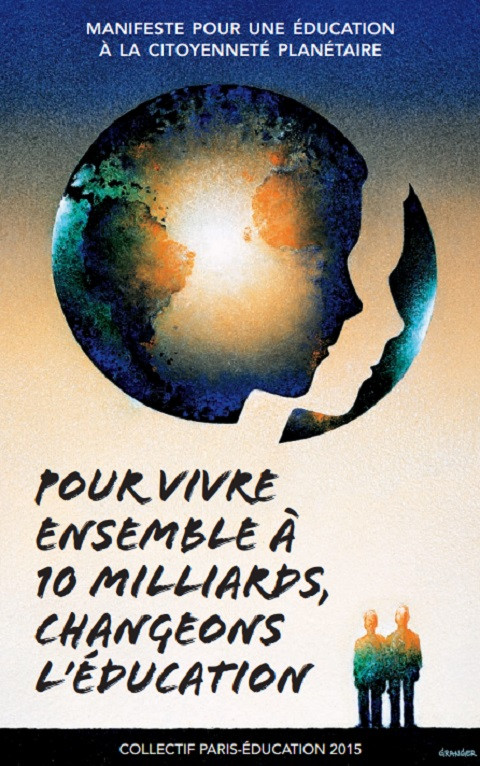 Pour vivre ensemble à 10 milliards, changeons l’éducation: Manifeste pour une éducation à la citoyenneté planétaire Corporate author: Le collectif Paris-éducation 2015 | Les Amis de Circée 2050, c’est demain. Nos enfants et petits-enfants seront alors, sans doute, 10 milliards sur la Terre. D’ici là, quelles que soient les décisions qui seront prises par les gouvernants et les engagements de millions de citoyens dans le monde, la température du globe aura monté, comme le niveau des océans. Selon ce que notre génération aura entrepris plus ou moins résolument pour réduire nos émissions de CO2, ce sera entre 2° C ou 4° C à l’horizon 2100, voire davantage. Il faudra donc, de toute façon, vivre autrement. Face à l’ampleur, l’urgence, la diversité et la complexité des problématiques engendrées par le modèle de développement de nos sociétés contemporaines, nous sommes donc obligés, dans l’urgence, de nous pencher sur les questions d’éducation et de formation des générations futures qui devront affronter des réalités biophysiques, économiques et politiques inédites, dont nous commençons à peine à entrevoir l’ampleur. Ce qui est dès lors en jeu, avec l’avenir de l’homme et de la Terre, c’est l’humain, ce qu’il deviendra, ce qu’il sera capable de porter comme projet pour l’humanité. Quelles qualités d’humains devons-nous faire advenir pour que ces réalités inédites puissent être rencontrées demain, sans que l’humanité bascule dans la violence et le dépeçage égoïste de la planète? Quels enfants voulons-nous laisser à notre Terre?Cette urgence impose un changement d’échelle dans la transformation des systèmes éducatifs, des contenus et des méthodes d’enseignement. Malgré la volonté et la compétence de nombreux acteurs de l’école, force est de constater que les actions menées pour une éducation plus en cohérence avec les enjeux climatiques et, plus largement, sociétaux restent à la marge. Elles sont réalisées par des individus clairvoyants. Il est temps d’enclencher la vitesse supérieure.
 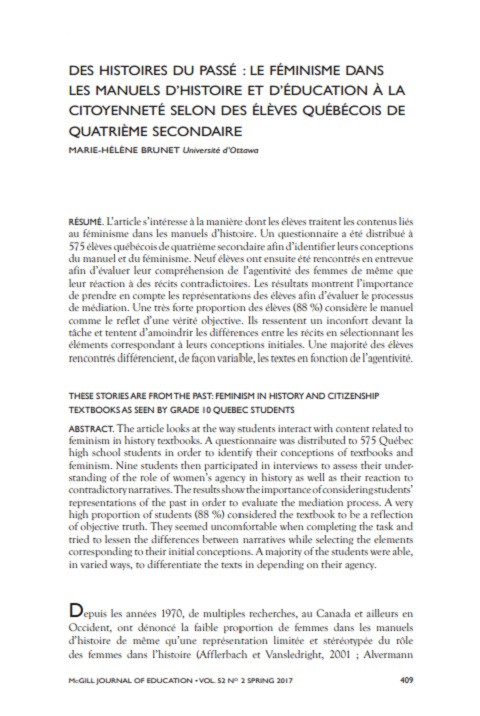 These Stories are From the Past: Feminism in History and Citizenship Textbooks as Seen by Grade 10 Quebec Students (McGill Journal of Education; Vol. 52, No. 2) Year of publication: 2017 Author: Marie-Hélène Brunet Corporate author: McGill University. Faculty of Education The article looks at the way students interact with content related to feminism in history textbooks. A questionnaire was distributed to 575 Québec high school students in order to identify their conceptions of textbooks and feminism. Nine students then participated in interviews to assess their understanding of the role of women’s agency in history as well as their reaction to contradictory narratives. The results show the importance of considering students’ representations of the past in order to evaluate the mediation process. A very high proportion of students (88 %) considered the textbook to be a reflection of objective truth. They seemed uncomfortable when completing the task and tried to lessen the differences between narratives while selecting the elements corresponding to their initial conceptions. A majority of the students were able, in varied ways, to differentiate the texts in depending on their agency.
  유럽 개발교육 혁신공모전 수상작 모음집 Year of publication: 2019 Corporate author: KOICA ODA 교육원 GENE(유럽 개발교육 네트워크)은 개발교육 혁신공모전을 통해 개발교육 혁신 사례를 시상하고 널리 알린다. 본 공모전은 긍정적 변화를 촉진하고 사람들이 자신이 사는 지역은 물론 전 세계가 마주한 현실에 눈과 마음을 열게 만드는 개발교육 프로젝트를 시상한다. 개발교육 혁신공모전은 창의성, 참여, 실천, 시너지, 혁신을 통해 변화를 현실화하는 개발교육, 궁극적으로 공공정책에 영향을 줄 수 있는 개발교육을 장려한다.2017년과 2018년의 개발교육 혁신공모전은 해당 연도 기준으로 진행 중이거나 막 끝난 유럽 내 개발교육 프로젝트들을 집중 조명한다. 본 공모전에는 혁신의 모범 사례이면서 그 과정에서 얻은 교훈을 유럽 전역의 정책결정자들에게 전파할 수 있는 이니셔티브들이 선정되었다.GENE은 개발교육 혁신공모전을 통해 유럽의 개발교육 프로그램들로부터 교훈과 반성의 기회를 얻는 데 기여하고자 한다. 다양한 접근법과 배경을 고려해 선정된 이니셔티브들이 개발교육의 기금 후원자 및 정책 개발자들에게 새로운 사고, 창의성, 영감의 기회가 되기를 희망한다.
  The Sustainable Development Goals and Youth: Resource Pack Year of publication: 2015 Author: Valerie Duffy | Leo Gilmartin | Fionn Scott Corporate author: National Youth Council of Ireland (NYCI) | Irish Aid This resource encourages young people and those who work with young people to learn about the new Sustainable Development Goals (SDGs) and think about how these Goals can be incorporated into our everyday lives. It supports the exploration of key local, national and global issues to see and understand how we are linked together.