
Resources
Explore a wide range of valuable resources on GCED to deepen your understanding and enhance your research, advocacy, teaching, and learning.
3,500 Results found
 A Report on Education for Democratic Citizenship and Human Rights Education Policy and Practice in Six Eastern Partnership Countries: Promoting Human Rights Education and Democratic Citizenship in Eastern Partnership Countries Year of publication: 2017 Author: Ralph Edward Huddleston | Karine Harutyunyan | Ulviyya Mikayilova | Irina Fursa | Shorena Gharibashvili | Cezar Gavriliuc | Polina Verbytska Corporate author: Council of Europe This report has been produced within the framework of the EU/CoE Joint Programme “Supporting Education Policies in Democratic Citizenship and Human Rights Education in 6 Eastern Partnership countries”. The Programme embraces the six countries of the EU’s Eastern Partnership: Armenia, Azerbaijan, Belarus, Georgia, Moldova and Ukraine. Its aim is to support integration and/or further develop of education for democratic citizenship and human rights education in national education systems (including school curriculum) in Eastern Partnership countries, in accordance with the Council of Europe Charter on Education for Democratic Citizenship and Human Rights Education. The report draws on the results of a research exercise designed to map the most important initiatives and priorities in the area of Education for Democratic Citizenship and Human Rights Education (EDC/HRE) in the six countries. The research exercise was carried out 2015-16 by local experts within each country. It resulted in six individual country reports outlining the current situation in relation to the integration of the principles of EDC/HRE within the national education system, and identifying opportunities for further development.
 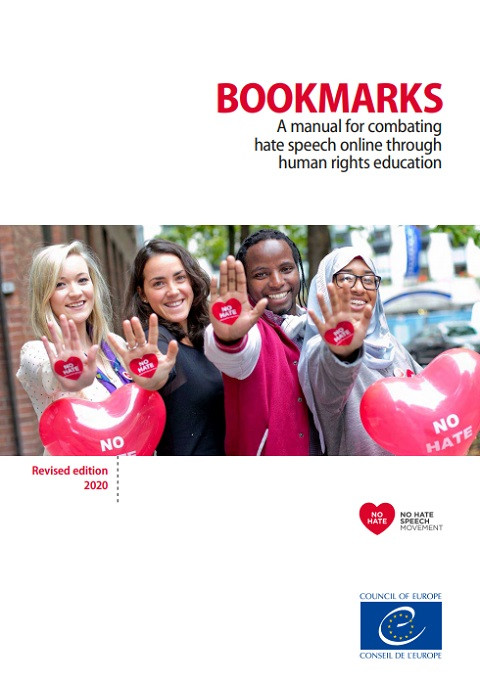 Bookmarks: A Manual for Combating Hate Speech Online Through Human Rights Education Year of publication: 2020 Author: Ellie Keen | Mara Georgescu Corporate author: Council of Europe The work of the Council of Europe for democracy is strongly based on education: education in schools, and education as a lifelong learning process of practising democracy, such as in non-formal learning activities. Human rights education and education for democratic citizenship form an integral part of what we have to secure to make democracy sustainable. Hate speech is one of the most worrying forms of racism and discrimination prevailing across Europe and amplified by the Internet and social media.Hate speech online is the visible tip of the iceberg of intolerance and ethnocentrism. Young people are directly concerned as agents and victims of online abuse of human rights; Europe needs young people to care and look after human rights, the life insurance for democracy.Bookmarks was originally published to support the No Hate Speech Movement youth campaign of the Council of Europe for human rights online. Bookmarks is useful for educators wanting to address hate speech online from a human rights perspective, both inside and outside the formal education system. The manual is designed for working with learners aged 13 to 18 but the activities can be adapted to other age ranges.This edition of Bookmarks reflects the end of the coordination of the youth campaign by the Council Europe. The campaign may be officially over, but the education and awarenessraising to counter hate speech and promote human rights values remain an urgent task for young people of all ages. Connexions: Manuel pour la lutte contre le discours de haine en ligne par l’éducation aux droits humains Year of publication: 2020 Author: Ellie Keen | Mara Georgescu Corporate author: Conseil de l'Europe L’action du Conseil de l’Europe en faveur de la démocratie est fortement axée sur l’éducation : l’éducation à l’école, mais aussi l’éducation en tant que pratique de la démocratie tout au long de la vie, comme dans le cadre des activités d’apprentissage non formel. L’éducation aux droits humains et l’éducation à la citoyenneté démocratique font partie intégrante du socle que nous devons bâtir pour faire de la démocratie une réalité durable.Le discours de haine est l’une des formes les plus inquiétantes de racisme et de discrimination qui sévit aujourd’hui en Europe, amplifiée par Internet et par les médias sociaux. Le discours de haine en ligne n’est que la partie visible de l’iceberg de l’intolérance et de l’ethnocentrisme. Les jeunes sont directement concernés, en tant qu’acteurs et victimes d’atteintes aux droits humains en ligne. L’Europe a besoin que les jeunes veillent aux droits de l’homme et les protègent : c’est là l’assurance-vie de la démocratie.Connexions a été créé dans le cadre du Mouvement contre le discours de haine, autrement dit, la campagne de la jeunesse du Conseil de l’Europe pour les droits humains en ligne. C’est un outil précieux pour les éducateurs qui souhaitent aborder le discours de haine en ligne sous l’angle des droits de l’homme, tant dans le système éducatif formel que dans le cadre de l’éducation informelle. Ce manuel a été conçu pour travailler avec des apprenants de 13 à 18 ans, mais les activités proposées peuvent être adaptées à d’autres groupes d’âge.Cette édition de Connexions a été révisée après que le Conseil de l’Europe a mis fin à la coordination de la campagne de jeunesse liée au Mouvement contre le discours de haine. Bien que la campagne ait pris officiellement fin, il importe de poursuivre l’éducation et la sensibilisation des jeunes pour combattre le discours de haine et promouvoir les valeurs liées aux droits humains.
 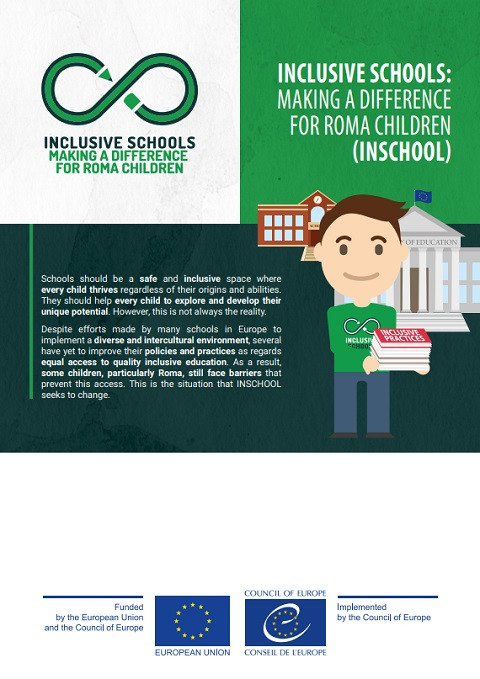 Inclusive Schools: Making a Difference for Roma Children (Inschool) Corporate author: European Union (EU) | Council of Europe This leaflet presents a joint project of the European Union and the Council of Europe on “Inclusive schools: making a difference for Roma children” targeting schools where Roma children learn, in the Czech Republic, Hungary, Romania, Slovak Republic and United Kingdom. The project aims at enhancing social inclusion of Roma by promoting inclusive education policies and practices in Europe.
  Digital Citizenship Education Handbook Year of publication: 2019 Author: Janice Richardson | Elizabeth Milovidov Corporate author: Council of Europe Digital citizenship and engagement involves a wide range of activities, from creating, consuming, sharing, playing and socialising, to investigating, communicating, learning and working. Competent digital citizens are able to respond to new and everyday challenges related to learning, work, employability, leisure, inclusion and participation in society, respecting human rights and intercultural differences.This Digital citizenship education handbook is designed to help educators and other interested adults understand and deal with them. It builds on the Council of Europe’s Reference Framework of Competences for Democratic Culture and the achievements of our longstanding Education for Democratic Citizenship programme, and complements the Internet literacy handbook as part of a coherent approach to educating citizens for the society of the future.
  Peace Education: Handbook for Educators Year of publication: 2015 Corporate author: International Falcon Movement-Socialist Educational International (IFM-SEI) | Council of Europe This document presents peace education tools so that children and adolescents can play a vital role, changing individual attitudes and examining the social, economic and political context to understand where conflicts come from and how to transform them. Education à la Paix: Manuel de l’éducatrice et de l’éducateur Year of publication: 2015 Corporate author: International Falcon Movement-Socialist Educational International (IFM-SEI) | Conseil de l'Europe Cet ouvrage en deux parties est basé sur les résultats de notre travail, ainsi que des outils developpés et testés par certaines de nos organisations membres: • De la matière à réflexion, des conseils et des informations pour les éducateurs·trices à la paix. Des activités éducatives que vous pouvez réaliser avec les enfants, les jeunes ou les autres chefs de groupe et les pairs éducateurs·trices. La deuxième partie comprend trois chapitres. Chacun de ces derniers se concentre sur un aspect différent de l’éducation de la paix. Comprendre le conflit introduit différentes questions sur le conflit et la guerre, la sensibilisation sur ses causes et ses conséquences. Transformer le conflit met l’accent sur la dynamique du conflit et les différentes façons dont nous pouvons traiter avec elle - de manière agressive ou constructive. Faire la paix vous invite à réfléchir et à développer des idées pour la paix et donne des outils pour la consolidation de la paix, comme la communication et le dialogue compétences. Educación por la Paz: Guía para educadores y educadoras Year of publication: 2015 Corporate author: International Falcon Movement-Socialist Educational International (IFM-SEI) | Council of Europe Este documento presenta herrameintas de ediuación para la paz de manera que niñas, niños y adolescentes puedan jugar un papel vital, cambiando las actitudes individuales y examinando el contexto social, económico y político para comprender de dónde provienen los conflictos y cómo transformarlos.
 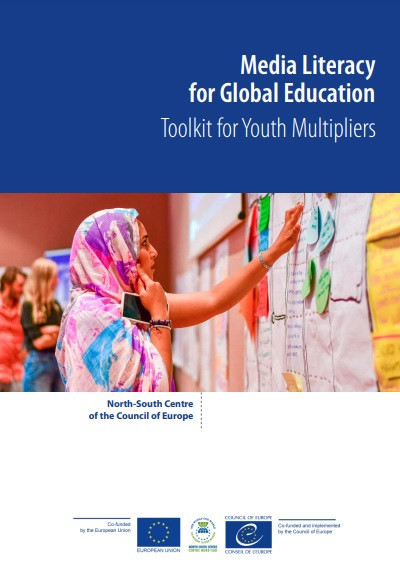 Media Literacy for Global Education: Toolkit for Youth Multipliers Year of publication: 2022 Corporate author: North-South Centre of the Council of Europe | Council of Europe | European Union (EU) This toolkit targets youth multipliers and educators and gathers practical and contextual information about Media Literacy (ML) and its contribution to the field of Global Education (GE). Its activities and fact sheets are focused on non-formal learning contexts, but they can also be implemented in schools since the toolkit combines the most recent developments in GE, ML and Digital Citizenship Education useful to enrich formal school curricula. All the practical activities proposed in the toolkit are in line with the Competences for Democratic Culture and the Human Rights approach of the Council of Europe.The toolkit’s main aim is to empower practitioners on ML, but also to provide the wider public with the knowledge and tools to become more responsible and active citizens, offering activities focused on the critical analysis and production of media messages, analysis of algorithms, active participation in societies, maintenance of privacy, maintenance of well-being and management of e-identity.
 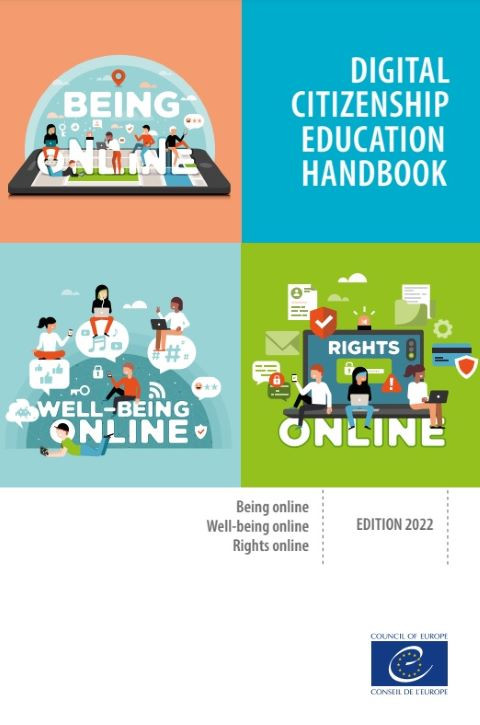 Digital Citizenship Education Handbook (Edition 2022) Year of publication: 2022 Author: Janice Richardson | Elizabeth Milovidov Corporate author: Council of Europe Digital citizenship competences define how we act and interact online. They comprise the values, attitudes, skills and knowledge and critical understanding necessary to responsibly navigate the constantly evolving digital world, and to shape technology to meet our own needs rather than to be shaped by it. The Digital citizenship education handbook offers information, tools and good practice to support the development of these competences in keeping with the Council of Europe’s vocation to empower and protect children, enabling them to live together as equals in today’s culturally diverse democratic societies, both on- and offline.The Digital citizenship education handbook is intended for teachers and parents, education decision makers and platform providers alike. It describes in depth the multiple dimensions that make up each of 10 digital citizenship domains, and includes a fact sheet on each domain providing ideas, good practice and further references to support educators in building the competences that will stand children in good stead when they are confronted with the challenges of tomorrow’s digital world. The Digital citizenship education handbook is consistent with the Council of Europe’s Reference Framework of Competences for Democratic Culture and compatible for use with the Internet literacy handbook.