
Resources
Explore a wide range of valuable resources on GCED to deepen your understanding and enhance your research, advocacy, teaching, and learning.
3,502 Results found
 ‘평화, 인권, 국제이해, 협력, 기본적 자유, 세계시민성, 지속가능발전을 위한 교육 권고’에서 제시한 지속가능발전교육 내용과 향후 실천 과제 (국제이해교육연구; Vol. 19, No. 2) Year of publication: 2024 Author: 김다원 Corporate author: 한국국제이해교육학회 본 연구는 2023년 11월 유네스코 제42차 총회에서 개정된 1974 국제이해교육 개정 권고에 제시된 지속가능발전교육의 내용과 향후 과제를 파악하는 데 목적을 두었다. 본 개정 권고에서는 새롭게 ‘세계시민성’, ‘지속가능발전’을 위한 교육을 적극적으로 포함하였다. 유엔과 유네스코에서는 1992년 리우 선언 발표, 2004년 ‘지속가능발전교육 10년(2005~2014)’ 추진, 2015년 ‘지속가능발전을 위한 2030 어젠더’에서 글로벌 추진 과제로 지속가능발전목표(SDGs)를 제시하여 전 세계에 적극적인 지속가능발전교육의 실행을 요청해 왔다. 이러한 흐름에서 1974 국제이해교육 개정 권고는 그간의 지속가능발전을 위한 교육의 흐름을 반영하면서도 최근의 글로벌 사회에서 나타나고 있는 기후변화, 분쟁과 갈등, 심화되는 불평등 등의 문제를 해결하고 인류 평화와 지구 생태계 유지를 위해 필요한 지속가능발전교육이 무엇인지를 제시했다는 데 각별한 의미가 있다. 이러한 배경에서 본 연구는 1974 국제이해교육 개정 권고에 제시된 지속가능발전교육의 성격, 목표, 방법을 분석적 시각으로 살펴보았다. 그리고 이를 토대로 향후 한국 지속가능발전교육의 해결해야 할 과제와 방향을 모색하였다.
  The Development of a Middle School Social Studies Instructional Module for Place-Based Global Citizenship Education: The Case of Jeju Island (Journal of Education for International Understanding; Vol. 14, No. 2) Year of publication: 2019 Author: Han Sanghee Corporate author: Korean Society of Education for International Understanding (KOSEIU) This study aims to develop an instructional module for middle school social studies as part of place-based global citizenship education. The main contents of this study are as follows:first, the methods used in developing an instructional module for middle school social studies in global citizenship education; second, the method applied in the module for middle school classes. The study was mainly based on reference research and action research. The place-based class module developed for this study is the case of Jeju Island and is focused on middle school social studies classes as oriented to the integrated curriculum. The results are as follows: First, I developed a class module for place-based global citizenship education. For this module, I created principles for the class module for place-based global citizenship education and compose the class module by focusing on the case of Jeju Island. The design of this module went through 3 stages. The first stage explores regional issues by considering mutual relationships and the context from which suitable themes to foster global citizenship in the region are uncovered. The second stage explores the geological, historical, social, and cultural contexts of the place-based issues. The third stage expands on the contexts of the regional issues and practice to exercise global citizenship. Through the application of the principles and developmental stages for the class module, I then compose three Jeju-based modules. Second, I developed and conducted a Jeju-based instructional module for global citizenship education. For the themes and Jeju cases of the place-based module, I present sympathy for universal values through the life of Kim Mandeok who gave aid to the poor in the late Joseon era; respect for diversity and difference through the history of Haenamcheon, the Jeju immigrant community during early industrialization; and solidarity and practice through the Jeju 4·3 Uprising and Massacre. These three class modules can be utilized independently or stage by stage. I concede that this study has spatial and content limitations due to the fact that the Jeju cases are only presented among domains relating to global citizenship education which means that follow-up research is required to expand into relating domains and other regions. In addition, this study has other limits in that it hasn’t been verified quantitatively by presenting the effects of global citizenship education only through the stories of students who attended this class and the follow-up educational activities through this module. 지역 기반 세계시민교육을 위한 중학교 사회과 수업모듈 개발: 제주 지역을 사례로 (국제이해교육연구; Vol. 14, No. 2) Year of publication: 2019 Author: Sang-Hee Han Corporate author: 한국국제이해교육학회 이 연구의 목적은 지역 기반 세계시민교육을 위한 중학교 사회과 수업 모듈을 개발하는 데 있다. 주요 연구 내용은 두 가지이다: 첫째, 지역 기반 세계시민교육을 위한 중학교 사회과 수업모듈을 어떻게 설계할 수 있는가, 둘째 지역 기반 세계시민교육 수업 모듈은 중학교 수업 현장에 어떻게 적용할 수 있는가이다. 연구 방법으로서 주로 문헌연구와 실행연구를 활용하였다. 이 연구에서 개발한 지역 기반 수업 모듈은 제주지역을 사례로 하였으며, 통합교육과정을 지향하는 중학교 사회과 수업에 초점을 맞추었다. 연구 결과는 다음과 같다. 첫째, 지역 기반 세계시민교육을 위한 수업 모듈을 설계하였다. 수업 모듈 설계는 먼저 지역 기반 세계시민교육 수업 모듈의 원리를 설정하고, 이에 따라 제주지역 사례를 중심으로 수업 모듈을 구성하였다. 모듈 설계는 3단계로 구성되는데, 1단계는 상호 연계성과 맥락(context)을 고려하여 지역 기반 이슈를 탐색하는 것으로 세계시민성 함양을 위한 적절한 주제를 지역에서 찾는 단계이다. 2단계는 지역 기반 이슈에 담긴 지리적, 역사적, 사회적, 문화적 맥락을 찾는 학습이 이루어지는 단계이다. 3단계는 지역 기반 이슈의 맥락을 확장하여 세계시민성을 발휘하도록 실천하는 단계이다. 이러한 수업 모듈의 원리와 단계를 적용하여 제주지역에 기반 한 수업 모듈 3가지를 제시하였다. 둘째, 제주지역을 기반으로 한 세계시민교육 수업 모듈을 개발하고 실행하였다. 지역 기반 세계시민교육 수업 모듈의 제주지역 사례로서 조선 후기 제주 빈민을 구제한 김만덕의 삶을 통한 보편적 가치에 대한 공감, 산업화 초기 제주 이주민 공동체인 해남촌 역사를 통해 본 차이와 다양성 존중, 제주 4⋅3을 통한 연대의식과 실천을 주제로 수업 모듈을 제시하였다. 이 연구는 세계시민교육 관련 영역 중 제주지역에 기반 한 사례만을 제시하였다는 점에서 공간적이고 내용적인 한계를 가지며, 이후 관련 영역 및 다른 지역 사례로 확장하는 후속 연구의 과제를 남긴다.
  Integrating Gender into Global Citizenship Education (Journal of Education for International Understanding; Vol. 14, No. 1) Year of publication: 2019 Author: Hyeseung Cho Corporate author: Korean Society of Education for International Understanding (KOSEIU) The purpose of this study is to explore the contents of global citizenship education(GCE) from a gender perspective, and to lay the theoretical foundation to integrate gender issues into GCE. To this end, this research analyzes GCE textbooks published by four Metropolitan City Offices of Education employing content analysis. As results, GCE textbooks rarely include contents related to gender (in)equality by representing 5.26%, 3.81%, and 8.97% of the textbooks of elementary, middle and high school respectively. In terms of topics, although a word of gender (in)equality is mentioned as an international agenda or a global problems in textbooks, the specific concept of it or various worldwide gender inequalities issues such as gender-based violence, women in poverty, reproductive rights were excluded. In terms of format aspects of the textbooks, the textbooks present gender perspective by describing woman as an independent global citizen, and by ensuring the equality of gender composition of characters. In some cases, however, the roles of women and men in textbooks are still divided, and gender stereotype was recognized through sex=segregated activities. Based on these results, this research argues that it is required to expand the contents of GCE by including the importance of gender equality and global structural gender inequality problems, and that it is necessary to review the discourse and practice of GCE in Korea from a gender perspective. 젠더 관점에서 본 세계시민교육 (국제이해교육연구; Vol. 14, No. 1) Year of publication: 2019 Author: 조혜승 Corporate author: 한국국제이해교육학회 본 연구는 국내 세계시민교육 내용을 젠더 관점에서 분석하여, 세계시민교육 내에 젠더 이슈를 포함하기 위한 논의의 토대를 마련하고자 하였다. 이를 위해 최근 시도교육청에서 발간한 세계시민교육 교과서 3종에 대해 내용분석(content analysis)을 실시하여 내용측면과 형식측면으로 나누어 살펴보았다. 분석결과, 세계시민교육 교과서 내 성(불)평등과 관련된 내용이 초등학교 교과서에는 5.26%, 중학교 교과서에는 3.81%, 고등학교 교과서에는 8.97%의 비중으로 포함되어 전반적으로 교과서 내 성(불)평등과 관련된 내용이 낮은 비중으로 나타나고 있었다. 또한 성(불)평등과 관련된 내용이 국제 아젠다 혹은 전지구적 문제로 명시되고는 있으나, 젠더폭력, 젠더와 빈곤, 재생산권 등의 성불평등과 관련된 국내외 이슈들이 배제되고 있었다. 교과서의 형식적 측면을 살펴보면 주체적인 세계시민으로서의 여성상을 제시하고 등장인물의 성별 구성의 형평성을 확보하는 등 성평등한 관점을 드러내기도 하였으나, 일부 사례에서는 여전히 여성과 남성의 역할을 구분하며 성 분리적 활동을 통한 성차별적 인식을 보이기도 하였다. 이러한 결과를 토대로 세계시민교육 내 성평등 이슈의 중요성 및 구조적 성불평등과 차별에 대한 내용이 확대되어야 함을 주장하며, 국내 세계시민교육의 담론과 실천을 젠더적 관점에서 재검토하는 작업이 필요하다고 제안하였다.
  국내 다문화교육역량 연구동향 분석 (다문화교육연구; Vol. 16, No.2) Year of publication: 2023 Author: 남경진 Corporate author: 한국다문화교육학회 본 연구는 향후 다문화교육역량의 국내 연구동향을 살펴보기 위하여 2012년부터 2023년까지 한국연구재단의 등재지 및 등재후보지에 게재된 연구 중 다문화교육역량에 대한 31편의 논문을 선정하였다. 연도별 추이, 연구주제, 연구대상 등을 분석틀로 하여 연구동향 및 특징을 분석하였다. 연구결과는 다음과 같다. 첫째, 다문화교육역량 관련 연구는 2012년부터 지속적으로 연구되어왔으며 2018년 가장 많은 연구가 이루어졌으나 이후 다시 감소하였다. 둘째, 다문화교육역량 관련 연구들은 주로 다문화, 교육, 학습자를 다루는 교육학 관련 학술지에 주로 게재되고 있었다. 셋째, 다문화교육역량 관련 연구주제는 다문화교육역량의 영향에 대한 요인연구 유형이 가장 많았다. 넷째, 다문화교육역량의 연구는 주로 양적연구를 활용하여 이루어졌다. 다섯째, 다문화교육역량의 연구대상은 예비교사와 교사를 대상으로 하는 시도가 가장 많은 것으로 검증되었다. 이러한 결과를 토대로 다문화교육역량 연구의 향후 방향에 대해 논의하였으며 다양한 연구방법을 활용할 필요가 있다는 점을 시사하였다.
 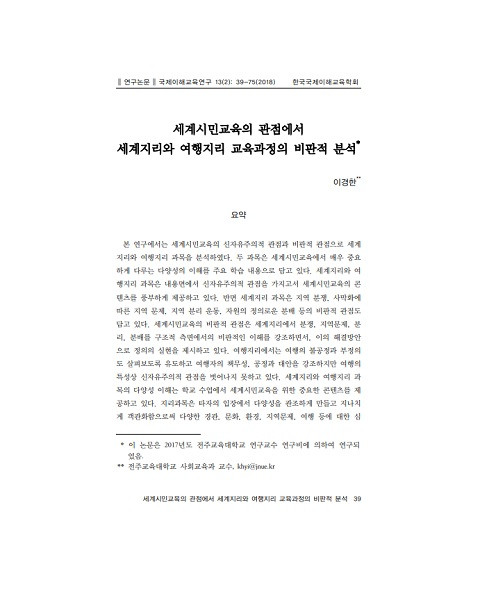 Critical Analysis of World Geography and Travel Geography Curriculum through the Viewpoints of Global Citizenship Education (Journal of Education for International Understanding; Vol. 13, No. 2) Year of publication: 2018 Author: Kyeonghan Yi Corporate author: Korean Society of Education for International Understanding (KOSEIU) In this study I analysed world geography and travel geography curriculum through neo-liberal and critical viewpoints of global citizenship education(GCED). They have many contents about the understanding of diversity which deals in GCED importantly. Two geography curriculums provide many contents of GCED with neo-liberal viewpoint. World geography includes critical viewpoint based on regional conflicts, desertification problems, regional separation movements, righteous distribution of resources etc. The critical viewpoint of GCED in world geography emphasizes the critical understanding of disputes, regional issues, distribution etc. with structural aspect, and guides the realization of justice with problems solutions of these. Travel geography guides students’ identification about unfairness and injustice of travel, and emphasizes travelers’ responsibility, fairness and alternatives. But this travel geography is in circle of neo-liberalism viewpoint mainly. The understanding of diversity in two geographies provides important contents for GCED in schools. Geography make a understanding of diversity with other’s perspectives objectively, but it can neglect the critical and structural understanding about diverse landscape, culture, environment, issues, and travel etc. So geography is necessary to deal critical viewpoint also, because geography has mainly neo-liberal viewpoint. Geography teachers should have the harmony of neo-liberal viewpoint and critical viewpoint to contribute on development of global citizens. Geography teachers should critically re-conceptualize geography curriculum and reconstruct the contents of textbook. And students is necessary to aim transformative learning to understand global diversity and critically participate with global issues in everyday life. 세계시민교육의 관점에서 세계지리와 여행지리 교육과정의 비판적 분석 (국제이해교육연구; Vol. 13, No. 2) Year of publication: 2018 Author: 이경한 Corporate author: 한국국제이해교육학회 본 연구에서는 세계시민교육의 신자유주의적 관점과 비판적 관점으로 세계지리와 여행지리 과목을 분석하였다. 두 과목은 세계시민교육에서 매우 중요하게 다루는 다양성의 이해를 주요 학습 내용으로 담고 있다. 세계지리와 여행지리 과목은 내용면에서 신자유주의적 관점을 가지고서 세계시민교육의 콘텐츠를 풍부하게 제공하고 있다. 반면 세계지리 과목은 지역 분쟁, 사막화에 따른 지역 문제, 지역 분리 운동, 자원의 정의로운 분배 등의 비판적 관점도 담고 있다. 세계시민교육의 비판적 관점은 세계지리에서 분쟁, 지역문제, 분리, 분배를 구조적 측면에서의 비판적인 이해를 강조하면서, 이의 해결방안으로 정의의 실현을 제시하고 있다. 여행지리에서는 여행의 불공정과 부정의도 살펴보도록 유도하고 여행자의 책무성, 공정과 대안을 강조하지만 여행의 특성상 신자유주의적 관점을 벗어나지 못하고 있다. 세계지리와 여행지리 과목의 다양성 이해는 학교 수업에서 세계시민교육을 위한 중요한 콘텐츠를 제공하고 있다. 지리과목은 타자의 입장에서 다양성을 관조하게 만들고 지나치게 객관화함으로써 다양한 경관, 문화, 환경, 지역문제, 여행 등에 대한 심층적이고 구조적, 비판적 이해를 소홀히 할 수도 있다. 그래서 지리과목이 신자유주의적 관점을 주로 가지고 있어서 비판적 관점도 함께 다룰 필요가 있다. 지리교사는 신자유주의적 관점과 비판적 관점을 균형 있게 가진 역량 있는 세계시민을 육성하는데 기여해야 한다. 이를 위해서 지리교사는 비판적으로 지리교육과정을 재개념화하고 지리교과서의 내용을 재구성하여 학생들이 일상의 삶 속에서 세계 다양성의 이해와 세계 쟁점에의 비판적 참여를 실천할 수 있도록 변혁적 학습을 지향할 필요가 있다.
 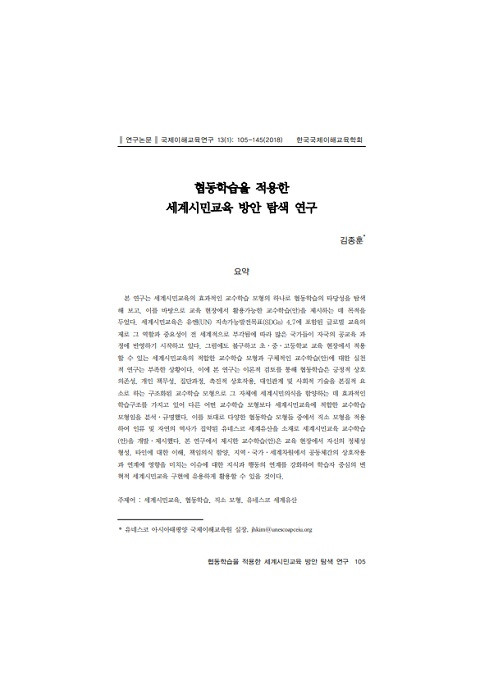 An Exploratory Study on Applying Cooperative Learning in Global Citizenship Education (Journal of Education for International Understanding; Vol. 13, No. 1) Year of publication: 2018 Author: Jonghun Kim Corporate author: Korean Society of Education for International Understanding (KOSEIU) The purpose of this study is to explore the validity of cooperative learning as an effective teaching and learning model of Global Citizenship Education(GCED) and to suggest lesson plan that can be used in an educational setting. With the inclusion of GCED as part of global education agenda through the UN SDG 4.7, its role and importance has been highlighted globally and many countries started to reflect GCED into their national curriculum. However, there is lack of practical research on the appropriate teaching and learning model of GCED that can be applied in primary and secondary school education. Therefore, this study, through theoretical review, analyzed and identified that cooperative learning is more appropriate in fostering global citizenship in comparison with other teaching and learning models because of its efficient learning structure which includes positive interdependence, individual accountability, group processing, promotive interaction, interpersonal and small group social skills as its essential elements. On the basis of this, jigsaw model, among various cooperative learning models, was applied and a lesson plan on GCED based on UNESCO World Heritage, an important repository of the history of humankind and nature, was developed and presented. The proposed lesson plan would strengthen learners’ ability to shape identities, understand others, raise sense of responsibility, link knowledge and action related to issues affecting interaction and connectedness of communities at local, national and global levels in an educational setting, and thus it will be useful in actualizing the learner-centered transformative objective of GCED. 협동학습을 적용한 세계시민교육 방안 탐색 연구 (국제이해교육연구; Vol. 13, No. 1) Year of publication: 2018 Author: 김종훈 Corporate author: 한국국제이해교육학회 본 연구는 세계시민교육의 효과적인 교수학습 모형의 하나로 협동학습의 타당성을 탐색해 보고, 이를 바탕으로 교육 현장에서 활용가능한 교수학습(안)을 제시하는 데 목적을 두었다. 세계시민교육은 유엔(UN) 지속가능발전목표(SDGs) 4.7에 포함된 글로벌 교육의제로 그 역할과 중요성이 전 세계적으로 부각됨에 따라 많은 국가들이 자국의 공교육 과정에 반영하기 시작하고 있다. 그럼에도 불구하고 초·중·고등학교 교육 현장에서 적용할 수 있는 세계시민교육의 적합한 교수학습 모형과 구체적인 교수학습(안)에 대한 실천적 연구는 부족한 상황이다. 이에 본 연구는 이론적 검토를 통해 협동학습은 긍정적 상호의존성, 개인 책무성, 집단과정, 촉진적 상호작용, 대인관계 및 사회적 기술을 본질적 요소로 하는 구조화된 교수학습 모형으로 그 자체에 세계시민의식을 함양하는 데 효과적인 학습구조를 가지고 있어 다른 어떤 교수학습 모형보다 세계시민교육에 적합한 교수학습 모형임을 분석·규명했다. 이를 토대로 다양한 협동학습 모형들 중에서 직소 모형을 적용하여 인류 및 자연의 역사가 집약된 유네스코 세계유산을 소재로 세계시민교육 교수학습(안)을 개발·제시했다. 본 연구에서 제시한 교수학습(안)은 교육 현장에서 자신의 정체성 형성, 타인에 대한 이해, 책임의식 함양, 지역·국가·세계차원에서 공동체간의 상호작용과 연계에 영향을 미치는 이슈에 대한 지식과 행동의 연계를 강화하여 학습자 중심의 변혁적 세계시민교육 구현에 유용하게 활용할 수 있을 것이다.