
Resources
Explore a wide range of valuable resources on GCED to deepen your understanding and enhance your research, advocacy, teaching, and learning.
3,500 Results found
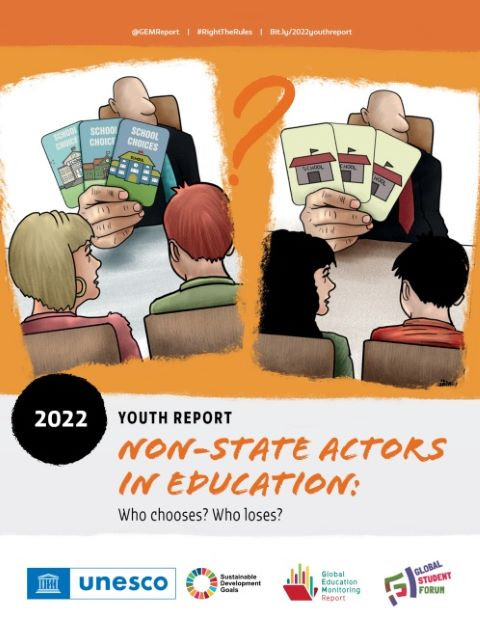 Informe sobre la juventud 2022: Los actores no estatales en la educación; ¿quién elige? ¿quién pierde? Year of publication: 2022 Corporate author: UNESCO Este informe fue redactado en colaboración con el Foro Mundial de Estudiantes (Global Student Forum) para ayudarte a conocer el punto de vista de las y los jóvenes sobre las diferentes funciones y el impacto de los actores no estatales en la educación. Para muchos, una discusión sobre el papel de los actores no estatales en la educación se reduce rápidamente a un debate sobre si las escuelas privadas apoyan o socavan la educación de buena calidad. Pero el papel de los actores no estatales repercute en muchos más aspectos del sector educativo, desde los libros de texto que utilizas, la comida de tus comedores, el apoyo tutorial adicional que recibes, las habilidades que puedes aprender en el trabajo y de muchas otras maneras. El informe invita a las y los jóvenes a unirse a un llamamiento a los gobiernos para #RedefinirLasReglas de tal manera que se garantice que la participación de los actores no estatales no comprometa la promesa de proporcionar 1 año de educación preescolar y 12 años de educación primaria y secundaria gratuita para todos. Rapport des jeunes 2022: Les acteurs non étatiques dans l’éducation; Qui décide? qui est perdant? Year of publication: 2022 Corporate author: Organisation des Nations Unies pour l'éducation, la science et la culture (UNESCO) Ce Rapport a été produit en partenariat avec le Forum mondial des étudiants pour vous donner un aperçu du point de vue des jeunes sur les différents rôles et l'impact des acteurs non étatiques de l'éducation. Pour beaucoup, débattre du rôle des acteurs non étatiques de l'éducation se résume rapidement à se demander si les écoles privées sont un atout ou un obstacle à une éducation de qualité. Mais le rôle des acteurs non étatiques a un impact sur bien d'autres aspects du secteur de l'éducation, qu'il s'agisse des manuels scolaires que vous utilisez, de la nourriture dans vos cantines, du soutien scolaire complémentaire que vous recevez, des compétences que vous pouvez acquérir au travail et bien plus encore. Le Rapport invite les jeunes à se joindre à l'appel à #RedéfinirLesRègles lancé aux gouvernements, appel qui garantira que l'implication des acteurs non étatiques ne compromette pas la promesse de fournir un an d'enseignement pré-primaire et douze ans d'enseignement primaire et secondaire gratuit pour tous.
  Non-state Actors in Tertiary Education: A Shared Vision for Quality and Affordability? (Policy Paper 47) Year of publication: 2022 Corporate author: UNESCO Non-state provision accounts for more than one third of tertiary education students worldwide, a considerably higher share than in primary or secondary education. Providers are diverse, respond to a variety of needs, and often blur the line between the state and non-state sectors. Non-state actors are also important players in the financing of tertiary education through households, market mechanisms and public–private partnerships. As a result, these actors play a significant role in influencing regulations and policymaking, and in shaping the tertiary system as a whole. Governments must ensure quality and equity, the key dimensions of Sustainable Development Goal target 4.3, regardless of how state and non-state actors share responsibilities.
  Un nuevo contrato social para la educación (The UNESCO Courier Special Edition; November 2021) Year of publication: 2021 Corporate author: UNESCO Reimagining Our Futures Together upholds the tradition of the major UNESCO reports that have already structured education policies throughout the world in the past. The Faure report, Learning to be, in 1972, and the Delors report, Learning: The Treasure Within, in 1996, have become benchmarks in the debate on learning. This third document presents a lucid assessment of the challenges confronting education today.Faced with the rapid changes in our environment, a change of direction is needed. We need to devote more importance to ecology; to provide students with the critical tools to detect misinformation, prejudices, and preconceived ideas; to strengthen teamwork, and to improve the professionalization of teachers. Beyond these imperatives, we must also rethink the multiple interdependencies, the links between generations and between cultures, and our relationship with living beings, to establish a new social contract for education. Un nouveau contrat social pour l’éducation (The UNESCO Courier Special Edition; November 2021) Year of publication: 2021 Corporate author: Organisation des Nations Unies pour l'éducation, la science et la culture (UNESCO) Reimagining Our Futures Together upholds the tradition of the major UNESCO reports that have already structured education policies throughout the world in the past. The Faure report, Learning to be, in 1972, and the Delors report, Learning: The Treasure Within, in 1996, have become benchmarks in the debate on learning. This third document presents a lucid assessment of the challenges confronting education today.Faced with the rapid changes in our environment, a change of direction is needed. We need to devote more importance to ecology; to provide students with the critical tools to detect misinformation, prejudices, and preconceived ideas; to strengthen teamwork, and to improve the professionalization of teachers. Beyond these imperatives, we must also rethink the multiple interdependencies, the links between generations and between cultures, and our relationship with living beings, to establish a new social contract for education. К новому общественному договору в области образования (The UNESCO Courier Special Edition; November 2021) Year of publication: 2021 Corporate author: Организация Объединенных Наций по вопросам образования, науки и культуры (UNESCO) Reimagining Our Futures Together upholds the tradition of the major UNESCO reports that have already structured education policies throughout the world in the past. The Faure report, Learning to be, in 1972, and the Delors report, Learning: The Treasure Within, in 1996, have become benchmarks in the debate on learning. This third document presents a lucid assessment of the challenges confronting education today.Faced with the rapid changes in our environment, a change of direction is needed. We need to devote more importance to ecology; to provide students with the critical tools to detect misinformation, prejudices, and preconceived ideas; to strengthen teamwork, and to improve the professionalization of teachers. Beyond these imperatives, we must also rethink the multiple interdependencies, the links between generations and between cultures, and our relationship with living beings, to establish a new social contract for education. 面向教育的新社会契约 (The UNESCO Courier Special Edition; November 2021) Year of publication: 2021 Corporate author: 联合国教科文组织 (UNESCO) Reimagining Our Futures Together upholds the tradition of the major UNESCO reports that have already structured education policies throughout the world in the past. The Faure report, Learning to be, in 1972, and the Delors report, Learning: The Treasure Within, in 1996, have become benchmarks in the debate on learning. This third document presents a lucid assessment of the challenges confronting education today.Faced with the rapid changes in our environment, a change of direction is needed. We need to devote more importance to ecology; to provide students with the critical tools to detect misinformation, prejudices, and preconceived ideas; to strengthen teamwork, and to improve the professionalization of teachers. Beyond these imperatives, we must also rethink the multiple interdependencies, the links between generations and between cultures, and our relationship with living beings, to establish a new social contract for education.
  Culture: Global Public Good (The UNESCO Courier no. 3; July-September 2022) Year of publication: 2022 Corporate author: UNESCO Culture is what defines us in space and time – our past and present roots, our prospects. Culture is an inexhaustible and renewable resource, which adapts to changing contexts and which speaks to humans first and foremost through their capacity to imagine, create and innovate. Culture is our most powerful global public good. In the words of Javier Pérez de Cuéllar, former Secretary-General of the United Nations, culture has a role “as a desirable end in itself, as giving meaning to our existence”. Today, more than ever, we need to find meaning, we need universality, we need culture in all its diversity. La Cultura: Un bien público mundial (The UNESCO Courier no. 3; July-September 2022) Year of publication: 2022 Corporate author: UNESCO Culture is what defines us in space and time – our past and present roots, our prospects. Culture is an inexhaustible and renewable resource, which adapts to changing contexts and which speaks to humans first and foremost through their capacity to imagine, create and innovate. Culture is our most powerful global public good. In the words of Javier Pérez de Cuéllar, former Secretary-General of the United Nations, culture has a role “as a desirable end in itself, as giving meaning to our existence”. Today, more than ever, we need to find meaning, we need universality, we need culture in all its diversity. La Culture: Un bien public mondial (The UNESCO Courier no. 3; July-September 2022) Year of publication: 2022 Corporate author: Organisation des Nations Unies pour l'éducation, la science et la culture (UNESCO) Culture is what defines us in space and time – our past and present roots, our prospects. Culture is an inexhaustible and renewable resource, which adapts to changing contexts and which speaks to humans first and foremost through their capacity to imagine, create and innovate. Culture is our most powerful global public good. In the words of Javier Pérez de Cuéllar, former Secretary-General of the United Nations, culture has a role “as a desirable end in itself, as giving meaning to our existence”. Today, more than ever, we need to find meaning, we need universality, we need culture in all its diversity.