
Resources
Explore a wide range of valuable resources on GCED to deepen your understanding and enhance your research, advocacy, teaching, and learning.
3,530 Results found
 Online Media Literacy Strategy Year of publication: 2021 Corporate author: Government of the United Kingdom The Online Harms White Paper set out a commitment to develop an Online Media Literacy Strategy ahead of the implementation of the online harms regulator. The aim of the strategy is to educate and empower internet users across the UK to manage their online safety. Over 170 organisations are currently involved in delivering media literacy education in the UK. The Media Literacy Strategy sets out the government’s multi-year plan to bring coordination to the media literacy landscape and outlines a Media Literacy Framework of best practice principles to inform the content and delivery of media literacy education.
  Climate Science Resource Pack: Silver Level Corporate author: British Science Association This is a project-based resource which can lead to a CREST award. Participants receive research and design briefs on topics such as ‘greener cities’ and ‘water scarcity’ and have to design climate- friendly sustainable solutions. 30+ hours of work is required for a Silver Award.
  Shaping Our Future: The Climate Challenge Corporate author: World Wide Fund for Nature (WWF) These lesson plans and supporting resources have been developed for both primary and secondary to inspire and empower teachers and educators to tackle climate change. Resources include presentations, teacher notes and worksheets. For more details, please click the link below.
  Global Citizenship Education and the Police: An Opportunity For Partnership? Year of publication: 2021 Author: Robin Young Corporate author: Bridge 47 This publication aims to provide some reflective questions and practicalities to consider before embarking on a partnership with the police sector and to contribute to a wider reflection, dialogue and knowledge sharing within the GCE sector globally about the opportunities and challenges for advancing the mission of GCE through engagement with the police sector.
 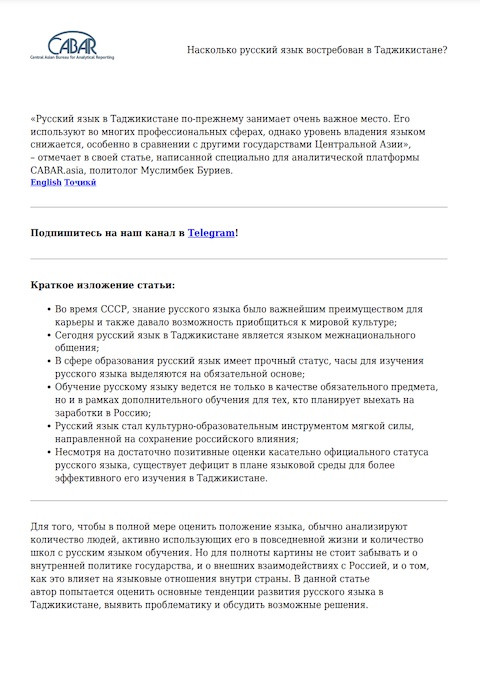 How Popular Is The Russian Language In Tajikistan? Year of publication: 2019 Author: Muslimbek Buriev Corporate author: Central Asian Bureau for Analytical Reporting (CABAR) | Institute for War and Peace Reporting (IWPR) «Russian language still occupies in Tajikistan a very important place. It is used in many professional spheres, but the proficiency level is being reduced in comparison with other Central Asian countries», -notes a political analyst Muslimbek Buriev in his article written specifically for analytical platform CABAR.asia. Насколько русский язык востребован в Таджикистане? Year of publication: 2019 Author: Muslimbek Buriev Corporate author: Central Asian Bureau for Analytical Reporting (CABAR) | Institute for War and Peace Reporting (IWPR) «Русский язык в Таджикистане по-прежнему занимает очень важное место. Его используют во многих профессиональных сферах, однако уровень владения языком снижается, особенно в сравнении с другими государствами Центральной Азии», – отмечает в своей статье, написанной специально для аналитической платформы CABAR.asia, политолог Муслимбек Буриев.
 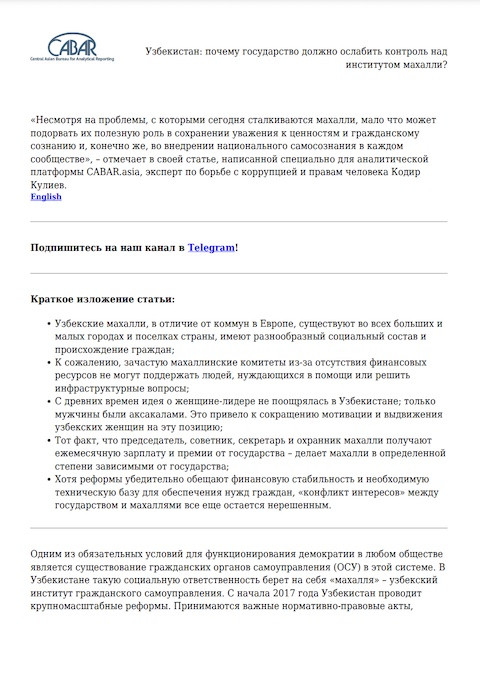 Uzbekistan: Why Should the State Weaken Control Over the Institute of Makhalla? Year of publication: 2019 Author: Kodir Kuliev Corporate author: Central Asian Bureau for Analytical Reporting (CABAR) | Institute for War and Peace Reporting (IWPR) One of the vital conditions for the functioning of democracy in any society is the existence of citizens’ self-governing bodies (CSB) within that system. In Uzbekistan, such social responsibility is assumed by “mahalla” – the Uzbek citizens’ self-governing institution. Since the beginning of 2017 Uzbekistan has been carrying out large-scale reforms. Important laws and regulations are being adopted, which should create favorable conditions for quality life and ensure freedom for the Uzbek people. With mahallas, however, such positive change in the long-run seems to be just a lip-service. The main challenges mahallas are facing today are, inter alia, obscured freedom they have in ruling themselves and controlling their own affairs and incapability to effectively tackle citizens’ problems, thus leaving people’s trust unjustified. Узбекистан: Почему государство должно ослабить контроль над институтом махалли? Year of publication: 2019 Author: Kodir Kuliev Corporate author: Central Asian Bureau for Analytical Reporting (CABAR) | Institute for War and Peace Reporting (IWPR) Одним из обязательных условий для функционирования демократии в любом обществе является существование гражданских органов самоуправления (ОСУ) в этой системе. В Узбекистане такую социальную ответственность берет на себя «махалля» – узбекский институт гражданского самоуправления. С начала 2017 года Узбекистан проводит крупномасштабные реформы. Принимаются важные нормативно-правовые акты, которые должны создать благоприятные условия для качественной жизни и обеспечить свободу узбекскому народу. Однако с махаллей такое положительное изменение в долгосрочной перспективе кажется неоднозначным. Основные проблемы, с которыми сегодня сталкиваются махалли – это ограниченная свобода и контроль собственных дел и неспособноть эффективно решать проблемы граждан, что не оправдывает доверия людей.
 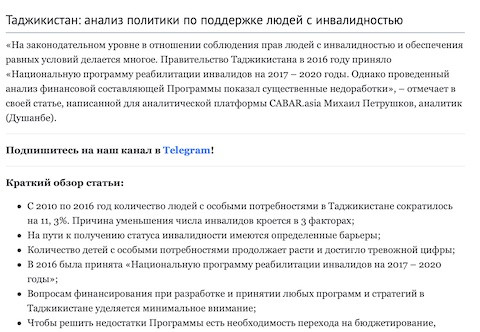 Tajikistan: Policy Analysis to Support Persons with Disabilities Year of publication: 2018 Author: Mikhail Petrushkov Corporate author: Central Asian Bureau for Analytical Reporting (CABAR) | Institute for War and Peace Reporting (IWPR) “Much is being done at the legislative level with regard to the observance of the rights of people with disabilities and ensuring equal conditions. In 2016, the Government of Tajikistan adopted the National Program for the Rehabilitation of Persons with Disabilities for 2017-2020. However, the analysis of the financial component of the Program showed significant shortcomings, ”says Mikhail Petrushkov, an analyst (Dushanbe), in his article written for the analytical platform CABAR.asia.
 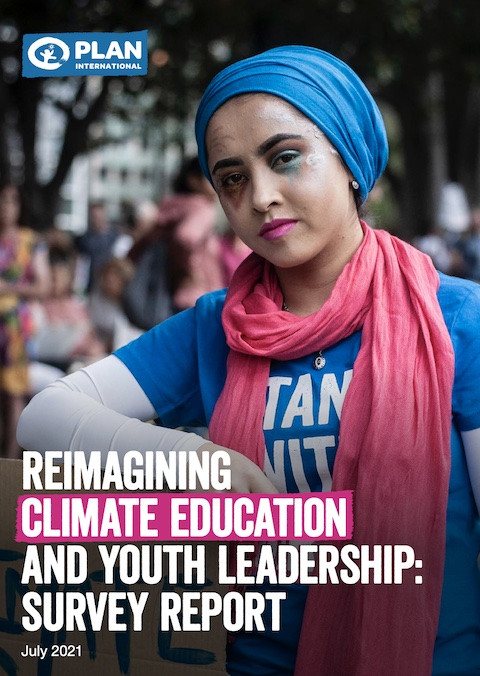 Reimagining Climate Education and Youth Leadership: Survey Report Year of publication: 2021 Author: Lucia Rost | Jessica Cooke | Isobel Fergus Corporate author: Plan International Climate change is a social, intergenerational, gender, and racial injustice. Plan International aims to support children and youth to meaningfully and safely engage in climate policy processes and to reduce the barriers preventing them from engaging in and influencing climate policy and advocacy.With this in mind, Plan International conducted a global online survey to capture the opinions and experiences of young people on climate change education and their participation in climate policy processes. The survey was available in seven languages and was open to 15 to 24-year- olds in all 77 countries where Plan International operates. Over 1,800 adolescents and youth, between the ages of 15 to 24, from 37 countries, participated: more than half (54 per cent) were 15 to 18 years old and 72 per cent were girls.