
Resources
Explore a wide range of valuable resources on GCED to deepen your understanding and enhance your research, advocacy, teaching, and learning.
3,500 Results found
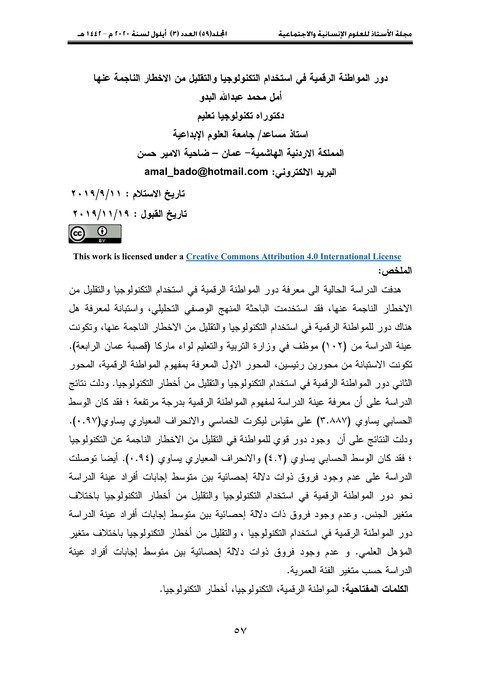 The Role of Digital Citizenship in the Use of Technology and Reducing the Risks Resulting from it (Alustath Journal for Human and Social Sciences; vol.59, no.3) Year of publication: 2020 Author: Amal Mohammed Abdullah Albado Corporate author: University of Baghdad. College of Education Ibn Rushd The current study aims to know the role of digital citizenship in the use of technology and reducing the risks resulting from it. The researcher uses the descriptive analytical approach and makes a questionnaire to know if there is a role for the digital citizenship in the use of technology and reducing the dangers caused by it. The study sample consists of (102) employees in the Ministry of Education Marka Brigade (the fourth Amman qasaba). The questionnaire consists of two main axes: the first axis, which is defined as the concept of digital citizenship, the second axis is the role of digital citizenship in the use of technology and reducing the dangers of technology. The results of the study show that the awareness of the sample of the study of the concept of digital citizenship is on a high level, on average that equals (3.887) of the Likert quinary scale and the standard deviation is equal to (0.97). The results also show a strong role for citizens in reducing the dangers caused by technology where the arithmetic mean equals (4.2) and the standard deviation was (0.94). دور المواطنة الرقمية في استخدام التكنولوجيا والتقليل من الاخطار الناجمة عنها (الاستاذ للعلوم الانسانية والاجتماعية; no.3, vol.59) Year of publication: 2020 Author: Amal Mohammed Abdullah Albado Corporate author: University of Baghdad. College of Education Ibn Rushd هدفت الدراسة الحالية الى معرفة دور المواطنة الرقمية في استخدام التكنولوجيا والتقليل من الاخطار الناجمة عنها، فقد استخدمت الباحثة المنهج الوصفي التحليلي، واستبانة لمعرفة هل هناك دور للمواطنة الرقمية في استخدام التكنولوجيا والتقليل من الاخطار الناجمة عنها، وتكونت عينة الدراسة من (102) موظف في وزارة التربية والتعليم لواء ماركا (قصبة عمان الرابعة). تكونت الاستبانة من محورين رئيسين، المحور الاول المعرفة بمفهوم المواطنة الرقمية، المحور الثاني دور المواطنة الرقمية في استخدام التكنولوجيا والتقليل من أخطار التكنولوجيا. ودلت نتائج الدراسة على أن معرفة عينة الدراسة لمفهوم المواطنة الرقمية بدرجة مرتفعة ؛ فقد كان الوسط الحسابي يساوي (3.887) على مقياس ليكرت الخماسي والانحراف المعياري يساوي(0.97). ودلت النتائج على أن وجود دور قوي للمواطنة في التقليل من الاخطار الناجمة عن التكنولوجيا ؛ فقد كان الوسط الحسابي يساوي (4.2) والانحراف المعياري يساوي (0.94).
 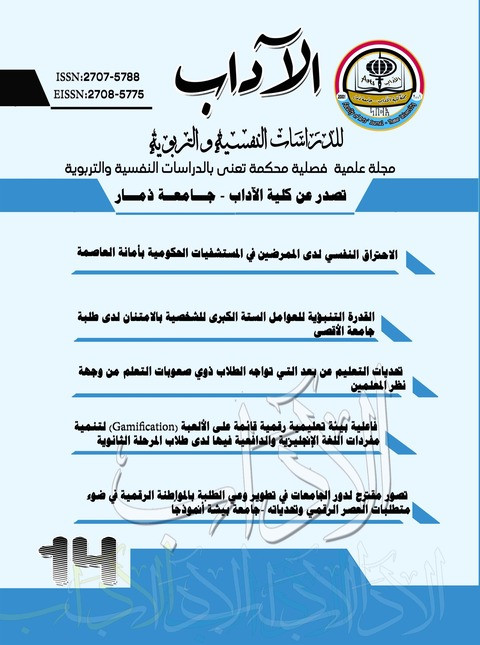 A Suggested Proposal for the Role of Universities in Developing Students’ Awareness of Digital Citizenship in Light of Requirements and Challenges of the Digital Age: A Case Study of Bisha University (Arts for Educational & Psychological Studies; vol.14, no.1) Year of publication: 2022 Author: Sheikha Abdullah Al-Briki Balabied Corporate author: Dhamar University The study aimed to measure the degree of students’ awareness of the digital citizenship at the University of Bisha, and to develop a proposed scenario in the light of the results of the study, which included a framework for activating the role of universities in developing their students' awareness of digital citizenship to meet the requirements and challenges of the digital age. The analytical descriptive method was used by conducting an exploratory study and designing a questionnaire to measure the degree of students' awareness of digital citizenship. The most prominent results were that the degree of students' awareness of digital citizenship was "very high" on the total digital citizenship awareness scale. There were no statistically significant differences between the average scores of males and females, nor between the average degrees of students of theoretical and practical colleges on the total digital citizenship awareness scale. تصور مقترح لدور الجامعات في تطوير وعي الطلبة بالمواطنة الرقمية في ضوء متطلبات العصر الرقمي وتحدياته جامعة بيشة أنموذجًا (مجلة الآداب للدراسات النفسية والتربوية; vol.14, no.1) Year of publication: 2022 Author: Sheikha Abdullah Al-Briki Balabied Corporate author: Dhamar University هدفت الدراسة إلى قياس درجة وعي طلبة الجامعة بالمواطنة الرقمية، ووضع تصور مقترح في ضوء نتائج الدراسة تضمن إطار عمل لتفعيل دور الجامعات في تنمية وعي الطلبة بالمواطنة الرقمية في ضوء متطلبات وتحديات العصر الرقمي. استُخدم المنهج الوصفي التحليلي من خلال تصميم استبانة لقياس درجة وعي الطلبة بالمواطنة الرقمية. ولتحقيق ذلك اتبعت الباحثة المنهج الوصفي التحليلي من خلال الدراسة الاستطلاعية وبناء استبانة لقياس درجة وعي الطلبة بالمواطنة الرقمية. وكانت أبرز النتائج أن درجة وعي الطلاب بالمواطنة الرقمية "مرتفعة جدًا"، بالإضافة إلى عدم وجود فروق ذات دلالة إحصائية بين متوسطات درجات الذكور والإناث، وكذلك بين متوسطات درجات طلاب الكليات النظرية والعملية على إجمالي مقياس الوعي بالمواطنة الرقمية.
  I Don’t Want… War! Year of publication: 2024 Corporate author: Amnesty International | Entreculturas | Mundo Cooperante | Save the Children On the occasion of the International Day of the Girl Child, which is commemorated on October 11, the organizations Amnesty International, Entreculturas, Mundo Cooperante and Save the Children, under the framework of the joint alliance NO QUIERO, denounce the serious consequences that armed conflicts have on girls and their integral development. Today, more than ever, it is urgent to address the effects of wars that prevent millions of girls from living a future free of violence, such as child and forced marriage or sexual violence. ¡No Quiero… la guerra! Year of publication: 2024 Corporate author: Amnesty International | Entreculturas | Mundo Cooperante | Save the Children Con motivo del Día Internacional de la Niña, que se conmemora el 11 de octubre, las organizaciones Amnistía Internacional, Entreculturas, Mundo Cooperante y Save the Children, bajo el marco de la alianza conjunta NO QUIERO, denunciamos las graves consecuencias que los conflictos armados tienen sobre las niñas y su desarrollo integral. Hoy, más que nunca, es urgente abordar los efectos de las guerras que impiden que millones de niñas puedan vivir un futuro libre de violencias, como el matrimonio infantil y forzoso o la violencia sexual.
  School Coexistence Toolkit: Prevention of Gender-Based Violence Corporate author: Ministry of Education of Colombia The infographics on the prevention of gender-based violence are intended precisely to raise awareness about this naturalized phenomenon so that families, children, adolescents and young people, and educators understand that this type of violence is not normal, it causes suffering and serious consequences for victims, and cannot be tolerated in any way. The infographics, based on the protocol, provide information in a simple and easy-to-understand way about what gender-based violence is, which can be sexual, physical, psychological or symbolic violence, how to prevent it, and what to do if you identify a victim or are a victim of this aggression. Kit de herramientas para la convivencia escolar: Prevención de las violencias basadas en el género Corporate author: Ministry of Education of Colombia Las infografías de prevención de las violencias basadas en el género, tienen la intencionalidad precisamente de sensibilizar sobre este fenómeno naturalizado para que las familias, las niñas, niños, adolescentes y jóvenes y los educadores, entiendan que estas violencias no son normales, producen sufrimiento y graves secuelas entre las víctimas y no pueden ser toleradas de ninguna manera. Las infografías, basadas en el protocolo, informan, de una manera sencilla y fácil de comprender, sobre qué son las violencias de género, las cuales pueden ser violencia sexual, física, psicológica o simbólica, cómo prevenirlas y qué hacer en caso de identificar una víctima o ser víctima de estas agresiones.
  Citizens as Users of Languages and Digital Technology Year of publication: 2021 Corporate author: European Centre for Modern Languages (ECML) | Council of Europe A recent meta-analysis of the literature portrays male and female citizens who are users of languages and digital technologies. This helps to understand the goals of an education aimed at developing male and female citizens capable of using digital technology in a competent, informed, safe, responsible, ethical, and critical manner. Citoyens et citoyennes usagers et usagères des langues Year of publication: 2021 Corporate author: European Centre for Modern Languages (ECML) | Conseil de l'Europe Une méta-analyse de la littérature récente dresse le portrait des citoyens et citoyennes usagers et usagères de langues et du numérique. Cela permet de connaitre les objectifs d’une éducation qui vise le développement de citoyens et citoyennes capables d’utiliser le numérique d’une façon compétente, informée, sûre, responsable, éthique et critique.