
Resources
Explore a wide range of valuable resources on GCED to deepen your understanding and enhance your research, advocacy, teaching, and learning.
2,813 Results found
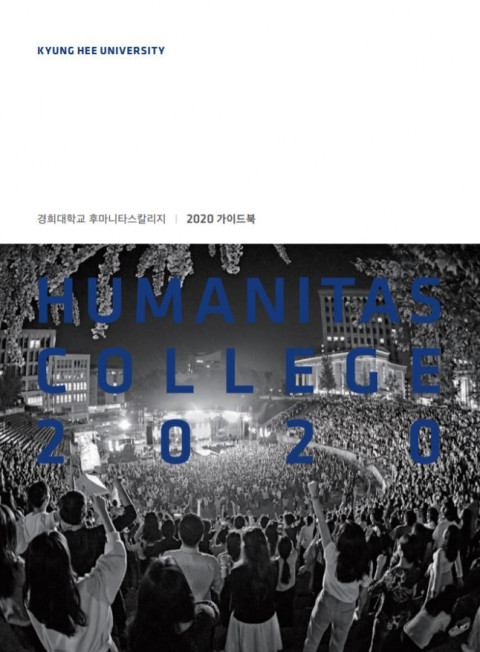 경희대학교 후마니타스칼리지 2020 가이드북 (Humanitas College 2020) Year of publication: 2020 Corporate author: 경희대학교 후마니타스칼리지 신입생에게 후마니타스칼리지 교양교육에 대한 이해를 돕고, 후마가 한 해 동안 거둔 성과를 담은 『2020 후마니타스칼리지 가이드북』이 발간됐다. 후마는 2014년부터 해마다 가이드북을 발간하고 있다.『2020 후마 가이드북』에는 미래비전을 새로 정립하고 재도약에 나선 후마의 행보를 담았다. 신입생뿐 아니라 구성원 모두가 눈여겨볼 만하다. 대학 내에서의 세계시민교육 교과과정 및 현장 활동 우수 사례들을 담고 있으며 세계시민교육은 단순한 실험이나 실습이 아닌 ‘실천’임을 강조한다. 앞으로 세계시민교육을 수강하고 독립연구를 계획하는 학생들에게 도움이 될 것으로 보인다.
  Objectifs du développement durable (odd) & éducation à la citoyenneté et à la solidarité internationale (ecsi): Quelles mobilisations pour quels changements ? Year of publication: 2019 Corporate author: Educasol Du mois de mai au mois de juillet 2019, Educasol a organisé un parcours d’animation-formation structuré autour de 5 temps et consacré à l’interaction entre Objectifs du Développement Durable et Education à la Citoyenneté et à la Solidarité internationale. Trois angles d’analyse ont été priorisés : culture et universalité, transversalité et territoire, et enfin la question du changement. Ce parcours a permis d’initier un processus permettant aux participants de :• Penser leurs actions d’ECSI,• Se penser eux-mêmes à partir de leurs actions et organisations,• Penser les autres autant que possible en évitant la projection de soi• Questionner la relation avec les bailleurs,• Construire une représentation commune des ODD et identifier les conditions qui en permettraient un meilleur usage Cette publication regroupe l’ensemble des documents produits dans le cadre des 3 journées du parcours et lors de la séance conclusive.
 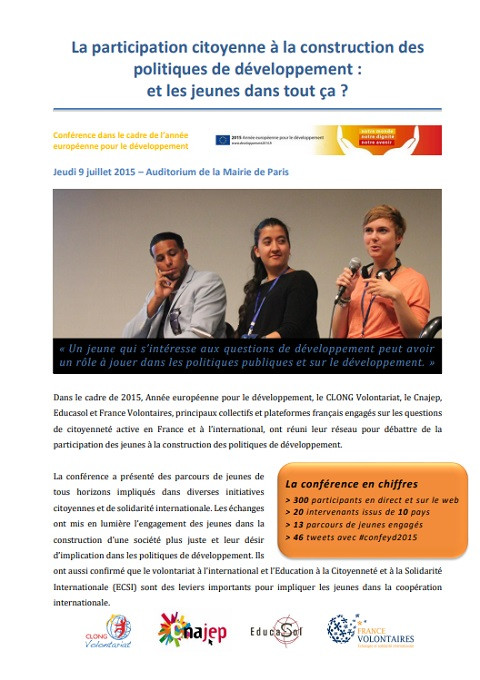 La participation citoyenne à la construction des politiques de développement: Et les jeunes dans tout ça ? Year of publication: 2015 Corporate author: Educasol Le Jeudi 9 juillet 2015, à Paris, le CLONG Volontariat, le Cnajep, Educasol et France Volontaires, principaux collectifs et plateformes français engagés sur les questions de citoyenneté active en France et à l’international, ont réuni leur réseau pour débattre de la participation des jeunes à la construction des politiques de développement. Ce document reprend les temps forts et messages clefs de la journée.
  L'engagement des jeunes Year of publication: 2015 Author: Jeanne Lorrain Corporate author: Educasol Le 9 juillet 2015, à l’initiative inédite de quatre collectifs et plateformes engagés sur les questions de citoyenneté active à l’international, le CLONG Volontariat, EDUCASOL, France Volontaires et le Cnajep, jeunes, associations et institutions se sont interrogés : « Quelle participation citoyenne à la construction des politiques de développement ? Et les jeunes dans tout ça ? » Au cours de la journée, la parole a été donnée aux jeunes pour qu’ils puissent exprimer ce que représente pour eux l’engagement et pour mettre en avant ceux qui n’ont généralement pas la parole. A travers un regard croisé Europe/International sur l’engagement citoyen et de nombreux témoignages sur leur parcours, les jeunes intervenants ont rappelé que ces questions ne sont pas réservées à une élite, que peu importe le niveau ou l’échelle d’engagement (international-national-quartier-région), ceux qui s’intéressent aux questions de développement peuvent avoir un impact sur les politiques publiques et faire que leur voix soit entendue. Cette journée a permis de développer deux outils de communication et d’information afin de promouvoir l’engagement citoyen et de faire de la sensibilisation auprès de différents publics en France et à l’international.
 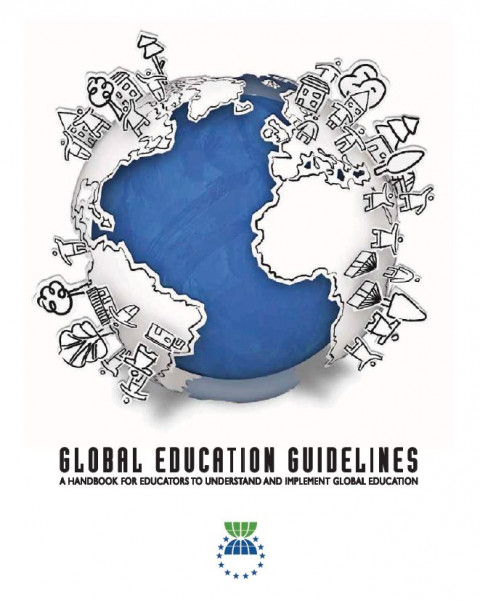 Global Education Guidelines: A Handbook for Educators to Understand and Implement Global Education Year of publication: 2008 Author: Alicia Cabezudo | Christos Christidis | Miguel Carvalho da Silva | Valentina Demetriadou-Saltet | Franz Halbartschlager | Georgeta-Paula Mihai Corporate author: North-South Centre of the Council of Europe These Global Education Guidelines are the result of a need expressed by the North-South Centre’s (NSC) network of global education practitioners – the Global Education Week network - to have a common tool, built on experience gained by the network and other partners, to support educators to comprehend and successfully implement global education initiatives. By offering perspectives on global education as well as related methods and evaluation criteria – including sharing of practices, tools and resources - these Guidelines aim at strengthening the overall work for global education. It also aims at supporting practitioners in formal and non-formal education settings by introducing general elements which may be developed by them according to the needs and based on their own experiences; assist them in identifying existing global education approaches and practices; support them in reflecting on and becoming more aware of their own global education activities; increase global education practice sharing and create synergies between stakeholders; contribute to education policies at local, regional, national and international level.The Global Education Guidelines are an initiative of the Global Education Programme of the NorthSouth Centre of the Council of Europe, involving a team of educators from the Global Education Week network which constituted the drafting team with the mandate of drafting collectively the Global Education Guidelines. The writing process included a participatory method at several levels of consultancy amongst global education educators and practitioners actively involved with the North-South Centre global education and youth programmes. Moreover, a Group of Mentors was identified among NSC’s European and international partners, which included, inter alia, a team of trainers from the NSC’s University on Youth & Development.Topics presented in the Guidelines aim at clarifying fundamental questions related to global education; it suggest strategies on how to build contents; put forward aims, skills, values and attitudes; offer guidance on methods, curricular design and evaluation and list useful contacts, links and bibliography. The Guidelines should be regarded as an ongoing process of evolution, which should be regularly reviewed with new ideas, inputs and practices brought from a diversity of partners and their experiences. Pautas para una Educación Global : Manual para que los educadores comprendan e implementen la educación global Year of publication: 2008 Author: Alicia Cabezudo | Christos Christidis | Miguel Carvalho da Silva | Valentina Demetriadou-Saltet | Franz Halbartschlager | Georgeta-Paula Mihai Corporate author: North-South Centre of the Council of Europe Estas Pautas para la Educación Global son el resultado de (una) la necesidad expresada por la Red Norte-Sur-Centro (NSC – NSC sus siglas en inglés) de los partidarios de la educación global - la Red Semanal de Educación Global – quienes precisaban una herramienta común, basada en la experiencia adquirida por la red y otros compañeros, para asistir a los educadores en una mejor comprensión e implementación exitosa de iniciativas y acciones en el campo de la educación global.Las Pautas para una Educación Global son una iniciativa del Programa de Educación Global del Centro Norte-Sur del Consejo de Europa, que involucra a un equipo de educadores de la Red de la Semana de Educación Global con la misión de reunir colectivamente pautas para sus prácticas y actividades. El proceso de redacción del presente documento se realizó mediante un método participativo en varios niveles de consulta entre educadores y profesionales de la educación global activamente involucrados en programas para la juventud del Centro Norte-Sur. Además, se seleccionó un grupo de Asesores entre los socios europeos e internacionales del NSC que incluye, entre otros, a un grupo de instructores de la Universidad del NSC sobre Juventud y Desarrollo.
  Spotlight: Quality Education for All during COVID-19 Crisis Year of publication: 2020 Author: Chris Petrie | Katija Aladin | Pukhraj Ranjan | Romayne Javangwe | Danny Gilliland | Saku Tuominen | Leponiemi Lasse Corporate author: HundrED | Organisation for Economic Co-operation and Development (OECD) | Supercell This report aims to offer effective solutions that help parents, teachers and children navigate through challenges facing education during the pandemic. It has plentiful insights and high- quality resources from the opportunity for teacher to form much stronger connections with parents, students to challenges of untrained teacher and lack of access to digital learning resources.
  Education for Global Citizenship: Meanings and Practices for a Transformative Cosmopolitism Year of publication: 2017 Author: Alejandra Boni Aristizabal According to the author: "The article aims to analyze in depth the meanings of global citizenships in order to characterize the pedagogical practices of what is known as education for global citizenship. After a brief analysis of the different stages that education for development has gone through, from the assistencialist approach of the 50s to education for global citizenship, we study different perspectives of cosmopolitanism: a vision from the field of ethics, mainly from Martha Nussbaum's perspective that talks about cosmopolitan abilities, from politics, that has democratic proposals such as David Held's, critical perspectives as Boaventura de Souza Santos' ones, and the sociological perspective that allows us to identify intercultural communicative processes where the cosmopolitan view is produced, according to Ulrick Beck's or Gerald Delanty's words. After this, we conclude with a discussion about how to encourage education for develpment spaces that foster global citizenship." Educación para la Ciudadanía Global: Significados y espacios para un cosmopolitismo transformado Year of publication: 2017 Author: Alejandra Boni Aristizabal Según la autora: "El presente artículo tiene como objetivo profundizar en los significados de la ciudadanía global con el fin de caracterizar las prácticas pedagógicas de lo que se conoce como educación para la ciudadanía global. Tras una breve análisis de las distintas etapas por las que ha pasado la educación para el desarrollo, desde el planteamiento asistencialista de los años 50 hasta la educación para la ciudadanía global, nos detenemos en diferentes perspectivas del cosmopolitismo: la visión desde la ética, fundamentalmente a través de la obra de Martha Nussbaum que nos habla de las habilidades cosmopolitas, desde la política, que contiene propuestas de democracia como las de David Held y perspectivas más críticas como las de Boaventura de Sousa Santos, y la perspectiva sociológica que nos permite identificar los procesos de comunicación intercultural donde se produce la mirada cosmopolita, según palabras de Ulrick Beck o Gerard Delanty. Tras ello, concluiremos con una discusión sobre cómo potenciar espacios de educación para el desarrollo desde donde contribuir a la formación de ciudadanos globales"
  Research on the Strategy of Inner Mongolia Ecological Cultural Construction Year of publication: 2019 Author: WEI Zhiyong | BAI Zhifeng Corporate author: China Environment Publishing Group Focusing on the Ecological Civilization of Inner-Mongolia, China, this book presents to readers the backgroud and history of the ecological civilization development in the area. By analyzing the relevant policies, introducing the available resouces and typical cases, it showcases how the concept of harmonized development between man and nature evolving into the core of ecological cultural development in Inner-Mongolia. It summarizes the experiences and lessons learnt during the process, presents challenges faced and proposed practical suggestions and solutions. It also introduced some successful cases from the international experiences.