
Resources
Explore a wide range of valuable resources on GCED to deepen your understanding and enhance your research, advocacy, teaching, and learning.
2,839 Results found
 One Youth Can: Changing Gender Norms and Promoting Gender Equality Year of publication: 2017 Author: Tapiwa Manyati | Remmy Shawa Corporate author: Sonke Gender Justice This manual is intended to be a resource for those working with youth on issues of citizenship, human rights, gender, health, sexuality and violence. The content is informed by a commitment to social justice, gender equality and engaged citizen activism. The activities encourage all youth to reflect on their own experiences, attitudes and values regarding sexuality; gender; what it means to be a boy/man or girl/woman; domestic and sexual violence; HIV/AIDS, democracy and human rights. They encourage all youth to take action to help prevent domestic and sexual violence, reduce the spread and impact of HIV and AIDS, and promote gender equality.
  Le guide de l’antiracisme Year of publication: 2016 Corporate author: Movement contre le Racisme, l’Antisémitisme et la Xénophobie (MRAX) Ce guide est destiné aux personnes qui veulent vivre ensemble dans une société multiculturelle où chacun est égal en droit et en dignité, indépendamment de ses origines, de sa couleur de peau, de sa culture, de sa religion, de sa langue. Ce guide de l’antiracisme devrait vous aider à franchir le pas. De l’indifférence vers la volonté d’agir. De l’impuissance vers l’action. Il explore la réalité concrète du racisme et des discriminations. Il contient des informations utiles et pratiques, des explications synthétiques, des définitions clés, des témoignages, des réponses juridiques, des conseils, des pistes d’action, des outils pédagogiques pour lutter contre le racisme.
  Inequality in the Era of the 2030 Agenda for Sustainable Development: North and Central Asia Year of publication: 2018 Corporate author: UN. Economic and Social Commission for Asia and the Pacific (UN. ESCAP) This study considers issues pertaining to inequality and its causes in North and Central Asia, based on multidimensional indicators that are now available. It reviews where these countries of North and Central Asia stand in terms of reducing both inequality of outcomes and opportunities through cross-country comparisons. Challenges surrounding inequality of opportunities for selected social groups, namely women, young and older people, rural population and migrant workers are examined. Several concerns come to light: (1) Women tend to be both underpaid and underrepresented in decision-making processes, even though they are economically active and educated; (2) Young people are more likely to be unemployed, which could lead to social displacement; (3) Aging population in selected countries could jeopardize current pension systems which currently cover almost all older persons; (4) a rural-urban divide in terms of access as well as quality of public services remain; and (5) working conditions of migrants are precarious. Неравенство в эпоху Повестки дня в области устойчивого развития на период до 2030 года: Северная и Центральная Азия Year of publication: 2018 Corporate author: UN. Economic and Social Commission for Asia and the Pacific (UN. ESCAP) В этом исследовании рассматриваются вопросы, касающиеся неравенства и его причин в Северной и Центральной Азии, на основе многомерных показателей, которые в настоящее время доступны. В нем рассматривается положение этих стран Северной и Центральной Азии с точки зрения сокращения как неравенства результатов, так и возможностей путем межстрановых сравнений. Рассматриваются проблемы, связанные с неравенством возможностей для отдельных социальных групп, а именно женщин, молодежи и пожилых людей, сельского населения и трудящихся-мигрантов. Выявляется ряд проблем: (1) женщины, как правило, недоплачивают и недопредставляются в процессах принятия решений, даже если они экономически активны и образованы; (2) молодые люди чаще становятся безработными, что может привести к социальному перемещению; (3) старение населения в отдельных странах может поставить под угрозу нынешние пенсионные системы, которые в настоящее время охватывают почти все пожилые люди; (4) сохраняется разрыв между городом и селом с точки зрения доступа, а также качества государственных услуг; и (5) условия труда мигрантов нестабильны.
 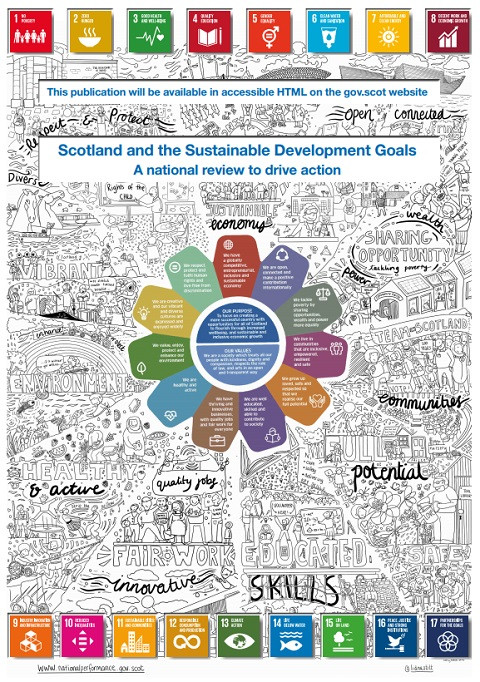 Scotland and the Sustainable Development Goals: A National Review to Drive Action Year of publication: 2020 Corporate author: Government of Scotland The 2030 Agenda for Sustainable Development provides a shared blueprint for peace and prosperity for people and the planet, now and into the future. As part of this, the Sustainable Development Goals (SDGs) are a universal call to action. Scotland signed up to the SDGs in 2015 and this review brings together evidence, actions and stories of how we are making progress to meet the Goals. It contains inspirational examples of how people across Scotland are taking action to make us a more successful country and to ensure we are at the forefront of this international agenda. It also highlights some of the challenges we face. This review, a collaborative effort between the SDG Network Scotland, Scottish Government and the Convention of Scottish Local Authorities (COSLA), scratches the surface of the depth of activity across Scotland. This review provides an overall picture of activity and performance based on the evidence currently available.
  أهمية المحاسبة البيئية في استدامة التنمية Year of publication: 2013 Author: Jamila aljawzii Corporate author: Kasdi Merbah University لقد تزايد الاتجاه نحو الإفصاح عن الأداء البيئي، وإدخال المحاسبة البيئية ضمن الإطار العام للنظام المحاسبي نتيجة لاهتمام التنظيمات الحكومية والأهلية بالبيئة والتنمية المستدامة، والضغوط التي تمارسها الهيئات الدولية والمهنية والأكاديمية على المؤسسات والدول بشأن البيئة وضرورة حمايتها وتنميتها من خلال تبني مفهوم التنمية المستدامة. وفي هذا الإطار جاءت هذه الورقة لتوضيح أهمية المحاسبة البيئية في استدامة التنمية، وذلك من خلال العناصر التالية: - التنمية المستدامة. - المحاسبة البيئية. - دور المحاسبة البيئية في استدامة التنمية. The Importance of Environmental Accounting in the Sustainability of Development Year of publication: 2013 Author: Jamila aljawzii Corporate author: Kasdi Merbah University The trend towards disclosure of environmental performance and the introduction of environmental accounting within the general framework of the accounting system has increased as a result of the concern of government and civil organizations for the environment and sustainable development, and the pressure exerted by international, professional and academic bodies on institutions and countries on the environment and the need to protect and develop them through the adoption of the concept of sustainable development. In this context, this paper explains the importance of environmental accounting for sustainable development through the following elements: - Sustainable development. - Environmental accounting. - The role of environmental accounting in sustainable development.
  When Feeling and Action Come Together in Educational Practice. Relations Between Development Education and Learning Service for a Global Citizenship Year of publication: 2016 Author: Yolanda Fernández Carrión | Mª Jesús Martínez Usarralde The difficulties based on the development are a usual topic in education. After emphasizing the relevance of the development education as an essential element for the construction of the global citizenship, the challenge stands out by its innovative intention of trying to implicate it with service learning. This one tries to be an explorative and interpretative theoretic analyses about the potentialities which can be provided by service learning in the achievement of the objectives planned by the development education. This correlation not only affects the substantial improvement of both practices by building positive synergies but also its universalization forms a clear positive influence in the endogenous development of the village people, carrying out the real empowerment of the critical, sensible and global citizenship. The possibility of giving the main role as a human developmental engine to education is within our reach and the union between development education and service learning teaches us the keys. Cuando sentimiento y acción confluyen en la práctica educativa. Alianzas entre educación para el desarrollo y aprendizaje servicio para una ciudadanía global Year of publication: 2016 Author: Yolanda Fernández Carrión | Mª Jesús Martínez Usarralde Las problemáticas basadas en el desarrollo constituyen un tema recurrente en educación. Tras resaltar la relevancia de la Educación para el Desarrollo (EpD) como elemento fundamental en la construcción de una ciudadanía global, el objetivo de este artículo consiste en relacionarla con una cultura educativa, el Aprendizaje Servicio (ApS). Éste pretende ser, así, un análisis teórico exploratorio e interpretativo sobre las potencialidades que puede aportar el ApS en la consecución de las metas planteadas por la EpD. Esta vinculación no sólo repercute en la mejora substancial de la práctica de ambas creando sinergias positivas, sino que su universalización constituye una clara incidencia positiva en el desarrollo endógeno de los pueblos, llevando a la práctica el empoderamiento real de la ciudadanía crítica, reflexiva y global. La posibilidad de otorgar el papel relevante que posee la educación como motor de desarrollo humano está a nuestro alcance: la alianza entre EpD y APS nos muestran las claves.
  A Transdisciplinary Biomimetic Perspective on Global Citizenship Education Year of publication: 2016 Author: Javier Collado Ruano Corporate author: University of the Andes This paper reflects on the Global Citizenship Edu- cation (GCE) and Sustainable Development Goals (SDGs) discussed in 2015 during the Second UNESCO Forum on Global Citizenship Education in January, the Second Global Education Forum in May and the Millenium Summit in September. The study is supported by a transdisciplinary methodolo- gy and the biomimetic principles in order to streng- then the bonds between education and sustainabili- ty. As a result, this research identifies the operational principles that constitute the interdependence of ecosystems in order to make a biomimetic imple- mentation in the social, political and educational structure in human systems. To conclude, three pro- posals to achieve SDGs are given.