
Resources
Explore a wide range of valuable resources on GCED to deepen your understanding and enhance your research, advocacy, teaching, and learning.
2,839 Results found
 Practices of Citizenship in East Africa: Perspectives from Philosophical Pragmatism Year of publication: 2020 Author: Katariina Holma | Tiina Kontinen Corporate author: Routledge Practices of Citizenship in East Africa uses insights from philosophical pragmatism to explore how to strengthen citizenship within developing countries. Using a bottom-up approach, the book investigates the various everyday practices in which citizenship habits are formed and reformulated. In particular, the book reflects on the challenges of implementing the ideals of transformative and critical learning in the attempts to promote active citizenship. Drawing on extensive empirical research from rural Uganda and Tanzania and bringing forward the voices of African researchers and academics, the book highlights the importance of context in defining how habits and practices of citizenship are constructed and understood within communities. The book demonstrates how conceptualizations derived from philosophical pragmatism facilitate identification of the dynamics of incremental change in citizenship. It also provides a definition of learning as reformulation of habits, which helps to understand the difficulties in promoting change. This book will be of interest to scholars within the fields of development, governance, and educational philosophy. Practitioners and policy-makers working on inclusive citizenship and interventions to strengthen civil society will also find the concepts explored in this book useful to their work.
  Taking Action for Change: Youth Civic Engagement and Activism; A Resource for Educators Year of publication: 2019 Author: Ian Davies | Mark Evans | Márta Fülöp | Dina Kiwan | Andrew Peterson | Jasmine B.-Y. Sim Corporate author: University of York ‘Youth activism, engagement and the development of new civic learning spaces’ was a project funded by the Leverhulme Trust and developed by an international network of researchers. The project took place between 2016 and 2019.In this resource for education, each member of the project team discusses developments in their own country and identifies key ideas and issues about how young people participate in society and what implications have for education. This book gives several examples that have already been done in different geographical areas and educational perspectives and includes promising practices that begin to illustrate ways in which educators may act.
  The State of Global Education in Europe 2019 Year of publication: 2020 Corporate author: Global Education Network Europe (GENE) | European Union (EU) This fourth edition of the State of Global Education in Europe has been developed to provide an updated account of current key issues, policy priorities, funding trends and activities inGlobal Education in Europe, among the Ministries and Agencies that participate in GENE. This report explores key trends, policy themes and budgetary information for Global Education in European countries, drawing on information provided by GENE member Ministries and Agencies during 2018 and 2019.
 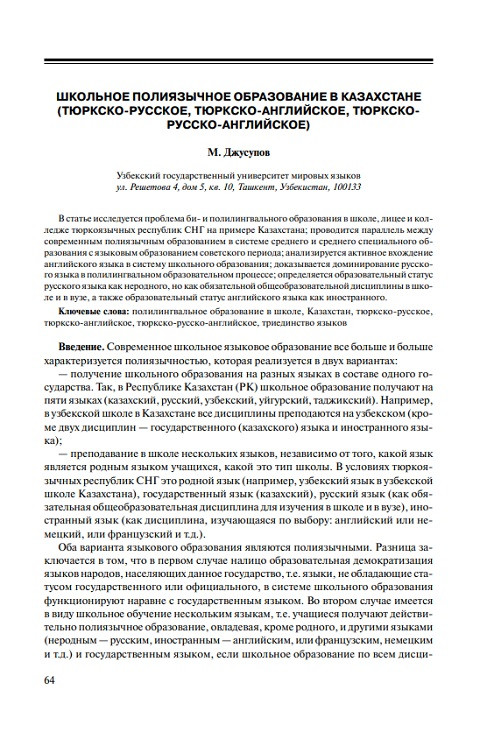 School Polylingual Education in Kazakhstan (Turkic-Russian, Turkic-English, Turkis-Russian-English) Year of publication: 2015 Author: Dzhusupov M. This article deals with a problem of bilingual and polylingual education at school, lyceum and college of Turkic Republic of CIS on the illustration of Kazakhstan; it is drawn an analogy (parallel) between modern polylingual education of — Soviet period; active ingress of English language in a system of school polylingual education has been analyzed; the domination of Russian language in polylingual educational process has been proved, it is determined an educational status of Russian language not as adoptive, but as obligatory general subject at school and in the institute of higher education and educational status of English language as foreign, i.e. as an alternative (optional) subject. Школьное полиязычное образование в Казахстане (тюркско-русское, тюркско-английское, тюркско-русско-английское) Year of publication: 2015 Author: Dzhusupov M. В статье исследуется проблема би- и полилингвального образования в школе, лицее и колледже тюркоязычных республик СНГ на примере Казахстана; проводится параллель между современным полиязычным образованием в системе среднего и среднего специального образования с языковым образованием советского периода; анализируется активное вхождение английского языка в систему школьного образования; доказывается доминирование русского языка в полилингвальном образовательном процессе; определяется образовательный статус русского языка как неродного, но как обязательной общеобразовательной дисциплины в школе и в вузе, а также образовательный статус английского языка как иностранного.
  Looking into the Future Development of Central Asian Civil Society 2025 Year of publication: 2020 Corporate author: Civil Society Development Association (ARGO) “Looking into the future Development of Central Asian Civil Society - 2025” is a vision that reflects the role, trends and prospects for the development of civil society in Central Asia for 5 years. The Vision represents an image of civil society (‘We are the ones who’) and defines strategic priorities for the development of civil society in Central Asia. Взгляд в будущее развития гражданского общества в Центральной Азии 2025 Year of publication: 2020 Corporate author: Civil Society Development Association (ARGO) «Взгляд в будущее развитие гражданского общества Центральной Азии – 2025» — это видение, в котором отражены роль, тренды и перспективы развития гражданского общества в Центральной Азии на 5 лет. Видение представляет собой портрет гражданского общества в образе «Я» и определяет приоритеты развития гражданского общества в Центральной Азии.
  Analytical Report on the Rights of People With Disabilities in Central Asia and Azerbaijan Year of publication: 2017 Author: Lyazzat Kaltayeva | Nurzhamal Prenova Corporate author: Civil Society Development Association (ARGO) | United States Agency for International Development (USAID) This analytical report is the culmination of a research study conducted in four countries of Central Asia (Kazakhstan, Kyrgyzstan, Tajikistan, and Turkmenistan) and Azerbaijan in spring 2017. The primary focus of the study was disability rights, which have a direct impact on the quality of life experienced by people with disabilities, and analysis of potential strategies and opportunities for civil society organizations to improve disability rights in target countries.Through the study, the research team followed the latest legislative and policy changes relevant to disability rights, and identified and documented best practices, lessons learned, and key challenges related to the promotion and protection of disability rights in the region. Аналитический доклад в сфере прав людей с инвалидностью стран Центральной Азии и Азербайджана Year of publication: 2017 Author: Lyazzat Kaltayeva | Nurzhamal Prenova Corporate author: Civil Society Development Association (ARGO) | United States Agency for International Development (USAID) Данный аналитический доклад выпущен по результатам экспертного исследования, проведенного в странах ЦА и Азербайджан весной 2017 года. В фокусе исследования - права людей с инвалидностью, которые напрямую влияют на качество жизни людей с инвалидностью и анализ подходов, потенциал и возможности организации гражданского общества для улучшения положения с правами людей с инвалидностью в выбранных странах.Исследование позволило отследить последние изменения в области политики и законодательства по правам людей с инвалидностью, выявить и зафиксировать лучшие практики, уроки и вызовы, связанные с продвижением прав людей с инвалидностью в регионе.
  Global Citizenship Education: Confusion and Clarification (International and Comparative Education; No. 3) Year of publication: 2019 Author: Rao Shuqi Corporate author: Beijing Normal University As a debatable and controversial area, global citizenship education has not been elevated to the center of practical agenda due to three confusion surround the term. From the aspect of regarding citizenship as status, the absence of global political community makes global society unimaginable. However, as the legal status of global citizen originates from the confirmation of intimate interpersonal relationship, global citizenship education enjoys legitimacy. From the aspect of conceiving citizenship as rights, the absence of global political community leads to global citizenship vacuous in essence. However, as the landscape of rights and responsibilities has been transformed, the contents of global citizenship education are enriched by pervasive human rights and responsibilities. From the aspect of considering citizenship as identity, global identity runs a risk of diminishing the need for national identity. However, given the consensus concerning the discourse of multidimensional identity, global identity should be developed on the basis of national identity. The perception of global citizenship education should not be confined within the traditional nation-state framework. Global citizenship education is not an alternative to national citizenship education.