
Resources
Explore a wide range of valuable resources on GCED to deepen your understanding and enhance your research, advocacy, teaching, and learning.
2,813 Results found
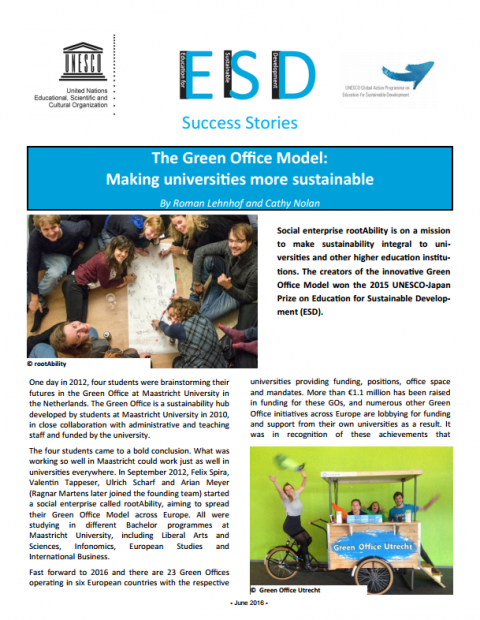 Le Modèle du bureau vert: faire des universités des lieux de développement plus durable Year of publication: 2016 Author: Roman Lehnhof | Cathy Nolan Corporate author: Organisation des Nations Unies pour l'éducation, la science et la culture (UNESCO) ESD Success Stories are showcasing compelling stories with a personal/human dimension from all five UNESCO regions (Africa, Arab States, Asia and Pacific, Europe & North America and Latin America & the Caribbean). The stories illustrate the wide diversity of ESD approaches and initiatives taking place in different parts of the world. They show how involvement with ESD has changed the lives of specific individual persons and how they have become more active in their community. Each story centers on one individual or a group of individuals.The rootAbility, a social enterprise, is planned by four students at Maastricht University, aiming to spread Green Office Model across Europe. The Green Office can effectively drive a dynamic sustainability process in universities and other institutions of higher education by collaboratively working with students and university staff and integrating sustainability into university’s teaching and research El Modelo de la oficina de sostenibilidad: construyendo unas universidades más sostenibles Year of publication: 2016 Author: Roman Lehnhof | Cathy Nolan Corporate author: Organización de las Naciones Unidas para la Educación, la Ciencia y la Cultura (UNESCO) ESD Success Stories are showcasing compelling stories with a personal/human dimension from all five UNESCO regions (Africa, Arab States, Asia and Pacific, Europe & North America and Latin America & the Caribbean). The stories illustrate the wide diversity of ESD approaches and initiatives taking place in different parts of the world. They show how involvement with ESD has changed the lives of specific individual persons and how they have become more active in their community. Each story centers on one individual or a group of individuals.The rootAbility, a social enterprise, is planned by four students at Maastricht University, aiming to spread Green Office Model across Europe. The Green Office can effectively drive a dynamic sustainability process in universities and other institutions of higher education by collaboratively working with students and university staff and integrating sustainability into university’s teaching and research
  Молодежь и насильственный экстремизм в социальных медиа: Сопоставление исследований Year of publication: 2017 Author: Séraphin Alava | Divina Frau-Meigs | Ghayda Hassan Corporate author: Организация Объединенных Наций по вопросам образования, науки и культуры (UNESCO) Приводят ли социальные сети уязвимых людей к насилию? Многие люди верят, что это так. И они отвечают на такую возможность введением цензуры, слежкой и контрпропагандой. Но что мы действительно знаем об Интернете как о причине и что мы знаем о влиянии этих реакций? Во всем мире правительства и интернет-компании принимают решения на основе предположений о причинах и средствах защиты от насильственных нападений. Задача состоит в том, чтобы обеспечить надежные обоснования для проводимого анализа и принимаемых ответных мер. Необходима политика, которая строится на основе фактов и доказательств, а не основывается на догадках - или движимая паникой и страхом. Именно в этом контексте ЮНЕСКО заказала исследование под названием «Молодежь и насильственный экстремизм в социальных сетях». В данной работе представлено глобальное сопоставление исследований (проведенных в основном в период 2012-2016 гг.), посвященных изучению предполагаемой роли, которую играют социальные сети в процессах насильственной радикализации, особенно когда они затрагивают молодежь и женщин.
 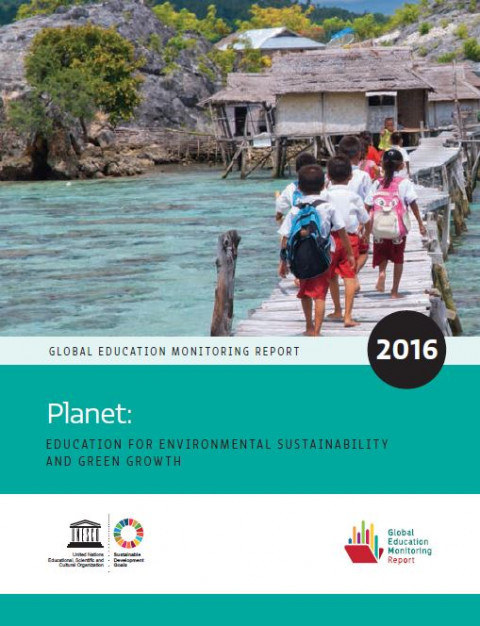 Global Education Monitoring Report, 2016: Planet: Education for Environmental Sustainability and Green Growth Year of publication: 2016 Corporate author: UNESCO PLANET: Education for environmental sustainability and green growth, a publication taken from the full 2016 Global Education Monitoring Report, explores the knowledge and skills needed for sustainable and inclusive economic growth that does not damage our planet.This publication demonstrates how education can help people understand and respond to environmental issues and climate change. Environmental education can increase green knowledge and build sustainability practices. The publication warns that while education contributes to economic growth, education systems must be careful not to encourage unsustainable lifestyles and all learners must acquire the knowledge and skills needed to promote sustainable development.It also argues that we must continue to learn throughout our lives in order to make production and consumption sustainable, and to provide green skills for green industries. Creating green industries relies on high-skill workers with specific training, yet by 2020 there could be 40 million too few workers with tertiary education relative to demand. Higher education and research should also be oriented towards green innovation and growth; innovation depends on cooperation in higher education and investment in research and development to transform production in vast swaths of the economy.It also recognises that education must change in order to keep up with the changing face of work. Green and transferable skills should be taught in both school and the workplace. The greening of industries requires not only the production of more high-skill workers, but the continued training and education for low and medium skill workers, often on the job. “To ensure the Sustainable Development Goals are implemented, everyone involved needs to think, to work, to organise, to communicate and to report in ways that are completely different from what has been done up till now. Education truly is key to a wide appreciation not just of the SDGs but the new ways of thinking and working that are going to be necessary to fulfil them. So the challenge to all of us is to re-learn, and that does not just apply to educators, but it applies to all of us.”
  Guidelines on Sustainability Science in Research and Education Year of publication: 2017 Corporate author: UNESCO “Guidelines on Sustainability Science in Research and Education” is the main output of the international UNESCO project “Broadening the Application of the Sustainability Science Approach” initiated in October 2015 with the support of the Japanese Ministry of Education, Culture, Sports, Science and Technology (Japan/MEXT) to identify good practices and develop policy guidelines to help Member States harness the potential of sustainability science in their sustainable development strategies.This project aimed to help UNESCO Member States and other stakeholders introduce or reinforce a sustainability science approach into transdisciplinary research and education, to enable them to better respond to global challenges, through three symposia to foster dialogue and collaboration among experts and policy-makers. Based on the joint efforts of UNESCO’s Natural Sciences Sector, Social and Human Sciences Sector, Education Sector and Regional Science Bureau for Asia and the Pacific in Jakarta, the project benefited from the guidance of a multidisciplinary steering committee and a drafting sub-committee.For further information on Sustainability Science, please visit: https://en.unesco.org/sustainability-science
 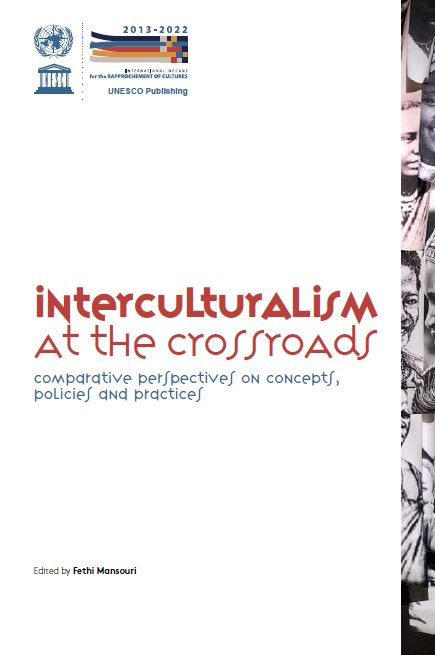 Interculturalism at the Crossroads: Comparative Perspectives on Concepts, Policies and Practices Year of publication: 2017 Author: Fethi Mansouri Corporate author: UNESCO Today most societies across the world are witnessing rising levels of social and cultural diversity brought about by globalisation and in particular increased human mobility and significant advances in information and communications technologies. The dilemma, therefore, has been how best to manage the resultant diversity and what optimal social policy paradigms to adopt towards this end.Assimilation, multiculturalism and presently interculturalism have all been proposed as possible policy conduits for managing socio-cultural diversity.This book, in focusing on the latter concept, and in particular in its intercultural dialogue manifestation, offers at once theoretical examinations, policy discussion and practical explorations of its uptake across the world. The core argument connecting the book’s three distinct sections is that whilst assimilation in its racist manifestation is no longer a viable option in today’s world, intercultural dialogue within existing multicultural settings has much to offer.
 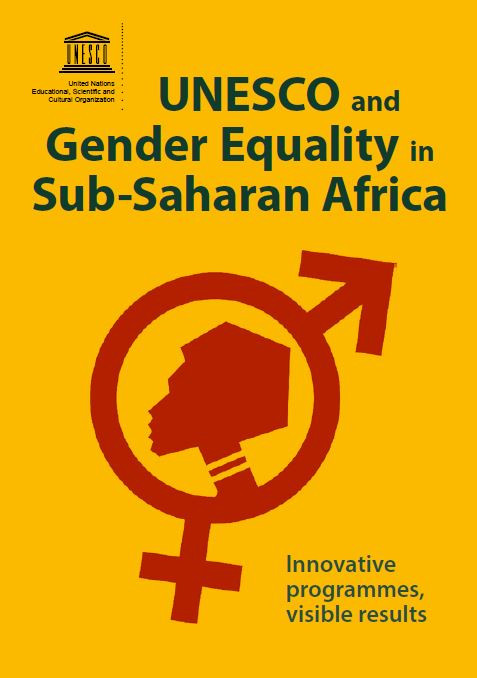 UNESCO and Gender Equality in Sub-Saharan Africa: Innovative Programmes, Visible Results Corporate author: UNESCO For over twenty years, UNESCO’s work in Africa has been undertaken in a specific framework with a range of institutional mechanisms designed to help translate into action its priorities: Africa and gender equality. During this period, UNESCO achieved important results in the areas covered by its mandate to promote gender equality.This publication highlights UNESCO’s contribution to the implementation of the African Union’s Agenda 2063 and the 2030 Agenda for Sustainable Development of the United Nations, in the field of gender equality in Africa, through examples of good practice, lessons learnt as well as suggestions and recommendations for the future. L'UNESCO et l'égalité des Genres en Afrique Subsaharienne: Des Programmes Novateurs, des Résultats Perceptibles Corporate author: Organisation des Nations Unies pour l'éducation, la science et la culture (UNESCO) Depuis plus d’une vingtaine d’années l’UNESCO a inscrit son action dans un cadre spécial assorti d’un ensemble de mécanismes institutionnels conçus pour appuyer l’opérationnalisation de ses Priorités: l’Afrique et l’égalité des genres. Au cours de cette période, l’UNESCO a été à l’origine d’importantes réalisations dans les domaines relevant de son mandat à travers la mise en oeuvre des programmes et activités novateurs.La présente publication met en exergue la contribution de l’UNESCO à la mise en oeuvre de l’Agenda 2063 de l’Union africaine et du Programme de développement durable à l’horizon 2030 dans le domaine de l’égalité des genres en Afrique, à travers des exemples de bonnes pratiques, de leçons apprises ainsi que des suggestions et recommandations pour le futur.
 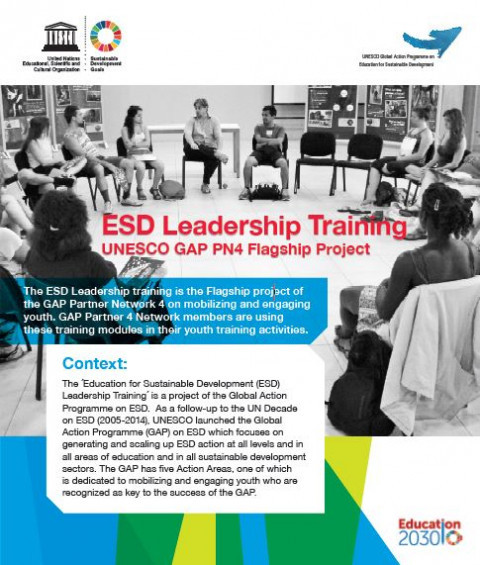 ESD Leadership Training: UNESCO GAP PN4 Flagship Project Year of publication: 2017 Corporate author: UNESCO The ESD Leadership training is the Flagship project of the GAP Partner Network 4 on mobilizing and engaging youth. GAP Partner 4 Network members are using these training modules in their youth training activities. Formation au Leadership pour l'EDD: Projet phare GAP PN4 de l'UNESCO Year of publication: 2017 Corporate author: Organisation des Nations Unies pour l'éducation, la science et la culture (UNESCO) La formation au leadership pour l’EDD est le projet phare du réseau de partenaires 4 (PN4) mis en place pour le Programme d’action global en vue d’autonomiser et de mobiliser les jeunes. Les membres de ce réseau utilisent ces modules pour leurs activités de formation des jeunes.