
Resources
Explore a wide range of valuable resources on GCED to deepen your understanding and enhance your research, advocacy, teaching, and learning.
2,813 Results found
 Plan Estratégico 2018 - 2021. Equipo especial internacional sobre docentes para Educación 2030 Year of publication: 2018 Corporate author: Organización de las Naciones Unidas para la Educación, la Ciencia y la Cultura (UNESCO) Con el final de la era de la EPT, la TTF ha decidido articular sus actividades en torno a los objetivos educativos internacionales recientemente adoptados.El Plan Estratégico 2018-2021 se basa en los Objetivos de Desarrollo Sostenible (ODS), especialmente en la meta del ODS 4.c sobre docentes, y en la Declaración de Incheon y el Marco de Acción para la realización del Objetivo de Desarrollo Sostenible 4 adoptados en 2015.Este nuevo Plan Estratégico fue informado por una evaluación externa realizada en 2016-2017. Las conclusiones y recomendaciones de la evaluación fueron discutidas por el Comité Directivo de la TTF en mayo de 2017 e impulsan algunas de las direcciones estratégicas de este Plan Estratégico.
  UNESCO ICT Competency Framework for Teachers (ver.3) Year of publication: 2018 Corporate author: UNESCO UNESCO has developed the ICT Competency Framework for Teachers (ICT CFT) as a tool to guide pre- and in-service teacher training on the use of ICTs across the education system. The ICT CFT is intended to be adapted to support national and institutional goals by providing an up-to-date framework for policy development and capacity building in this dynamic area.The ICT Competency Framework for Teachers (ICT CFT) Version 3 is a response to recent technological and pedagogical developments in the field of ICT and Education, and incorporates in its structure inclusive principles of non-discrimination, open and equitable information accessibility and gender equality in the delivery of education supported by technology. It addresses the impacts of recent technological advances on education and learning, such as Artificial Intelligence (AI), Mobile Technologies, the Internet of Things and Open Educational Resources, to support the creation of inclusive Knowledge Societies. The ICT CFT provides a comprehensive set of competencies teachers need to integrate ICT into their professional practice in order to facilitate students’ achievement of curricular objectives. Strong political commitments and sustained investment in teacher education, and concerted actions between pre- and in-service teacher trainings form the foundation of the successful implementation of this Framework as it is contextualized to national and institutional goals. For this reason, this document underlines the importance of steadfast commitment to supporting teachers’ continuous professional development including through ICT, and includes examples to illustrate how ICT CFT could be used to facilitate teachers’ development in diverse contexts. We look forward to strengthening our collaboration with all stakeholders everywhere to leverage ICT to develop the skills required to thrive within the fast-changing inclusive Knowledge Societies.
 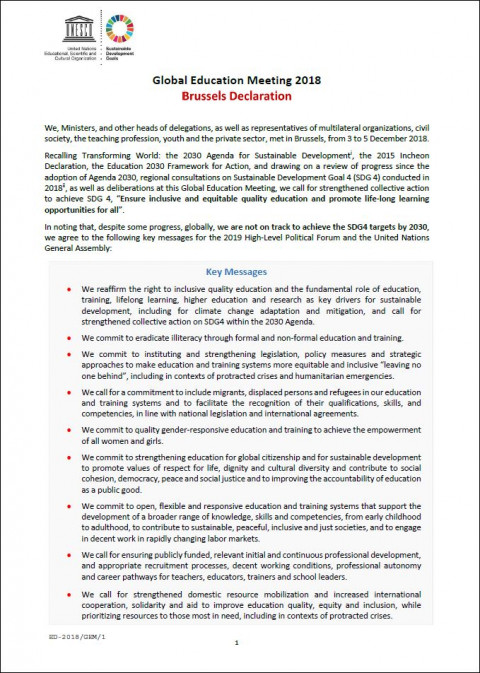 Global Education Meeting 2018: Brussels Declaration Year of publication: 2018 Corporate author: UNESCO Ministers, and other heads of delegations, as well as representatives of multilateral organizations, civil society, the teaching profession, youth and the private sector, met in Brussels, from 3 to 5 December 2018. This document describes key messsages and commitments for the 2019 High-Level Political Forum and the United Nations General Assembly.
  Guidelines and Recommendations for Reorienting Teacher Education to Address Sustainability Year of publication: 2005 Corporate author: UNESCO Members of the International Network made recommendations related to reorienting teacher education to address sustainability. The recommendations are pieces of wisdom garnered through the experimentation and hard work of teacher educators.The recommendations concern ministerial and national levels to the local level. The recommendations involve curriculum, pedagogy, policy, practice, programs, rewards, research, information and computer technology, partnerships, networking, communications, etc.Members of the International Network repeatedly mentioned the urgency to act and the need for profound change. While many spoke of the enormity of the task at hand, all who participated were able to make signifi cant and positive inroads. Interested individuals operating within their own spheres of control (e.g., weaving sustainability themes into their own classroom curricula) made great headway reorienting their programs. Also, many institutions were able to develop new courses at both the undergraduate and graduate levels. Problems arose, however, when the Network members advocated for change beyond the sphere of direct control. ESD within teacher-education institutions is currently endorsed by early-adopters. However, it will take concerted effort and resources to establish ESD in curricula, programs, practices, and policies across teacher-education institutions.
 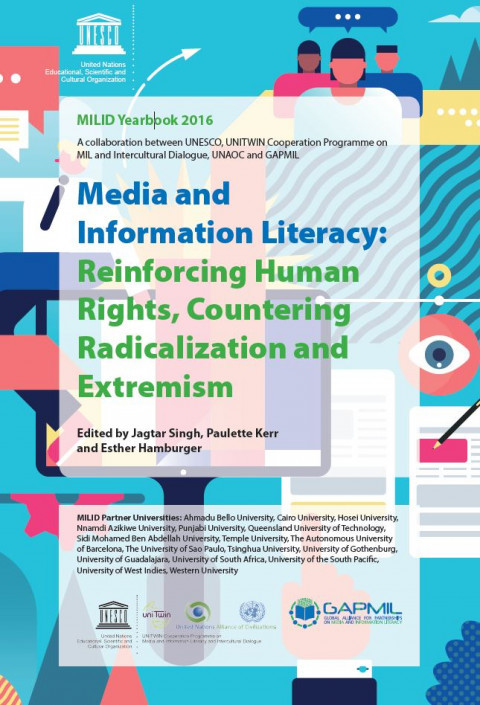 Media and Information Literacy: Reinforcing Human Rights, Countering Radicalization and Extremism (The MILID Yearbook, 2016) Year of publication: 2016 Author: Jagtar Singh | Paulette Kerr | Esther Hamburger Corporate author: UNESCO | Alliance of Civilizations Media and Information Literacy (MIL) is a strong tool, cutting across educational, cultural and social contexts. It can help overcome disinformation, stereotypes and intolerance conveyed through some media and in online spaces. Here, stimulating critical empathy is one of the vital components and there are many stakeholders that have a role to play in this dimension of MIL.This year’s edition is focused on a highly relevant theme of “Media and Information Literacy: Reinforcing Human Rights, Countering Radicalization and Extremism”. It is a relevant reference point to initiate discussion and offer perspectives to stakeholders seeking to apply MIL as a tool to counter violent extremism. There is evident need for evidence-based research, assessment and evaluation that can provide insight into the impact of media and information literacy on societies. UNESCO trusts that this publication will contribute to ongoing scholarship and debate on these key topics.For media and other information providers to serve their purpose, we need critical minds in the public, which means to develop MIL programmes at the national, regional and international levels.
  Предложение в отношении Глобальной программы действий по образованию в интересах устойчивого развития в качестве последующей деятельности по итогам Десятилетия образования в интересах устойчивого развития (ДОУР) Организации Объединенных Наций в период после 2014 г. Year of publication: 2013 Corporate author: Организация Объединенных Наций по вопросам образования, науки и культуры (UNESCO) Настоящий документ содержит предложение в отношении Гло-бальной программы действий по образованию в интересах устойчивого развития (ОУР), а также комментарии и замечания Исполнительного со-вета.
  [Video] Snapshot on Education - Global & Regional Perspectives on Progress and Current Challenges Year of publication: 2018 Corporate author: UNESCO The video is a snapshot of the reflection on progress and challenges for education. Taking into consideration the global and regional SDG4-Education 2030 consultations throughout 2018. More at https://en.unesco.org/themes/education/globaleducationmeeting2018 Un apercu sur l’éducation Year of publication: 2018 Corporate author: Organisation des Nations Unies pour l'éducation, la science et la culture (UNESCO) La vidéo est un apercu de la réflexion sur les progrès et les défis de l'éducation. Prenant en considération les consultations mondiales et régionales de l’ODD4-Education 2030 tout au long de 2018. Pour en savoir plus https://fr.unesco.org/themes/education
 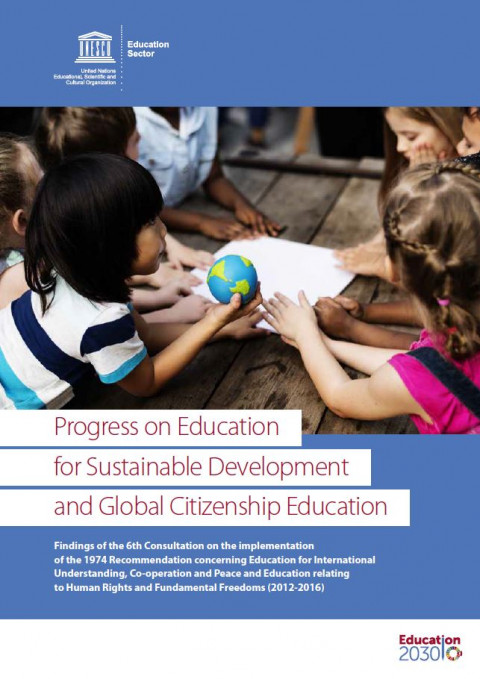 Progress on Education for Sustainable Development and Global Citizenship Education: Findings of the 6th Consultation on the Implementation of the 1974 Recommendation Year of publication: 2018 Corporate author: UNESCO Findings of the 6th Consultation on the implementation of the 1974 Recommendation concerning Education for International Understanding, Co-operation and Peace and Education relating to Human Rights and Fundamental Freedoms (2012-2016) Progress on Education for Sustainable Development and Global Citizenship Education “The Recommendation concerning Education for International Understanding, Co-operation and Peace and Education relating to Human Rights and Fundamental Freedoms” was adopted by UNESCO’s General Conference at its 18th session in 1974. Every four years, Member States report to UNESCO on measures taken to implement the Recommendation in pre-primary, primary, secondary and post-secondary/tertiary education. This document summarizes and analyses the main findings of the 6th Consultation on the implementation of the 1974 Recommendation, covering the period of 2012 to 2016. The findings of the 6th Consultation provide important insight into how Member States are implementing the 1974 Recommendation as well as how they are progressing towards Target 4.7 of Sustainable Development Goal 4 on Education. Target 4.7 concerns Education for Sustainable Development and Global Citizenship Education, which are closely related to the 1974 Recommendation. Supporting Member States in implementing Target 4.7 is a UNESCO priority and essential to progress across the 2030 Agenda for Sustainable Development. Avances en la educación para el desarrollo sostenible y la educación para la ciudadanía mundial: resultados de la sexta consulta sobre la aplicación de la Recomendación sobre la Educación para la Comprensión Year of publication: 2018 Corporate author: Organización de las Naciones Unidas para la Educación, la Ciencia y la Cultura (UNESCO) Hallazgos de la 6ta consulta sobre la implementación de la Recomendación de 1974 sobre Educación para la Comprensión, la Cooperación y la Paz Internacionales y la Educación relativa a los Derechos Humanos y a las Libertades Fundamentales (2012-2016). Progresos en Educación para Desarrollo Sostenible y Educación para la Ciudadanía Mundial “La Recomendación concerniente a la Educación para Comprensión, Cooperación y Paz internacional y Educación relativa a los Derechos Humanos y a las Libertades Fundamentales” fue adoptada en la Conferencia General de la UNESCO en su 18ava sesión de 1974. Cada cuatro años, los Estados Miembros reportan a la UNESCO sobre las medidas llevadas a cabo para implementar la Recomendación en los niveles preescolares, primario, secundario y post-secundario/terciario de educación. Este documento resume y analiza los hallazgos principales de la 6ta Consulta sobre la implementación de la Recomendación de 1974, cubriendo el período de 2012 a 2016. Los hallazgos de la 6ta Consulta proporcionan información importante sobre cómo los Estados Miembros están implementando la Recomendación de 1974, y de cómo están progresando hacia la Meta 4.7 del Objetivo de Desarrollo Sostenible 4 en Educación. La Meta 4.7 concierne a la Educación para el Desarrollo Sostenible y la Educación para la Ciudadanía Mundial, que están muy ligadas a la Recomendación de 1974. El apoyo a los Estados Miembros en la implementación de la Meta 4.7 es una prioridad para la UNESCO dado que es esencial para progresar hacia los objetivos de la Agenda 2030 para Desarrollo Sostenible. (Avances en la educación para el desarrollo sostenible y la educación para la ciudadanía mundial: resultados de la sexta consulta sobre la aplicación de la Recomendación sobre la Educación para la Comprensión, la Cooperación y la Paz Internacionales y la Educación relativa a los Derechos Humanos y las Libertades Fundamentales, de 1974 (2012-2016))