
Resources
Explore a wide range of valuable resources on GCED to deepen your understanding and enhance your research, advocacy, teaching, and learning.
2,813 Results found
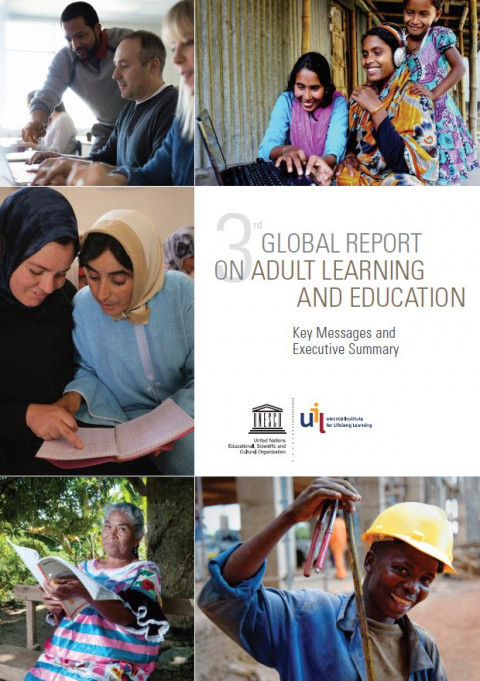 [Summary] 3rd Global Report on Adult Learning and Education: The Impact of Adult Learning and Education on Health and Well-being, Employment and the Labour Market, and Social, Civic and Community Life; Key Messages and Executive Summary Year of publication: 2016 Corporate author: UNESCO Institute for Lifelong Learning (UIL) The third Global Report on Adult Learning and Education (GRALE III) draws on monitoring surveys completed by 139 UNESCO Member States to develop a differentiated picture of the global state of adult learning and education (ALE). It evaluates countries’ progress in fulfilling the commitments they made in the Belém Framework for Action, which was adopted at the Sixth International Conference on Adult Education (CONFINTEA VI) in 2009.In addition, the report examines the impact of ALE on three major areas: health and well-being; employment and the labour market; and social, civic and community life. GRALE III provides policymakers, researchers and practitioners with compelling evidence for the wider benefits of ALE across all of these areas. In so doing, it highlights some of the major contributions that ALE can make to realizing the 2030 Agenda for Sustainable Development. This report is guided by three goals: first, to analyse the results of a monitoring survey of UNESCO Member States, and to take stock of whether countries are fulfilling the commitments they made at CONFINTEA VI; second, to strengthen the case for adult learning and education with evidence of its benefits on health and well-being,employment and the labour market, and social, civic and community life; and third, to provide a platform for debate and action at national, regional and global levels. [Résumé] 3e rapport mondial sur l'apprentissage et l'éducation des adultes: l'impact de l'apprentissage et l'éducation des adultes sur la santé et le bien-être, l'emploi et le marché du travail, et la vie sociale, civique et communautaire, points à retenir et résumé exécutif Year of publication: 2016 Corporate author: Institut de l’UNESCO pour l’apprentissage tout au long de la vie (UIL) Le troisième Rapport mondial sur l’apprentissage et l’éducation des adultes (GRALE III) s’appuie sur les réponses de 139 Etats membres de l’UNESCO à l’enquête de suivi GRALE III et brosse un tableau nuancé de la situation de l’apprentissage et de l’éducation des adultes dans le monde. Le rapport évalue les progrès accomplis par les pays dans la mise en oeuvre des engagements qu’ils ont pris dans le Cadre d’action de Belém, document adopté lors de la sixième Conférence internationale sur l’éducation des adultes (CONFINTEA VI) en 2009.En outre, le rapport examine l’impact de l’apprentissage et de l’éducation des adultes sur trois domaines majeurs : la santé et le bien-être ; l’emploi et le marché du travail ; et la vie sociale, civique et communautaire. GRALE III fournit aux décideurs politiques, chercheurs et praticiens des preuves irréfutables des bénéfices élargis de l’apprentissage et l’éducation des adultes dans tous ces domaines et éclaire, de ce fait, les contributions essentielles qu’ils peuvent apporter à la réalisation du Programme de développement durable à l’horizon 2030.Ce rapport répond à trois objectifs : premièrement, analyser les résultats d’un suivi des États membres de l’UNESCO et établir si les pays remplissent les engagements pris à CONFINTEA VI ; deuxièmement, promouvoir l’apprentissage et l’éducation des adultes par des preuves de leurs effets positifs sur la santé et le bien-être, l’emploi et le marché du travail, ainsi que la vie sociale, civique et communautaire ; et troisièmement fournir une plate-forme de débat et d’action aux niveaux national, régional et international. [Resumen] 3do Informe mundial sobre el aprendizaje y la educación de adultos: el impacto del aprendizaje y la educación de adultos sobre la salud y el bienestar, el empleo y el mercado de trabajo, y la vida social, cívica y comunitaria, mensajes clave y resumen ejecutivo Year of publication: 2016 Corporate author: UNESCO Institute for Lifelong Learning (UIL) El tercer Informe mundial sobre el aprendizaje y la educación de adultos (GRALE III) se funda en los estudios de monitoreo completados por 139 Estados Miembros de la UNESCO a fin de producir una visión diferenciada sobre el estado global del aprendizaje y la educación de adultos (AEA). Evalúa el progreso de los países en lo que respecta al cumplimiento de los compromisos que hicieron en el Marco de acción de Bélem, aprobado en la VI Conferencia Internacional de Educación de Adultos (CONFINTEA VI) en 2009.Además, el informe examina el impacto del AEA en tres áreas importantes: salud y bienestar; empleo y mercado de trabajo, así como vida cívica y comunitaria. El GRALE III brinda a los responsables de la formulación de política, investigadores y practicantes pruebas convincentes de los más amplios beneficio del AEA en todas estas áreas. Al hacerlo, destaca algunas de las contribuciones más importantes que el AEA puede hacer para realizar los objetivos de la Agenda 2030 para el Desarrollo Sostenible.El presente informe responde a tres objetivos: en primer lugar, analizar los resultados de una encuesta de seguimiento realizada entre los Estados Miembros de la UNESCO y determinar si los países están cumpliendo los compromisos que contrajeron en CONFINTEA VI; en segundo lugar, reforzar los argumentos en favor del aprendizaje y la educación de adultos con datos fehacientes sobre los beneficios que reportan en los ámbitos de la salud y el bienestar, el empleo y el mercado de trabajo y la vida social, cívica y comunitaria; y en tercer lugar, proporcionar un referente a partir del cual debatir y pasar a la acción a escala nacional, regional e internacional.
  미래교육 전망: UNESCO 교육의 미래와 OECD 교육 2030을 중심으로 Year of publication: 2022 Author: 김미경 Corporate author: 한국교육과정평가원 본 연구는 변화하는 미래 사회를 대비하기 위해 UNESCO 교육의 미래와 OECD 교육 2030을 비교하여 미래 교육을 전망하고, 이에 따른 향후 우리나라 교육의 방향을 모색하고 정책을 제언하는 것을 목적으로 한다. 이를 위해 2021년 발간된 UNESCO 교육의 미래 보고서의 주요 내용을 살펴보고, OECD 교육 2030과 미래 학교교육 시나 리오에서 제시한 미래 교육 내용을 UNESCO 교육의 미래와 비교 분석하여 시사점을 도출하였다. 또한 이를 토대로 한국의 미래 교육이 나아가야 할 방향과 제언을 제시하였다.
  유네스코 1974 국제이해교육 권고 개정안 검토 포럼 자료집 Year of publication: 2022 Corporate author: 한국국제이해교육학회 | 유네스코 아시아태평양 국제이해교육원 | 유네스코한국위원회 2022년 10월 5일 유네스코 아태교육원과 유네스코한국위원회, 한국국제이해교육학회가 공동으로 개최한 <유네스코 1974 국제이해교육 권고 개정안 검토 포럼> 자료집 입니다. 본 포럼은 유네스코의 「국제이해, 협력, 평화를 위한 교육과 인권, 기본 자유에 관한 교육 권고( 1974 국제이해교육 권고)」가 오늘날 변화된 시대 상황과 지구촌의 새로운 과제 등을 반영할 수 있도록 개정안 초안에 대한 전문적 검토 요지 발표와 토론을 실시한 후, 참가자들의 의견을 수렴하였습니다. <목차> I. 인사말 한경구 (유네스코한국위원회 사무총장) 임현묵 (유네스코 아시아태평양 국제이해교육원장) 박순용 (한국국제이해교육학회장) II. [1부] 1974 국제이해교육 권고 개정 배경 및 현황 1974 국제이해교육 권고 개요와 개정 추진 현황 - 유네스코 아시아태평양 국제이해교육원 / 유네스코한국위원회 국제전문가그룹의 주요 활동 및 1974 국제이해교육 권고 개정안 초안의 주요 내용 / 강순원 (한신대학교 교수) III. [2부] 1974 국제이해교육 권고 개정안 초안 검토 조대훈 (성신여자대학교 교수) 김병연 (양재고등학교 교사) 권혁장 (국가인권위원회 인권교육기획과장) 이선경 (청주교육대학교 교수) 변순용 (서울교육대학교 교수) 이동연 (한국예술종합학교 교수) 손동빈/장경희 (서울시교육청 민주시민생활교육과 과장/장학사) 부록 Recommendation concerning Education for International Understanding, Co-operation and Peace and Education relating to Human Rights and Fundamental Freedoms 국제이해, 협력, 평화를 위한 교육과 인권, 기본 자유에 관한 교육 권고 REVISED RECOMMENDATION CONCERNING EDUCATION FOR INTERNATIONAL UNDERSTANDING, CO-OPERATION AND PEACE AND EDUCATION RELATING TO HUMAN RIGHTS AND FUNDAMENTAL FREEDOMS (‘1974 RECOMMENDATION’)
  제22회 한국국제이해교육학회 국제학술대회: 미래형 교육과정과 세계시민교육: 도전과 과제 Year of publication: 2021 Corporate author: 한국국제이해교육학회 2021년 11월 13일에 개최되었던 제22회 한국국제이해교육학회 국제학술대회 자료집으로 '미래형 교육과정과 세계시민교육: 도전과 과제'라는 주제로 세계시민교육의 역할과 가능성을 어떻게 학교교실 안으로 가져올지에 대한 토론과 발표내용을 담고 있습니다. 본 자료집에는 기조강연/패널부터 자유 발표 등에 이르기까지 모든 발표자들의 자료가 포함되어 있으며 기조강연 및 패널, 패널4(이기 프로젝트)의 경우 일본어 번역자료도 함께 수록되어 있습니다.
  예비교사를 위한 글로벌-다문화 교육 역량 강화 교육 프로그램 사례 (국제이해교육연구; Vol. 18, No. 2) Year of publication: 2023 Author: 김관태 | 오홍식 | 권상철 Corporate author: 한국국제이해교육학회 이 글은 예비교사의 글로벌-다문화 교육 역량 강화를 위해 시행한 글로벌교원양성(GTU) 사업의 제주대학교 활동 경험을 소개하며 그 확대 방안을 제시한다. 제주대학교 GTU 사업은 글로벌 역량과 다문화 역량을 포괄하는 글로벌-다문화 교육 프로그램을 지식, 기능, 태도의 영역으로 구분하고 국내와 해외에서 교과 수업, 비교과 활동으로 과정별로 진행하였다. 과정은 대다수의 예비교사를 대상으로 하는 기초, 국내․외 교육 현장 봉사 활동 중심의 심화, 그리고 해외 교육실습 및 특강 강사로 참여하는 특화로 진행하였다. 다양한 글로벌-다문화 역량 강화 교육 활동은 그 내용을 영역별 기대 효과와 더불어 제시해 선별적으로 선택해 운영할 수 있디록 제시하였다. 제주대학교 GTU 사업은 다양한 국내․외 활동을 단계적으로 진행하며 글로벌 다문화 사회에 필요한 역량을 갖춘 교원을 양성하는 프로그램을 제공하고 있다. 제주대학교의 글로벌-다문화 교육 경험은 다른 교원양성기관의 예비교사 양성 사업 활동에 참고할 수 있을 것이다.
 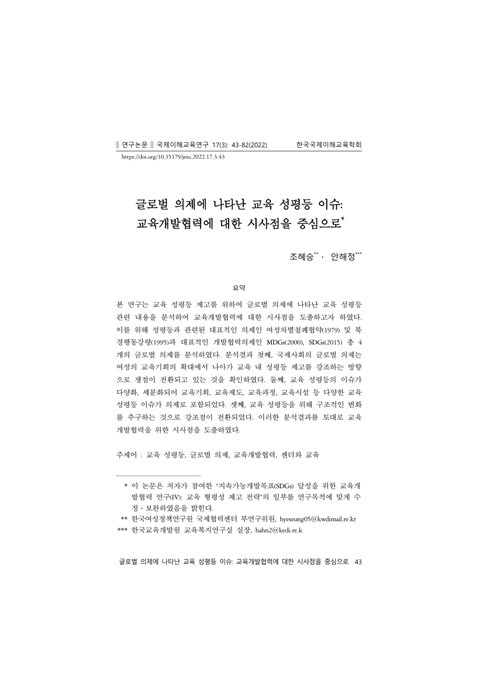 글로벌 의제에 나타난 교육 성평등 이슈: 교육개발협력에 대한 시사점을 중심으로 (국제이해교육연구; Vol. 17, No. 3) Year of publication: 2022 Author: 조혜승 | 안해정 Corporate author: 한국국제이해교육학회 본 연구는 교육 성평등 제고를 위하여 글로벌 의제에 나타난 교육 성평등 관련 내용을 분석하여 교육개발협력에 대한 시사점을 도출하고자 하였다. 이를 위해 성평등과 관련된 대표적인 의제인 여성차별철폐협약(1979) 및 북경행동강령(1995)과 대표적인 개발협력의제인 MDGs(2000), SDGs(2015) 총 4개의 글로벌 의제를 분석하였다. 분석결과 첫째, 국제사회의 글로벌 의제는 여성의 교육기회의 확대에서 나아가 교육 내 성평등 제고를 강조하는 방향으로 쟁점이 전환되고 있는 것을 확인하였다. 둘째, 교육 성평등의 이슈가 다양화, 세분화되어 교육기회, 교육제도, 교육과정, 교육시설 등 다양한 교육 성평등 이슈가 의제로 포함되었다. 셋째, 교육 성평등을 위해 구조적인 변화를 추구하는 것으로 강조점이 전환되었다. 이러한 분석결과를 토대로 교육개발협력을 위한 시사점을 도출하였다.
 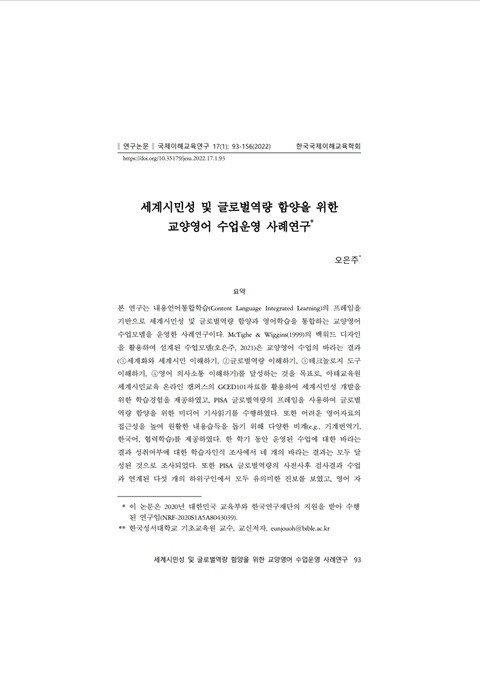 세계시민성 및 글로벌역량 함양을 위한 교양영어 수업운영 사례연구 (국제이해교육연구; Vol. 17, No. 1) Year of publication: 2022 Author: 오은주 Corporate author: 한국국제이해교육학회 본 연구는 내용언어통합학습(Content Language Integrated Learning)의 프레임을 기반으로 세계시민성 및 글로벌역량 함양과 영어학습을 통합하는 교양영어 수업모델을 운영한 사례연구이다. McTighe & Wiggins(1999)의 백워드 디자인을 활용하여 설계된 수업모델(오은주, 2021)은 교양영어 수업의 바라는 결과(1. 세계화와 세계시민 이해하기, 2. 글로벌역량 이해하기, 3. 테크놀로지 도구 이해하기, 4. 영어 의사소통 이해하기)를 달성하는 것을 목표로, 아태교육원 세계시민교육 온라인 캠퍼스의 GCED101자료를 활용하여 세계시민성 개발을 위한 학습경험을 제공하였고, PISA 글로벌역량의 프레임을 사용하여 글로벌 역량 함양을 위한 미디어 기사읽기를 수행하였다. 또한 어려운 영어자료의 접근성을 높여 원활한 내용습득을 돕기 위해 다양한 비계(e.g., 기계번역기, 한국어, 협력학습)를 제공하였다. 한 학기 동안 운영된 수업에 대한 바라는 결과 성취여부에 대한 학습자인식 조사에서 네 개의 바라는 결과는 모두 달성된 것으로 조사되었다. 또한 PISA 글로벌역량의 사전사후 검사결과 수업과 연계된 다섯 개의 하위구인에서 모두 유의미한 진보를 보였고, 영어 자기효능감 검사의 사전사후 결과에서는 읽기, 듣기, 말하기, 쓰기 모든 영역에서 유의미한 상승을 보였다. 연구 결과의 함의는 세계시민성 및 글로벌역량을 함양하는 교양영어 수업이 언어 학습의 본질적 기능 뿐 아니라 21세기 대학의 교양교육이 지향하는 가치 지향적 학습이 동시에 이루어지는 기초필수 교과목으로서의 잠재성을 탐색한 점이다.
 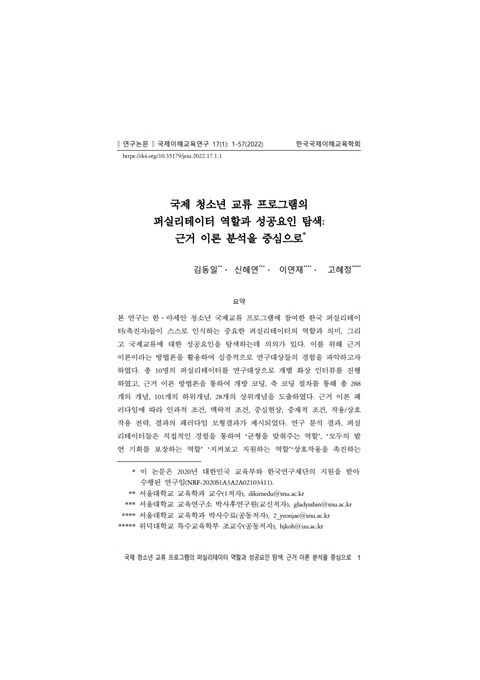 국제 청소년 교류 프로그램의 퍼실리테이터 역할과 성공요인 탐색: 근거 이론 분석을 중심으로 (국제이해교육연구; Vol. 17, No. 1) Year of publication: 2022 Author: 김동일 | 신혜연 | 이연재 | 고혜정 Corporate author: 한국국제이해교육학회 본 연구는 한․아세안 청소년 국제교류 프로그램에 참여한 한국 퍼실리테이터(촉진자)들이 스스로 인식하는 중요한 퍼실리테이터의 역할과 의미, 그리고 국제교류에 대한 성공요인을 탐색하는데 의의가 있다. 이를 위해 근거 이론이라는 방법론을 활용하여 심층적으로 연구대상들의 경험을 파악하고자 하였다. 총 10명의 퍼실리테이터를 연구대상으로 개별 화상 인터뷰를 진행하였고, 근거 이론 방법론을 통하여 개방 코딩, 축 코딩 절차를 통해 총 288개의 개념, 101개의 하위개념, 28개의 상위개념을 도출하였다. 근거 이론 패러다임에 따라 인과적 조건, 맥락적 조건, 중심현상, 중재적 조건, 작용/상호작용 전략, 결과의 패러다임 모형결과가 제시되었다. 연구 분석 결과, 퍼실리테이터들은 직접적인 경험을 통하여 ‘균형을 맞춰주는 역할’, ‘모두의 발언 기회를 보장하는 역할’ ‘지켜보고 지원하는 역할’‘상호작용을 촉진하는 역할’ 등으로 묘사하였고, 청소년을 대상으로 한 국제교류 프로그램 특성에 대해 성공요인을 ‘성공적인 문화적 교류’, ‘여러 국가 참가자들의 연대’, ‘유사한 예절과 가치관’, ‘청소년 시기의 시의적절한 경험’, ‘촉진자도 토론을 통한 긍정적인 경험’, ‘토론을 통한 의사 결정 능력 함양’ 등으로 표현하였다. 특히, 코로나19로 지속적인 온라인 학습 경험에 기반하여 국제교류 의미에 관한 의견이 도출되었으며, 차후 더 나은 온라인 국제교류를 위한 방안도 논의되었다. 본 연구는 한․아세안 청소년 국제교류 프로그램을 통해 퍼실리테이션의 역할, 방향성과 더불어 국제교류에 미치는 요소들를 비교 분석하였고, 앞으로 이러한 온라인 플랫폼과 퍼실리테이터들의 역할에 기여하는 요인을 구체적으로 제공하였기에 그 의의가 크다고 여겨진다.