
Resources
Explore a wide range of valuable resources on GCED to deepen your understanding and enhance your research, advocacy, teaching, and learning.
2,813 Results found
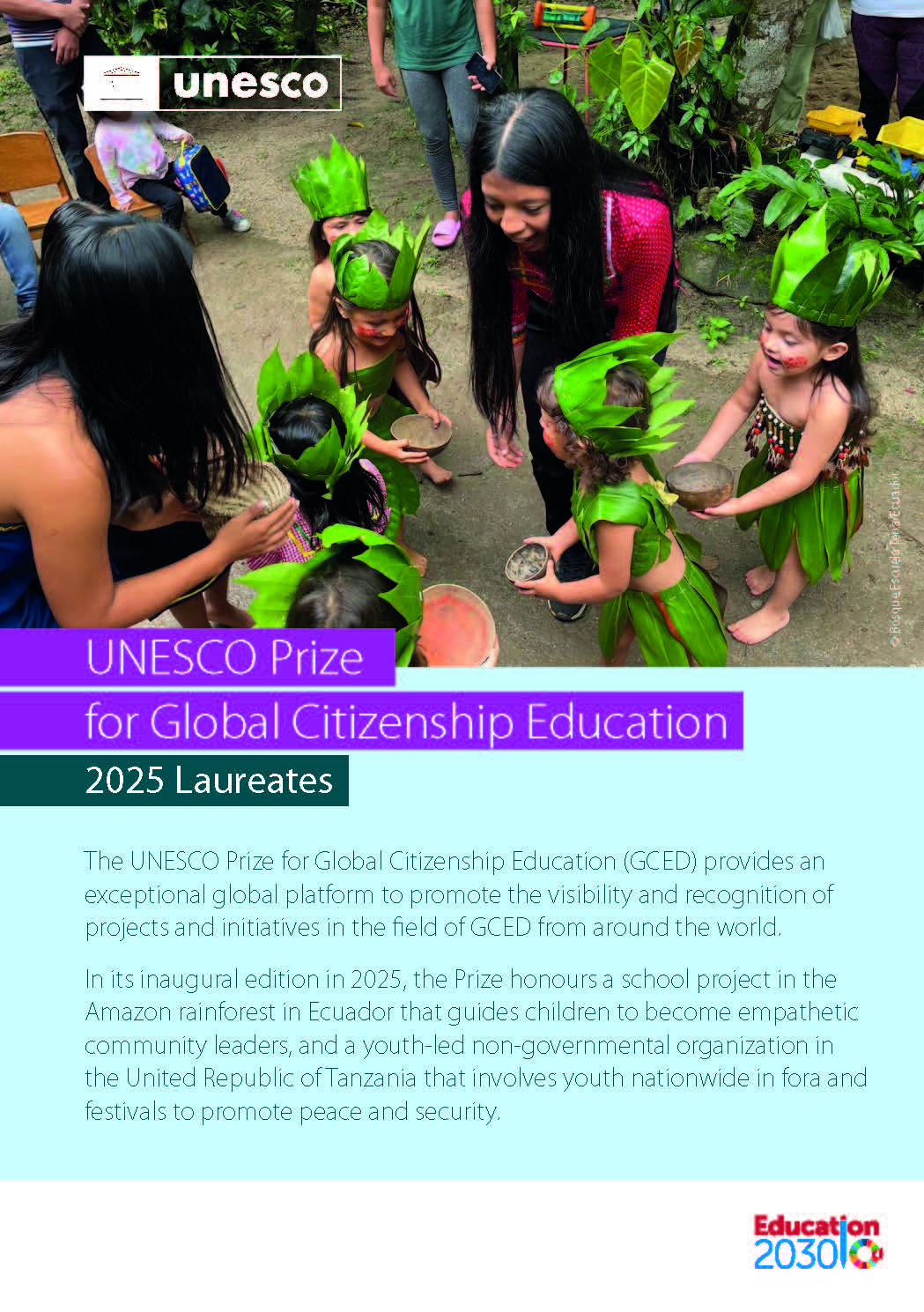 UNESCO Prize for Global Citizenship Education 2025 Laureates Year of publication: 2025 Corporate author: UNESCO The UNESCO Prize for Global Citizenship Education (GCED) provides an exceptional global platform to promote the visibility and recognition of projects and initiatives in the field of GCED from around the world.In its inaugural edition in 2025, the Prize honours a school project in the Amazon rainforest in Ecuador that guides children to become empathetic community leaders, and a youth-led non-governmental organization in the United Republic of Tanzania that involves youth nationwide in fora and festivals to promote peace and security.
 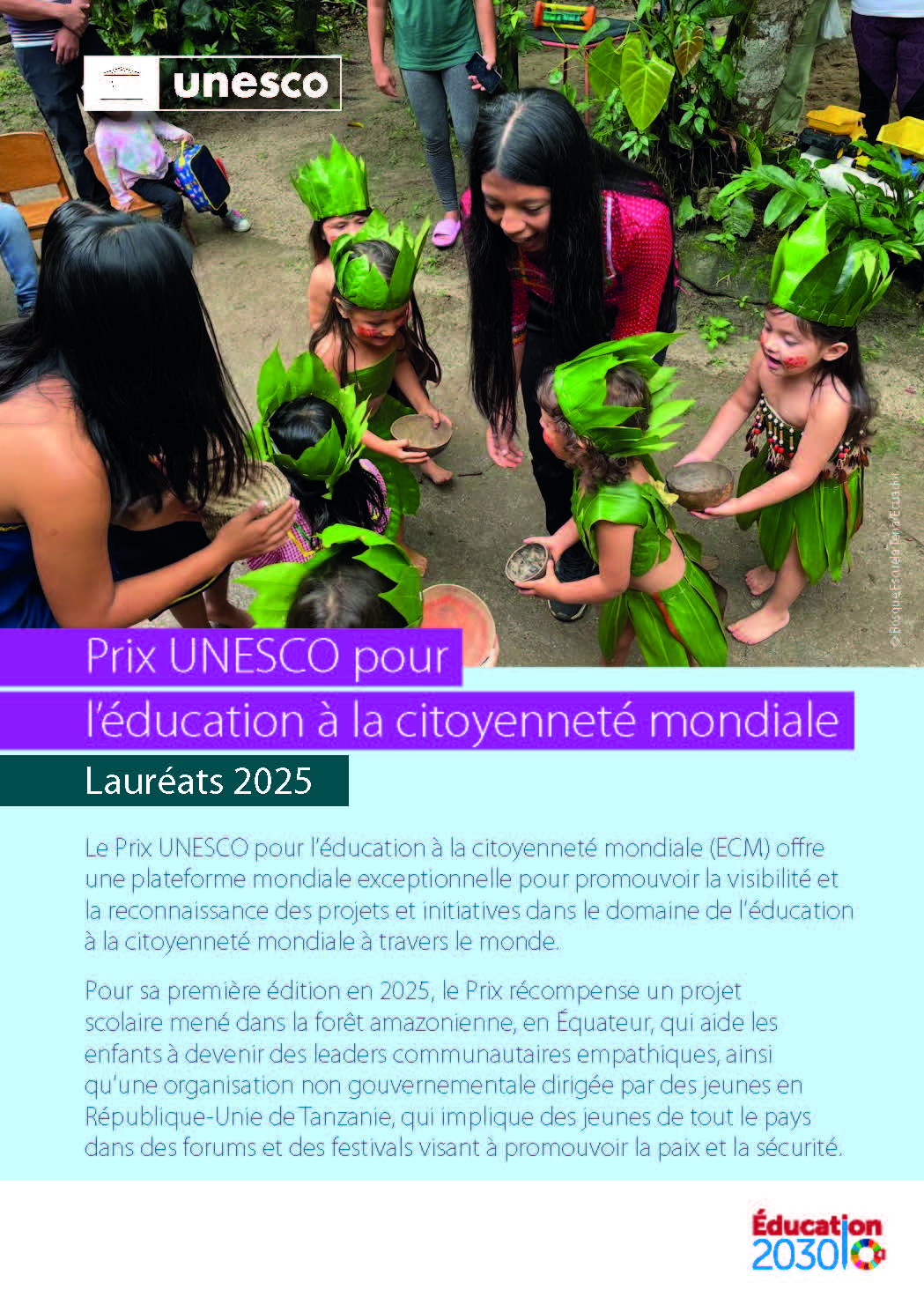 Prix UNESCO pour l’éducation à la citoyenneté mondiale : lauréats 2025 Year of publication: 2025 Corporate author: Organisation des Nations Unies pour l'éducation, la science et la culture (UNESCO) Le Prix UNESCO pour l’éducation à la citoyenneté mondiale (ECM) offre une plateforme mondiale exceptionnelle pour promouvoir la visibilité et la reconnaissance des projets et initiatives dans le domaine de l’éducation à la citoyenneté mondiale à travers le monde.Pour sa première édition en 2025, le Prix récompense un projet scolaire mené dans la forêt amazonienne, en Équateur, qui aide les enfants à devenir des leaders communautaires empathiques, ainsi qu’une organisation non gouvernementale dirigée par des jeunes en République-Unie de Tanzanie, qui implique des jeunes de tout le pays dans des forums et des festivals visant à promouvoir la paix et la sécurité.
 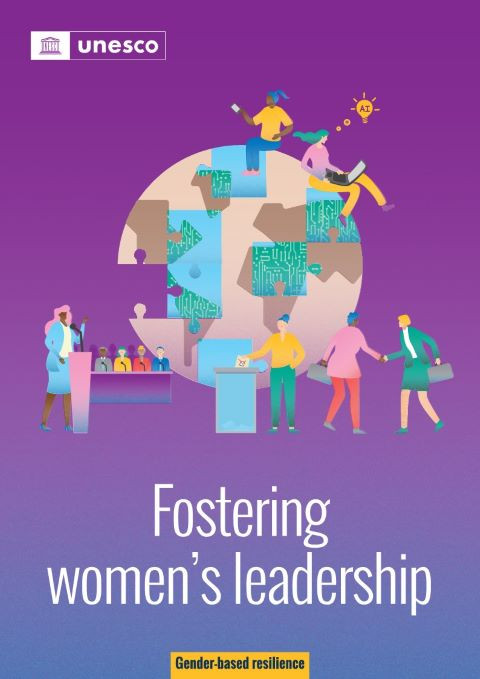 Fostering Women's Leadership Year of publication: 2024 Author: Mariagrazia Squicciarini | Anna Rita Manca | Garance Sarlat Corporate author: UNESCO No (leadership) share no gain (for societies and economies)! Leveraging UNESCO’s unique Gender-Based Resilience Framework, this report explores the role of women in leadership positions in both decision-making and high-tech, including in artificial intelligence-related innovations. It further highlights progress towards the G20 Brisbane Target, aimed to accelerate progress on gender equality by reducing the gender gap in labour market participation rates by 25% by 2025. Women remain underrepresented in decision-making, holding only about 26% of seats in national parliaments worldwide on average. In the world of work, female labour participation continues to lag behind men’s, at 47% for women against 72% for men on average. Despite progress by G20 members towards the Brisbane Target, a 2% average gap in absolute terms remained to be filled in 2022. In the high-tech world, women make up only 30% of AI professionals, and even less of leaders. Female inventors in AI account for about 37% of patents filed in 2022-23.
 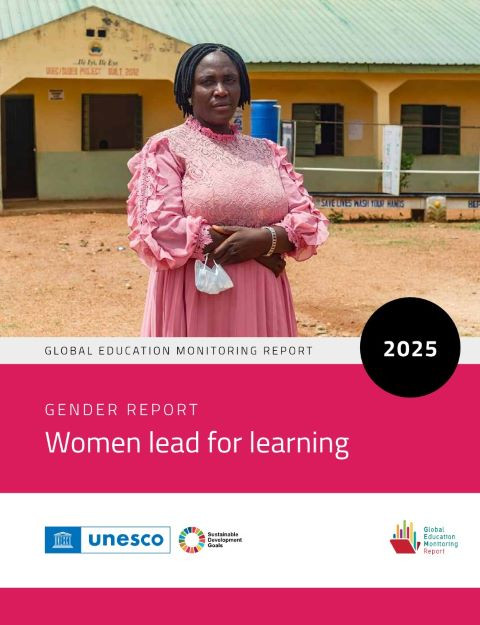 Global Education Monitoring Report 2025: Gender Report: Women Lead for Learning Year of publication: 2025 Corporate author: UNESCO Barriers to gender equality in education leadership positions can and need to be overcome This gender edition, which is part of the 2024/5 Global Education Monitoring Report on leadership in education, addresses the remaining obstacles for women in their efforts to climb up the leadership ladder in education. Although the teaching profession has been feminized, there are considerable gender gaps in school management, education administration and political leadership positions, a situation illuminated in detail with examples from all over the world. Gender disparity in education leadership is the result of entrenched stereotypes and biases – conscious or unconscious – on the one hand and on the other institutional processes or professional development mechanisms that are insufficiently supportive. Research suggests that women leaders display some differences relative to men in their approaches to education leadership, for example the extent to which they emphasize collaboration, build relationships with the community and retain a focus on learning. While there is little to suggest that these differences are universal or immutable, the evidence points to the fact that the lack of equitable opportunities translates to less talent and fewer diverse approaches to leadership, which are a loss to education systems – not to mention the obvious need for equity. This is particularly evident in parts of the world where gender disparities remain large. This gender edition calls on countries to take a much closer look at gender disparity in education leadership and adopt measures to raise awareness, improve mechanisms and strengthen capacities to address discrimination and bias and thus encourage women who aspire to such careers to pursue them. Gender disparity in education leadership is the result of entrenched stereotypes and biases – conscious or unconscious – on the one hand and on the other institutional processes or professional development mechanisms that are insufficiently supportive. Research suggests that women leaders display some differences relative to men in their approaches to education leadership, for example the extent to which they emphasize collaboration, build relationships with the community and retain a focus on learning. While there is little to suggest that these differences are universal or immutable, the evidence points to the fact that the lack of equitable opportunities translates to less talent and fewer diverse approaches to leadership, which are a loss to education systems – not to mention the obvious need for equity. This is particularly evident in parts of the world where gender disparities remain large. This gender edition calls on countries to take a much closer look at gender disparity in education leadership and adopt measures to raise awareness, improve mechanisms and strengthen capacities to address discrimination and bias and thus encourage women who aspire to such careers to pursue them.
  Journée internationale de l’éducation 2025 : L’intelligence artificielle et l’éducation : préserver l’autonomie dans un monde automatisé Year of publication: 2025 Corporate author: Organisation des Nations Unies pour l'éducation, la science et la culture (UNESCO) La Journée internationale de l’éducation 2025 vise à : Examiner les nouvelles possibilités offertes par l’IA, en particulier pour l’enseignement, l’apprentissage, l’évaluation et l’administration éducative. Promouvoir le développement de compétences critiques en matière d’IA en dotant les éducateurs et les apprenants des aptitudes nécessaires pour comprendre, utiliser et influencer les technologies d’IA, conformément aux cadres de compétences en IA de l’UNESCO pour les enseignants et les élèves. Veiller à ce que l’IA complète, plutôt qu’elle ne remplace, les éléments humains essentiels de l’apprentissage, notamment le développement des relations en présentiel et de l’intelligence émotionnelle.
  Countering Holocaust Denial and Distortion through Education: A Guide for Teachers Year of publication: 2025 Corporate author: UNESCO Antisemitic hate speech, disinformation, and conspiracy theories thrive during crises, making it vital for teachers to address these issues in school curricula. Social media has significantly amplified the spread of such harmful content, including Holocaust denial and distortion. These falsehoods, rooted in antisemitic prejudice and conspiratorial thinking, threaten our shared historical memory and promote hatred. To effectively combat these issues, it is essential to have a comprehensive understanding of the Holocaust —how and why the genocide of the Jewish people occurred. This knowledge helps us recognize the causes and risk factors, contributing to the prevention of future atrocity crimes and the fight against antisemitism. In the digital age, it is also imperative to be able to decipher the manipulation of history, and the misrepresentation of the past.The guide provides teachers with the necessary tools and guidance to prevent the spread of Holocaust denial and distortion. It equips teachers with knowledge, teaching principles, and strategies to foster digital literacy, historical understanding, and critical thinking in learners. Aimed primarily at history and social sciences teachers, it outlines key concepts, teaching methods, and approaches to counter Holocaust denial and distortion.
  Strategies to Counter Antisemitism: A Handbook for Educators Year of publication: 2025 Corporate author: UNESCO Education is the first line of defence against hate and prejudice. By targeting the root causes of hate ideologies, deconstructing the stereotypes that underlie them from an early age, and promoting inclusive models, education is the keystone of a holistic approach to combating discrimination. Tackling antisemitism through education requires tailored content that addresses its complex, shifting and multilayered forms, both past and present.Acknowledging the topic’s complexity and the paucity of resources available to education stakeholders, this concise guide developed by UNESCO and funded by the European Commission aims to provide a roadmap for policymakers, curriculum developers and educators on current approaches and initiatives. It presents ten educational practices, each grounded in academic literature and illustrated by a promising educational initiative that operationalizes core pedagogical principles. The handbook is built around the three core learning domains which inform UNESCO’s approach to Global Citizenship Education: cognitive, socio-emotional, and behavioural learning.Conceived as an accessible operational guide for practitioners, this resource sets out to start a larger conversation about the needs of educators for tackling contemporary forms of antisemitism. It aims to encourage investments in high-quality empirical research that can pave the way for a better approach to combat antisemitism.
  Global Education Monitoring Report 2024: Gender Report; Technology on Her Terms Year of publication: 2024 Corporate author: UNESCO | Global Education Monitoring Report Team The 2024 Gender Report tells the increasingly positive story of girls’ education access, attainment and achievement, which is helping reverse decades of discrimination. But there is much more to say on gender equality in and through education. A companion to the 2023 GEM Report, this report looks at the interaction between education and technology with a gender lens. First, it looks at the impact of technology on girls’ education opportunities and outcomes. Although many instances are seen of radio, television and mobile phones providing a learning lifeline for girls, particularly in crisis contexts, gender divides exist globally in both access to technology and in digital skills, although the latter are smaller among youth compared to among adults. Biased social and cultural norms inhibit equitable access to and engagement with technology in and outside of school, with girls always left on the wrong side of the divide. While technology offers many girls opportunities to access important education content in safe environments, for instance on comprehensive sexuality education, technology in practice often exacerbates negative gender norms or stereotypes. Social media usage impacts learners’ and particularly girls’ well-being and self-esteem. The ease with which cyberbullying can be magnified through the use of online devices in the school environment is a cause of concern, as is the biased design of artificial intelligence algorithms. Second, the report looks into the role of education on the shape of future technological development. It shows that women struggle to pursue STEM careers, which manifests from an early age in the form of anxiety in mathematics and develops into a reluctance to study STEM subjects, ultimately resulting in a lack of women in the technology workforce. Women make up only 35% STEM graduates, and hold only a quarter of science, engineering and ICT jobs. Ensuring women participate on equal terms in shaping the world’s ongoing digital transformation will ensure that technology works for everyone and takes into consideration the needs of all humanity.
  Youth Report 2024: Technology in Education; A Tool on Our Terms! Year of publication: 2024 Corporate author: UNESCO | Global Education Monitoring Report Team | Restless Development The 2024 Youth Report on technology in education is the result of an extensive consultation process in partnership with Restless Development involving +1500 youth and students across 8 regions. The consultations invited participants to reflect on the key challenges and opportunities for the use of technology in education in their regions through the lenses of the recommendations in the global 2023 Global Education Monitoring Report on technology in education: Technology on our terms. The discussions centred on the need for the use of technology in education to be appropriate for national and local contexts and to be equitable and leave no one behind. The report calls for decisions about technology in education to keep learners at the centre when deciding whether the use of technology in education would be appropriate, equitable, evidence-based, and sustainable. Through this report, young people have described what technology on their terms would look like. It concludes with a call to action calling which highlights concrete recommendations that governments can follow to ensure that technology in education is on youth terms.
  3rd Global Forum Against Racism and Discrimination: Final Document Year of publication: 2024 Corporate author: UNESCO The third edition of the Global Forum against Racism and Discrimination with the theme “Race to the top: putting racial equity and justice at the forefront of development agendas” was held in São Paulo, Brazil, on 29 November 2023 and 1 December 2023. At the invitation of Brazil, in partnership with the Ford Foundation, the Open Society Foundations, the Mover Foundation, Instituto Ibirapitanga, the Global Forum highlighted the importance of placing racial issues at the core of development and implementation strategies, with a view to socioeconomic development. The Global Forum welcomed Ministers, high-ranking officials of national bodies responsible for combating discrimination and promoting equality, mayors of the International Coalition of Inclusive and Sustainable Cities - ICCAR, academics, scientists, civil society actors, NGOs, artists and digital influencers to share good practices, strengthen commitments and discuss effective strategies to combat racism and various forms of discriminations, including recommendations on how to proceed. The Global Forum’s agenda covered several topics, such as co-creating inclusive policies with impacted communities’ inputs; increasing awareness-raising on historical systems such as transatlantic enslavement to better comprehend and dismantle their contemporary legacies such as racism; progress towards gender equality; enhancing the capacities of civil society to be an agent of change; addressing artificial intelligence and its role in perpetuating racism; protecting the rights of indigenous peoples; establishing legal and policy frameworks prioritizing anti-racism and anti-discrimination on a local and global scale; strengthening the roles of cities, civic spaces, artistic and academic communities; enhancing the importance of informed data baseline on equality for governments; and promoting social philanthropy to address racial inequality. The 2023 edition was also marked by the launch of new initiatives. One of the main outcomes of the Global Forum is the establishment of the UNESCO Network of Anti-Racism and Anti-Discrimination Officials aiming to strengthen the development of innovative and inclusive policy solutions for peace, equity and non-discrimination. UNESCO has launched the new UNESCO Anti-Racism Toolkit, the Gender-Based Resilience Framework, the ‘Let’s Talk‘ project with Harvard University to combat prejudice against migrants, and the development of a new joint OECD-UNESCO briefing on combating discrimination against migrants. Volume X of the UNESCO General History of Africa, entitled Africa and its Diasporas, was also launched during the Global Forum. The publication offers a mapping of African diasporas throughout the world, valorizing their contributions to modern societies.