
Resources
Explore a wide range of valuable resources on GCED to deepen your understanding and enhance your research, advocacy, teaching, and learning.
2,768 Results found
 Greening Education Partnership: Getting Every Learner Climate-Ready Year of publication: 2024 Corporate author: UNESCO Bangkok The UN Secretary-General calls the climate crisis ‘a battle for our lives’, as we still struggle to transform our societies to reach the 1.5°C-degree path recommended by the Paris Agreement. Rapid and radical transformation at all levels and in many aspects of our life is required, with education as a central and powerful means to support the adaptation and strengthening of the resilience of learners and societies. It is also important to ensure that education systems become more resilient to climate change to create safe and climate-proof schools. Building off of the knowledge and practice accumulated in Education for Sustainable Development (ESD), a new Greening Education Partnership aims to deliver strong, coordinated and comprehensive action which will prepare every learner to acquire the knowledge, skills, values, and attitudes to tackle climate change and to promote sustainable development.
 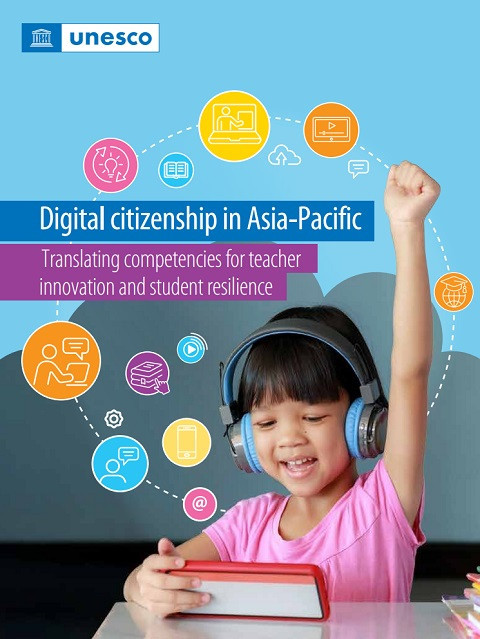 Digital Citizenship in Asia-Pacific: Translating Competencies for Teacher Innovation and Student Resilience Year of publication: 2023 Corporate author: UNESCO Bangkok A digitally-equipped and competent teaching force is crucial for cultivating students' digital citizenship skills. This UNESCO report, consisting of a comprehensive analysis comprising 15 countries in the Asia-Pacific region, unveils compelling evidence pertaining to what factors influence teachers' Information and Communication Technology (ICT) skills and their impact on students’ digital citizenship competencies. Perhaps unsurprisingly, the findings of this report show that students are developing most of their digital citizenship competencies through self-directed learning and outside of school. Nevertheless, teachers still play an important role, particularly in coaching students to use technology safely and effectively. Thus as UNESCO reports, Digital Creativity and Innovation remains relatively underdeveloped in all participating research countries. Additionally, female students tend to benefit more from teachers' guidance and advice, especially in terms of Digital Safety and Resilience. Support for teachers in terms of access to ICT infrastructure and training on ICT and pedagogical skills will contribute towards improving their ability to effectively guide and mentor their students, ultimately leading to better outcomes in terms of digital citizenship competencies. To achieve this, it is important for education systems to develop comprehensive and contextualized approaches to enhance digital citizenship capacities in teachers. Education policymakers and leaders are encouraged to use the 10 recommendations herein as a ‘roadmap’ to ensure that teachers are equipped with the necessary skills and knowledge to effectively integrate digital citizenship education into their teaching practices. This will ultimately help prepare students for the digital world and ensure their safety and well-being online.
 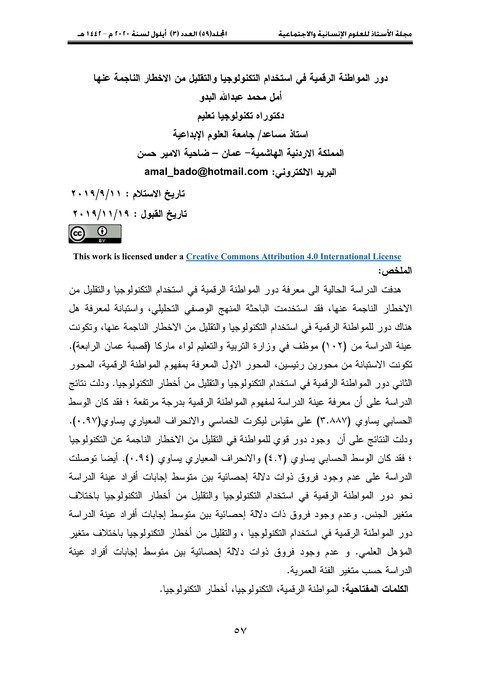 The Role of Digital Citizenship in the Use of Technology and Reducing the Risks Resulting from it (Alustath Journal for Human and Social Sciences; vol.59, no.3) Year of publication: 2020 Author: Amal Mohammed Abdullah Albado Corporate author: University of Baghdad. College of Education Ibn Rushd The current study aims to know the role of digital citizenship in the use of technology and reducing the risks resulting from it. The researcher uses the descriptive analytical approach and makes a questionnaire to know if there is a role for the digital citizenship in the use of technology and reducing the dangers caused by it. The study sample consists of (102) employees in the Ministry of Education Marka Brigade (the fourth Amman qasaba). The questionnaire consists of two main axes: the first axis, which is defined as the concept of digital citizenship, the second axis is the role of digital citizenship in the use of technology and reducing the dangers of technology. The results of the study show that the awareness of the sample of the study of the concept of digital citizenship is on a high level, on average that equals (3.887) of the Likert quinary scale and the standard deviation is equal to (0.97). The results also show a strong role for citizens in reducing the dangers caused by technology where the arithmetic mean equals (4.2) and the standard deviation was (0.94). دور المواطنة الرقمية في استخدام التكنولوجيا والتقليل من الاخطار الناجمة عنها (الاستاذ للعلوم الانسانية والاجتماعية; no.3, vol.59) Year of publication: 2020 Author: Amal Mohammed Abdullah Albado Corporate author: University of Baghdad. College of Education Ibn Rushd هدفت الدراسة الحالية الى معرفة دور المواطنة الرقمية في استخدام التكنولوجيا والتقليل من الاخطار الناجمة عنها، فقد استخدمت الباحثة المنهج الوصفي التحليلي، واستبانة لمعرفة هل هناك دور للمواطنة الرقمية في استخدام التكنولوجيا والتقليل من الاخطار الناجمة عنها، وتكونت عينة الدراسة من (102) موظف في وزارة التربية والتعليم لواء ماركا (قصبة عمان الرابعة). تكونت الاستبانة من محورين رئيسين، المحور الاول المعرفة بمفهوم المواطنة الرقمية، المحور الثاني دور المواطنة الرقمية في استخدام التكنولوجيا والتقليل من أخطار التكنولوجيا. ودلت نتائج الدراسة على أن معرفة عينة الدراسة لمفهوم المواطنة الرقمية بدرجة مرتفعة ؛ فقد كان الوسط الحسابي يساوي (3.887) على مقياس ليكرت الخماسي والانحراف المعياري يساوي(0.97). ودلت النتائج على أن وجود دور قوي للمواطنة في التقليل من الاخطار الناجمة عن التكنولوجيا ؛ فقد كان الوسط الحسابي يساوي (4.2) والانحراف المعياري يساوي (0.94).
  A Suggested Proposal for the Role of Universities in Developing Students’ Awareness of Digital Citizenship in Light of Requirements and Challenges of the Digital Age: A Case Study of Bisha University (Arts for Educational & Psychological Studies; vol.14, no.1) Year of publication: 2022 Author: Sheikha Abdullah Al-Briki Balabied Corporate author: Dhamar University The study aimed to measure the degree of students’ awareness of the digital citizenship at the University of Bisha, and to develop a proposed scenario in the light of the results of the study, which included a framework for activating the role of universities in developing their students' awareness of digital citizenship to meet the requirements and challenges of the digital age. The analytical descriptive method was used by conducting an exploratory study and designing a questionnaire to measure the degree of students' awareness of digital citizenship. The most prominent results were that the degree of students' awareness of digital citizenship was "very high" on the total digital citizenship awareness scale. There were no statistically significant differences between the average scores of males and females, nor between the average degrees of students of theoretical and practical colleges on the total digital citizenship awareness scale. تصور مقترح لدور الجامعات في تطوير وعي الطلبة بالمواطنة الرقمية في ضوء متطلبات العصر الرقمي وتحدياته جامعة بيشة أنموذجًا (مجلة الآداب للدراسات النفسية والتربوية; vol.14, no.1) Year of publication: 2022 Author: Sheikha Abdullah Al-Briki Balabied Corporate author: Dhamar University هدفت الدراسة إلى قياس درجة وعي طلبة الجامعة بالمواطنة الرقمية، ووضع تصور مقترح في ضوء نتائج الدراسة تضمن إطار عمل لتفعيل دور الجامعات في تنمية وعي الطلبة بالمواطنة الرقمية في ضوء متطلبات وتحديات العصر الرقمي. استُخدم المنهج الوصفي التحليلي من خلال تصميم استبانة لقياس درجة وعي الطلبة بالمواطنة الرقمية. ولتحقيق ذلك اتبعت الباحثة المنهج الوصفي التحليلي من خلال الدراسة الاستطلاعية وبناء استبانة لقياس درجة وعي الطلبة بالمواطنة الرقمية. وكانت أبرز النتائج أن درجة وعي الطلاب بالمواطنة الرقمية "مرتفعة جدًا"، بالإضافة إلى عدم وجود فروق ذات دلالة إحصائية بين متوسطات درجات الذكور والإناث، وكذلك بين متوسطات درجات طلاب الكليات النظرية والعملية على إجمالي مقياس الوعي بالمواطنة الرقمية.
 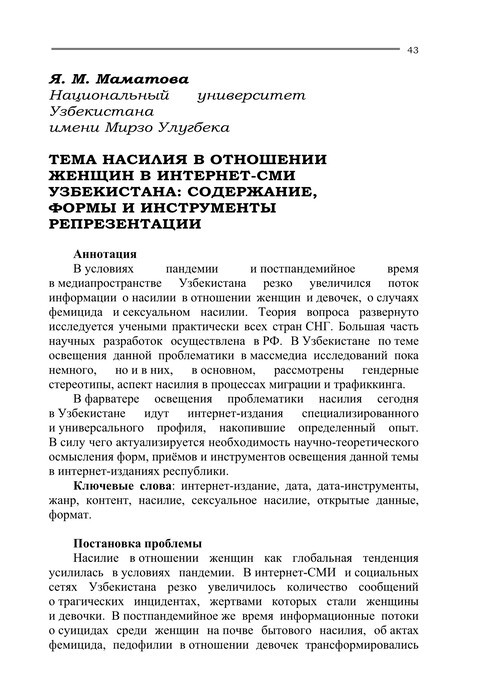 The Theme of Violence Against Women on the Internet Media of Uzbekistan: Content, Tools of Representation (PR and Advertising in a Changing World: Regional Aspect; No.28, 2023) Year of publication: 2023 Author: Я. М. Маматова In the context of the pandemic and post-pandemic in the media space of Uzbekistan, the flow of information about violence against women and girls, about cases of femicide and sexual violence has increased dramatically. In Uzbekistan, there are still few studies on the topic of coverage of this issue in the mass media, but they also mainly consider gender stereotypes, the aspect of violence in the processes of migration and trafficking. Тема насилия в отношении женщин в интеренет-СМИ Узбекистана: содержание, формы и инструменты репрезентации (PR и реклама в изменяющемся мире: региональный аспект; No.28, 2023) Year of publication: 2023 Author: Я. М. Маматова В условиях пандемии и постпандемийное время в медиапространстве Узбекистана резко увеличился поток информации о насилии в отношении женщин и девочек, о случаях фемицида и сексуальном насилии. В Узбекистане по теме освещения данной проблематики в массмедиа исследований пока немного, но и в них, в основном, рассмотрены гендерные стереотипы, аспект насилия в процессах миграции и трафиккинга.
  Citizens as Users of Languages and Digital Technology Year of publication: 2021 Corporate author: European Centre for Modern Languages (ECML) | Council of Europe A recent meta-analysis of the literature portrays male and female citizens who are users of languages and digital technologies. This helps to understand the goals of an education aimed at developing male and female citizens capable of using digital technology in a competent, informed, safe, responsible, ethical, and critical manner. Citoyens et citoyennes usagers et usagères des langues Year of publication: 2021 Corporate author: European Centre for Modern Languages (ECML) | Conseil de l'Europe Une méta-analyse de la littérature récente dresse le portrait des citoyens et citoyennes usagers et usagères de langues et du numérique. Cela permet de connaitre les objectifs d’une éducation qui vise le développement de citoyens et citoyennes capables d’utiliser le numérique d’une façon compétente, informée, sûre, responsable, éthique et critique.