
Resources
Explore a wide range of valuable resources on GCED to deepen your understanding and enhance your research, advocacy, teaching, and learning.
2,768 Results found
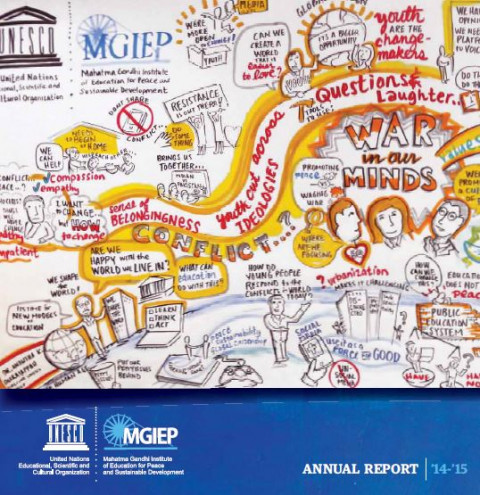 MGIEP Annual Report '14-'15 Year of publication: 2016 Corporate author: Mahatma Gandhi Institute of Education for Peace and Sustainable Development (MGIEP) The Mahatma Gandhi Institute of Education for Peace and Sustainable Development (MGIEP) is UNESCO’s first Category I institute in the Asia-Pacific region, established with the generous support of the Government of India. UNESCO MGIEP focuses on transforming current education policies and practices by developing innovative teaching and learning methods.Their objective is to build generations of young people equipped to create peaceful and sustainable societies. This annual report describes MGIEP’s main works and various educational programmes for peace and sustainable development.
  Empathy, Perspective and Complicity: How Digital Games can Support Peace Education and Conflict Resolution Year of publication: 2016 Author: Paul Darvasi Corporate author: Mahatma Gandhi Institute of Education for Peace and Sustainable Development (MGIEP) This paper will address how digital games may be uniquely suited to further the work of peace education and conflict resolution. There is a scarcity of research that specifically studies how digital games, as dynamic and interreactive learning tools, can be leveraged to support and enhance the closely related fields of peace education or conflict resolution; however, research in a number relevant sectors will be recruited to better understand the topic and expose gaps for further work. After defining basic terms, the first section will briefly discuss the aims of peace education and interactive conflict resolution and how digital games can assist in facilitating intergroup contact and collaboration. The heart of the paper will examine several serious games for their potential to cultivate perspective-taking and empathy, explore ethical dilemmas, promote intercultural understanding and encourage a sense of complicity, all crucial components in the work of peace education and conflict resolution. The final section will discuss the importance of context and reflection when implementing digital games and consider whether they can produce long-term, sustainable changes to behaviors and attitudes.
  MGIEP Annual Report 2015-2016 Year of publication: 2017 Corporate author: Mahatma Gandhi Institute of Education for Peace and Sustainable Development (MGIEP) The Mahatma Gandhi Institute of Education for Peace and Sustainable Development (MGIEP) is UNESCO’s first Category I institute in the Asia-Pacific region, established with the generous support of the Government of India.UNESCO MGIEP focuses on transforming current education policies and practices by developing innovative teaching and learning methods. Their objective is to build generations of young people equipped to create peaceful and sustainable societies.This annual report describes MGIEP’s main works and various educational programmes for peace and sustainable development.
 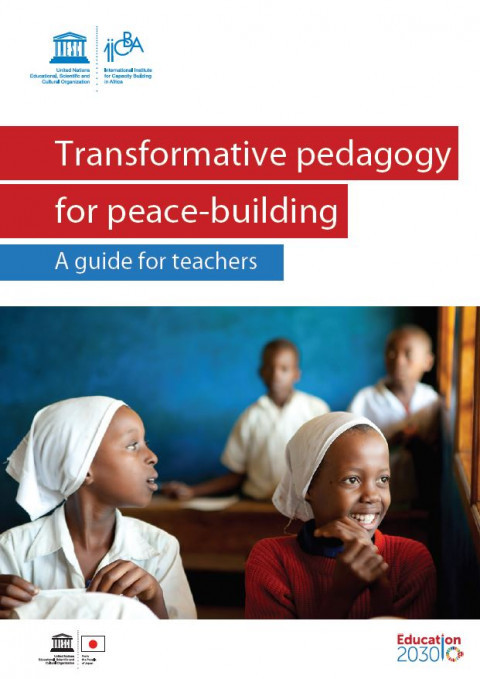 Transformative Pedagogy for Peace-building: A Guide for Teachers Year of publication: 2017 Corporate author: UNESCO International Institute for Capacity-Building in Africa (IICBA) This publication is a guide for teachers and teacher trainers on transformative pedagogy so that they are able to empower youth with peace-building knowledge, skills and competencies necessary to develop into advocates and actors of peace.The guide particularly aims to introduce teachers to the foundation of conflict analysis and peace-building and to equip them with a learner-centered approach to peace education and community engagement.This guide is a resource for educators to engage and support youth in their journey to becoming active peace-builders and fostering transformation in the Horn of Africa and Surrounding Countries.
  Translating globalization theories into educational research : thoughts on recent shifts in Holocaust education Much educational research on globalization aims to prepare students to be successful citizens in a global society. We propose a set of three concepts, drawing on systems theory (Nassehi, Stichweh) and theories of the subject (Butler, Foucault), to think the global which enables educational research to step back from hegemonic discourses and reflect on current practices. Globalization is understood in this approach as referring to: (1) a cognitive shift; (2) expanding relevancy spaces; and (3) new forms of subjectivation. The framework is illustrated with examples from educational policy and learning materials, with an extended look at how globalization is articulated in recent shifts in Holocaust education. (By the author)
  The Elusive and Exclusive Global Citizen Year of publication: 2015 Author: Jill Koyama Corporate author: Mahatma Gandhi Institute of Education for Peace and Sustainable Development (MGIEP) In this paper, the author interrogate the notion of global citizenship, both as an aspiration and an improbable practice, by situating it within contemporary understandings of citizenship and globalization.It is a conceptualization that suffers from the dangers inherent in the term “citizenship” and misconceptions of the terms “global,” and it is rooted in the West’s long engagement in normative undertakings in non-Western countries. The writer refute ideas of the autonomous and agentic global citizen. he encourage a rethinking of global citizenship and global citizenship education (GCE) and offer recommendations for redirecting attention to contemporary global stratifications and issues of human rights to address the issues of social justice and inequality that, due to the problematic definition of global citizenship, are currently inadequately covered in existing GCE curricula.
  Building Citizenship from Universities; University Social Responsibility and Challenges in the XXI century Year of publication: 2011 Author: Eduardo Gasca-Pliego | Julio César Olvera-García Corporate author: Universidad Autónoma del Estado de México The present essay contributes with a reflection on the role universities must take as agents of transformation and consolidation of the democratic model, mainly before the challenge of building full citizens, interested in the need of the physical and social environment, in collective decision making, who think of themselves as participant citizens and not only voters with their own interests in view. Distinguishable is the primordial role of university social responsibility to promote the social management of knowledge for everyone, which has as an end the construction of informed, responsible and participant citizenship, which responds to injustice, non-sustainability, violence and corruption. Rethinking the social function of the university requires defending the values proper to public education, in the sense that every citizen has equal opportunities to develop their capabilities, eliminating obstacles of social and economic nature, as well as the cultural and political that affect and hinder said development. Construir ciudadanía desde las universidades, responsabilidad social universitaria y desafíos ante el siglo XXI Year of publication: 2011 Author: Eduardo Gasca-Pliego | Julio César Olvera-García Corporate author: Universidad Autónoma del Estado de México El presente ensayo aporta una reflexión respecto al rol que deben adquirir las universidades como agentes de transformación y consolidación del modelo democrático, principalmente ante al reto de construir ciudadanos completos, interesados por las necesidades del entorno físico y social, por la toma de decisiones colectivas, que se conciben a sí mismos como ciudadanos partícipes y no únicamente como votantes con miras a satisfacer sus propios intereses. Destaca el papel prioritario de la responsabilidad social universitaria que promueva la gestión social del conocimiento para todos los actores sociales, que tenga como finalidad la construcción de una ciudadanía informada, responsable y participativa, que responda ante la injusticia, la insostenibilidad, la violencia y la corrupción. Repensar la función social de la universidad pública requiere defender los valores propios de la educación pública, en el sentido de que todos los ciudadanos tengan la igualdad de oportunidades para desarrollar sus capacidades, eliminando obstáculos de carácter económico y social, así como los culturales y políticos que afectan e impiden ese desarrollo.
  Public Universities and Neoliberal Common Sense: Seven Iconoclastic Thesis Year of publication: 2014 Author: Carlos Alberto Torres Corporate author: Universidad Nacional de Tres de Febrero (UNTREF) Neoliberalism has utterly failed as a viable model of economic development, yet the politics of culture associated with neoliberalism is still in force, becoming the new common sense shaping the role of government and education. This ‘common sense’ has become an ideology playing a major role in constructing hegemony as moral and intellectual leadership in contemporary societies. Neoliberal globalisation, predicated on the dominance of the market over the state and on deregulatory models of governance, has deeply affected the university in the context of ‘academic capitalism’. The resulting reforms, rationalised as advancing international competitiveness, have affected public universities in four primary areas: efficiency and accountability, accreditation and universalisation, international competitiveness and privatisation. There is also growing resistance to globalisation as top-down-imposed reforms reflected in the public debates about schooling reform, curriculum and instruction, teacher training and school governance. Many question whether neoliberal reforms attempt to limit the effectiveness of universities as sites of contestation of the national and global order and thus undermine the broader goals of education. Neoliberal reforms have limited access and opportunity along class and racial lines, including limiting access to higher education through the imposition of higher tuition and reduced government support to institutions and individuals. Las universidades públicas y el sentido común neoliberal: siete tesis iconoclastas Year of publication: 2014 Author: Carlos Alberto Torres Corporate author: Universidad Nacional de Tres de Febrero (UNTREF) El neoliberalismo ha fracasado completamente como un modelo viable de desarrollo económico, sin embargo, la política de la cultura asociada con el neoliberalismo sigue en vigor, convirtiéndose en el nuevo sentido común definiendo el rol del gobierno y de la educación. Este “sentido común“ se ha convertido en una ideología que juega un papel importante en la construcción de un liderazgo moral e intelectual hegemónico en las sociedades contemporáneas. La globalización neoliberal, basada en el predominio del mercado sobre el Estado y en modelos desregulados de gobierno, ha afectado profundamente a la universidad en el contexto del “capitalismo académico“. Las reformas resultantes, justificadas como avances en la competitividad internacional, han afectado a las universidades públicas en cuatro áreas principales: la eficiencia y la rendición de cuentas, la acreditación y universalización, la competitividad internacional y la privatización. También hay una creciente resistencia a la globalización y a las reformas impuestas de arriba hacia abajo reflejadas en los debates públicos sobre la reforma de la escolaridad, el currículo y la instrucción, la formación de docentes y la gestión escolar. Muchos se preguntan si las reformas neoliberales intentan limitar la eficacia de las universidades como lugares de disputa del orden nacional y global y así socavar los objetivos últimos de la educación. Las reformas neoliberales brindan un acceso y oportunidades limitadas según las clases y grupos raciales, incluyendo la restricción del acceso a la educación superior a través de la imposición de matrículas más costosas y la reducción del apoyo gubernamental a instituciones e individuos.