
Resources
Explore a wide range of valuable resources on GCED to deepen your understanding and enhance your research, advocacy, teaching, and learning.
1,983 Results found
 [ملخص] وضع تصورات جديدة لمستقبلنا معاً: عقد اجتماعي جديد للتربية والتعليم Year of publication: 2021 Corporate author: International Commission on the Futures of Education | منظمة الأمم المتحدة للتربية والعلم والثقافة (UNESCO) إن إنسان ّيتُنا وكوكبُنا الأرض في خطر. مما يستدعي حاجة ما ّسة إلى وضع إجراءات عاجلة، لتُتخذ معاً، من أجل تغيير المسار وإعادة تخيل مستقبلنا. وأضحى للتعليم، الذي لطالما أُ ِقر بدوره كقو ًة ُّ ّفاعل ًة لإحداث تغيير إيجابي، مه ّم ًة جديد ًة وعاجلة وها ّمة يتع ّين عليه النهوض بها. وبنا ًء على عملية تشاور عالمية شارك فيها حوالي مليون شخص، يدعو هذا التقرير الصادر عن اللجنة الدولية المعنية بمستقبل التربية والتعليم الحكومات والمؤسسات والمنظمات والمواطنين في جميع أنحاء العالم إلى ً صياغة عقد اجتماعي جديد للتعليم يساعدنا على بناء مستقبل ي ّتسم بال ِّسلم والعدالة والاستدامة معا ومن أجل الجميع. يلقي التقرير نظر ًة متعمق ًة على التكنولوجيات الرقمية، وتغير المناخ، والتدهور الديمقراطي، ُ ّ ُّ والاستقطاب المجتمعي، وحالة عدم اليقين التي تكتنف مستقبل فرص العمل. ولا يتوَّ ّخى التقرير مج ّرد فتح باب الحوار ّحول اًلتعليم للجميع وتحفيز الأفكار ذات الصلة، وإنما يح ُّث كل واحد م ّنا على العمل. ويرى التقرير أنه، أولا وقبل كل شيء، يمكننا من خلال الملايين من الأعمال الفردية والجماعية التي ت ّتسمّبالشجاعة والقيادة والمقاومة والإبداع والرعاية تغيير المسار وإحداث تح ّول جذري في التعليم يمكننا من بناء مستقبل عادل و ُمنصف ومستدام. [Summary] Reimagining Our Futures Together: A New Social Contract for Education Year of publication: 2021 Corporate author: International Commission on the Futures of Education | UNESCO Our humanity and planet Earth are under threat. Urgent action, taken together, is needed to change course and reimagine our futures. Education, long acknowledged as a powerful force for positive change, has new, urgent and important work to do. Informed by a global consultation process engaging about one million people, this report of the International Commission on the Futures of Education invites governments, institutions, organizations, and citizens around the world to forge a new social contract for education that will help us build peaceful, just, and sustainable futures together and for all.The report features in-depth looks at digital technologies, climate change, democratic slippage and societal polarization and the uncertain future of work. It aims not only to open the conversation about education to everyone and provoke thought, but to spur each of us on to action. It argues, above all, that it is through millions of individual and collective acts of courage, leadership, resistance, creativity and care that we will change course and transform education to build just, equitable and sustainable futures. [Resumen] Reimaginar juntos nuestros futuros: Un nuevo contrato social para la educación Year of publication: 2021 Corporate author: International Commission on the Futures of Education | Organización de las Naciones Unidas para la Educación, la Ciencia y la Cultura (UNESCO) La humanidad y el planeta Tierra se encuentran en peligro. Tenemos que adoptar medidas consensuadas de forma urgente para cambiar de rumbo y replantearnos nuestros futuros. En el plano educativo, que desde antaño se reconoce como un importante motor que propicia cambios positivos, se nos plantean desafíos nuevos, urgentes e importantes. Este informe de la Comisión Internacional sobre Los futuros de la educación, que se ha nutrido de un proceso mundial de consultas en el que han participado aproximadamente 1 millón de personas, insta a los gobiernos, las instituciones, las organizaciones y los ciudadanos de todo el mundo a preparar un nuevo contrato social en materia educativa que nos permita colaborar con el objetivo de forjar futuros pacíficos, justos y sostenibles para todas las personas. En el informe se abordan de forma detallada las tecnologías digitales, el cambio climático, el retroceso democrático y la polarización social, y el incierto futuro de la esfera laboral. Mediante este documento, no solo se pretende contribuir a que todas las personas participen en la conversación sobre la educación y promover la reflexión, sino también instar a todos los individuos a actuar. Según la tesis fundamental del informe, a través de millones de actos individuales y colectivos caracterizados por su valentía, liderazgo, resistencia, creatividad y atención, cambiaremos de rumbo y transformaremos el ámbito educativo a fin de forjar futuros justos, equitativos y sostenibles.
  함께 그려보는 우리의 미래 - 교육을 위한 새로운 사회계약 Year of publication: 2021 Corporate author: International Commission on the Futures of Education | 유네스코 우리의 인류와 지구는 위협을 받고 있습니다. 전염병은 우리의 연약함과 상호 연결성을 증명하는 역할을 했을 뿐입니다. 이제 방향을 바꾸고 우리의 미래를 재창조하기 위해 함께 취하는 긴급 조치가 필요합니다. 국제미래교육위원회는 심오한 변화를 가져오는 교육의 힘을 인정합니다. 우리는 모든 어린이, 청소년 및 성인을 위한 양질의 교육에 대한 권리를 보장하고 지속 가능한 집합적 미래를 위한 경로로서 교육의 변혁적 잠재력을 완전히 실현하겠다는 약속을 이행해야 하는 이중 과제에 직면해 있습니다. 이를 위해서는 불의를 바로잡으면서 미래를 변화시킬 수 있는 교육을 위한 새로운 사회계약이 필요합니다.이 새로운 사회 계약은 인권에 기초해야 하고 비차별, 사회 정의, 생명 존중, 인간 존엄성 및 문화적 다양성의 원칙에 기초해야 합니다. 그것은 배려, 호혜주의, 연대의 윤리를 포함해야 합니다. 공공의 노력과 공동선으로서의 교육을 강화해야 합니다.작성 기간이 2년이고 약 100만 명이 참여하는 글로벌 협의 프로세스를 기반으로한 이 보고서는 우리가 모두를 위해 평화롭고 정의로우며 지속 가능한 미래를 건설하는 데 도움이 될 교육을 위한 새로운 사회 계약을 맺도록 전 세계의 정부, 기관, 조직 및 시민을 초대합니다.여기에 제시된 비전, 원칙 및 제안은 단지 출발점일 뿐입니다. 그것들을 번역하고 맥락화하는 것은 공동의 노력입니다. 많은 밝은 점이 이미 존재합니다. 이 보고서는 이를 캡처하고 구축하려고 시도합니다. 매뉴얼도 청사진도 아닌 중요한 대화의 시작입니다.
  Sub-Education Policy Review Report: Inclusive Education Year of publication: 2021 Corporate author: UNESCO Inclusion highlights opportunities for an equal involvement of individuals with disabilities (physical, social, and emotional) when possible into typical education, but leaves accessible the probability of individual selections and possibilities for special aid and accommodations for persons who need it. This review was initiated by UNESCO to inform the ongoing discourse about inclusive education within Malaysia, Indonesia, Brunei, Philippine and Timur-Leste. Sustainable Development Goal 4 (SDG 4) reinforces the importance of inclusive education which adheres nations to adopt the framework of action in providing inclusion and equity through education of children with perceived differences. The review contributes to the body of literature on inclusive education by synthesizing policy recommendations and evaluations and identifying contradictions and overlaps in those policies. This review draws upon UNESCO reports pertaining to inclusive education policies and initiatives. In addition, a systematic review of empirical studies on inclusive education policy (2010-2020) identified from related and major databases (Eric) is conducted. Both the UNSECO reports and empirical studies are analyzed based on the SDG4 and its targets pertaining to inclusion policy.
 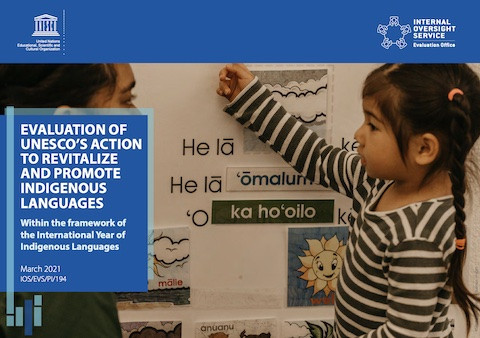 Evaluation of UNESCO’s Action to Revitalize and Promote Indigenous Languages: Within the Framework of the International Year of Indigenous Languages Year of publication: 2021 Author: Claire Thomas | Lydia van de Fliert | Oliver Loode | Silvia Quattrini | Mihaela Cojocaru Corporate author: UNESCO To draw attention to the critical loss of indigenous languages and the urgent need to preserve, revitalize and promote them and to take further urgent steps at the national and international levels, in 2016 the United Nations General Assembly in its resolution 71/178 proclaimed the year beginning on 1 January 2019 the International Year of Indigenous Languages (hereafter the IYIL2019). UNESCO was invited to serve as the lead agency for the Year and the coordination role was internally assigned to the Communication and Information Sector. UNESCO requested an evaluation of its action within the IYIL2019 with a view to learning from its experience during 2019 and further strengthening its coordination and implementation role during the upcoming Decade of Indigenous Languages (2022-2032).As the lead agency for the IYIL2019, UNESCO played a key role raising awareness of not only the critical loss of indigenous languages, but also the positive value and meanings that indigenous languages provide to Indigenous Peoples and humanity at large. The evaluation found that UNESCO led the development of an ambitious and relevant Action Plan for the Year. It also succeeded in setting up an 18-member Steering Committee composed of representatives of Member States, Indigenous Peoples and the UN three-party indigenous mechanisms. UNESCO staff implemented more than 80 activities around the world, with three-quarters of these at the global level and the majority of national events in Latin America and the Caribbean region. It also maintained an interactive website, which registered more than 880 events around the world.Leading and coordinating the IYIL2019 was not without its challenges, particularly as UNESCO was asked to lead this effort within existing resources and relying on a very small core team. Its programme sectors found creative solutions for indigenous language programming, but without a budget for intersectoral activities, collaboration between sectors was limited to information sharing and activities in Africa and the Arab States were few. The evaluation also found that the Action Plan lacked a meaningful results framework and thereby did not facilitate the monitoring of the IYIL2019. Partnerships with UNESCO networks and the wider UN system were underutilized and many opportunities for future collaboration have been highlighted for the upcoming Decade.
  Mapping the Mainstreaming of Education for Sustainable Development Across SDG 4.7: A Comparative Analysis of the Mainstreaming of ESD in Cyprus, Greece, Malta and Turkey Year of publication: 2020 Author: Devonne Goad Corporate author: UNESCO The objective of the present report is to summarize the state of ESD implementation in Cyprus, Greece, Malta and Turkey. This report summarizes and shares the successes and challenges highlighted within National Implementation Reports, as such a summary could be an important contribution to UNESCO, as the organization is currently facilitating dialogues to establish the direction of the new global programme for ESD. For that reason, these four countries within the regional scope of the UNESCO Regional Bureau in Venice, Italy, were chosen for the preliminary study. For the purpose of this study, the binary data contained within the National Implementation reports of Cyprus, Greece, Malta and Turkey were extracted to summarize the state of ESD implementation.
 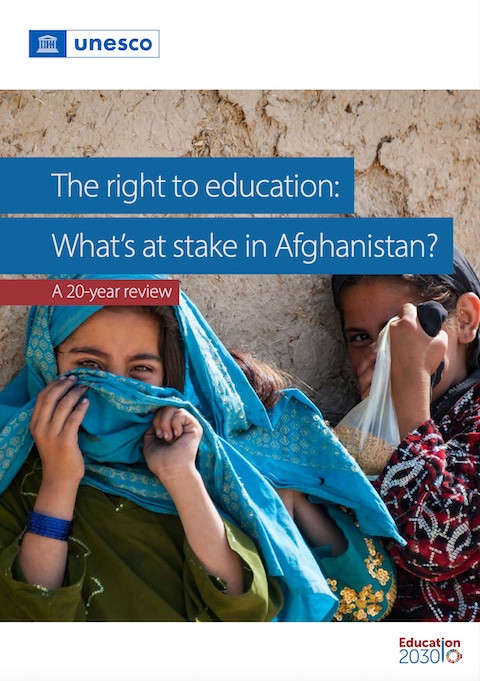 The Right to Education: What’s at Stake in Afghanistan?; A 20-Year Review Year of publication: 2021 Corporate author: UNESCO This report takes stock of the achievements in education made by Afghanistan over the past 20 years and sets out immediate action to safeguard the right to education for all learners following deep political change in the country in 2021.Although Afghanistan lags far behind countries across South and West Asia on most development indicators, it has made impressive progress in education over two decades. Enrolment has increased ten-fold, with substantial gains for girls and female literacy. Female teachers have been hired. Steady efforts have been made to expand the school network across the country.The country has ratified key international normative instruments relating to the right to education; enshrined this right in the Constitution and adopted a wide range of policy measures to increase access, improve education quality and reduce gender, socio- economic and rural/urban disparities.But the challenges remain colossal, with half the primary school-aged children not enrolled in school and very low learning outcomes. The country is highly dependent on external aid to sustain its education system. It needs to uphold state obligations on the right to education without any discrimination and continue removing barriers that impede progress towards the Sustainable Development Goal on education to build the country’s future.
 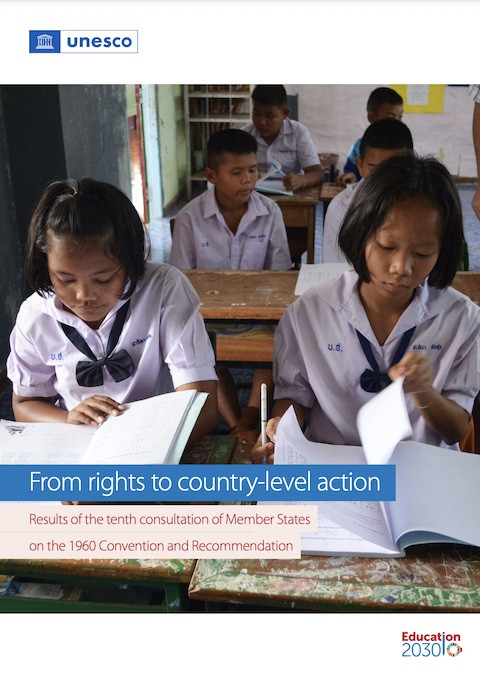 From Rights to Country-Level Action: Results of the Tenth Consultation of Member States on the 1960 Convention and Recommendation Year of publication: 2022 Author: Rolla Moumné | Sharlene Bianchi Corporate author: UNESCO The year 2020 marked a turning point for education worldwide. The impact of the COVID-19 pandemic not only amplified the difficulties and revealed existing weaknesses, but also brought the unpreparedness and lack of resilience of national education systems to the fore.The tenth consultation on the 1960 Convention against Discrimination in Education was conducted in precisely this context.Providing a valuable opportunity for States to take stock of the progress made in implementing Convention and sharing interesting national practices, the Consultation revealed continuous and new challenges the education sector faces. The unique timing of the consultation also created an opportunity to report on actions taken to faceadverse effects of the pandemic. This report analyzes and presents the Consultation findings, draws trends, and provides guidance for action. It shows how, by implementing the provisions of the Consultation, States can accelerate progress towards achieving Sustainable Development Goal 4, while invites a reflection on possibly reviewing the framework of the right to education to further respond to new challenges and put an end to increased inequalities worldwide. ПЕРЕОСМЫСЛИМ НАШЕ БУДУЩЕЕ Year of publication: 2021 Corporate author: International Commission on the Futures of Education | UNESCO Наше человечество, наша планета находятся в опасности, пандемия лишь подтвердила нашу хрупкость и взаимозависимость, чтобы изменить ход вещей и переосмыслить наше будущее, необходимы неотложные совместные действия; в этом докладе Международной комиссии по перспективам образования подтверждается способность образования к осуществлению коренных изменений. Перед нами стоит двойная задача – выполнить невыполненное обещание обеспечить право на качественное образование для каждого ребёнка, молодого человека и взрослого и полностью реализовать преобразующий потенциал образования, способного проложить путь к устойчивому коллективному будущему. Для этого нам нужен новый общественный договор в области образования, который сможет устранять проявления несправедливости, преобразуя будущее.Этот новый общественный договор должен основываться на принципах прав человека, недопущения дискриминации, социальной справедливости, уважения жизни, человеческого достоинства и культурного разнообразия. Он должен включать в себя этику заботы о людях, взаимности и солидарности. Он должен укреплять позиции образования как общественного дела и общего блага.Этот доклад, который готовился два года на основе глобального процесса консультаций с участием миллиона человек, предлагает правительствам, учреждениям, организациям и гражданам всего мира разработать новый общественный договор в области образования, который поможет нам построить мирное, справедливое и устойчивое будущее, отвечающее всеобщим интересам.Представленные здесь концепции, принципы и предложения являются лишь отправной точкой. Их воплощение в практику в конкретных условиях – это коллективная работа. Уже есть много положительных моментов, и в настоящем докладе предпринята попытка их отразить и развить. Это не инструкция и не план, а начало жизненно важного разговора.