
Resources
Explore a wide range of valuable resources on GCED to deepen your understanding and enhance your research, advocacy, teaching, and learning.
1,951 Results found
 L'enseignement supérieur face au défi de la transition écologique Year of publication: 2023 Corporate author: Cour des Comptes Les établissements d’enseignement supérieur occupent une place spécifique dans la transition écologique. Représentant près de la moitié des opérateurs de l’État et accueillant un large public, ils ont un impact environnemental substantiel. De nombreuses initiatives ont été prises ces dernières années en la matière et les politiques menées dans les établissements commencent à se mettre en place. Elles sont cependant encore insuffisantes pour atteindre les objectifs affichés, manquant en particulier de nombreux outils pour développer une démarche rigoureuse, cohérente et efficace. L’enseignement supérieur a pourtant un rôle majeur à jouer, non seulement pour réduire sa propre empreinte écologique, mais aussi pour produire, adapter et diffuser les connaissances nécessaires à la réussite de la transition écologique.Higher education institution occupy a specific place in the ecological transition. Representing nearly half of the state operators and catering to a diverse audience, they have a substantial environmental impact. Numerous initiatives have been undertaken in recent years, and policies within these institutions are beginning to take shae. However, they are still insufficient to achieve the stated objectives, notably lacking many tools to develop a rigorous, coherent and effective approach. Higher education has a crucial role to play, not only in reducing its own ecological footprint but also in generating, adapting, and disseminating th knowledge necessary for the success of the ecological transition.
  Food Sovereignty Year of publication: 2023 Corporate author: Quebec Association of International Cooperation Organizations (AQOCI) In 2023-2024, AQOCI and its members have chosen food sovereignty as the theme for their global citizenship education campaigns. These campaigns include videos explaining food sovereignty and related issues. Souveraineté alimentaire Year of publication: 2023 Corporate author: Association québécoise des organismes de coopération internationale (AQOCI) En 2023-2024, l’AQOCI et ses membres ont choisi la souveraineté alimentaire comme thématique pour les campagnes d’éducation à la citoyenneté mondiale . Ces campagne s'accompagne notamment de vidéos explicatives sur la souveraineté alimentaire, et des problématiques liés à ce thèmes.
 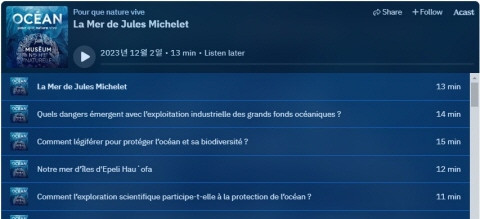 So That Nature Lives Year of publication: 2020 Author: Enky Wave Corporate author: National Museum of Natural History | Création Collective In the face of growing environmental collapse, the National History Museum's scientists are speaking out to alert people. The central theme of So that nature lives on is nature: understanding it better to preserve it more effectively. In each 30-minute episode, a researcher shares his or her knowledge and solutions to help us better understand living things and the world around us. Pour que la nature vive Year of publication: 2020 Author: Enky Wave Corporate author: National Museum of Natural History | Création Collective Face à l’effondrement environnemental croissant, les scientifiques du Muséum National d'Histoire Naturelle prennent la parole pour alerter. Pour que nature vive a pour thème central la nature : mieux la connaître pour mieux la préserver. Dans chaque épisode de 30 minutes, une chercheuse ou un chercheur partage ses connaissances et solutions, pour mieux comprendre le vivant et le monde qui nous entoure.
 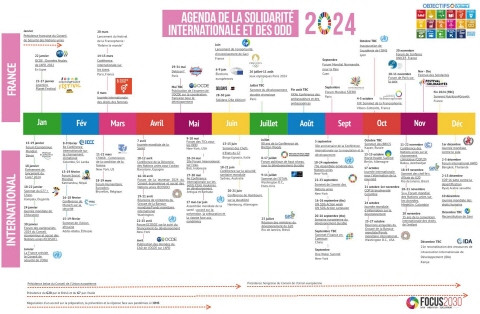 Solidarité Internationale 2024: Les grandes étapes à venir Year of publication: 2023 Corporate author: Focus 2030 2024 : fin du multilatéralisme ou renouveau ? Les Objectifs de développement durable en suspens. L’année à venir sera l’occasion de mobiliser de manière régulière la communauté internationale autour de nombreux sommets internationaux et rencontres dont les résultats seront susceptibles de changer la face du monde. 2024: End of Multilateralism or Renewal? Sustainable Development Goals in Limbo. The upcoming year will provide a regular platform for mobilizing the international community through numerous international summits and meetings, the outcomes of which have the potential to reshape the world.
 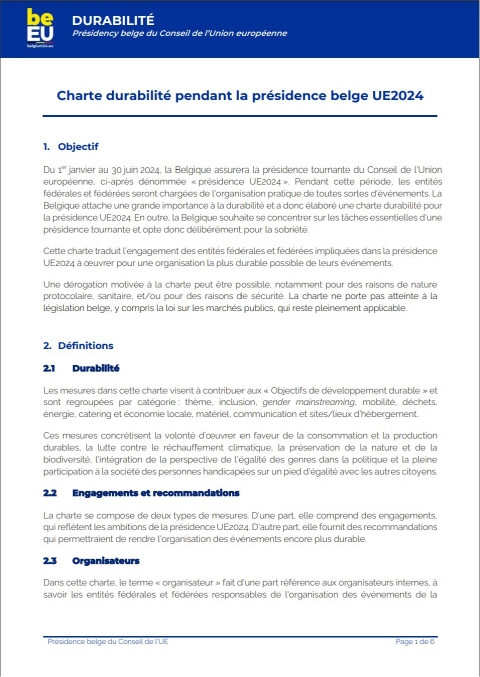 Charte durabilité pendant la présidence belge UE2024 Year of publication: 2023 Corporate author: Présidence belge du Conseil de l’UE La Belgique attache une grande importance à la durabilité et a donc élaboré une charte durabilité pour la Présidence UE2024. En outre, la Belgique souhaite se concentrer sur les tâches essentielles d'une présidence tournante et opte donc délibérément pour la sobriété. Cette charte traduit l’engagement des entités fédérales et fédérées impliquées dans la Présidence UE2024 à œuvrer pour une organisation la plus durable possible de leurs événements Sustanibility has a great importance for Belgium and so, it greated a sustainibility charter for Presidency EU2024. Moreover, Belgium wish to concetrate on essential tasks a rotating presidency and therefore deliberately opts for sobriety. This Charter reflects the commitment of federal and federated entities involved in Presidency EU2024 to work for an organisation as sustainable as possible during their events.
  Les limites planétaires : trois question à François Laugier Year of publication: 2024 Corporate author: Vie Publique Sur les 9 limites planétaires définies, 6 sont déjà atteintes. Mais qu'entend-on par «limite planétaire» ? Que se passe-t-il lorsqu'une limite planétaire est franchie. Out of the 9 planetary limitation defined, 6 are already reached. But what do we call "planetary limitations"? What happens when a limitation is crossed?
 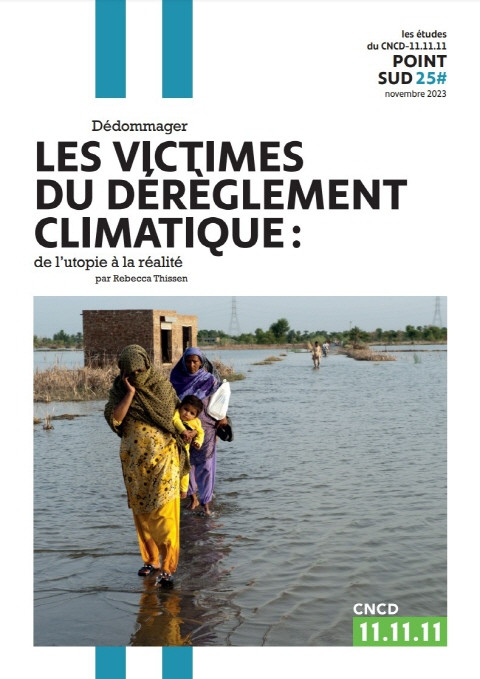 Les victimes du dérèglement climatique : de l'utopie à la réalité Year of publication: 2023 Author: Rebecca Thissen Corporate author: CND 11.11.11 «Pourquoi devrions-nous, au Pakistan, payer pour des inondations catastrophiques que nous n’avons pas causées ?» Telle était la question lancée par la ministre pakistanaise de l’Environnement en amont de la COP27, au moment où un tiers de son pays se retrouvait sous les eaux à cause de terribles inondations. Il a fallu attendre 30 ans pour que la question du dédommagement des victimes climatiques avance dans les négociations internationales : fin 2022, lors de la COP27, les Nations Unies ont décidé d’établir un fonds et des arrangements financiers spécifiques. L’étude « Pertes et préjudices, de l’utopie à la réalité » vise à donner une compréhension plus fine des pertes et préjudices, tout en les replaçant dans leur contexte historique, ce qui permet de comprendre les dynamiques en présence et l’aboutissement de la décision de la COP27. Il se veut également être une porte d’entrée quant à la réflexion sur le financement des pertes et préjudices en tant que tel, détaillant les pistes de solutions pour définir son rôle, à qui il devrait bénéficier, via quel mécanisme il devrait être acheminé et quelles sources de financement permettraient de l’alimenter. " Why should we, in Pakistan, pay for catastrophic floods that we did not cause?" That is the question posed by the Pakistani Minister of Environment ahead of the COP27, at a time when one-third of her country was submerged due to devastating floods. It took 30 years fo the issues of compensation for climate victims to progress in international negotiations: by the end of 2022, during the COP27, the United Nation decided to established a fund and specific financial arrangements. The study « Loss and Prejudices , from utopia to reality » aims at giving a more detailled comprehension of loss and prejudices, while placing them in their historical context, which helps understanding the dynamics at play and the outcome of the COP27 decision. It also aims at serving as a gateway to the consideration of financing losses and damages per se, outlining potential solutions to define its role, who should benefit from it, through which mechanism it should be channeled, and what funding sources would contribute to it.
  Green Pack Year of publication: 2013 Corporate author: Regional Environmental Center for Central and Eastern Europe Inspired by the political process “Environment for Europe”, in 2000 the Regional Environmental Center for Central and Eastern Europe (REC) launched a programme on education for sustainable development (ESD), sponsored by Toyota. This included the development and introduction of an innovative multimedia educational kit, the Green Pack, for school teachers and their students in Central and EasternEurope. Other ESD tools similar to the Green Pack have been developed and introduced in recent years to address different target groups. Currently, the main group of REC ESD tools includes:Green Pack, aimed at children aged between 11 and 15 and their teachersGreen Pack Junior, aimed at children aged between 7 and 10 and their teachersGreen Steps, aimed at citizens and families After 14 years of project implementation, REC ESD materials have been introduced in 19 countries in Europe and Asia. Since the Green Pack launch in 2001, around 40,000 teachers and over 4.5 million students have been educated, fundamentally changing the way in which the teaching of sustainability is approached. Each project has been developed in cooperation with businesses, governments, professional organisations and NGOs in order to foster community support across a broad spectrum of society. Many donors from the international, governmental, business and private communities have supported this process. URL:http://www.greenpackonline.org/english/menu.html