
Resources
Explore a wide range of valuable resources on GCED to deepen your understanding and enhance your research, advocacy, teaching, and learning.
1,983 Results found
 Combattre les discours de haine sur internet Year of publication: 2015 Author: Iginio Gagliardone | Danit Gal | Thiago Alves | Gabriela Martinez Corporate author: Organisation des Nations Unies pour l'éducation, la science et la culture (UNESCO) Le présent rapport offre un panorama mondial des dynamiques caractéristiques des discours de haine en ligne et des mesures prises pour les combattre et les contenir, en mettant en évidence les bonnes pratiques qui ont émergé au niveau local comme au niveau international. Si l’étude fournit une analyse exhaustive des cadres normatifs internationaux, régionaux et nationaux mis en place pour lutter contre les discours de haine en ligne et de leurs répercussions sur la liberté d’expression, elle met particulièrement l’accent sur les mécanismes sociaux et non réglementaires qui peuvent contribuer à lutter contre la production, la diffusion et l’impact des messages de haine en ligne.
  Towards Inclusion in Education: Status, Trends and Challenges: The UNESCO Salamanca Statement 25 Years on Year of publication: 2020 Corporate author: UNESCO The 2030 Agenda for Sustainable Development focuses on leaving no one behind with its Goal 4 on education calling upon education systems ‘to ensure inclusive and equitable quality education and promote lifelong learning opportunities for all’. With ten years remaining to the target date of 2030, countries need to step up e¬orts to reach out to all learners, respect their diverse needs, abilities and characteristics and eliminate all forms of discrimination in the learning environment. This requires adopting an inclusive approach whose foundations have been laid by the UNESCO World Conference on Special Needs Education held in Salamanca, Spain, in 1994. The publication looks at the past, present and future since Salamanca. It provides examples from around the world and make recommendations to guide the further development of inclusive national policies and practices.
 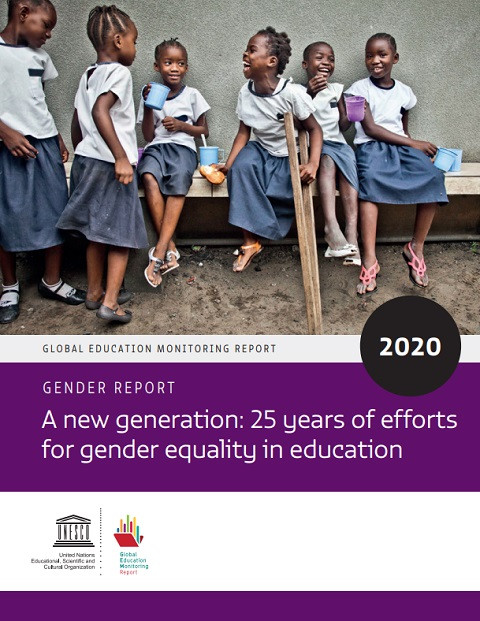 Gender Report 2020: A New Generation; 25 Years of Efforts for Gender Equality in Education (Global Education Monitoring Report) Year of publication: 2020 Corporate author: UNESCO | Global Education Monitoring Report Team Building on the 2020 Global Education Monitoring Report, this report investigates how inclusion in education can advance gender equality in and through education, which is critical to make progress towards gender equality in society. The goal of gender equality is, of course, not new. It was enshrined in the 1979 Convention on the Elimination of All Forms of Discrimination Against Women and was at the core of the 1995 Beijing Declaration and Platform for Action, whose 25th anniversary is marked in 2020.
  Media and Information Literacy: Policy and Strategy Guidelines Year of publication: 2013 Author: Alton Grizzle | Penny Moore | Michael Dezuanni | Sanjay Asthana | Carolyn Wilson | Fackson Banda | Chido Onumah | Maria Carme Torras Calvo Corporate author: UNESCO This resource aims to treat MIL as a composite concept, unifying information literacy and media literacy as well as considering the right to freedom of expression and access to information through ICTs. It is divided into two parts. Part 1 is the MIL Policy Brief, and is designed for policy or decision makers and can serve as a summary of the publication. Part 2 is divided into several comprehensive chapters and suggests: 1) how to enlist MIL a development tool; 2) conceptual frameworks for MIL policies and strategies; and 3) model MIL policy and strategies that can be adapted by countries globally.
 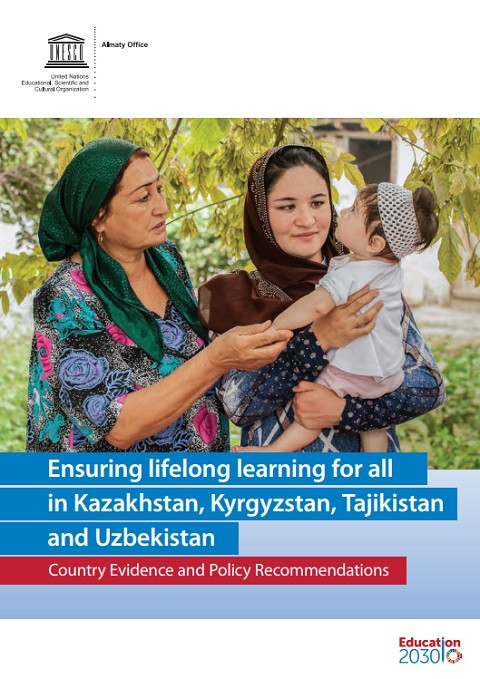 Ensuring Lifelong Learning for All in Kazakhstan, Kyrgyzstan, Tajikistan and Uzbekistan: Country Evidence and Policy Recommendations Year of publication: 2020 Author: Arne Carlsen Corporate author: UNESCO Lifelong Learning is at the heart of the 2030 Agenda for Sustainable Development and its 17 goals. More speci¬cally, Sustainable Development Goal 4 is devoted to ensuring quality education and lifelong learning opportunities for all. As the lead agency for education, UNESCO is mandated to support Member States in implementing SDG 4 through the Education 2030 Framework for Action. Central Asian countries – Kazakhstan, Kyrgyzstan, Tajikistan and Uzbekistan – have all shown their commitment to achieving the SDGs by 2030, including SDG 4, and have taken several actions in this regard. This sub-regional study aims to provide a broader picture of lifelong learning in Central Asia, supported by evidence and policy recommendations in order to propose a systemic approach for future education reforms. Обеспечение возможности обучения на протяжении всей жизни для всех в Казахстане, Кыргызстане, Таджикистане и Узбекистане: Опыт отдельных стран и рекомендации по вопросам политики Year of publication: 2020 Author: Arne Carlsen Corporate author: Организация Объединенных Наций по вопросам образования, науки и культуры (UNESCO) Обучение на протяжении всей жизни лежит в основе Глобальной программы устойчивого развития, состоящей из 17 целей. Суть Цели 4 в области устойчивого развития заключается в «Обеспечении всеохватного и справедливого качественного образования и поощрение возможности обучения на протяжении всей жизни для всех». ЮНЕСКО, как специализированному учреждению ООН по вопросам образования, было поручено оказывать государствам-членам содействие в достижении ЦУР 4 через выполнение Рамочной программы действий в области образования до 2030 года.Страны Центральной Азии – Казахстан, Кыргызстан, Таджикистан и Узбекистан – выразили заинтересованность в достижении к 2030 году всех ЦУР, включая ЦУР 4, и уже предприняли ряд действий в этом направлении. Цель настоящего субрегионального исследования состоит в предоставлении более точной картины положения дел в области обучения на протяжении всей жизни в Центральной Азии, подкрепленной фактическим материалом и рекомендациями по вопросам политики, для подготовки предложений по системному подходу к будущим реформам образования.
 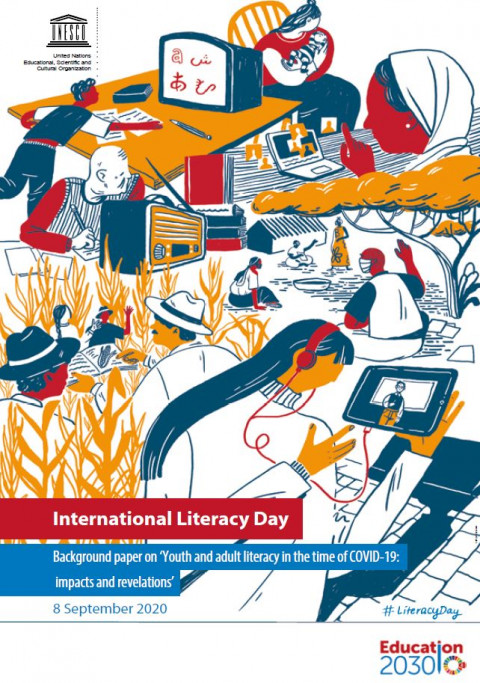 International Literacy Day: Background Paper on 'Youth and Adult Literacy in the Time of COVID-19; Impacts and Revelations' Year of publication: 2020 Corporate author: UNESCO Specially prepared on the occasion of International Literacy Day 2020, this background paper illustrates the impact of the COVID-19 crisis on youth and adult literacy, based on the limited information that is currently available. It provides five regional snapshots and identifies preliminary lessons learned thus far, while aiming to inspire continued reflection and subsequent action. It also makes the case for the ongoing importance of advancing youth and adult literacy, a priority that was already neglected even before the pandemic but which deserves all our attention. ILD 2020 thus seeks to trigger reimaginations of literacy teaching and learning in the COVID-19 crisis and beyond, with a particular focus on the role of educators.
  Understanding Media and Information Literacy (MIL) in the Digital Age: A Question of Democracy Year of publication: 2019 Author: Ulla Carlsson Corporate author: University of Gothenburg | UNESCO This book consists of three parts. In the first part, a number of articles of a more general nature discuss media and information literacy (MIL) in a variety of contexts as well as courses of development on national, regional and global levels. The focus in the second part is on Sweden, the host the UNESCO Global MIL Week Feature Conference 2019. The articles in this part present current research findings, policy decisions and political initiatives, and some examples of ‘best practices’ in the MIL area. The third part presents a new approach to MIL in a context of social change and Agenda 2030.
  Multi-Stakeholder Approaches to Education for Sustainable Development in Local Communities: Towards Achieving the Sustainable Development Goals in Asia Year of publication: 2020 Corporate author: UNESCO The idea for this publication first emerged from the ‘10th Asia-Pacific RCE Regional Meeting and Symposium on the Sustainable Development Goals: From Goals to Action’, held from 2 to 4 November 2017 at the India Habitat Centre in New Delhi, India. The case studies presented at the symposium became the basis for this publication.The cases presented in this publication show how RCEs create solutions that enable sustainable development practices in local communities by utilizing education, innovative learning methods and multi-stakeholder partnerships. Local stakeholders take ownership of the sustainability processes, consistently address the targeted SDGs, and demonstrate RCE contributions to the ESD for 2030 priority action areas – policy, education and training settings, educators, youth and community.
 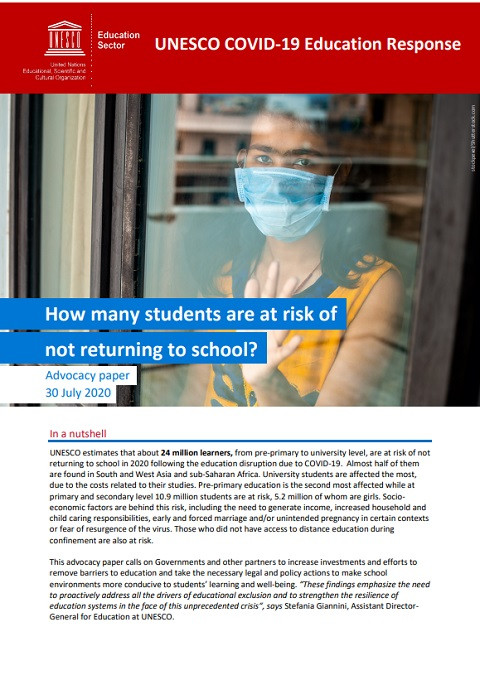 UNESCO COVID-19 Education Response: How Many Students Are at Risk of Not Returning to School?; Advocacy paper Year of publication: 2020 Corporate author: UNESCO UNESCO estimates that about 24 million learners, from pre-primary to university level, are at risk of not returning to school in 2020 following the education disruption due to COVID-19. Almost half of them are found in South and West Asia and sub-Saharan Africa. University students are affected the most, due to the costs related to their studies. Pre-primary education is the second most affected while at primary and secondary level 10.9 million students are at risk, 5.2 million of whom are girls. Socioeconomic factors are behind this risk, including the need to generate income, increased household and child caring responsibilities, early and forced marriage and/or unintended pregnancy in certain contexts or fear of resurgence of the virus. Those who did not have access to distance education during confinement are also at risk. This advocacy paper calls on Governments and other partners to increase investments and efforts to remove barriers to education and take the necessary legal and policy actions to make school environments more conducive to students’ learning and well-being. “These findings emphasize the need to proactively address all the drivers of educational exclusion and to strengthen the resilience of education systems in the face of this unprecedented crisis“, says Stefania Giannini, Assistant DirectorGeneral for Education at UNESCO.