
Resources
Explore a wide range of valuable resources on GCED to deepen your understanding and enhance your research, advocacy, teaching, and learning.
1,951 Results found
 Les droits humains: 13 idées reçues à déconstruire Year of publication: 2022 Author: Céline Branaa | Louise Pluyaud | Louise Savri Corporate author: Commission nationale consultative des droits de l'homme (CNCDH) Destiné aux 14-20 ans, ce livre vise à faire connaître les droits humains et rappelle la place majeure qu’ils occupent dans nos vies ainsi que dans l’organisation de notre société contemporaine. Aujourd’hui, les droits humains sont remis en cause par différents mouvements qui contestent leur utilité, leur efficacité ou encore leur universalité. Les liens entre certaines violations des droits fondamentaux, le changement climatique, les dangers du numérique, et tant d’autres aspects contemporains restent d’ailleurs bien souvent incompris voire méconnus. La CNCDH est convaincue de l’urgence de réaffirmer que les droits humains constituent le fondement d’une société démocratique. À cette fin, les membres de la CNCDH ont souhaité déconstruire 13 des idées reçues les plus souvent entendues ou diffusées dans les médias et sur les réseaux sociaux. À travers 13 chapitres illustrés, correspondant chacun à une idée reçue, les droits humains apparaissent au cœur de notre civilisation à la manière d’une référence actuelle et indispensable. Le lecteur y est invité à devenir acteur de leur promotion. Cet ouvrage rappelle à quel point les droits fondamentaux ne sont pas une construction appartenant au passé mais bien un outil nécessaire pour le temps présent. Mettant en avant la richesse des droits humains cet ouvrage est invitation à anticiper un avenir commun dans lequel la dignité et la liberté de la personne humaine représentent une promesse accessible. Pour toutes et tous.
  Human Rights Between The Realities of International Human Rights Law and Islamic Perception (An Analytical Comparative Study Between Islamic Law And the Law) (Journal of Professor Researcher for Legal and Political Studies; Vol.6, No.3) Year of publication: 2022 Author: Abderachid Abdelhafid | Hafeda Mebarek Corporate author: M'sila University Human rights are the basis of freedom, justice and peace. They consist of all the fundamental freedoms that have been established for human beings since their inception. They are inherent in human beings. No one shall violate them, on any account, and all human beings shall be equal, within the framework of justice and equality, that is, every human being shall be born free and equal to other individuals in terms of the dignity and rights proclaimed by international human rights law. The subject of human rights has received the attention of scholars, law and politics through numerous research and studies on human rights and their protection mechanisms, with a view to achieving public interest and international security and stability. Human rights also have a significant impact on the formation and functioning of modern regimes of international governance, as well as on the political, social and economic relations between the States that make up the international community. Through this research, we will try to highlight the reality of human rights through international law and Islamic law. حقوق الإنسان بين واقع القانون الدولي لحقوق الإنسان والتصور الإسلامي: دراسة تحليلية مقارنة بين الشريعة الإسلامية والقانون (مجلة الأستاذ الباحث للدراسات القانونية والسياسية; Vol.6, No.3) Year of publication: 2022 Author: Abderachid Abdelhafid | Hafeda Mebarek Corporate author: M'sila University تعتبر حقوق الإنسان أساس الحرية والعدالة والسلام ، وتتلخص في مجموع الحريات الأساسية التي تتقرر للإنسان منذ نشأته، وهي متأصلة فيه، لا يحق لأي كان انتهاكها، لأي اعتبار كان، ويتساوى فيها كل بني البشر، في إطار العدل والمساواة، أي أن كل إنسان يولد حُراً متساوياً مع غيره من الأفراد من حيث الكرامة والحقوق التي ينادي بها القانون الدولي لحقوق الإنسان. وقد حظي موضوع حقوق الإنسان باهتمام رجال الفقه والقانون والسياسة، من خلال البحوث والدراسات العديدة التي تناولت هذه الحقوق، وآليات حمايتها، بهدف تحقيق المصلحة العامة، وتوفير الأمن والاستقرار الدوليين. كما أن لحقوق الإنسان تأثير كبير في تشكيل وعمل الأنظمة الحديثة للإدارة الدولية، بالإضافة إلى تأثيرها على العلاقات السياسية والاجتماعية والاقتصادية بين الدول التي تتشكل منها الجماعة الدولية. سنحاول من خلال بحثنا هذا تسليط الضوء على واقع حقوق الإنسان من خلال القانون الدولي والشريعة الإسلامية.
  Buenos Aires Recommendations Year of publication: 2007 Corporate author: PRELAC II Recognizing that education is a public good and is the key to building a more just and better world for all, the Second Intergovernmental Meeting of the Regional Education Project, PRELAC II, held in the city of Buenos Aires, on the 29th and March 30, 2007, agrees the following recommendations as criteria and lines of action for national policies and international cooperation. Recomendaciones de Buenos Aires Year of publication: 2007 Corporate author: PRELAC II Reconociendo que la educación es un bien público y es la llave para la construcción de un mundo más justo y mejor para todos, la Segunda Reunión Intergubernamental del Proyecto Regional de Educación, PRELAC II, reunida en la ciudad de Buenos Aires, los días 29 y 30 de marzo de 2007, acuerda las siguientes recomendaciones como criterios y líneas de acción para las políticas nacionales y la cooperación internacional.
  The Right to Education of Migrants and Refugees Year of publication: 2014 Author: Vernor Muñoz Villalobos The focus of this report is on those who have crossed national borders, who generally are at risk of marginalization and specifically to discrimination in the provision of education. The research addresses six core issues, the consideration of which follows an analysis of the contextual background. Attention to these issues is viewed as indispensable in meeting the educational challenges and opportunities related to migration. These core, but inevitably interrelated themes are: the legal and normative framework; social and cultural issues; language and curriculum; teachers; accreditation and lifelong learning. The preparation of the report has benefitted greatly from the active and constructive engagement of many relevant actors including Governments, international organizations, academics, non-governmental organizations and concerned individuals. Together they have offered a wealth of different perspectives and which form the basis of a number of recommendations ending the text. El Derecho a la Educación de las Personas Migrantes y Refugiadas Year of publication: 2014 Author: Vernor Muñoz Villalobos El objetivo de este artículo es sobre las personas que han cruzado las fronteras nacionales, quienes generalmente se encuentran en riesgo de exclusión social y se enfrentan a la discriminación en el acceso y las oportunidades educativas. El texto aborda seis temas principales, seguido de un análisis del marco contextual. La atención a estas cuestiones es indispensable para enfrentar los desafíos y las oportunidades educativas relacionadas con la migración. Los temas tratados están inevitablemente interrelacionados son el marco legal y normativo, las cuestiones sociales y culturales, el lenguaje y el currículo, los maestros, acreditación y el aprendizaje a lo largo de la vida. La elaboración de la investigación que nutre este artículo se ha beneficiado en gran medida de la participación activa y constructiva de muchas partes interesadas, incluidos los gobiernos, organizaciones internacionales, académicos, organizaciones no gubernamentales y personas interesadas. Juntos han ofrecido una gran cantidad de diferentes perspectivas y que forman la base de una serie de recomendaciones con las que termina el texto.
 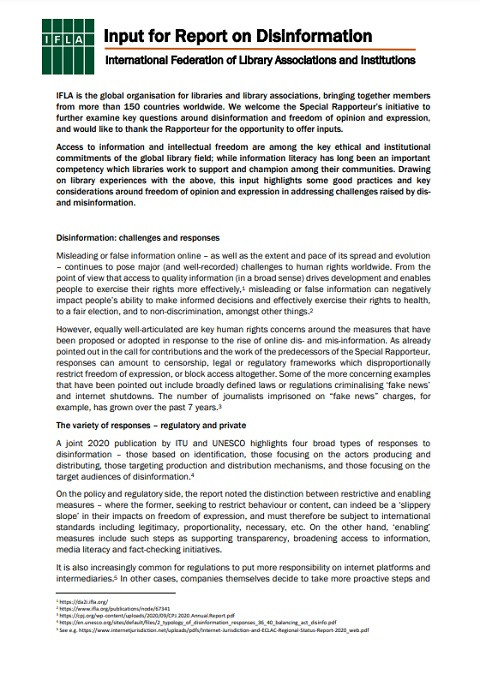 Input for Report on Disinformation Year of publication: 2021 Corporate author: International Federation of Library Associations and Institutions (IFLA) IFLA responded to a call for inputs about human rights impacts of measures against disinformation, issued by the United Nations Special Rapporteur on the promotion and protection of the right to freedom of opinion and expression. Concerns over – and dialogue about ways to address – the negative impacts of false and misleading information online have remained high on the agenda over the past months, particularly in light of prominent examples of health and electoral dis- and mis-information.Disinformation, uniquely challenging in the increasingly dense and complex digital information environment, interferes with individuals’ ability to make informed decisions and realise their essential human rights. However, the new call for inputs by the UN Special Rapporteur also draws attention to the concerns about human rights impacts of measures which different stakeholders – from states to online platforms, human rights organisations and others – take to combat disinformation.These include, of course, the impacts of broadly- or vaguely-defined “fake news” laws on freedom of expression and opinion; or internet shutdowns that bear a heavy cost on people’s access to information as a driver of development and rights.In light of this, IFLA’s submission highlights the potential of media and information literacy interventions to help address the challenges of mis- and dis-information. Drawing on the global library field’s experiences, it points to some possible good practices and insights from the ongoing work and research in this field – from targeted and tailored outreach initiatives that can help reach those who are not currently in formal education, to scalability and replicability of interventions.Of course, this is an emerging field. Our understanding of how media and information literacy interventions can be effectively leveraged against disinformation, pitfalls to avoid and ways to maximise impact, continues to evolve. That’s why the submission emphasises the need for more research and cross-stakeholder collaboration – and libraries can and do offer valuable practical and theoretical insights for this ongoing discussion.
  Engaging Girls, Boys and Youth as Active Citizens: Plan International’s Position Paper Year of publication: 2020 Corporate author: Plan International Plan International believes that every child and young person has the right to express their views freely and safely; influence decisions and take action on issues that matter to them. However, around the world children and young people – particularly girls and young women – face significant challenges in realising this right. They tend to be wrongly dismissed as insufficiently mature to participate in political and civic processes. They also tend to be stigmatised as potential perpetrators of disruption, not as valued citizens and contributors to society who can lead and drive positive change. Plan International is calling for a paradigm shift in the way the international community talks about, engages and partners with children and young people. Children and young people are not just the future. They are the present. Young people constitute almost half of the world’s population, yet they are dramatically underrepresented – even excluded – in political decision-making. It is critical that their views and needs are taken into account politically, socially, legally and economically. Promoting the voices and views of children and young people – especially girls and women – in all their diversity and supporting them to actively engage in decision-making on issues that affect their lives must be an urgent priority for the world’s power holders. Realising children and young people’s civil and political rights is a prerequisite for building sustainable and peaceful societies, and a gender just world envisioned in international human rights frameworks and the 2030 Agenda’s Sustainable Development Goals (SGDs).Across the 75+ countries Plan International works in, young people have consistently identified the denial of their political and civil rights as a priority issue. In March 2017, Plan International conducted consultations with young women and men aged 14 to 30 from 14 countries. In every country, young people reported a sense of “citizen responsibility” and an interest in public life, yet identified the lack of platforms to meaningfully engage with decision-makers and inability to ensure their opinions are taken seriously as key barriers. Girls and young women in particular have called for the removal of gendered norms that increase those barriers, silence their voices and disproportionately hold them back from leadership and active citizenship. Impliquer les filles, garçons et jeunes en tant que citoyens actifs : Prise de position de Plan International Year of publication: 2020 Corporate author: Plan International Ce rapport expose la position de Plan International sur le droit à la participation à la vie publique, ainsi qu’une analyse : du cadre juridique et politique ; de l’impact des normes sociales et genrées sur la participation ; et des problèmes spécifiques relatifs à l’émancipation politique et à la citoyenneté active. Ce rapport appuie 100 Millions de Raisons, la Stratégie Mondiale 2017-2022 de Plan International, dont la priorité principale est le soutien des filles, des garçons et des jeunes en tant qu’acteurs actifs du changement. Il défend notre travail en relation avec l’Agenda 2030 et les Objectifs de Développement Durable – plus spécifiquement les objectifs 5, 10 et 16. Un certain nombre de recommandations importantes sont incluses afin de guider le plaidoyer.